




Abstract
This study examined whether text-message users would differ in levels of executive function, a trait of impulsivity, and impulsive decision making. A sample of 167 college students (57 percent of whom were female and the mean age was 19.9 years with the standard deviation of 4.1) participated. Using a hierarchical cluster analysis with levels of text-message dependency, the participants were grouped into excessive and dependent users (dependent users), excessive but nondependent users (excessive users), or nonexcessive and nondependent users (normal users). The groups were then compared on the extent to which they differed in levels of executive function, impulsivity, and impulsive decision making. The results showed that, relative to excessive users, dependent users were lower on levels of executive function and higher on levels of the trait of impulsivity. The moderating effects of gender on these differences were also examined, but gender did not significantly moderate the differences. This study demonstrated that excessive text-message users are not necessarily dependent text-message users and executive function and impulsivity may play an important role in differentiating the two types of users.
Introduction
Among various smartphone-related activities, text-messaging, which can be through short message service and/or through various smartphone applications, is often the most prevalent. 1 College students in the United States, for example, reported that they spend 1.5–3.5 hours per day on text-messaging2,3 and send 77–97 text messages per day.4,5 Excessive text-messaging can lead to text-message dependency, which is defined as a psychological state of overreliance on text messages based on acute needs for interpersonal communication.6–8 Note that excessive text-messaging is a behavior, whereas text-message dependency is a psychological state that may accompany such a behavior and potentially disrupt one's daily lives. 9
Using a cluster analysis, a previous study 10 investigated whether text-message users can be grouped into distinct subgroups that differ in terms of excessiveness of and dependency on text-messaging. The results showed that text-message users can be categorized into excessive and dependent users (hereafter dependent users), excessive but nondependent users (hereafter excessive users), or nonexcessive and nondependent users (hereafter normal users). This finding was systematically replicated by a subsequent study, 11 in which a cluster analysis was conducted with the users' levels of valuation of text-messaging. These findings that not all excessive users are dependent users are consistent with several recent studies in which psychological measures of problematic mobile phone use/dependency are not necessarily correlated with objective measures of mobile phone use. 12
To develop effective prevention and intervention strategies for text-message dependency, we propose that a next important step is to investigate the neurocognitive processes through which excessive text-message users become dependent or remain nondependent. This is particularly important because previous research has established that various neurocognitive processes, such as executive function, impulsive decision making (behavioral impulsivity), and a trait of impulsivity, are associated with text-message dependency13–15 and problematic mobile phone use.16–22
To maximize the effectiveness of prevention and intervention strategies for text-message dependency, it is of great importance to avoid a “one size fits all” approach. 23 For this purpose, a variable that warrants further investigation would be gender. Previous research shows that females and males differ motivationally and behaviorally in their text-messaging,2,24 and that the relationship between text-message dependency and impulsive decision making differs between females and males. 15 These findings provide a rationale to investigate the moderating role of gender in the difference in neurocognitive processes between dependent and excessive users.
Taken together, this study examined whether dependent and excessive users differ in levels of executive function, a trait of impulsivity (self-reported impulsivity), and impulsive decision making (behavioral impulsivity). Along with a previous study, 10 distinct subgroups of text-message users were identified by conducting a cluster analysis on the scores of text-message dependency. It was hypothesized that dependent users would show lower and higher levels of executive function and impulsivity, respectively, than excessive users. In addition, this study examined whether the differences between dependent users and excessive users, if any, can be moderated by gender. Because this was an exploratory investigation, we had no a priori hypothesis.
Materials and Methods
Procedure
One hundred and sixty-seven undergraduate students at a university in the northeastern United States participated for a course credit. The students completed an online survey on demographics (age, gender, and years of higher education), text-message dependency, executive function, self-reported impulsivity, and behavioral impulsivity. The institutional review board at the Pennsylvania State University approved the study protocol.
Text-message dependency
The Self-perception of Text-message Dependency Scale (STDS) 8 is a self-reported measure of text-message dependency that consists of three subcategories: emotional reaction (excessive concerns about replies to text messages), excessive use (self-perception of excessive/compulsive text-messaging), and relationship maintenance (psychological reliance on text messages to maintain social relationship). Each subcategory has five questions with a 5-point Likert scale ranging from 1 (strongly disagree) to 5 (strongly agree). Higher scores indicate higher levels of dependency. The Cronbach's alphas with the present sample were 0.90, 0.80, 0.82, and 0.89 for emotional reaction, excessive use, relationship maintenance, and the total score, respectively.
Executive function
The Executive Function Index (EFI) 25 is a self-reported measure of executive function. The EFI consists of 27 questions with a 5-point Likert scale ranging from 1 (not at all) to 5 (very much). Questions with negatively worded items are reverse coded, and higher scores indicate higher levels of executive function. The Cronbach's alpha with the present sample was 0.79. The EFI demonstrated content validity in clinical and neuroimaging studies. 25
Self-reported impulsivity
The Barratt Impulsiveness Scale (BIS)-1126 is a self-reported measure of impulsivity that consists of 30 questions with a 4-point Likert scale ranging from 1 (rarely/never) to 4 (almost always/always). Questions with negatively worded items are reverse coded, and higher scores indicate higher levels of impulsivity. The Cronbach's alpha with the present sample was 0.79.
Behavioral impulsivity
The delay discounting task was adapted from a previous study. 27 The participants made repeated choices between smaller hypothetical monetary rewards available immediately versus larger hypothetical monetary rewards available after a delay (1 week, 1 month, 6 months, 1 year, or 5 years). On each screen, the participants made a total of 11 choices between two types of rewards. The smaller immediate rewards ranged from $99 to $1 ($99, $90, $80, $70, $60, $50, $40, $30, $20, $10, and $1), and the larger delayed reward was always $100 after a fixed delay. The area under the curve (AUC) 28 served as the dependent measure. Consistent with previous studies,19,29 participants who showed nonsystematic patterns of responses (n = 29) were identified according to the criteria developed by a previous study 30 and their data were excluded from the analyses.
Statistical analysis
A hierarchical cluster analysis was conducted to identify subgroups of text-message users. The scores of the three subcategories of the STDS were entered into the analysis, with Ward's method as the method of clustering, squared Euclidian distances as the measure of the distance, and z-score conversion as the method of standardization.31,32 The determination of the number of clusters was based on the inverse scree technique. 32
Gender was analyzed by a chi-square test. Continuous variables were analyzed by a one-way analysis of variance (ANOVA) or by the Welch ANOVA if the assumption of homogeneity of variances, as assessed by Levene's test for equality of variances, was violated. To determine whether gender moderates the differences in levels of executive function and self-reported and behavioral impulsivity among the subgroups, a two-way ANOVA was performed for each dependent variable. All post hoc pairwise comparisons were performed by the Tukey test or by the Games-Howell test if the assumption of homogeneity of variances was violated. Correlational analyses were conducted by calculating Pearson correlation coefficients. All statistical analyses were performed with SPSS Version 25.
Results
Figure 1 shows the coefficient values of the cluster analysis as a function of the number of clusters. There was a robust increase in coefficient values as the analysis shifted from the model with three clusters to the model with two clusters, suggesting that the model with three clusters best fits the present data. Table 1 gives the demographic characteristics of the three clusters. Table 2 gives Pearson correlational coefficients of all study variables.

Scree plot of the cluster analysis. There is a robust increase in coefficient values between 2 and 3, indicating the three-cluster model best fits the data.
Demographic Characteristics for All Clusters
Note: The numbers are means (and standard deviations) except for gender.
p < 0.05.
Cluster 1, dependent users; cluster 2, excessive users; cluster 3, normal users.
Pearson Correlational Coefficients of Study Variables
p < 0.05.
p < 0.01.
AUC, area under the curve; BIS, Barratt Impulsiveness Scale; EFI, Executive Function Index; ER, emotional reaction; EU, excessive use; RM, relationship maintenance; STDS, Self-perception of Text-message Dependency Scale.
Figure 2 shows the scores of the STDS across the three clusters. The results of the ANOVA revealed the clusters differed significantly for all four measures: emotional reaction, F(2, 164) = 109.00, p < 0.001, partial η 2 = 0.57; excessive use, Welch's F(2, 109.07) = 120.44, p < 0.001, partial η 2 = 0.51; relational maintenance, Welch's F(2, 109.07) = 70.90, p < 0.001, partial η 2 = 0.44; and total STDS score, F(2, 164) = 148.56, p < 0.001, partial η 2 = 0.64. The results of the post hoc comparisons are given in Table 3. Overall, the three clusters show distinctive patterns in terms of the STDS scores. Cluster 1 was characterized by relatively high scores in all three subcategories of the STDS (hereafter referred to as dependent users), and they showed the highest total STDS score. Cluster 2 was characterized by relatively high scores in excessive use and low scores in emotional reaction and relationship maintenance (excessive users), and they showed the moderate total STDS score. Cluster 3 was characterized by relatively low scores in all three subcategories of the STDS (normal users), and they showed the lowest total STDS score.

The scores of the STDS as a function of the clusters. Horizontal lines indicate means. *p < 0.05. ***p < 0.001. C1, cluster 1 (dependent users); C2, cluster 2 (excessive users); C3, cluster 3 (normal users); STDS, Self-perception of Text-message Dependency Scale.
Post Hoc Comparisons of the Self-Perception of Text-Message Dependency Scale Scores Among Clusters
Note: Bold numbers indicate statistical significance. The p values and 95 percent CIs were adjusted for multiple comparisons according to the Turkey or Games-Howell method.
C1, cluster 1 (dependent users); C2, cluster 2 (excessive users); C3, cluster 3 (normal users); CI, confidence interval; SE, standard error.
The results of a two-way ANOVA revealed there was no statistically significant interaction between gender and cluster for EFI, F(2, 161) = 0.19, p = 0.829, partial η 2 = 0.002; BIS, F(2, 161) = 1.04, p = 0.354, partial η 2 = 0.013; and AUC, F(2, 161) = 0.41, p = 0.667, partial η 2 = 0.006. Therefore, an analysis of the main effect for cluster was performed. As shown in Figure 3, there was a significant main effect of cluster for EFI, F(2, 161) = 5.32, p = 0.006, partial η 2 = 0.062; and BIS, F(2, 161) = 11.53, p < 0.001, partial η 2 = 0.125; but not for AUC, F(2, 133) = 1.85, p = 0.162, partial η 2 = 0.027. The results of the post hoc comparisons for the EFI and BIS scores are given in Table 4.
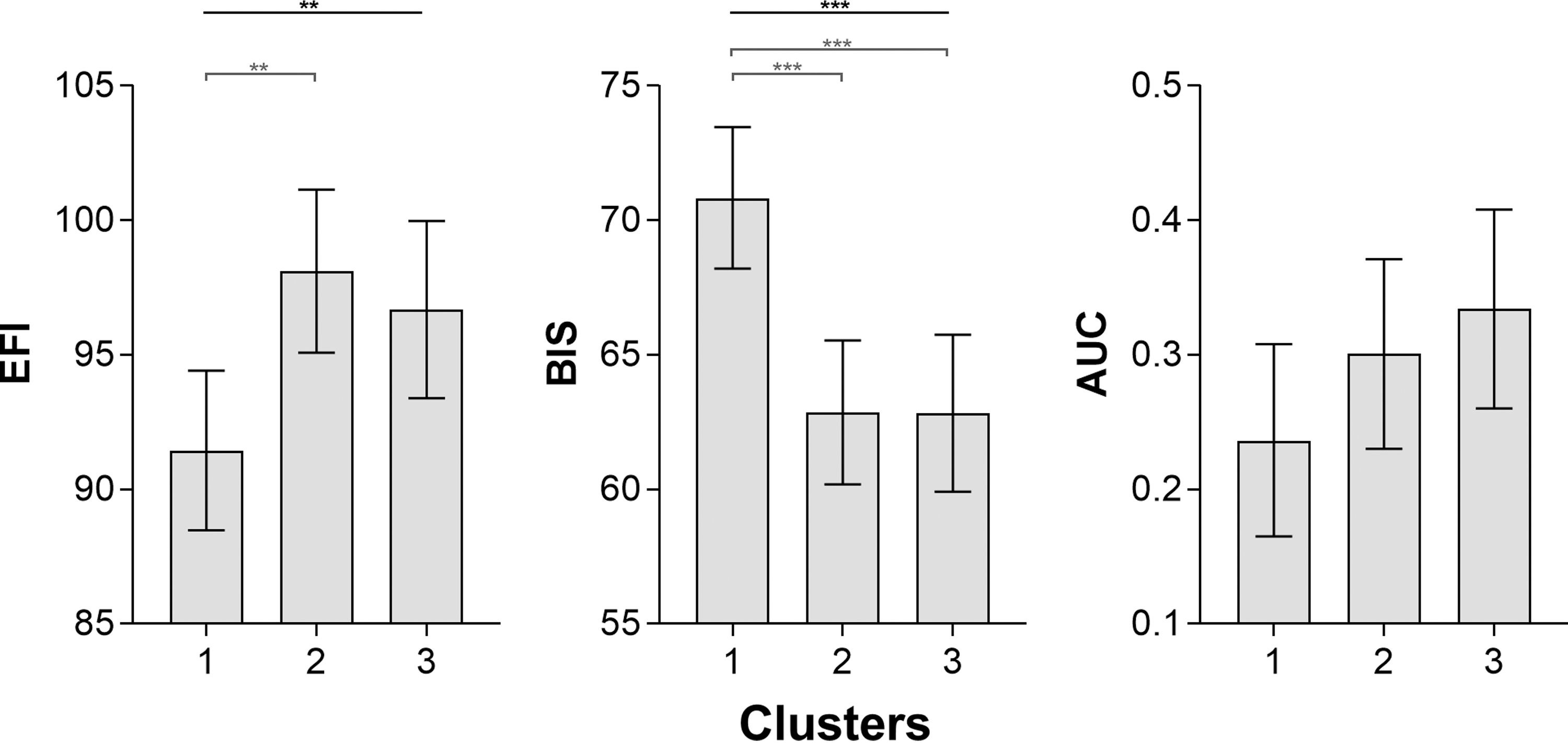
The mean scores of the EFI, BIS, and AUC as a function of the clusters. Error bars indicate 95 percent confidence intervals. **p < 0.01. ***p < 0.001. Other details are the same as given in Figure 2. AUC, area under the curve; BIS, Barratt Impulsiveness Scale; EFI, Executive Function Index.
Post Hoc Comparisons of the Executive Function Index and Barratt Impulsiveness Scale Scores Among Clusters
Note: Bold numbers indicate statistical significance. The p values and 95 percent CIs were adjusted for multiple comparisons according to the Turkey method.
Discussion
To the best of our knowledge, this is among the first studies demonstrating that dependent users and excessive users differ in levels of cognitive and neurological processes, such as executive function. Taken together with previous studies demonstrating significant associations between levels of text-message dependency and executive function, 13 the present results suggest that executive function is a critical factor that determines whether users who excessively engage in text-messaging become dependent or remain nondependent. Particularly, given the present results that dependent users were more impulsive than excessive users, impulse control, a component of executive function, may be of particular relevance as a moderator to differentiate between dependent and excessive users. These suggest that some forms of impulse-control training33–35 may be effective for text-message dependency. Further study is needed to test this possibility, which should contribute to the development of effective prevention and intervention strategies.
Another major contribution of this study is that, along with previous studies,10,11 it demonstrated that excessive users were not necessarily dependent/problematic users. This finding is important to avoid overpathologizing a normal behavior that is excessive in its frequency yet may be normal in its psychological state. 36 In addition, the finding may suggest that excessive and dependent text-messaging behaviors may differ in their function. That is, excessive text-messaging may be primarily maintained by the process of positive reinforcement, in which users enjoy the positive aspects of text-messaging (e.g., mood enhancement), whereas dependent text-messaging may be primarily maintained by the process of negative reinforcement, in which text-messaging alleviates the negative emotions and obsessive thoughts of using one's phone. 37 Such functional assessments of text-messaging behavior are an important target in future research, and the present finding that dependent and excessive users differed in levels of executive function and impulsivity should be important to better characterize the difference between dependent and excessive text-messaging behaviors.
Some limitations of this study are noteworthy. First, the assessment of text-message dependency was based on self-reported data. Future research may incorporate some objective measures of text-message dependency 38 as a supplemental measure. Second, the assessment of executive function was also based on self-reported data. Future research may incorporate a performance-based measure of executive function. 39 Third, the present sample was very small and exclusively consisted of college students. The external validity of the present findings should be tested with a larger sample of different populations (e.g., adolescents).
The literature on substance abuse suggests that different patterns of substance use can be differentiated based on individual factors, such as impulsivity, reward dependence, and sensation seeking. 40 The present finding that excessive and dependent use of text messages was differentially associated with levels of executive function and impulsivity is consistent with the literature. Although whether text-message dependency is qualified as a behavioral addiction is debatable, 41 it is possible that text-message dependency shares some critical features with other impulsivity-related problems.11,14,15 Placing text-message dependency in such a larger context should further our understanding of text-message dependency in future research.
Footnotes
Author Disclosure Statement
No competing financial interests exist.
Funding Information
The current study did not receive any funding.