




Abstract
Identity shift describes how individuals commit to self-presentations made in public computer-mediated contexts. This study attempts to expand identity shift effects to virtual reality. Participants were randomly assigned to present themselves as extraverted or introverted in pilot tested public or private virtual environments. The hypotheses and data analysis strategy were preregistered, and the study had sufficient a priori statistical power. The results did not support identity shift effects. Baseline extraversion predicted postmanipulation extraversion scores, thus suggesting identity stability. The discussion focuses on the empirical consistency of the identity shift effect and avenues for future research.
Introduction
I
This study attempts to extend the identity shift effect to virtual environments. One reason to undertake this task is that users' ability to edit and even transform the self is a long-standing theme in computer-mediated communication and virtual reality research. 4 Individuals may engage in optimized self-presentation by selectively disclosing desirable aspects of the self when using avatars, text, and photos in online interactions. 5 For example, individuals may exaggerate their sociability and outgoingness in social media relative to their actual self. 6 In addition, Facebook's acquisition of Oculus VR along with advancements in transmitting and encoding human behavior (e.g., 360° cameras, motion sensors, social features, including “profiles” and “hangouts”) suggests that virtual reality is becoming more oriented toward social networking purposes and not only meant for individual use and playing video games. 7 Thus, individual's ability to edit and change the self while engaging in self-presentation through virtual reality deserves further attention.
Identity shift in mediated communication
Identity shift refers to how public online self-presentation influences individuals to embrace the traits performed in front of an audience. 1 Public self-presentation compels individuals to public commitment with their stated identity. 2 Individuals maintain consistent internal and external states and, thus, may subsequently internalize public self-presentation behaviors. 1 In addition to public self-presentation, online feedback such as senders receiving replies to their statements from either human or computer actors can also trigger identity shift.8,9 In this context, researchers have called for implementing baseline extraversion measurements to account for greater statistical variance in identity shift studies. 9 The use of such pre–post test experimental designs also has theoretical implications as it may help establish the exact departing point for identity shift. Thus, this study will ask participants to report extraversion scores before undergoing a standard task meant to trigger identity shift1,10 in virtual reality.
From a theoretical standpoint, it is worth studying whether identity shift applies to virtual reality as it offers a distinct untested mechanism to explain how individuals are influenced by their social personas. Existing mechanisms include the Proteus effect, which predicts that avatar appearance can affect individual's behavior in virtual reality. However, identity shift assumes a sense of being in public 1 and feedback as causal factors, 9 whereas the Proteus effect relies on Bem's self-perception theory (i.e., avatar users infer their attitudes based on their own virtual behavior) 11 and priming (i.e., avatar appearance activates learned thoughts and behaviors). 12 In addition, identity shift studies rely on selective self-presentation tasks, such as participants portraying a personality trait or loyal brand advocacy,1,9,13 whereas Proteus effect studies rely on avatar visual appearance manipulations, such as assigning participants to avatars in dark or light-colored uniforms; tall or short avatars; or obese or thin avatars.11,12,14 Thus, this study attempts to make a theoretical and methodological contribution, which is distinguishable from existing research into virtual identity, such as the Proteus effect.
There are several reasons to believe that identity shift should apply to virtual reality. Participants report increased internalization of emotional responsiveness and emotional stability when presenting themselves in public instead of a private face-to-face laboratory experience. 10 Thus, identity shift does not seem to be constrained to text-based communication or social media. 5 This is a key consideration as virtual reality provides a more synchronous experience, which is closer to face-to-face interaction than text-based communication. Because identity shift is predicated on public commitment mechanisms instead of specific social media features,1,3 identity shift effects should apply to virtual reality systems in ways similar to face-to-face contexts. 10 Thus:
Methods
Participants
Participants (N = 228) were recruited from a large U.S. West Coast public university. Of the total participants, 86.8 percent were women. Average participant age was 20.26 years (SD = 2.019). Of the participants, 47.4 percent were Asian, 28.1 percent were Latino, 18.4 percent were Caucasian, 2.2 percent were Black, and 3.9 percent identified as from “other” race. An a priori power analysis using G*Power 15 was carried out for a factorial design with four groups to be analyzed with F tests examining main and interaction effects. Identity shift effect size was calculated based on the data for 76 participants provided in Ref. 1 The a priori power analysis set Cohen's d = 0.36 was based on the data reported for the extraverted and introverted self-presentations in their public condition. 1 G*Power determined that a sample of 103 participants would be necessary to obtain an identity shift effect. In sum, this study had sufficient statistical power to test for identity shift effects. In addition, the study's hypotheses and data analysis plan were preregistered in a public research domain. 16 This report focused on the identity shift hypothesis and proposed analysis.
Materials and procedure
The experiment was presented to participants with the cover story of focusing on the detection of personality traits in others' self-descriptions. 1 As in previous studies,1,8–10 participants were told that they would be interviewed and that their recording would be later used by communication and psychology students who were testing people's ability to detect personality traits. Participants then completed the measures described below privately and in a different room from where the interview took place.
Self-presentation manipulation
Participants were randomly assigned to portray either an extraverted or introverted person while answering four questions (i.e., pastimes with friends, family vacations, extracurricular activities, and the most important thing learned in college). Participants were told to think of past and present experiences and use those examples instead of lying or imagining events. Typical verbal and nonverbal behaviors of introverted or extraverted people were defined to each participant using a consistent script (e.g., introverted people are shy, quiet. They stand with a closed body position; extraverts are outgoing, warm, and active. They stand with an open body position). To implement a baseline, participants privately reported their “true” personality before coming to the laboratory.
Public identifiability manipulation
This factor was manipulated by randomly assigning participants in the private condition to act out their assigned trait in an empty virtual classroom, whereas participants in the public condition acted out in a full virtual classroom. The empty classroom had no people sitting in the audience; the full classroom had all seats filled with an audience of students (Fig. 1). The classrooms were presented using VTime, a virtual reality program. Participants were outfitted with Oculus Rift goggles and motion controllers throughout the interview and were encouraged to gesture and speak according to their assigned trait. The two environments were rendered as a 360° setting in which participants were in front of a classroom.
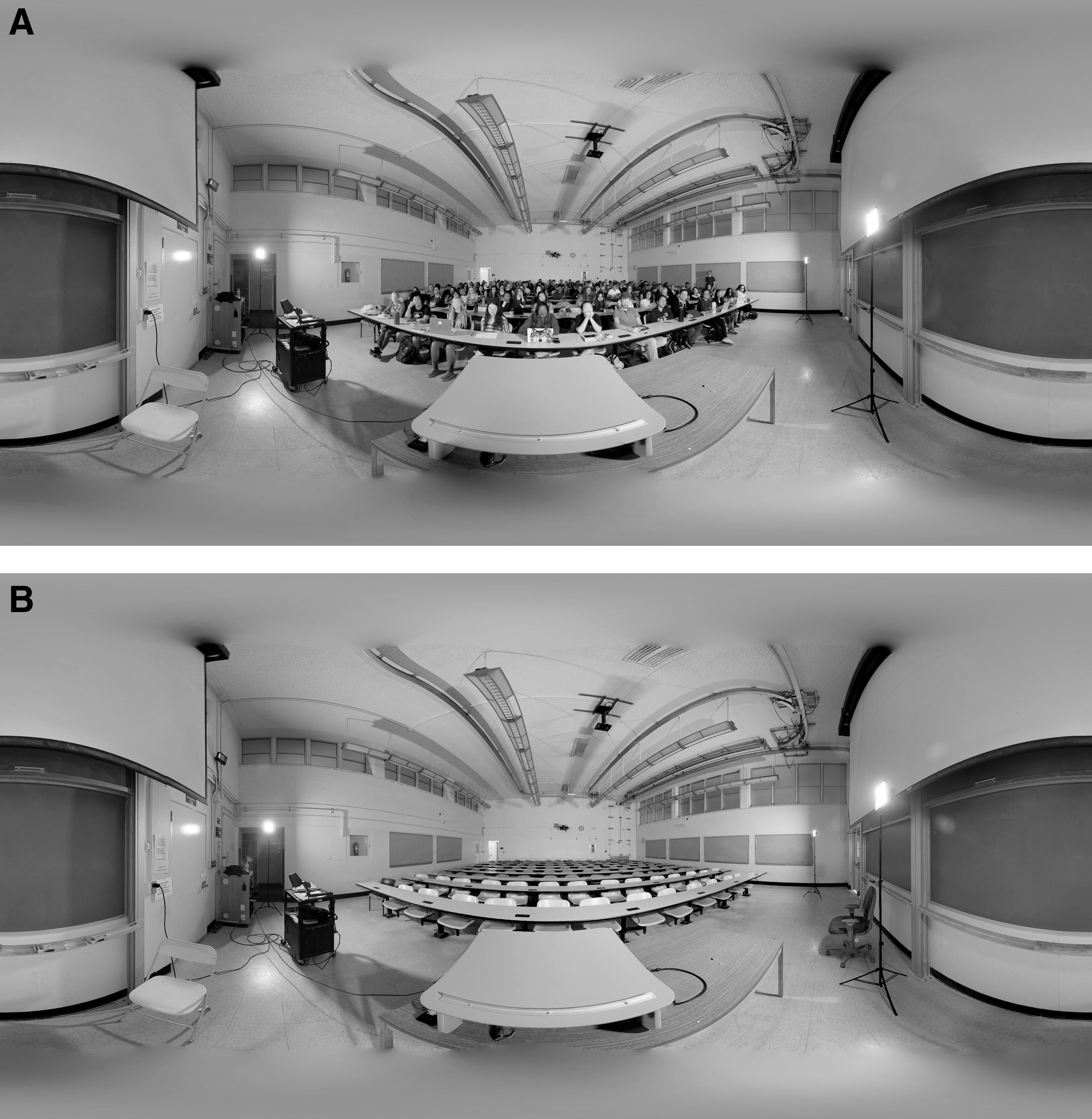
Pilot test
The public and private virtual environments were selected based on the results of a pilot test. A separate sample of participants (N = 54) evaluated eight virtual classroom environments before the actual experiment. Pilot test participants came to a laboratory, were furnished with Oculus Rift goggles and motion controllers same as study participants eventually would, and then were shown several virtual classrooms. The environments were presented from the perspective of a speaker in front of the classroom. Different environmental illumination conditions were pilot tested (e.g., lecture room lights shining on speaker; lecture room lights shining on audience).
Pilot test participants were asked to imagine giving a speech or describing themselves in that location and then rated each environment after 45 seconds of exposure. Pilot test participants looked around and gestured as if they were delivering speech or introducing themselves to the class. To avoid fatigue and primacy-recency effects, the presentation of the environments was randomized so that each participant would rate all environments in different orders. All student faces in the virtual environments were blurred to avoid participants to recognize fellow students. Pilot test participants rated how publicly identifiable they felt in each virtual classroom using five items presented as nine-point semantic differential scale adapted from previous studies.1,9 Sample items included “The environment makes you feel as if: I'm in a private location—I'm in a public location; people are not watching me-people are watching me; I'm not under surveillance-I'm under surveillance; I'm unidentifiable—I'm identifiable; I'm unrecognizable-I'm recognizable.” Scale reliability was good (α = 0.90, M = 5.967, SD = 2.340).
Differences between the same full or empty virtual location were examined with paired-samples t tests. In all iterations, the full audience versions of the classroom and the auditorium prompted more public identifiability relative to the empty audience version of the same locations. The full classroom with lights shining in the direction of the audience inspired more public identifiability (M = 7.570; SD = 1.473) than the empty classroom with similar illumination (M = 3.966; SD = 1.974), t(53) = 9.671, p = 0.001, d = 2.069. In addition, the full classroom with ambient lights prompted more public identifiability (M = 7.755; SD = 1.372) than the empty classroom with same illumination (M = 4.744; SD = 2.204), t(53) = 8.751, p = 0.001, d = 1.640. The full classroom with lights shining in the direction of the speaker inspired more public identifiability (M = 7.400; SD = 1.538) than the empty classroom with lights in the direction of the speaker (M = 4.370; SD = 1.980), t(53) = 8.200, p = 0.001, d = 1.709. Based on the pilot test, we selected the full and the empty classroom with lights shining in the direction of the audience as the public and private virtual conditions.
Measures
Perceived extraversion
Participants provided a “true” baseline rating of their personalities. Sixty-one percent of participants took the personality pretest a week before coming to the laboratory; 39 percent took the pretest the night before or after providing informed consent. Personality was measured with an 11-point scale that included 10 semantic differential items (e.g., talkative-quiet; unsociable-sociable; friendly-unfriendly; extraverted-introverted; and outgoing-shy). 10 Following the interview, participants again provided a “true” rating of their personality (i.e., extraversion post-test). Extraversion scores were calculated per participant by summing the scores of the 10 semantic differential items. 1 The scales were reliable (αbaseline = 0.89, M = 71.105, SD = 16.250; αpost-test = 0.91, M = 71.469, SD = 17.203).
Manipulation check
Participants completed two items in a 1 to 7 Likert-type scale measuring their experience of public identifiability. 1 Sample questions included “To what extent do you think your presentation in this experiment was publicly identifiable?” The scale was reliable (α = 0.88, M = 3.730, SD = 1.498). Participants acting as extraverts reported higher perceived public identifiability relative to participants that acted as introverts, b = 0.481, SE = 0.197, t(228) = 2.445, p = 0.015, 95% CI = 0.093–0.868. Participants in the public virtual condition did not show perceived public identifiability differences relative to participants in the private virtual condition, t < 1. No interaction effects were found.
Results
The preregistered data analysis strategy replicated previous statistical tests applied to perceived extraversion scores. There were no significant main effects of acting as an introverted or extraverted person on post-test extraversion scores, F(1, 224) = 0.284, p = 0.595, partial η 2 = 0.001. There were no significant main effects of acting out in a public or private virtual environment on post-test extraversion scores, F(1, 224) = 0.030, p = 0.863, partial η 2 = 0.002. There were no interaction effects of acting as an introverted or extraverted person in a public or private condition, F(1, 194) = 0.225, p = 0.636, partial η 2 = 0.001.
The results were then retested using a repeated-measures analysis of variance with simple contrasts to account for any pre–post experiment effects on extraversion scores. There were no extraversion score changes from baseline to postvirtual experience, Fself-presentation manipulation(1, 224) = 0.830, p = 0.363, partial η 2 = 0.004, Fpublic-private manipulation(1, 224) = 0.824, p = 0.365, partial η 2 = 0.004, Finteraction(1, 224) = 0.146, p = 0.703, partial η 2 = 0.001. No identity shift effects on extraversion scores were found. H1 was rejected. Descriptive statistics is shown in Table 1. Exploratory tests revealed that baseline extraversion scores significantly predicted post-test extraversion scores, b = 0.90, t(228) = 24.416, p = 0.001, 95% CI = 0.830–0.976.
Sums of Post-test Extraversion Scores by Experimental Condition
Discussion
The identity shift hypothesis predicted increased internalization of extraversion following a public self-presentation event in a technologically mediated setting. We find no evidence for this prediction in this preregistered study, which attempted to expand identity shift to virtual reality. Participants did not regard themselves as more extraverted after self-presentation as extraverts in a public virtual environment.
One possibility for this lack of findings is that identity shift was inherently tied to asynchronous text-based computer-mediated communication contexts. This is unlikely as identity shift is rooted in basic social psychological mechanisms such as public commitment effects and it has also been observed in synchronous face-to-face contexts. 10 Consider that identity exploration and change among 18-year olds do occur in new technological contexts, 17 but this phenomenon is a fundamental self-concept and identity development process among adolescents instead of a new effect brought about by social media.
Another possibility is that identity shift effects are statistically weak. The original results were small in statistical size, 1 studies report inconsistent effects across experiments, 13 and no results appeared in social media contexts.18–20 Feedback manipulations seem to be more effective at triggering identity shift effects.8,9 In comparison, extraversion showed stability across countries and after years in between test–retest data. 21 After 1 week, extraversion test–retest correlations were 0.92, and the mean 5- to 10-year stability coefficient for extraversion was 0.81, thus implying that extraversion is one of the most stable traits. 21 Identity shift effects would have to be robust enough to overcome extraversion stability and, thus, one contribution of this study is showing how there is no effect within the present context.
In response to calls for implementing baseline measurements, baseline extraversion scores accounted for more postexperiment extraversion score variance than identity shift manipulations. This again suggests extraversion stability. Future studies should continue to implement baselines and pre–post test designs to examine the identity shift effect.
In addition, participants acting as extraverts reported increased public identifiability. This finding was unexpected as it had not been observed in previous studies. It is possible that these participants felt more identifiable because they talked more about themselves relative to participants in the introverted condition. Future studies should confirm whether self-presentation tasks reliably trigger differences in perceived public identifiability.
Although identity shift and Proteus effect research share the assumption that situational cues in mediated environments affect behavior and self-perception, it is possible that identity change is more effective when relying on avatar manipulations instead of identity shift procedures. Proteus effect studies used dramatic visual stereotypes displayed in first-person or third-person point of view.11,12,14 It is possible that the visual vividness of Proteus effect manipulations yield stronger effects than identity shift procedures, as implied by a meta-analysis revealing that the Proteus effect was more consistent than other digital media effects. 22
Limitations of this study include a mostly female sample. This may not be a fatal limitation as women showed a stronger but insignificant tendency relative to men to report changes in post-test extraversion scores. Female participants should have been more prone to display identity shift if such effect would have been obtained. Low statistical power cannot explain the lack of findings in this study. A priori tests indicated sufficient statistical power. The materials were requested from the authors, the laboratory procedure was implemented similarly, and the virtual environments were pilot tested.
We conclude that the identity shift effect is an interesting hypothesis that did not transfer successfully to a virtual reality context. Replications and expansions that fail to confirm hypotheses such as the present study have important theoretical implications as they test the robustness of theoretical predictions. 23 In addition, replications and expansions increase the internal and external validity of theoretical predictions as individual studies can be aggregated using meta-analytical techniques. 23 Although the present study adds to a trend of research showing no identity shift effects,18–20 the findings need to be taken cautiously until further replications and meta-analyses become available. Nonetheless, our main contribution was to draw attention to a computer-mediated communication effect that may not translate across contexts as robustly as we once thought.
Footnotes
Author Disclosure Statement
No competing financial interests exist.
Funding Information
No funding was received for this article.