




Abstract
The reports suggesting a beneficial effect of nicotine on coronavirus disease 2019 (COVID-19) severity may encourage smoking. We aimed to analyze tweets on COVID-19 and smoking coming from casual Twitter users and Twitter accounts representing the tobacco industry. We collected tweets on COVID-19 and smoking from January 1 to May 1, 2020, using Twitter application programming interface. We analyzed sentiment, likes, or retweet to followers ratios, and the posts coming from the casual users to find pieces of news that could affect the discourse. Tweets coming from industry were analyzed manually. We analyzed n = 33,890 tweets on COVID-19 and smoking. The sentiment of tweets was negative, hitting a nadir in mid-March, but became less negative in April when preprints suggesting benefits from smoking on COVID-19 were released. Similar trends were observed for the ratios of likes or retweets to followers. We found 58 messages from the tobacco industry concerning COVID-19. Twenty-two (37.9 percent) mentioned the efforts of tobacco companies to support the development of a COVID-19 vaccine. Two tweets included Food and Drug Administration statements that there is no evidence that vaping increases the risk of COVID-19. The occurrence of preprints suggesting benefits of smoking in COVID-19 might increase sentiment and reactions to tweets on tobacco products and the virus. The authors of potentially controversial articles should restrain from the promotion of their results before the completion of the peer-review process. Twitter presents a convenient tool to monitor e-discourse during a health crisis. The research community should monitor the tobacco industry's social media.
Introduction
Association between smoking and coronavirus disease 2019 (COVID-19) prognosis is a subject of scientific dispute.1–3 Even though smokers seem to represent a disproportionately small part of hospitalized patients,3,4 a meta-analysis of Chinese studies did not show a significant association between smoking and the severity of COVID-19. 5 Farsalinos et al. concluded that smoking is generally harmful, but nicotine may be considered as a treatment option for COVID-19 due to low prevalence of smokers among patients hospitalized in China. 6 The preprint of the article by Farsalinos et al. was published on April 4, 2020. 7 Two recent preprints suggested that smokers might be less susceptible to COVID-19 than nonsmokers.8,9 Changeux et al. presented a hypothesis that nicotine may compete with SARS-CoV-2 in binding to the nicotine acetylcholine receptor that might be engaged in inflammatory response during infection. 8 Importantly, the authors admitted that overall smoking has severe health consequences. Miyara et al. found that the prevalence of daily smokers among symptomatic COVID-19 patients treated in one French hospital and outpatients were lower than the prevalence of smokers in general population. 9 However, the authors confused terms incidence with prevalence, there were concerns on definitions of former smokers, and the study group came from one health center excluding patients in intensive care units, which is the strongest source of bias. Nevertheless, most of the studies pointed out that smoking may worsen the COVID-19 course.10–13
Smokers tend to rationalize their behavior.14,15 Studies suggesting the benefits of using tobacco products during the COVID-19 pandemic might be used by smokers to justify smoking and cause increased interest in tobacco products among former or never smokers. For this reason, France limited sales of tobacco products in a few days after the Changeux et al. and Miyara et al. preprints8,9 became viral. 16 Furthermore, the threat of the prolonged lockdown, supply chain breakage, or government bans on tobacco products may drive consumers to stock up these goods.17,18 Finally, the tobacco industry may promote its products by disseminating the results of selected preprints.
Twitter is a popular network of microblogs. The pieces of news are disseminated by short messages called “tweets.” All of the tweets may receive feedback in the forms of a commentary, favorite tags (also called likes), or sharing (“retweet”). Twitter users create social networks by “following” others accounts. The tweets are one of the most popular data sources for analyzing health issues in e-discourse. 19 The Twitter data were used to investigate the effects of an antismoking campaign, 20 posts and networks of people who vape 21 or use JUUL™ e-cigarettes,22,23 as well as those who struggled with smoking cessation. 24
To date, no study investigated the social media data on using tobacco products during the COVID-19 pandemic. We hypothesize that analysis of tweets on COVID-19 and smoking may show what information generates the most attention, and how the discourse changes over time. Furthermore, the investigation may unravel how the tobacco industry communicates and promotes during the pandemic.
We aimed to analyze tweets on COVID-19 and smoking coming from (1) casual Twitter users and (2) Twitter accounts representing the tobacco industry in the scope of progression of the pandemic as well as studies on smoking or vaping, and severity of COVID-19.
Materials and Methods
Data collection
This study processed Twitter data, thus, did not require ethical committee approval. The research does not violate the terms of the platform.
Initially, we connected with official Twitter application programming interface (API) using R package rtweet, 25 and collected all tweets including terms related to COVID-19 (“COVID,” “coronavirus,” “pandemic,” “SARS,” and “CoV”), and smoking (“smoking,” “cigarette,” “vaping,” “smoke,” and “nicotine”) in the nine days preceding the day of the collection (April 28, 2020). We obtained the original tweets coming from 22,613 different users. Furthermore, we used function get_timeline() from rtweet package 25 to collect all tweets since January 1, 2020, to May 1, 2020, from the identified accounts.
We identified Twitter accounts representing six tobacco companies (Phillip Morris International, British American Tobacco, Imperial Brands, Japan Tobacco International, Altria, and China Tobacco), and their branches in 47 countries (European Countries, Commonwealth, Norway, Switzerland, United States, India, Turkey, Russia, Japan, South Africa, Mexico, Brazil, Argentina, and Chile). We searched for account names using Google and Twitter built-in search engines. Finally, we found a total n = 39 different accounts, and collected tweets related to COVID-19 from January 1, 2020, to May 1, 2020, using rtweet package. 25
Data analysis
We calculated relative reactions to each tweet by dividing likes or retweets to the number of followers of the account. The higher ratios mean that tweets gained more attention of Twitter users. We performed a sentiment analysis on tweets written in English using the tidytext R package. 26 First, we performed unnesting tokenization to words, which is a process of splitting text into single words. Then we removed stop words, which are the most commonly used words but have a secondary role in the meaning of a sentence—such as prepositions (e.g., “in,” “with,” and “through”) or conjunctions (e.g., “and,” “for,” and “or”).
Finally, we combined the collection of words representing each tweet with a sentiment dictionary called “Bing.” 27 The dictionary describes >6,700 English words by terms “positive” or “negative.” For instance, words such as “easy,” “fortune,” and “pride” are classified as positive, whereas “angry,” “concern,” and “impossible” are classified as negative. We calculated sentiment by subtracting the number of positive and negative words of each tweet. Furthermore, we wrote annotation of time trends according to the COVID-19 timeline, 28 and publication of preprints suggesting neutral/beneficial effects of smoking on the COVID-19 course. We performed a network analysis of the pair words in the tweets. We visualized pairs occurring at least 100 times in the data set.
The tweets coming from tobacco industry accounts were analyzed independently by two authors (M.K. and A.M.). The senior author refereed all discrepancies. We distinguished four types of tweets on emotional support (e.g., for people who stay at home), financial support (e.g., support of health care workers), scientific research, and corporate affairs (e.g., announcement of current remote work policy). If the tweets were not written in English, we used Google Translate to catch the context using the language label of tweets provided by API.
Results
We collected a total of 22,644,994 tweets from the analyzed casual Twitter accounts, of which 33,890 (0.15 percent) concerned both smoking and COVID-19.
The sentiment of tweets was generally negative and was the lowest in mid-March. The undertone became less negative in April when Food and Drug Administration (FDA) published a statement on COVID-19 and vaping. 29 At that time, preprints suggesting beneficial effects of tobacco products were posted online, and the sentiment of tweets increases (Fig. 1A). The likes and retweets to followers ratios were the lowest at the end of February and peaked in April when preprints suggesting beneficial effects of nicotine on COVID-19 occurred (Fig. 1B, C).
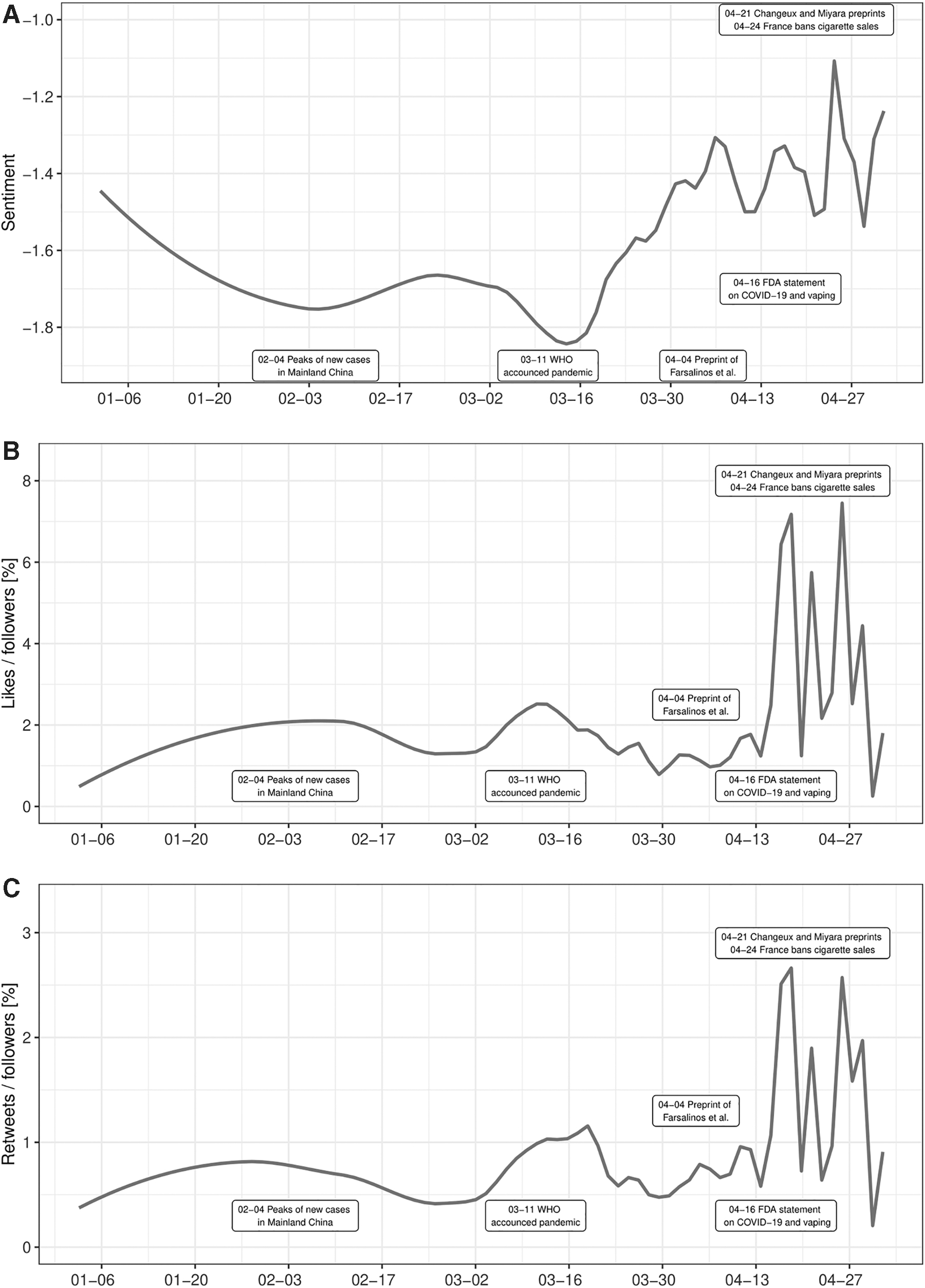
Trends of sentiments and reactions to tweets on COVID-19 and smoking.
In the network analysis, COVID-19 and smoking discourse focused on several topics: the French study on the potential beneficial effects of smoking on SARS-CoV-2 infection, nicotine patches, smoking as a risk factor, smoking cessation, and cigarette sales online (Fig. 2).

Networks of words on COVID-19 and smoking. The visualization includes a pair of words that occurred at least 100 times in the analyzed tweets. Darker gradient of network edges correlates positively with the frequency of pair.
We identified a total of 2,250 tweets posted by tobacco industry accounts, of which 58 (2.6 percent) mentioned COVID-19. Of them, 11 (19.0 percent) concerned emotional support, 3 (5.2 percent) financial support, 28 (48.3 percent) scientific research, and 16 (27.6 percent) corporate affairs. Twenty-two tweets mentioned efforts of a company associated with British American Tobacco to develop COVID-19 vaccine, for example:
“Some good news on a grey Wednesday! A BAT subsidiary in the US, Kentucky BioProcessing (KBP), has a potential vaccine in development for #COVID-19 using new, fast-growing tobacco plant technology – pre-clinical testing is now underway.
Two tweets coming from Phillip Morris account mentioned Medicago, which is partially funded by the corporation, and works on COVID-19 vaccine:
“#Medicago has made significant progress toward producing an experimental vaccine for #COVID19. It uses a close relative of a tobacco plant which, if proven effective, can be mass-produced within a month.
Moreover, we found two tweets with information that vaping is not associated with the risk of COVID-19:
John Player, @JohnPlayer_Ire (part of Imperial Brands), tweet ID: 1252253364408266753 “No evidence that vaping increases the risk of COVID-19 BAT Belgium, @BE_BAT_official (Belgian account of British American Tobacco), tweet ID: 1243095096762957825 “The @US_FDA (Food and Drug Administration) have admitted there is no evidence from anywhere in the world showing vapers to be at higher risk for COVID-19. Read more in this piece by @ReasonFdn
The first tweet directed the Australia Tobacco Harm Reduction Association (ATHRA) post that briefly discusses current knowledge on vaping on the risk of COVID-19. 30 The ATHRA notes provide references from peer-reviewed journals and preprints of Farsalinos et al. 7 and Sussman and Escrig. 31
None of the tweets coming from the tobacco industry promoted suggested the beneficial effects of smoking on COVID-19 prognosis.
Discussion
We analyzed a large number of tweets on COVID-19 and smoking from casual users and tobacco industry accounts. We analyzed sentiments and reactions time trends, as well as the main topics of the messages. Pieces of news on the effects of tobacco products on the severity of the COVID-19 might drive the e-discourse of the disease and smoking.
Main findings
Abd-Alrazaq et al. found that most of the tweets related to COVID-19 had positive sentiment. 32 In this study, the undertone was generally negative—whereas the sentiment of the tweets on COVID-19 and smoking changes over time. Initially, the undertone decreased and reached the nadir when the WHO announced the COVID-19 pandemic. Later, the sentiment became less negative and fluctuated after the occurrence of potential good pieces of news for smokers. Unger et al. suggested that users tweeting on smoking are more likely to consume tobacco products. 33 Therefore, the sentiment may reflect the attitude of smokers on the viral news on smoking during the pandemic. A similar pattern concerned changes in relative reaction on analyzed tweets. The results may suggest that the more hopeful (or less negative) information on smoking and the coronavirus gains more attention. Interestingly, previous studies found that most of the tweets on smoking have positive sentiment.34,35 Here, smoking in the context of COVID-19 was generally negative. The current situation could be scaring for Twitter users who use nicotine products. The network analysis suggested that the tweets are related to safety, availability, cessation of smoking, and recent researches rather than recreational use of tobacco products to relax during the pandemic.
We found that only a minority of tobacco industry tweets during the COVID-19 pandemic concerned the virus. Over one of three was related to the efforts of vaccine development by the tobacco industry. On the one hand, we may hope that the companies create a safe vaccine with good preventive effect. On the other hand, possible success might be utilized for the protection of the tobacco industry public image. Therefore, it is a great responsibility of regulators and reviewers to ensure that the development and assessment of the vaccine (not only produced by tobacco industry-related companies) are rigorous, and without bias.
Two tweets of tobacco industry accounts mentioned an FDA statement on the association between vaping and risk of COVID-19. Regrettably, the link from the second tweet expired, and we could not have verified it. It probably included information on FDA statement on vaping and COVID-19. 29 To date, there is no clinical evidence that vaping may worsen the course of COVID-19. Most of the e-cigarette users are young and more likely to undergo the disease without any or with only mild symptoms; thus, the effects of vaping may be undetectable. However, the smoking of e-cigarettes may contribute to angiotensin-converting enzyme-2 (ACE2) receptor upregulation, which is a receptor for SARS-CoV-2. 36 The increase of ACE2 receptors may increase susceptibility to COVID-19. Finally, the general knowledge of e-cigarette suggests that by increasing cardiovascular risk, 37 the vaping may worsen the prognosis of the disease. The effects of vaping on COVID-19 need to be established in further research.
It is worth considering the spread of news on beneficial properties of smoking on COVID-19 from a psychological perspective. People tend to favor information that confirms their personal beliefs or behavior. 38 Therefore, the current smokers may be more eager to post, like, or share tweets on benefits from smoking during the COVID-19 pandemic. Twitter users tend to follow their friends and acquaintances and authorities with similar beliefs or accounts, disseminating important information.39,40 In such circumstances, the confirmation bias might also be enhanced by the social proof phenomenon. 41 However, when a Twitter user meets with the opposite opinion, he/she may experience cognitive dissonance. 42 To diminish the distress, the user will search for information proving his/her position or to not react to the tweet. Therefore, even low-quality researches may resonate with the beliefs of a Twitter user and can be promptly disseminated through social networks.
Strengths and practical implications
The study is another example of using Twitter data for tobacco research. Here, we presented changes over time of text sentiment and reaction to posts coming from casual Twitter users. We provided a good example of how the dissemination of controversial preprints modifies the e-discourse on smoking and COVID-19. To our best knowledge, one of the preprints already mentioned was published to date. 6 Therefore, the authors of the potentially highly controversial articles should consider restraining from the promotion or even dissemination of the article before the completion of the peer-review process. The controversies propel the science, but in France, preprint caused a rush for nicotine products and further government intervention. 16
Furthermore, we monitored tweets related to COVID-19 coming from tobacco industry accounts. The industry did not use the preprints suggesting beneficial effects of smoking on COVID-19. Owing to the lack of effective treatment of severe COVID-19 all potential even unproven therapies gain attetion. 43 Therefore, it is important to vigilantly observe tobacco companies, whether they promote weak and biased protobacco studies.
Limitations
The study has several limitations. First, only a minority of the tweets concerned both COVID-19 and smoking. Second, we analyzed only posts of casual users written in English; thus, the results cannot be generalized. Finally, we analyzed data coming from one social media platform. However, this is counterbalanced by a broad analysis of a considerable number of tweets spanning several weeks.
Conclusion
Preprints suggesting the benefits of smoking in COVID-19 might increase sentiment and reactions to tweets on tobacco products and the virus. The authors of controversial articles should restrain from the promotion and dissemination of their work before completion of the peer-review process. Twitter may be a convenient tool to monitor e-discourse during a health crisis. Research community should monitor the tobacco industry's social media.
Ethical Committee
This study processed Twitter data, thus, did not require ethical committee approval. The research does not violate the terms of the platform.
Footnotes
Author Disclosure Statement
No competing financial interests exist.
Funding Information
No funding was received for this article.