




Abstract
There is a growing research interest in cyber dating abuse (CDA). CDA includes abusive online behavior toward a current or former intimate partner, such as aggression, control, harassment, and humiliation. Despite the potential overlap and reciprocal relationship of CDA and intimate partner violence, there remains considerable paucity in research exploring predictors of this abusive online behavior. In the current study, we adopt the General Aggression Model framework and explore the role of gender, hegemonic masculinity, vulnerable narcissism, and sexual aggression myths to predict perpetration of CDA. Participants (N = 415, 51 percent women; Mage = 32.68 years) were recruited via social media advertisements and completed an anonymous, confidential online questionnaire. The questionnaire comprised the Conformity to Masculine Roles Norms Inventory, the Hypersensitive Narcissism Scale, the Acceptance of Modern Myths About Sexual Aggression Scale, and a modified Cyber Aggression in Relationships Scale. A hierarchical regression analysis indicated that hegemonic masculinity, vulnerable narcissism, and sexual aggression myths were all significant positive predictors of perpetrating CDA. As gender was a significant predictor until the inclusion of these variables, a multiple mediation analysis was performed, indicating that both hegemonic masculinity and sexual aggression myths fully mediated the relationship between gender and perpetrating CDA. These results add to the growing body of research exploring how CDA emerges as a behavior and highlight possible implications for management and intervention.
Introduction
There is recent growing research interest in cyber dating abuse (CDA), which includes the use of technology to aggress toward and/or control current or former intimate partners. 1 Examples of CDA include cyberstalking and monitoring a partner online, sexually harassing a partner via technology, and publicly humiliating a partner online. 2 Research has highlighted a shared nomological network between CDA behaviors and intimate partner violence (IPV) 3 with CDA co-occurring with offline dating violence. 4 CDA and IPV may share a reciprocal relationship; for example, traditional psychological and physical dating abuse predicts CDA, 5 but there is also evidence that CDA behaviors in turn predict domestic violence. 6 Furthermore, it is well established that technology can readily be used to generate offline intimidation. 7 Given this reciprocal nature of the CDA-IPV relationship, modern violence prevention programs should ideally target both CDA and IPV behaviors. 8 Thus, understanding individual differences that predict online IPV-related behavior could provide insights regarding effective management and prevention. 9 The urgency of research in this field cannot be overstated, given estimations that 1 in 10 women aged 15 years or older will experience cyber violence. 10 Despite these prevalence rates, there remains a paucity of research exploring predictors of CDA.
The General Aggression Model (GAM) 11 provides a useful framework for understanding aggression and violence. 12 The GAM is an appropriate theoretical model for CDA perpetration as (a) CDA has been characterized as an aggressive behavior,5,13 and (b) the GAM has been applied to understand IPV.14,15 The GAM emphasizes the person component in aggressive behavior, 16 which includes proximal causal factors such as attitudes, beliefs, and personality traits. 17 Personality in particular is emphasized as an important variable for understanding person factors that influence aggressive behavior. 18 In the current study, we draw on the GAM and explore, for the first time, the utility of hegemonic masculinity, vulnerable narcissism, and sexual aggression myths (i.e., GAM person factors) to predict perpetration of CDA. In the following sections, we discuss the rationale for each of these variables.
Vulnerable narcissism and CDA
Trait narcissism is commonly conceptualized as two main forms: grandiose narcissism and vulnerable narcissism.19,20 Compared with grandiose narcissism (e.g., exhibitionism, arrogance, and dominance), vulnerable narcissism is characterized by neuroticism, negative affect, hypersensitivity, and fragile self-esteem. 21 Vulnerable narcissism is a reliable predictor of abusive intimate partner behavior, such as sexual aggression 22 and relationship violence. 23 Vulnerable narcissism has been found to be positively related with perpetration of CDA behavior. 24 However, this result requires replication due to potentially limited measurement of CDA being assessed with four nonvalidated behavioral items. 24
Hegemonic masculinity
Traditional masculine gender roles have been found to predict perpetration of relationship abuse and IPV,25,26 and endorsement of gender stereotypes is related to enacting CDA. 27 Despite these data, recent research 1 demonstrated no utility for masculinity to predict CDA, attributing this nonsignificant result to low conformity to masculine gender role norms. However, we suggest an alternative explanation—the authors 1 did not exclusively measure hegemonic masculinity. Hegemonic masculinity is conceptualized as a more toxic form of masculinity 28 and is characterized by subordination of women, marginalization of homosexual men, dominance, and competitiveness. 29 The authors 1 operationalized masculinity using the full version of the Conformity to Masculine Norms Inventory (CMNI) 30 ; only some domains specifically relate to hegemonic masculinity. Presumably, the use of the full CMNI 1 would have added noise to the data, with variables such as self-reliance and primacy of work unlikely to share conceptual links with CDA. Given the nature of toxic masculinity, it seems likely that conformity to hegemonic masculine norms may predict perpetrating of aggression toward intimate partners. 31 Finally, given the sexual nature of CDA behaviors, 2 the role of sexual abuse is also relevant to CDA.
Sexual aggression myths
Attitudinal factors play a significant role in offline sexual abuse and violence.32,33 The acceptance of myths about sexual aggression, such as rape myths, is a significant factor in problematic attitudes toward sexual assault and has been established as an explanatory predictor of perceived victim culpability34,35 and the actual perpetration of sexual violence.36,37 Although initial research focused on the physical crime of rape and associated myths, 38 such scales are typically positively skewed due to the extreme nature of the behaviors. As such, more recent conceptualizations have extended beyond rape to allow for more covert myths, and to address other, potentially less severe, forms of sexual aggression, including harassment and sexual assault. 39 Online forms of sexual aggression and abuse have also been attributed to myths and attributions that minimize experiences of abuse, including the victims are lying or exaggerating the nature of the impact, the perpetrators were provoked or justified in their behavior, and the victims deserved or needed to be controlled based on their behaviors or other characteristics.40,41
Rationale, aim, and hypotheses
Given the potential co-occurrence of online and offline forms of relational abuse, it is important to develop an understanding of attitudes and traits that may contribute to online CDA. As vulnerable narcissism, hegemonic masculinity, and sexual aggression myths have been linked to the engagement in offline relational abuse and IPV, the current study will investigate whether these variables are also linked to the perpetration of online relational abuse, specifically, CDA. As previous research has highlighted the role of gender in perpetrating forms of CDA,42,43 gender is also included as a variable of interest. However, no specific directional hypothesis is generated for gender as inconsistent patterns have emerged, such as higher perpetration for men, 44 higher perpetration for women,42,43 or even no gender differences. 13
In sum, the aim of the current study was to test the utility of gender, hegemonic masculinity, vulnerable narcissism, and acceptance of modern myths about sexual aggression (termed sexual aggression myths) to explain perpetration of CDA. Given previous mixed findings, an exploratory hypothesis (H1) was proposed, that gender would be a significant predictor of CDA, although no specific direction was predicted. Further to any variance explained by gender, it was predicted that (H2) hegemonic masculinity, vulnerable narcissism, and sexual aggression myths would be significant positive predictors of CDA.
Methods
Participants and procedure
After obtaining ethical clearance, prospective participants were invited to complete an anonymous online questionnaire via social media (e.g., Facebook, Reddit) advertisements. Inclusion criteria were that all participants were aged 18 years and older and were/had been in a romantic relationship. The sample comprised 415 participants (51 percent women) aged 18–74 years, with an average age of 32.68 years (SD = 10.62). Participants were predominantly white/Caucasian (71 percent), heterosexual (80 percent), and married (36.2 percent).
Measures
The questionnaire included a demographics section (e.g., gender, age) and the following validated measures.
Conformity to Masculine Norms Inventory-46
Following previous research,28,45 hegemonic masculinity scores were calculating by totaling responses to CMNI-46 46 subscales of heterosexual self-presentation (six items; e.g., “I would be furious if someone thought I was gay”; α = 0.84), power over women (four items; e.g., “In general, I control the women in my life”; α = 0.90), and violence, (six items; e.g., “Sometimes violent action is necessary”; α = 0.80). Participants responded to items on a 4-point Likert scale (1 = Strongly disagree; 4 = Strongly agree). Higher scores indicated higher levels of hegemonic masculinity.
Hypersensitive Narcissism Scale
Vulnerable narcissism was measured with the Hypersensitive Narcissism Scale, 47 which includes 10 self-report items (e.g., “My feelings are easily hurt by ridicule or the slighting remarks of others”; α = 0.81). Participants responded to items on a 5-point Likert scale (1 = Strongly disagree; 5 = Strongly agree). Total scores were summed, with higher scores indicating higher levels of hypersensitive narcissism.
Acceptance of Modern Myths About Sexual Aggression Scale
Participants' acceptance of sexual aggression myths was measured with the Acceptance of Modern Myths About Sexual Aggression Scale, 39 comprising 30 self-report items (e.g., “Interpreting harmless gestures as ‘sexual harassment’ is a popular weapon in the battle of the sexes”; α = 0.98). Participants responded to items on a 7-point Likert scale (1 = Completely disagree; 7 = Completely agree). Total scores were summed, with higher scores indicating higher levels of sexual aggression myths.
Cyber Aggression in Relationships Scale
To measure perpetration of CDA, participants completed a modified (Supplementary Data) version of the Cyber Aggression in Relationships Scale (CARS). 48 Although originally three-factor approach to the CARS was recommended, 48 more recent research 49 found no satisfactory factor structure or model fit and recommended treating the CARS as unidimensional. The CARS is composed of 16 items [“Sent threatening or harassing messages to my partner via text or social media” and “I have checked my partner's messages (e.g., e-mail, Facebook, phone) without them knowing”; α = 0.96]. Participants considered their current, or most recent relationship, and indicated how often the behaviors occurred on a scale of 1 = Never to 5 = Always. Following previous guidelines of scoring, 50 a dichotomous variable was created for each item (0 = absent; 1 = present). Items were summed for a total score, with higher scores indicating higher perpetration of CDA.
Design
The study was cross-sectional and correlational in design. Gender, hegemonic masculinity, vulnerable narcissism, and sexual aggression myths were the predictor variables, and CDA was the criterion. Hierarchical regression analyses were run to test the hypotheses. Initial checks indicated no effect of sexual orientation on hegemonic masculinity scores [F(3, 408) = 2.34, p = 0.073].
Results
Descriptives and correlational statistics
Before running analyses, assumptions (linearity, homoscedasticity, normality) were assessed with the standardized residual scatterplot and histogram and considered met. Total and gendered descriptives and gendered t-tests are presented in Table 1. Total and gendered correlations are presented in Table 2.
Total and Gendered Descriptive Statistics for Predictor Variables of Hegemonic Masculinity, Vulnerable Narcissism, and Sexual Aggression Myths and Criterion Variable of Cyber Dating Abuse
Note: D = sex difference; d = Cohen's d; t-tests Bonferroni corrected for multiple comparisons.
p < 0.001.
Total and Gendered Bivariate Correlations for Predictor Variables of Hegemonic Masculinity, Vulnerable Narcissism, and Sexual Aggression Myths and Criterion Variable of Cyber Dating Abuse
p < 0.001.
A two-step hierarchical regression analysis was run with gender at step 1 and explained a significant 2 percent (R 2 adjusted) of variance in CDA. Hegemonic masculinity, vulnerable narcissism, and sexual aggression myths were entered at step 2 and explained a significant additional 44.7 percent of variance. As a total model, gender, hegemonic masculinity, vulnerable narcissism, and sexual aggression myths explained a significant 46.4 percent (R 2 adjusted) of variance in CDA. F tests, R2, effect sizes, and coefficients are presented in Table 3.
Hierarchical Multiple Regression Analysis with Gender, Hegemonic Masculinity, Vulnerable Narcissism, and Sexual Aggression Myths as the Predictors and Cyber Dating Abuse as the Criterion
Gender is coded as men = 0, women = 1; effect size interpreted in line with Cohen's (1992) 54 conventions.
p < 0.01; **p < 0.001.
At step 1, gender (coded men = 0, women = 1) was a significant negative predictor of CDA, with men more likely to perpetrate CDA. At step 2, gender was no longer a significant predictor, and hegemonic masculinity, vulnerable narcissism, and sexual aggression myths were all significant positive predictors.
Exploratory analysis: mediation
As gender was no longer significant in step 2, some mediation effects may have been occurring. To examine this possibility, all variables entered in step 2 were tested as potential mediators for the relationship between gender and CDA in post hoc analyses. To account for shared variance, a multiple mediation model (Fig. 1) was run via PROCESS analysis. 51 Indirect effect bootstrapped 95 percent confidence intervals indicated that hegemonic masculinity and sexual aggression myths fully mediated the relationship between gender and CDA. As gender did not significantly predict vulnerable narcissism, vulnerable narcissism was not a significant mediator.
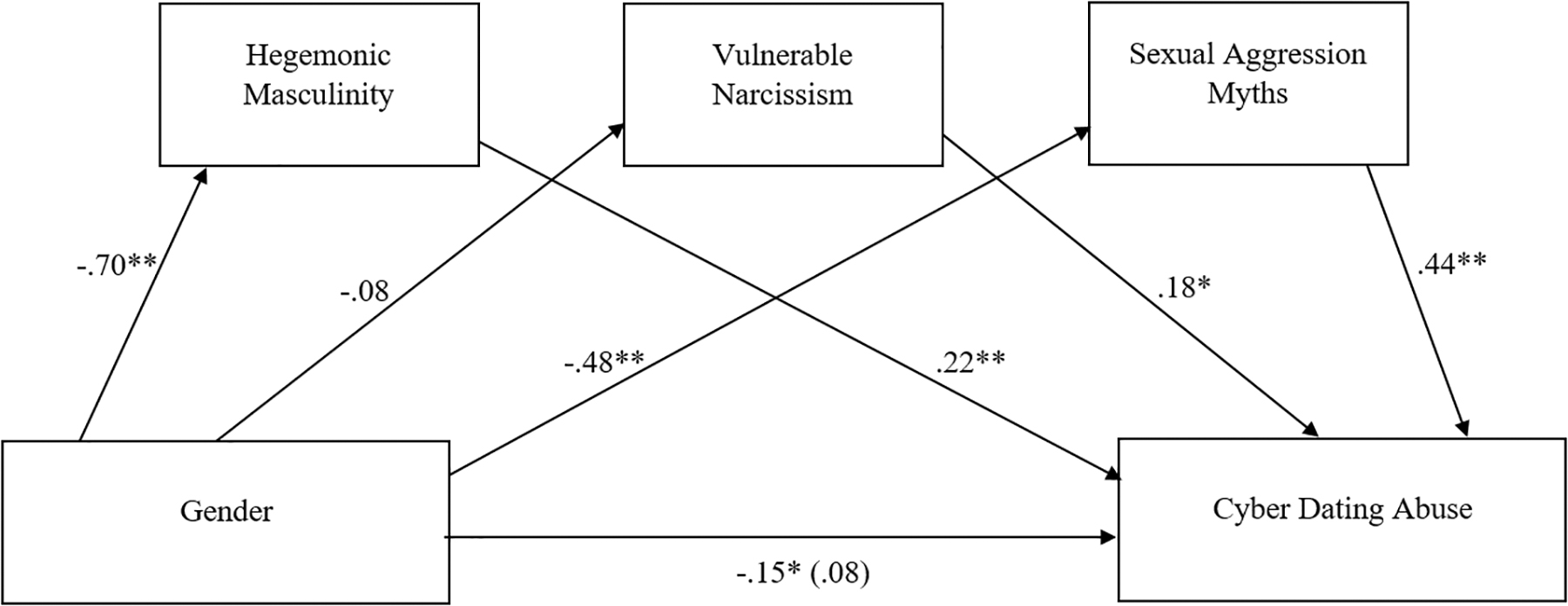
Standardized regression coefficients for the relationships between gender and CDA as mediated by hegemonic masculinity, vulnerable narcissism, and myths about sexual aggression. Gender is coded as 1 = male and 2 = female. Standardized regression coefficient for the relationship between gender and CDA when mediators are present is in parentheses. **p < 0.001; *p < 0.01. CDA, cyber dating abuse.
Discussion
In the current study, we tested the utility of gender, hegemonic masculinity, vulnerable narcissism, and acceptance of sexual aggression myths to predict perpetration of CDA. We predicted that (H1) gender would be a significant predictor of CDA, although no specific direction was predicted. Although being male significantly predicted perpetration of CDA, once the other variables were added to the regression model, gender was no longer significant. We also predicted that (H2) hegemonic masculinity, vulnerable narcissism, and sexual aggression myths would be significant positive predictors of CDA, and the results support this hypothesis. These findings are in line with the GAM, 11 consistent with the featured role of person factors 16 as meaningful contributors within the GAM model. Importantly, the current data show the applicability of the GAM in the context of CDA, adding to extant research14,15 on the broader utility of the GAM.
Post hoc analyses revealed that hegemonic masculinity and sexual aggression myths mediated the gender-CDA relationship, such that being male predicted stronger hegemonic masculinity and greater adherence to sexual aggression myths, which in turn predicted perpetration of CDA. This mediation provides some insight regarding previous inconsistent results of the relationship between gender and perpetration of CDA.13,42–44 Although some reverse directionality is possible, for example, engaging in CDA might perpetuate sexual aggression myths and hegemonic masculinity beliefs, the current data align with the GAM 11 in terms of the role of person factors as proximate inputs leading to aggression outcomes.
Notably, within the GAM, proximate factors that facilitate aggression also indicate potential avenues for intervention, particularly around their interaction with internal states and social encounters. 16 In our study, we found that comparative to vulnerable narcissism, variables associated with social norms (e.g., hegemonic masculinity and sexual aggression myths) had the strongest utility when predicting CDA perpetration. The strength of social norms over other characteristics has been highlighted for related digital dating behaviors, such as sext dissemination (i.e., sending/receiving sexually explicit images via apps or phones 52 ). For CDA, this is an important finding as social norms are more flexible than personality—narcissism tends to be relatively stable over time. 53 We suggest that CDA may be reduced through targeting men's hegemonic masculinity beliefs and sexual aggression myths. One implication of these results is that CDA perpetration may be especially problematic in cultures where sexual aggression myths are accepted and normalized.
Both men and women with high levels of vulnerable narcissism reported perpetrating CDA (i.e., no mediation was present). Broadly, this finding is consistent with extant research on the relationship between vulnerable narcissism and abusive intimate partner behavior.22–24 It seems likely that the contingent nature of self-esteem within vulnerable narcissism explains these results; the feelings of inadequacy associated with vulnerable narcissism, along with the vulnerable narcissist's potential preoccupation with fears of abandonment and rejection, 55 may be driving online monitoring/abusive behaviors regardless of the perpetrator's gender.
This study relied on self-report, which is both a strength and a limitation. It was essential to draw on self-report to assess the internal person factors, which we examined as predictors, and including a behavioral measure of CDA would have added another dimension to the research. Ethical concerns would obviously arise with covert monitoring of online behavior, and experimenter effects would possibly be elicited with overt monitoring. We therefore believe that the self-report approach used, which allowed data to be collected anonymously and online, presumably reducing socially desirable responding, was appropriate. Future studies are desirable that replicate our findings with different methodologies. Such methodologies could include longitudinal or experimental designs, dyadic data for a partner perspective, or diary study approaches to further corroborate the relationship. Given the inconsistent results of gender and perpetration of CDA, we recommend future researchers exploring the role of gender adopt methodology to include measures of gender roles.56,57 Furthermore, although initial checks indicated no effect of sexual orientation on hegemonic masculinity scores, it is worth noting that this result approached significance (p = 0.073). Future research could therefore seek to recruit more nonheterosexual individuals to increase statistical power to explore this potential effect.
In the current study, we operationalized CDA using a purposefully broad approach. It would be interesting in future research to unpack CDA further by differentiating active (e.g., downloading and using a tracking app) and passive (e.g., looking at social media pages) monitoring as well as controlling behaviors, and the role of partner consent in these actions. For example, if a partner consents to being monitored and even provides their password—does the monitoring behavior still constitute CDA? Similarly, this approach might allow insights into the point where passive largely normalized monitoring becomes dysfunctional and relationally damaging, and serving as a precursor or even adjunct to offline dating abuse. With future research, it might be possible to identify the person-related indicators that would flag potential cyber (and offline) dating abuse.
Digital dating is an increasingly mainstream activity with significant likelihood of negative experiences.1,2 The current study provides promising initial insights into the role that person factors (specifically hegemonic masculinity, vulnerable narcissism, and sexual aggression myths) play in CDA. Our data indicate that being male relates to CDA through hegemonic masculinity beliefs and sexual aggression myths, whereas vulnerable narcissism is directly related to CDA. Broadly, this research adds to the growing understanding of how CDA emerges as a behavior,51,58–60 builds on research highlighting the utility of examining vulnerable narcissism within the online context,61,62 and—importantly—indicates potential avenues for CDA intervention.
Footnotes

References
Supplementary Material
Please find the following supplemental material available below.
For Open Access articles published under a Creative Commons License, all supplemental material carries the same license as the article it is associated with.
For non-Open Access articles published, all supplemental material carries a non-exclusive license, and permission requests for re-use of supplemental material or any part of supplemental material shall be sent directly to the copyright owner as specified in the copyright notice associated with the article.
