




Abstract
The purpose of this study was to examine the moderating effects of technology use for relationship maintenance on the longitudinal associations among self-isolation during the coronavirus-19 (COVID-19) pandemic and romantic relationship quality among adolescents. Participants were 239 (120 female; M age = 16.69, standard deviation [SD] = 0.61; 60 percent Caucasian) 11th and 12th graders from three midwestern high schools. To qualify for this study, adolescents had to be in the same romantic relationship for the duration of the study, ∼7 months (M length of relationship = 10.03 months). Data were collected in October of 2019 (Time 1) and again 7 months later in May of 2020 (Time 2). Adolescents completed a romantic relationship questionnaire at Time 1 and again at Time 2, along with questionnaires on frequency of self-isolation during the COVID-19 pandemic and use of technology for romantic relationship maintenance. Findings revealed that increases in self-isolation during the COVID-19 pandemic related positively to the use of technology for romantic relationship maintenance and negatively to Time 2 romantic relationship quality. High use of technology for romantic relationship maintenance buffered against the negative effects of self-isolation during the COVID-19 pandemic on adolescents' romantic relationship quality 7 months later, whereas low use strengthened the negative relationship between self-isolation during the COVID-19 pandemic and romantic relationship quality. These findings suggest the importance of considering the implications of societal crisis or pandemics on adolescents' close relationships, particularly their romantic relationships.
Introduction
Over the past decade, scholars have increasingly studied adolescents' romantic relationships. Scholars recognize that romantic relationships combine prior experiences with parents and peers, making such relationships important to human development.1,2 Although adolescents experience intense emotions from romantic relationships, more research is needed to better understand the nature of adolescents' romantic relationships and the factors that might influence such relationships. Adolescents' romantic relationships are a great source of psychological and emotional support, further highlighting their importance to adolescent development. 3
It is unclear how a worldwide pandemic might impact adolescents' close relationships, particularly their romantic relationships. The coronavirus-19 (COVID-19) pandemic has increased stress and has disrupted coping strategies and taxed close relationships. 4 Close relationships serve an important social support function, and experiencing disruptions in such relationships due to COVID-19 might have dire consequences, such as mental health problems.
Adolescents are also impacted by COVID-19, and the self-isolation resulting from the pandemic could diminish the quality of their romantic relationships. Finding ways to stay connected with romantic partners during the pandemic, such as using technology to replace or augment physical connections, could mitigate the negative impact of self-isolation during the COVID-19 pandemic on adolescents' romantic relationships.
To this end, this study investigated the relationships among self-isolation during the COVID-19 pandemic, technology use for romantic relationship maintenance, and romantic relationship quality, measured 7 months later. A secondary goal was to examine the moderating effect of technology use for romantic relationship maintenance in the association between self-isolation during the COVID-19 pandemic and romantic relationship quality, measured 7 months later.
Relationship quality
Relationship quality is an essential component of positive well-being.5–7 It is correlated with positive affect and happiness. 8 In their relationships, people are interested in companionship, help, affection, nurturance, intimacy, and emotional security, each of which make up components of positive relationship quality. Furthermore, relationship quality is an indicator of romantic strength and stability and is negatively correlated with relationship dissolution. 9
Difficulties coping with the external stressors associated with pandemics might disrupt romantic relationship functioning, including relationship quality. Research has demonstrated that romantic partners faced various external stressors that have disrupted their functioning during the COVID-19 pandemic. 4 The impact of COVID-19 on romantic relationship functioning is currently unknown. A recent survey indicates that people in the United States are under enormous levels of stress due to economic and employment concerns. 10 It is important to focus on the impact of the COVID-19 pandemic because pandemics can disrupt mental health, economic situations, and employment, each of which are connected to romantic relationship functioning.11,12 Romantic relationships can provide comfort, security, and support, and these positive elements of such relationships promote social support and maintain emotional and physical well-being, making these relationships especially impactful during crises.13,14
It is important to understand how self-isolation resulting from COVID-19 might influence adolescents' romantic relationship quality. Such research is important because the pandemic has likely created additional external stressors for adolescents, including not being able to physically interact with peers, friends, and significant others, not being able to attend special events (e.g., graduation), and increased family stressors related to unemployment, food insecurity, and/or housing instability. Given the increased exposure to stressors and the lack of potential to interact with significant others, self-isolation resulting from COVID-19 might diminish romantic relationship quality; however, finding other mechanisms to keep connected, such as using technology, could mitigate the impact of self-isolation on romantic relationship quality among adolescents.
Technology use in romantic relationships
Technology use has had a profound impact on human interactions by changing the processes for initiating, maintaining, and terminating intimate relationships.15,16 There are positive implications of technology use on romantic relationship, with most of the research focusing on adult relationships. The role of technology use in adolescents' romantic relationships is beginning to be given research attention. Interactive technology allows couples to connect, and such interactions enhance their closeness, increase their confidence, open communication and emotional connection, and promote interaction with each other.17–20 Affectionate communication through technology increases intimacy, quality, and satisfaction within romantic relationships. 17
The use of technology might help to maintain relationship quality even when adolescents are exposed to prolonged and unique external stressors related to the COVID-19 pandemic. Although not able to necessarily interact face to face, the use of technology to maintain adolescents' romantic relationships could buffer against the effects of the pandemic on romantic relationship quality.
This study
The purpose of this study was to examine the relationships among self-isolation during the COVID-19 pandemic, technology use for romantic relationship maintenance, and romantic relationship quality, measured 7 months later. Another aim was to examine whether technology use for romantic relationship maintenance moderated the association between self-isolation during the COVID-19 pandemic and romantic relationship quality, measured 7 months later. A 7-month design was used to assess romantic relationship quality within the same school year to increase the likelihood that adolescents will have the same partners as it is important for the assessment of relationship quality. Gender, ethnicity, and previous levels of romantic relationship quality were controlled for in this study. Gender was controlled because of the consensus between men and women regarding what characteristics represent positive relationship quality.
21
Thus, the following hypotheses were created for this study:
Self-isolation during the COVID-19 pandemic will be negatively related to romantic relationship quality. Technology use for romantic relationship maintenance will be positively related to self-isolation during the COVID-19 pandemic and romantic relationship quality. Technology use for romantic relationship maintenance will moderate the association between self-isolation during the COVID-19 pandemic and romantic relationship quality, with higher levels strengthening the positive relationship and lower levels weakening the relationship.
Participants
Participants were 239 (120 female; M age = 16.69, SD = 0.61) 11th and 12th graders from three midwestern high schools. Most adolescents self-identified as Caucasian (60 percent), followed by Latino/a (26 percent), Black/African American (10 percent), Asian (2 percent), and other (2 percent). Family income was not collected from participants. Schools were in lower to middle-class neighborhoods. To be included in the study, adolescents had to be in the same romantic relationship throughout the duration of the study (∼7 months). Overall, adolescents reported that the length of their relationship was 10.03 months. Most participants were heterosexual (93 percent), followed by gay/lesbian (5 percent) and bisexual (2 percent).
Procedures and Measures
This study was part of a larger study on the developmental impact of adolescents' close relationships. Ethical approval was granted for the conduction of the study by the university's IRB. Next, a recruitment email was sent to the school principals of six large high schools. The letter described the purpose of the study, what adolescents would do in the study, and how adolescents could participate. Three school principals responded positively to the email and a meeting was conducted among the research personnel, principal, and 11th and 12th grade teachers.
After explaining the study to school staff, classroom announcements were made to adolescents. Letters and a parental permission slip were sent home to those adolescents who were under the age of 18 years, and for those adolescents who were 18 years, they received an adult consent document to review. To be part of this study, adolescents had to be in a current relationship during October of 2019 (Time 1; n = 366) and in the same relationship during May of 2020 (Time 2; n = 241). Of the adolescents recruited for this study, there were 423 parental permission slips distributed and 377 were returned with permission, 10 returned without permission, and the rest were never returned. Before data collection, adolescents read an assent document and gave their permission to participate in the study. For October of 2019 (Time 1), 365 adolescents participated in the study, with 1 adolescent declining to participate. Adolescents completed background information (e.g., demographics) and a measure of their romantic relationship quality for their current romantic relationship.
During Time 2 data collection, a letter was sent home to adolescents to remind parents/guardians about the study. No letters were returned to the adolescents' schools. Of the 365 adolescents included at Time 2, 126 indicated that they were no longer in a relationship, leading to a final sample of 239 adolescents. Before data collection, assent was collected and all adolescents agreed to participate. For Time 2, adolescents completed questionnaires on their romantic relationship quality for their current romantic relationship, frequency of self-isolation during the COVID-19 pandemic, and their use of technology for relationship maintenance.
Romantic relationship quality
The Perceived Relationship Quality Component questionnaire was used to measure adolescents' perceived relationship quality. 22 There are 18 items included in this questionnaire, with items rated on a scale of 1 (not at all) to 7 (extremely). Example items included “How content are you with your relationship” and “How much do you adore your partner.” All items were averaged to form a final score for romantic relationship quality, with higher scores indicating more perceived quality than lower scores. This questionnaire was administered at Time 1 and Time 2. Cronbach's alphas were 0.90 for Time 1 and 0.88 for Time 2.
Self-isolation during the COVID-19 pandemic
To measure how often adolescents engaged in self-isolation practices during the COVID-19 pandemic, they answered three items, which were rated on a scale of 1 (never) to 5 (all of the time). The three items included “I avoid going to stores or restaurants,” “I avoid interacting with other people, except for the people in my household,” and “I avoid special events such as birthdays and graduations.” These items were averaged to form a final score for this questionnaire, with higher scores indicating greater self-isolation during the COVID-19 pandemic. This questionnaire was administered at Time 2 only. Cronbach's alpha was 0.82.
Technology use for relationship maintenance
The Technology and Intimate Relationship Assessment was used to measure adolescents' use of technology for maintaining their current romantic relationship. 23 This questionnaire includes 22 items and 2 subscales: Intimacy Enhancing (11items) and Intimacy Reducing (11 items). Only the Intimacy-Enhancing Subscale was used for this study because findings from Campbell and Murray indicate that the items demonstrate better correlations with this subscale than do the items for the Intimacy-Reducing Subscale. Example items included “My use of technology helps me feel more emotionally connected to my partner” and “Technology helps my partner and me make plans for sharing time together.” This questionnaire was administered at Time 2 only. Cronbach's alpha for the 11-item Intimacy-Enhancing Subscale was 0.85.
Statistical analysis
Confirmatory Factor Analysis was performed to examine the measurement model using all items from the questionnaires in Mplus 6.12. The model fit was adequate, χ 2 = 503.97, df = 429, p < 0.05, comparative fit index (CFI) = 0.99, Tucker Lewis index (TLI) = 0.99, root-mean-squared error of approximation (RMSEA) = 0.04, and standardized root mean of the residual (SRMR) = 0.03. Standardized factor loadings ranged from 0.61 to 0.85, and all were significant, p's < 0.05 to 0.001. Items were included as indicators for the latent variables for the structural regression model.
The structural regression model was conducted to test the study's hypotheses. Paths were specified from self-isolation during the COVID-19 pandemic to Time 2 technology use for romantic relationship maintenance and Time 2 romantic relationship quality, and from Time 2 technology use for romantic relationship maintenance to Time 2 romantic relationship quality to assess Hypotheses 1 and 2. Gender and ethnicity were controlled by allowing these variables to predict all other variables. Time 1 romantic relationship quality was also controlled by allowing it to predict Time 2 romantic relationship quality. A two-way interaction was included between self-isolation during the COVID-19 pandemic and Time 2 technology use for relationship maintenance to test Hypothesis 3. To probe the significant interaction, the interaction program was used. This program provides a visual representation of the simple slopes at +1 SD, the mean, and −1 SD, and the unstandardized sample regression slopes.
Results
Descriptive statistics and correlations were performed for all the study's variables (Table 1). Time 2 self-isolation during the COVID-19 pandemic was negatively related to Time 1 and Time 2 romantic relationship quality and positively to Time 2 technology use for romantic relationship maintenance. Time 2 technology use for romantic relationship maintenance was correlated positively with Time 1 and Time 2 romantic relationship quality. Time 1 romantic relationship quality was related positively with Time 2 romantic relationship quality.
Correlations Among Variables
p < 0.05; **p < 0.01; ***p < 0.001.
T1 = Time 1; T2 = Time 2; RRQ, romantic relationship quality; SD, standard deviation.
Structural regression model
Results from the structural regression model indicated adequate fit, χ 2 = 533.67, df = 426, p < 0.05, CFI = 0.99, TLI = 0.99, RMSEA = 0.04, SRMR = 0.04 (Fig. 1). Gender was unrelated to Time 2 self-isolation (β = −0.02, p = n.s.), Time 2 technology use for romantic relationship maintenance (β = −0.05, p = n.s.), and Time 1 (β = −0.06, p = n.s.) and Time 2 romantic relationship quality (β = −0.07, p = n.s.). Ethnicity (coded as 0 for minority—Latino/a, Black/African American, Asian, and other; coded as 1 for nonminority—Caucasian) was also unrelated to Time 2 self-isolation (β = −0.05, p = n.s.), Time 2 technology use for romantic relationship maintenance (β = −0.03, p = n.s.), and Time 1 (β = −0.02, p = n.s.) and Time 2 romantic relationship quality (β = −0.07, p = n.s.). Time 1 romantic relationship quality was related positively to Time 2 romantic relationship quality (β = 0.33, p < 0.001). Time 2 self-isolation was related negatively to Time 2 romantic relationship quality (β = −0.29, p < 0.001), but positively to technology use for romantic relationship maintenance (β = 0.16, p < 0.05). Time 2 technology use for romantic relationship maintenance was related positively to Time 2 romantic relationship quality (β = 0.30, p < 0.001).

Structural regression model for the moderation of Time 2 technology use for relationship maintenance in the relationship between Time 2 self-isolation and Time 2 romantic relationship quality. *p < 0.05; **p < 0.01; ***p < 0.001.
A significant interaction was found between Time 2 self-isolation and Time 1 romantic relationship quality, β = 0.12, p < 0.05 (Fig. 2). Findings revealed that adolescents who reported higher Time 2 self-isolation reported less Time 2 romantic relationship quality when they had lower levels of Time 2 technology use for romantic relationship maintenance (B = −0.20, SE = 0.07, p < 0.001 at −1 SD), but this relationship was weaker at higher levels of Time 2 technology use for romantic relationship maintenance (B = 0.19, SE = 0.05, p < 0.001 at +1 SD).
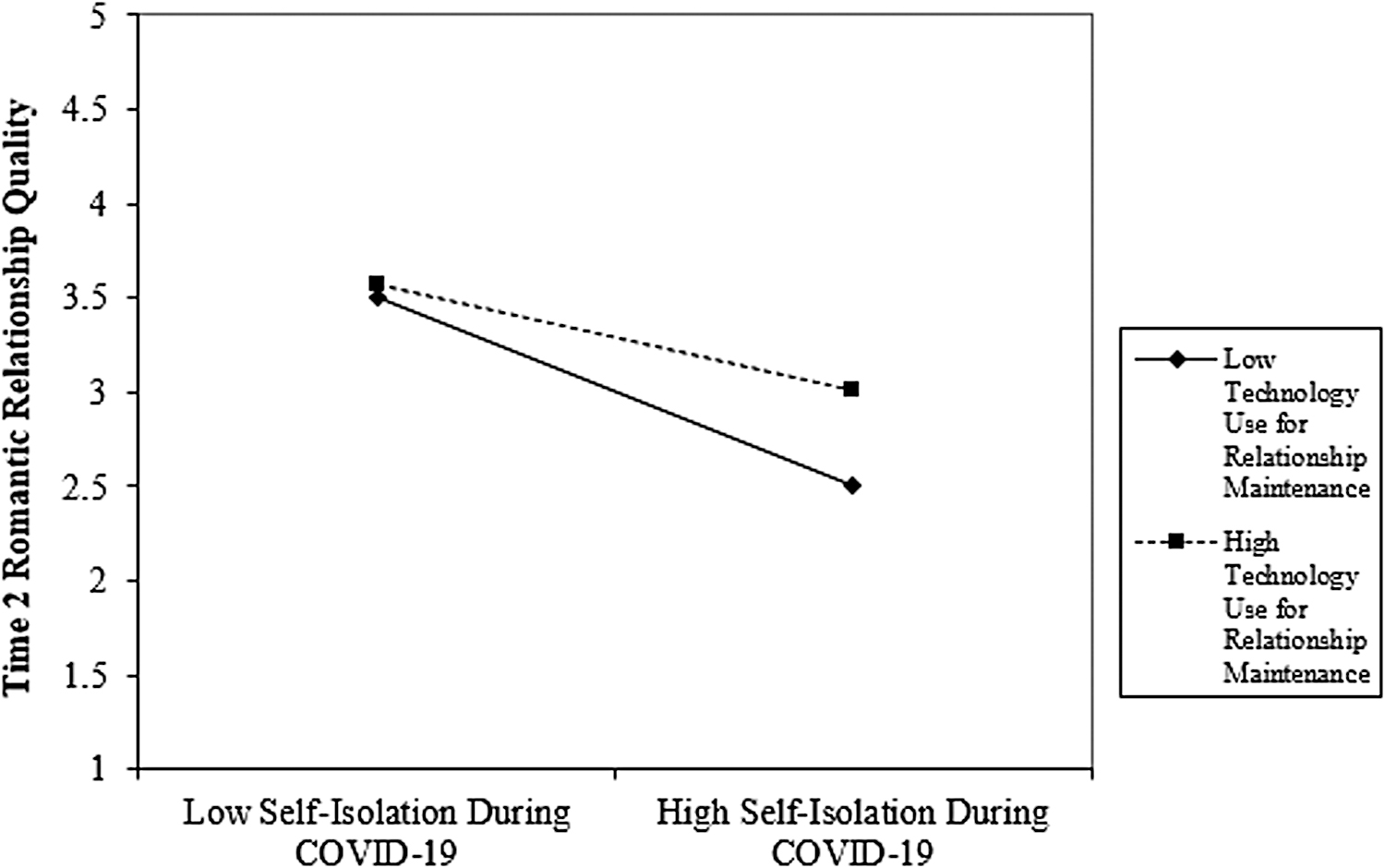
Graphical representation of the moderation of Time 2 technology use for relationship maintenance in the relationship between Time 2 self-isolation and Time 2 romantic relationship quality.
Discussion
The aim of this study was to investigate the relationships among self-isolation during the COVID-19 pandemic, technology use for romantic relationship maintenance, and romantic relationship quality, as well as to examine the moderation of technology use for romantic relationship maintenance in the association between self-isolation during the COVID-19 pandemic and romantic relationship quality, measured 7 months later.
Findings from the study revealed that self-isolation during the COVID-19 pandemic was related negatively to Time 2 romantic relationship quality (Hypothesis 2) and positively to technology use for romantic relationship maintenance (Hypothesis 1), while controlling for previous relationship quality 7 months earlier. Furthermore, technology use for romantic relationship maintenance moderated the associations between self-isolation during the COVID-19 pandemic and Time 2 romantic relationship quality, with lower use increasing the negative relationship and higher use diminishing the relationship (Hypothesis 3). The COVID-19 pandemic increases external stressors experienced by adolescents, which might disrupt their ability to cope effectively.4,13,14 This strain might hinder their relationships and subsequent relationship quality.11,12
Although it is safer for adolescents to avoid infection by self-isolating, researchers need to consider how isolation might influence adolescents' close relationships and determine whether other mechanisms might need to be implemented to protect against relationship disruption and dissolution, which could ultimately diminish adolescents' mental health. One way to mitigate issues in adolescents' close relationships, particularly their romantic relationships, is for them to utilize technology to stay connected with others. We found that technology use helped buffer against self-isolation during the COVID-19 pandemic and its impact on relationship quality. An important conclusion from our study is that the effect of external stressors brought about by the COVID-19 pandemic on romantic relationship quality might be diminished when adolescents utilize technology for maintaining their relationship.
We controlled for gender and ethnicity in this study and we did not find that it was a significant predictor of any of the study's variables. Gender and ethnicity were controlled because it is typically unrelated to relationship quality, with both men and women describing similar characteristics to represent positive relationship quality, 21 regardless of ethnicity as well. 24 Our findings are aligned with this research and indicate that adolescent boys and girls, no matter their ethnicity, reported similar levels of romantic relationship quality 7 months later.
Although not core to the focus of this study, we found no gender differences or ethnicity differences for self-isolation during the COVID-19 pandemic and technology use for romantic relationship maintenance. It is difficult to determine whether finding a lack of gender and ethnicity differences in self-isolation during the COVID-19 pandemic is consistent with the literature, because there is no research on this topic among adolescents. According to one poll, adult women and young people were more likely to self-isolate than adult men and older people and that minorities engaged in these practices more than nonminorities. 25 Our results do not align with these findings; however, adolescents are a younger segment of society and thus they might self-isolate at similar levels regardless of gender and ethnicity. It is unclear whether the finding regarding no gender and ethnicity differences in technology use for romantic relationship maintenance is consistent with previous literature. To explain this finding, the pandemic might trigger similar technology-related behaviors to maintain their romantic relationship for adolescents, regardless of gender or ethnicity.
Limitations and future directions
This study provides one of the first examinations of the impact of self-isolation during the COVID-19 pandemic on adolescents' romantic relationships. Despite such an important direction of the literature, there are some limitations that need to be discussed. First, the study relied on self-report, which are subject to biases. A possible future direction could be to also assess partners' rating of romantic relationship quality.
Second, the questionnaire on self-isolation during the COVID-19 pandemic needs some further development. Such development might also include asking adolescents about the stressors that have increased due to the pandemic. Another future direction of this research might explore the psychological or mental health consequences associated with self-isolation and how such consequences might impact adolescents' close relationships.
This research was underpowered to examine potential differences in the associations examined based on racial and ethnic background or sexual identity, and followup research should sample adolescents with these different backgrounds. A final suggestion for future research is to utilize Visual Sentiment Analysis to investigate how text messages and images between partners might trigger emotions and relate to relationship quality and satisfaction. 26
Conclusion
Results from this study revealed that high use of technology for romantic relationship maintenance reduced the negative relationship between self-isolation during the COVID-19 pandemic and romantic relationship quality, while low use increased the negative relationship. This study enhances our understanding of the contributors to romantic relationship quality among adolescents, and how such quality is influenced by societal crisis. Clinicians and researchers interested in understanding romantic relationship quality should also consider the role of technology and global crises. Additional research is needed to guide therapeutic interventions for adolescents affected by COVID-19.
Footnotes
Authors' Contributions
M.F.W. conceptualized the study, collected data, and wrote and edited the article. S.W. wrote, edited, and commented on the article.
Acknowledgment
The researchers want to thank the adolescents who participated in this research.
Author Disclosure Statement
No competing financial interests exist.
Funding Information
No funding was received for this article.