




Abstract
Virtual reality perspective-taking (VRPT) experiences effectively increase both empathy and prosocial behaviors toward related social targets (e.g., cutting down a tree in virtual reality increases concern for the environment). This project tests the prediction that empathy is analogous to a muscle that increases with practice and can transfer to unrelated contexts instead of being a mental state that increases only for a specific context or target. This study examines the extent to which VRPT experiences can train empathic skills that are applied to unrelated social targets and contexts. Two thirds of the participants engaged in VRPT experiences either showing what it is like to become homeless or how ocean acidification affects the marine environment. A third of the participants were in the control condition and did not complete a VRPT task. Results replicate previous findings showing that VRPT tasks increase related context empathy and prosocial behaviors; however, the results on VRPTs effect on empathy and prosocial behaviors for unrelated contexts were mixed. The VRPT ocean acidification task was more effective at inducing empathy for the homeless, an unrelated social target, than the control condition, but the empathy-transfer effect did not occur from the homeless context to the ocean context. Replicating previous work, participants who experienced what it is like to become homeless signed a petition supporting the homeless at significantly higher rates than participants in the control condition. These findings show that transfer of empathy from one context to another is possible, but this transfer does not occur for all contexts.
Introduction
Virtual reality (VR) enables users to experience narratives from a first-person perspective by embodying an avatar (i.e., a virtual representation of the user controlled by the user in real time) within a virtual environment.1,2 Virtual reality perspective-taking (VRPT) tasks specifically encourage users to experience someone else's perspective and are shown to be more effective at promoting empathy, improving attitudes, and increasing prosocial behaviors than less immersive perspective-taking tasks (e.g., watching a video or reading a narrative).3–6 Previous VRPT studies have asked participants to virtually take the perspective of people with schizophrenia 3 and the elderly. 4 Other studies have had people experience nature as users virtually transformed into animals 5 or cut down virtual trees. 6
VRPT tasks are able to enhance understanding of marginalized groups or abstract natural phenomena because of its affordances: embodiment, immersion, as well as geographical and temporal transportation.7–9 VRPT experiences can facilitate the sense of ownership and identification with an avatar even if the avatar is not similar to their corporal body, a phenomenon called body transfer. One of the techniques used to induce body transfer is visuo-motor synchrony, through which people experience synchrony between their physical movements and the movements of their virtual representation in real time.10–13
Prior research indicates that engaging in non-VRPT perspective-taking tasks, such as imagining the perspective of others, trains a person's empathic muscle (see Zaki 14 for a review). This implies that a person's capacity to feel empathic concern and act prosocially both within and outside the specific context of the perspective task increases. This argument is strengthened by Van Berkhout and Malouff's 15 meta-analysis of studies evaluating empathy trainings, which finds that these trainings are effective overall, with a medium effect size. The effectiveness of these non-VRPT empathy trainings allows for the prediction that perspective-taking tasks in VR should not only cultivate empathy for contexts directly related to the VR task but also for unrelated contexts.
This study examines to what extent VRPT-based empathy training fosters empathic skills that can be applied to a range of different contexts and targets. If VRPT empathy is transferable, as would be expected if VRPT tasks train participants' empathic muscle, participants should increase their level of empathic concern for people or entities unrelated to the particular VRPT task. To examine the effect of VRPT tasks on unrelated context empathy, an experiment compared the effects of two VRPT tasks relating to two sharply distinct issues (homelessness and ocean acidification) and a control condition.
Specifically, this study examines whether practicing the perspective-taking skills of participants by means of VR increases unrelated context empathy by testing the ability of the Becoming Homeless VR experience to contribute to increased concern for the marine environment, and the Stanford Ocean Acidification Experience VR experience to enhance positive attitudes toward the homeless. Since the building of skills may occur over time and may not be prevalent immediately after the training, 16 this study includes an additional measurement 2 weeks after exposure to the VRPT task or control condition. This study thus contributes to the handful of VR effects studies that obtain measurements one or more weeks after the intervention and in that way probe at the longer term effects.5–7,17
Materials and Methods
This study was approved by the Institutional Review Board at the University of Connecticut (Protocol #: H18-063).
Participants
An initial sample of 345 individuals was recruited from a medium-sized East Coast university in the United States, but only 275 participants completed all three parts of the study. Participants included in analysis (N = 275) consisted of 157 women and 118 men aged 18–35 years (M = 19.14, SD = 1.49).
Materials and apparatus
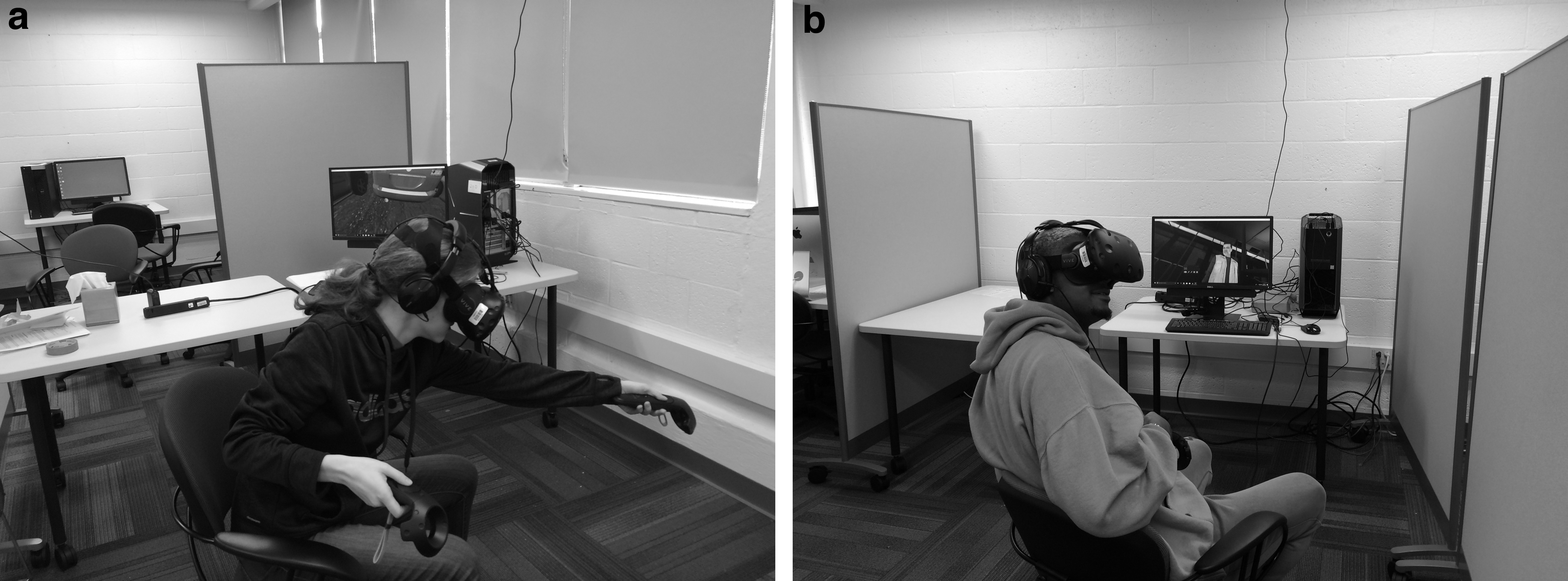
Participants in the VRPT conditions used the HTC Vive head-mounted display (HMD), hand controllers, and headphones (Fig. 1a, b), which had a resolution of 1080 × 1200 and an update rate of 90 Hz. An optical tracking system (Valve Lighthouse, update rate of 120 Hz) and three 6-degree of freedom sensors tracked participants' head position (x, y, z) and rotation (pitch, yaw, roll).
Both VRPT tasks were created in Stanford's Virtual Human Interaction Lab and specifically built for the purpose of generating empathy for the homeless and the marine environment, respectively. The VRPT task Becoming Homeless 18 consists of four scenes depicting what it is like to become homeless from the first-person perspective. Becoming Homeless has been shown to generate longer lasting positive attitudes as well as increases in prosocial behavior toward the homeless compared with video or imagination. 7 The Stanford Ocean Acidification Experience is an educational VR piece designed to raise awareness for ocean acidification and bring people closer to the natural environment. Markowitz et al. 19 used an early beta version of the Stanford Ocean Acidification Experience and reported an increase in pro-environmental attitudes after participants completed the VRPT task.
These two VRPT experiences take around 10 minutes to complete, which is the recommended amount of time for consuming VR that enables a high impact of the narrative and reduces discomfort [see chapter two of Bailenson, 20 for a review]. Furthermore, they both could be done while in a seated position but also required people to look around and physically engage with the stimuli using the hand controllers that were visible to them as avatar hands. This enabled a level of interactivity and embodiment that not all VRPT tasks require.
Design and procedure
This study was conducted in three phases. All participants signed the consent form, filled out a prequestionnaire 1 week before the treatment (Time 0), a laboratory experience, and a postquestionnaire immediately after the treatment (Time 1), and an additional questionnaire 2 weeks after the treatment (Time 2). Participants were randomly assigned to one of three conditions when they arrived in the laboratory: (a) Becoming Homeless (BH; n = 97), (b) Ocean Experience (OE; n = 100), and (c) Control (n = 78).
Those in VRPT conditions were fitted with the HMD and completed the either the Stanford Ocean Acidification Experience or the Becoming Homeless VR experience. After they completed the VRPT task, they completed a postquestionnaire. Two weeks after participants' laboratory visit, they completed a second postquestionnaire online.
Participants in the Control condition came to the laboratory and were asked to wait in a room for 10 minutes instead of doing a VRPT task. They were allowed to use their phones while they waited. After the 10 minutes passed, participants completed the postquestionnaire, and 2 weeks later, they completed the delayed post-test. All participants were debriefed upon completion of the second postquestionnaire.
Measuresa
Inclusion of Other in Self
The Inclusion of Other in Self (IOS) scale (adapted from Aron et al. 21 ) depicts a series of increasingly overlapping circles representing the self-overlapping with the ocean and the self-overlapping with a homeless individual. Participants chose the overlapping circles they deemed the best reflection of how close they considered themselves to be to the target.
Empathy
There were two versions of the empathy scale filled out by all participants (adapted from Batson et al. 22 ). Participants rated the extent to which they felt softhearted, touched, sympathetic, or compassionate toward the homeless and toward the current state of the ocean.
Attitudes and connectedness
Fourteen items were adapted from Batson et al. 23 to assess participants' attitudes toward the homeless and connectedness to the environment (i.e., “I think of the natural world as a community to which you belong”).
Petition agreement and signing
Participants were asked about the extent to which they agreed with either Proposition H (a petition supporting affordable housing adapted from Herrera et al. 7 ) or Proposition C (a petition supporting the implementation of an emissions tax) at Time 1. Moreover, all participants were also asked whether or not they would like to sign a petition supporting both propositions.
Results
Means and standard deviations of all dependent variables by condition are shown in Table 1. All continuous outcome variables were analyzed using a linear growth curve model with fixed effect of condition and random effect of individuals. 24 The analysis included two orthogonal planned contrasts. First, the effect of participating in either VRPT task (i.e., the BH and OE conditions) was compared with the Control condition. Second, the effects of participating in the BH condition were compared with the OE condition.
Means and Standard Deviations Over Time per Condition
IOS, Inclusion of Other in Self; VRPT, virtual reality perspective-taking.
Inclusion of Other in Self
Results indicate that there was no significant difference in IOS Homeless scores at Time 0 regardless of condition [b = 0.02, t(275) = 0.27, p = 0.786], indicating that participants across the conditions felt similar levels of closeness with the homeless population. However, there was a significant main effect of time such that participants indicated higher IOS Homeless scores over the course of 3 weeks regardless of condition [b = 0.2, t(275) = 8.31, p < 0.001]. Results from the first planned contrast revealed that there was no significant difference between the VRPT conditions and Control condition [b = −0.01, t(275) = −0.98, p = 0.326] on IOS Homeless over time. The second planned contrast revealed that there was a significant interaction effect of condition and time with participants in the BH condition reporting significantly higher IOS Homeless scores over the course of 3 weeks compared with participants in the OE condition [b = 0.11, t(275) = 3.61, p < 0.001], indicating that participants in the BH condition not only felt significantly closer with the homeless after the task but also continued to feel closer to the homeless over time (Fig. 2). While all participants reported increasing IOS Homeless over time, the participants in the BH condition indicated significantly higher levels of IOS Homeless, which is in line with a related context empathy effect of the Homeless VRPT task.
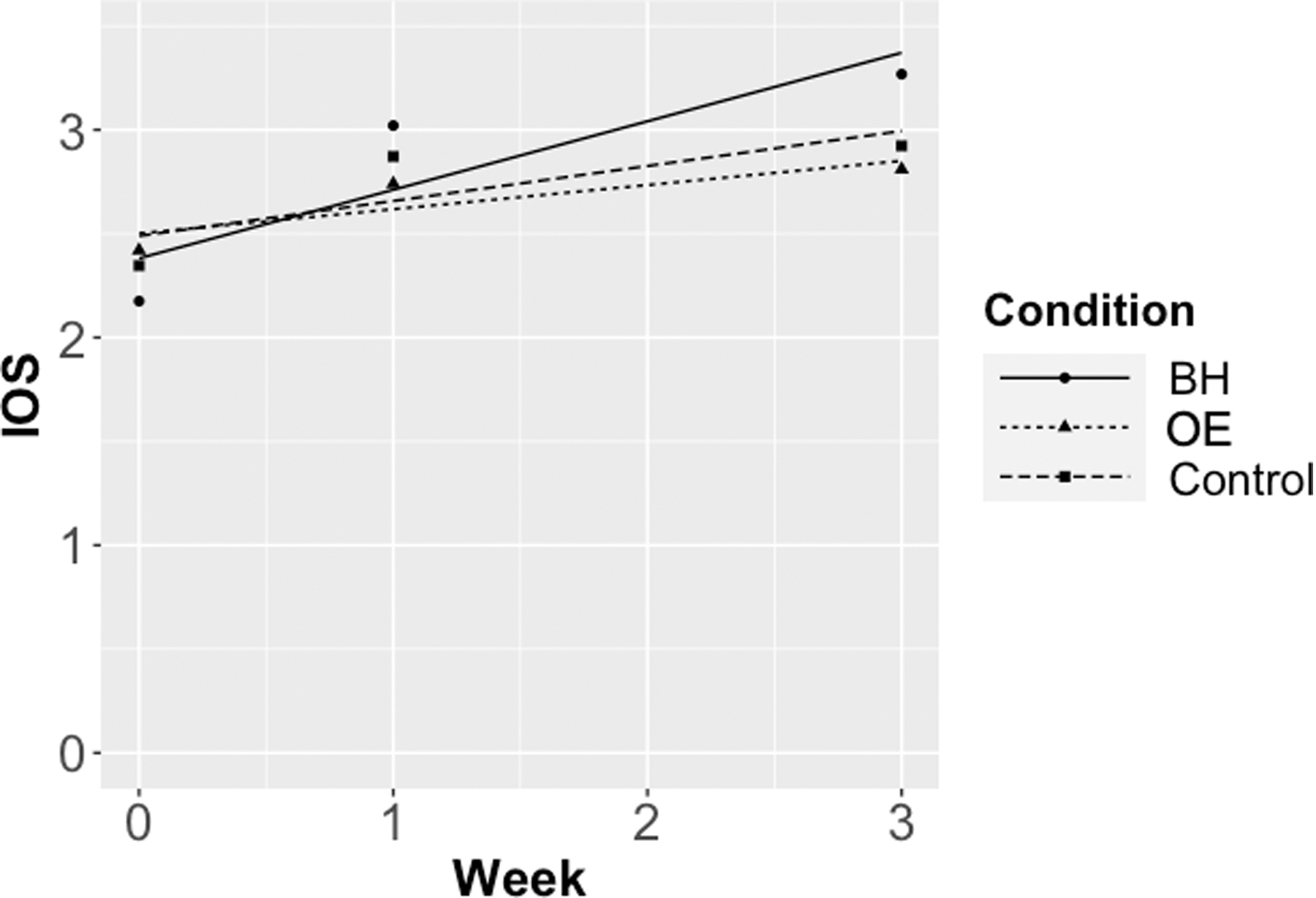
IOS scores associated with the homeless over time by condition. Week 0 refers to the prequestionnaire participants filled out 1 week before the treatment. Week 1 refers to a postquestionnaire directly after the treatment. Week 3 refers to an additional questionnaire 2 weeks after the treatment. BH, Becoming Homeless; OE, Ocean Experience; IOS, Inclusion of Other in Self.
Regarding perceived IOS Coral, or closeness with the environment, there was no significant difference across conditions at Time 0 [b = 0.02, t(275) = 0.31, p = 0.761]. However, there was a significant main effect of time [b = 0.11, t(275) = 4.92, p < 0.001], indicating that over the course of 3 weeks, participants felt closer to the environment regardless of condition. The first planned contrast revealed that there was a marginally significant interaction effect of condition and time with participants in the Control condition reporting feeling less IOS Coral than participants in the VRPT conditions [b = −0.03, t(275) = −1.69, p = 0.092]. The second planned contrast showed that there was a significant interaction effect between condition and time between the VRPT conditions [b = −0.06, t(275) = −2.06, p = 0.04], such that participants in the OE condition report higher IOS Coral scores over time compared with participants in the BH condition (Fig. 3). Whereas all participants felt more IOS Coral over time, this effect was particularly pronounced for participants in the OE condition, which confirms a strong related context effect for the Ocean VRPT task.

IOS scores associated with the environment by condition. Week 0 refers to the prequestionnaire participants filled out 1 week before the treatment. Week 1 refers to a postquestionnaire directly after the treatment. Week 3 refers to an additional questionnaire 2 weeks after the treatment.
Empathy homeless
Results showed that there was no significant main effect of condition [b = −0.05, t(275) = −0.91, p = 0.362] or time [b = −0.004, t(275) = −0.23, p = 0.822], indicating that participants across conditions felt similar levels of empathy toward the homeless (Fig. 4). However, the first planned contrast revealed that there was a significant interaction effect of condition and time such that participants in the VRPT conditions (i.e., BH and OE conditions) reported higher empathy scores associated with the homeless than participants in the Control condition [b = −0.03, t(275) = −2.24, p = 0.026]. There was no significant interaction effect of condition and time between the VRPT conditions [b = −0.001, t(275) = −0.05, p = 0.964] (Fig. 4). Since participants in both VRPT conditions showed an increase in empathy toward the homeless as opposed to the Control condition, and no significant differences between the VRPT conditions emerged, this result provides support for the unrelated context empathy building effect of the Ocean VRPT task.
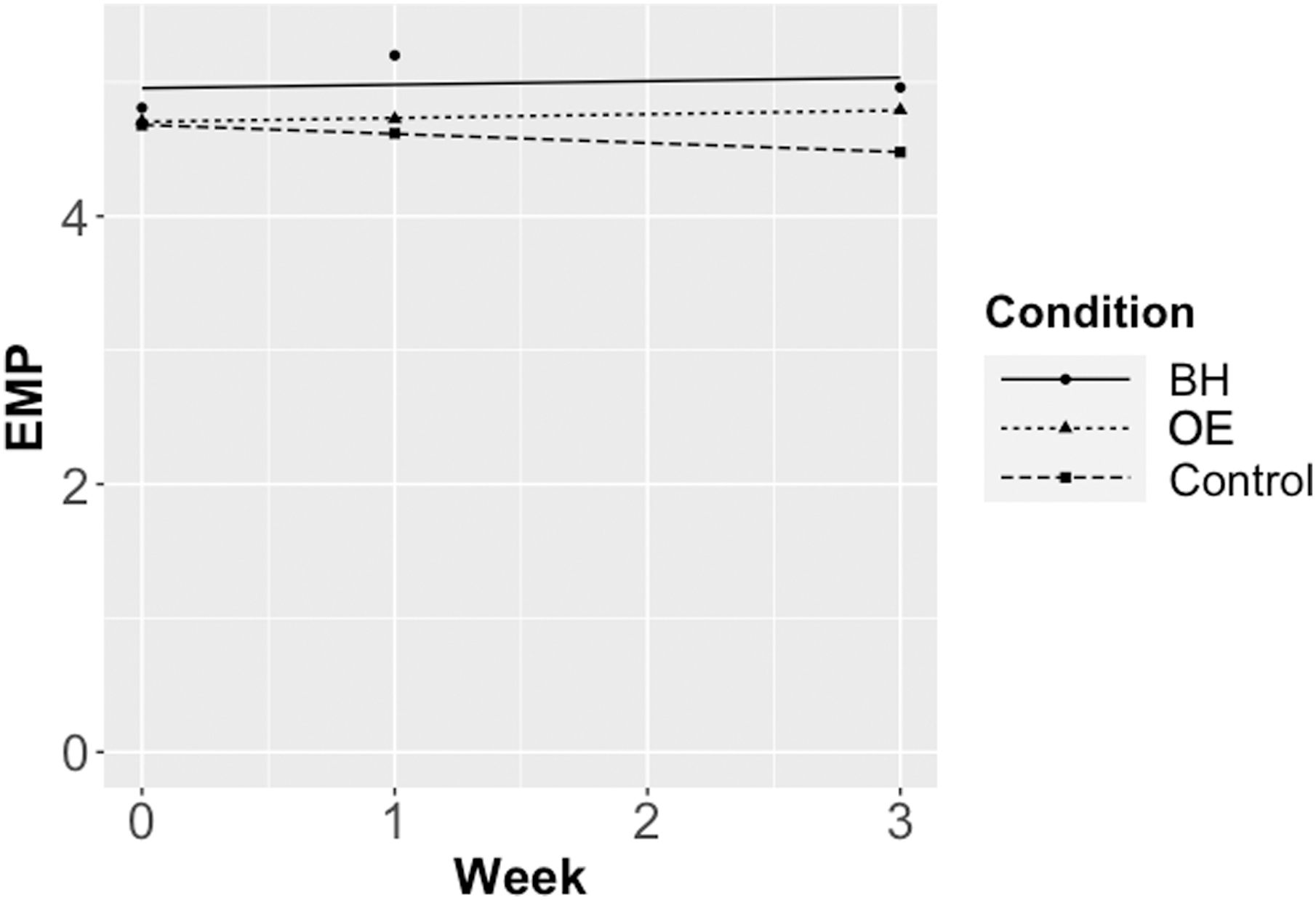
Empathy scores (EMP) toward the homeless scores over time by condition. Week 0 refers to the prequestionnaire participants filled out 1 week before the treatment. Week 1 refers to a postquestionnaire directly after the treatment. Week 3 refers to an additional questionnaire 2 weeks after the treatment.
Empathy coral
Results showed that there was no significant main effect of condition [b = −0.04, t(275) = −0.63, p = 0.528] or time [b = −0.02, t(275) = 0.72, p = 0.472]. However, the first planned contrast revealed that there was a significant interaction effect of condition and time such that participants in the VRPT conditions (i.e., BH and OE conditions) reported higher empathy scores toward the ocean than participants in the Control condition [b = −0.04, t(275) = −1.98, p = 0.049]. There was also a significant interaction effect of condition and time between the VRPT conditions [b = −0.11, t(275) = −3.53, p < 0.001], such that participants in the OE condition report higher empathy scores toward the coral reefs over time compared with the BH condition (Fig. 5). This result shows a strong related context empathy effect for the Ocean VRPT task.

Empathy scores (EMP) toward the environment scores over time by condition. Week 0 refers to the prequestionnaire participants filled out 1 week before the treatment. Week 1 refers to a postquestionnaire directly after the treatment. Week 3 refers to an additional questionnaire 2 weeks after the treatment.
Attitudes and connectedness
Results showed that there was no significant main effect of time [b = −0.02, t(275) = −1.21, p = 0.227] or condition [b = −0.04, t(275) = −0.82, p = 0.412] regarding attitudes to the homeless. The first planned contrasts showed that there was a significant interaction effect of condition and time, as participants in the VRPT conditions reported improved attitudes toward the homeless compared with the Control condition [b = −0.04, t(275) = −3.55, p < 0.001]. Results also showed that participants in the BH condition developed more positive attitudes toward the homeless than participants in the OE condition over time [b = 0.07, t(275) = 4.24, p < 0.001] (Fig. 6). These results support a strong related context empathy effect for the Homeless VRPT task. There were no significant differences between conditions regarding connectedness to nature.
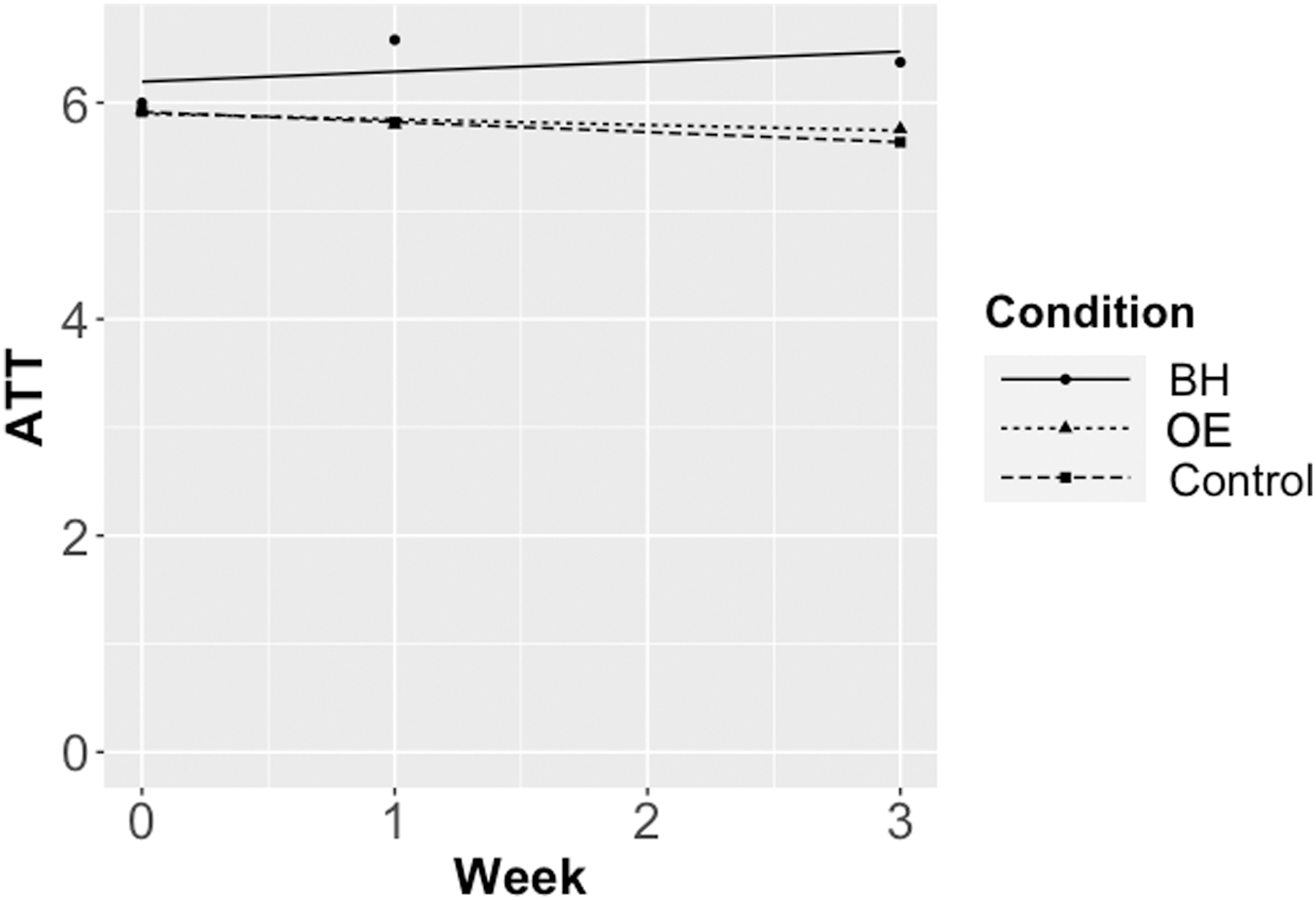
Attitudes (ATT) toward the homeless scores over time by condition. Week 0 refers to the prequestionnaire participants filled out 1 week before the treatment. Week 1 refers to a postquestionnaire directly after the treatment. Week 3 refers to an additional questionnaire 2 weeks after the treatment.
Agreement and signing of Proposition H and C
A significantly higher proportion of the participants in the BH condition signed a petition in support for Proposition H than the participants in the Control condition (Fisher's exact test: p = 0.01). Even though a higher proportion of participants in the BH condition signed the petition for Proposition H (66 percent) than those in the OE condition (56 percent), this difference was not significant. There were no significant differences between conditions in signing the petition for Proposition C, nor were there significant findings when comparing participants' agreement with either petition.
Discussion
The results replicate prior research that shows the effectiveness of VRPT at improving related context empathy,3–5,7 but the results on the empathy-transfer effect were mixed. In support of the transfer effect, participants in the VRPT conditions reported significantly more empathy toward the homeless than those in the control condition over time, while no significant difference between the VRPT conditions existed. This indicates that the Ocean VRPT condition was more effective in generating empathy for the homeless than participants in the control condition, while not significantly less effective than the relevant context Homeless VRPT condition. These findings provide some initial support for the ability of the Ocean VRPT task to train participants' empathic muscle, as participants in the Ocean VRPT condition are increasingly likely to empathize with targets from an unrelated context, in this case the homeless.
Nonetheless, the other measures only reveal context relevant effects. Participants in the Homeless VRPT condition developed significantly better attitudes for the homeless and felt significantly closer to the homeless (IOS Homeless) than those in the Ocean VRPT or control condition. In addition, participants in the Ocean VRPT condition reported significantly higher levels of empathy for coral reefs, felt more connectedness toward nature, and felt closer to the environment (IOS Coral) than those in either the Homeless VRPT or control condition. These results confirm the related context empathy effect found in previous studies3–5,7 and do not provide support for a possible transferable empathy effect.
This study thus provides tentative evidence that VRPT experiences in which people take the perspective of abstract natural phenomena foster not only related context empathy but unrelated context empathy as well. In contrast, VRPT tasks that generate empathy for human social targets do not transfer to nonhuman entities. Future research should investigate the extent to which empathy with nature and categories of people are different empathic processes and explore the boundary conditions of each. While this study finds that the Homeless VRPT task does not extend from the homeless to abstract nonhuman entities, it is possible that empathy induced from this experience might transfer to marginalized social groups such as (ex-)convicts, disabled individuals, or immigrants. However, future research is needed to confirm this hypothesis.
Some limitations of this study are the limited longitudinal duration and the single exposure to the VRPT task. Future studies could uncover at what point in time the IOS and empathy scores that increased over time in this study would decrease or stabilize. Furthermore, it may be worthwhile to increase and manipulate the number of exposures to the VRPT task in future studies, especially considering Banakou et al.'s 17 mixed results regarding the effect of multiple VRPT exposures on implicit bias. Another direction for future research is to explore to what extent the “gamification” aspect of VR experiences influences the empathic process. Some scholars argue that perceiving the experience as a “game” diminishes the participants' ability to empathize with the people depicted, 25 whereas others claim that taking the perspective of others by means of play should elicit empathy.26,27
All in all, this study provides tentative evidence that learning about ocean acidification in VR can increase empathy for an unrelated target, namely the homeless. This suggests that in some cases, the mere practice of perspective-taking in VR can train one's empathic muscle, in line with the efficacy of empathy trainings mentioned above.14,15 The implications for VR content designers that aim to generate empathic concern for a particular social target may be that any VR experience that rehearses perspective-taking could be helpful, regardless of the specific perspective that is taken.
Footnotes
Authors' Contributions
M.M.: analyzing and interpreting results, writing up of article. F.H.: conceiving and designing the study, analyzing and interpreting the results, writing up of article. K.N.: conceiving and designing the study, interpreting the results, editing article, collecting data. J.B.: conceiving and designing the study, interpreting the results, editing article.
Notes
Author Disclosure Statement
No competing financial interests exist.
Funding Information
This research was funded in part by NSF Award Number 1906728.

References
Supplementary Material
Please find the following supplemental material available below.
For Open Access articles published under a Creative Commons License, all supplemental material carries the same license as the article it is associated with.
For non-Open Access articles published, all supplemental material carries a non-exclusive license, and permission requests for re-use of supplemental material or any part of supplemental material shall be sent directly to the copyright owner as specified in the copyright notice associated with the article.
