




Abstract
The aim of this study was to determine the social profile of individuals who are most at risk of engaging in risky social media challenges (RSMCs). Young adults (N = 331, 56.3 percent female) aged 18–25 years (Mage = 21.4) completed an online survey in which they indicated which RSMCs they had done (e.g., Cinnamon Challenge, Fire Challenge), and completed measures of social motives (i.e., need to belong, need for popularity, and fear of missing out [FoMO]) and perceived social status (i.e., popularity and peer belonging). Results demonstrated that almost half (48.3 percent) of participants had engaged in at least one RSMC. Furthermore, findings from a latent-class analysis revealed a three-class solution. Participants in Class 1 (stable social position, low social motives) had moderate-to-high probabilities for perceived popularity and peer belonging, but low probabilities for all three social motives. Participants in Class 2 (high perceived popularity and related concerns) had the highest probability for perceived popularity, need to be popular, and FoMO, and participants in Class 3 (high need to belong) had the highest probability for need to belong, but the lowest probabilities for need to be popular and perceived popularity. Although results differed somewhat by gender, overall, and in line with hypotheses, participants in Class 2 (high perceived popularity and related concerns) were most at risk for engagement in RSMCs. Thus, results suggest that engagement in RSMCs may be more about standing out and gaining online popularity and attention than about fitting in with peers. These findings contribute to a larger conversation about the provision of popularity markers on social media (likes, views) and their ability to shape young people's behavior.
Introduction
Social media challenges involve recording and uploading videos of oneself engaging in a specific behavior and then nominating others to do so. Some challenges possess positive underlying intentions and are relatively safe (e.g., the ALS ice bucket challenge), yet many others involve health-risk behavior (e.g., the Cinnamon Challenge: ingesting a tablespoon of cinnamon without liquids; the Tide Pod Challenge: ingesting a Tide Pod, containing chemicals; and the Kiki Challenge: dancing beside a moving vehicle). Videos of young people engaging in risky social media challenges (RSMCs) have received millions of views on social networking sites (SNSs) such as YouTube, and have resulted in serious health consequences including aspiration, poisoning, motor vehicle accidents, and even death.1–3
With the onset of the COVID-19 pandemic, time on SNSs and video uploads among young people have increased. 4 Furthermore, new RSMCs continue to emerge, with some encouraging behaviors that may result in contracting the COVID-19 virus. 5 Thus, to address this timely issue and design prevention efforts, it is crucial to understand the type of young person who is most susceptible to engaging in RSMCs.
Prior research suggests that young adults' engagement in health-risk behaviors is predicted by social motives, including their need to belong, 6 their need for popularity, 7 and their fear of missing out (FoMO; a fear that others are having a relatively more rewarding experience) 8 as well as their perceived social standing in the peer network, including their perceived popularity and sense of belonging among peers. Young adults classified by a weaker sense of peer belonging, a stronger need to belong, and/or a greater sense of FoMO may be at a greater risk for participating in RSMCs, potentially to demonstrate their adherence to peer group norms or to ensure they are not “missing out.” Furthermore, self-reported popularity and need for popularity are consistently linked to risk behaviors, which are used to communicate one's coolness to peers.9,10 Moreover, a primary reason for uploading content to SNSs is to attract views and likes, which are a measure of online popularity. 11
That being said, there is evidence to suggest these social motives and standing combine to predict young people's risk behavior and thus should not be examined within a vacuum (e.g., as independent effects only). For instance, in one study, peer influence on substance use was most powerful among emerging adults with high perceived popularity and a strong sense of peer belonging. 12 In another study, higher perceived popularity predicted increased substance use, but only when need for popularity was also high. 7 There is also evidence to suggest that need for popularity, need for belonging, and FoMO combine to predict social media use behaviors. 13 Thus, to identify young adults at greatest risk of participating in RSMCs, it is crucial to examine classes of young individuals who share common social motives and standings in the peer context.
In this study, we relied on latent class analysis (LCA) to examine patterns of social motives and standings in the peer context (perceived popularity, peer belonging, need to be popular, need to belong, and FoMO) among young adults. We further tested a model to examine how the emergent classes predict RSMC engagement using latent class regression. We hypothesized that the class with stronger popularity-related variables will be most at risk of engaging in RSMCs.
Methods
Participants and procedure
Ethics was obtained by the lead authors' University Ethics Board. Young adults (18–25 years; from the United States and Canada) were recruited through Amazon Mechanical Turk to complete an online survey. The survey first contained the Letter of Information, and only those who consented to participate were directed to the survey questions. Data from four individuals were removed because they failed to correctly answer validation questions (e.g., “please select the ‘strongly agree’ option”), resulting in a sample size of 331 (Mage = 21.4, SD = 1.5; 56.3 percent female, 41.9 percent male, and 1.8 percent other, including transgendered/gender fluid). The majority of participants identified as White/European (66.6 percent), followed by Black North American/African (12.3 percent), Asian (13.0 percent), Latino (6.3 percent), and 1.8 percent identified as another ethnicity.
Measures
Social standing and motives
Five scales assessed social standing—perceived popularity, peer belonging—and social motives—need to belong, need to be popular, and FoMO. Scale details are given in Table 1.
Variables Included in Latent Classes
Engagement in RSMCs
The following definition of RSMCs was presented: “Online challenges refer to challenges that you record yourself doing and upload the videos online; they are considered risky if you are putting yourself in a position that could potentially result in physical harm or even death (for example, posting a video of yourself ingesting a tide pod, which contains harmful chemicals).” Participants selected from an inventory (Table 2) all the RSMCs in which they have engaged. Participants were also asked to list all their other RSMCs not already presented. The total number of different RSMCs was tallied.
Inventory of Risky Social Media Challenges
Number of disregarded nominations
Participants recorded the number of times they had been nominated for an RSMC they did not complete. This was included as a covariate.
Sensation seeking
Using a 4-point Likert scale, participants completed the four-item sensation seeking subscale of the Short UPPS-P Impulsivity Behavior Scale, 14 used as a covariate (e.g., “I welcome new and exciting experiences and sensations, even if they are a little frightening and unconventional”;α = 0.77).
Analytic plan
We conducted LCA using Mplus 8.3, 15 which identifies sample heterogeneity and groups participants based on probability of item/construct endorsement. Construct endorsement for our five social standing/motive variables of interest was defined as an average score equating to agreeance (see Table 1, column 5 for details on all variables).
We fit a series of models with one to four classes, using model fit statistics (Table 3) to determine the appropriate number of classes. Next, we conducted a latent class regression to examine whether class membership predicts RSMC involvement, while controlling for covariates: gender (male as reference group), ethnicity (non-White as reference group), disregarded RSMC nominations, and sensation seeking. Finally, we conducted a multigroup latent class regression to examine potential gender differences.
Model Fit Indexes for Latent Class Analysis
Note: To determine the appropriate number of classes for our data, we relied on observed decreases in −2LL, AIC, BIC, and the sample size aBIC. We also examined the Lo–Mendell–Rubin adjusted LRT and the BLRT, which determines whether a k − 1 class solution provides a better fit to the data.
Bold: best fitting model.
−2LL, negative two log likelihood; AIC, Akaike Information Criteria; BIC, Bayesian Information Criteria; aBIC, adjusted Bayesian Information Criteria; BLRT, bootstrapped likelihood ratio test; LRT, likelihood ratio test.
Results
Class enumeration
Table 3 gives model fit statistics. Although the lowest −2LL and aBIC were found for the four-class solution, the three-class solution possessed the lowest AIC and highest entrophy score (i.e., distinctiveness between groups). Furthermore, the likelihood ratio test and bootstrapped likelihood ratio test values were significant for the three-class but not for the four-class solution. Thus, we chose the three-class solution (Fig. 1).
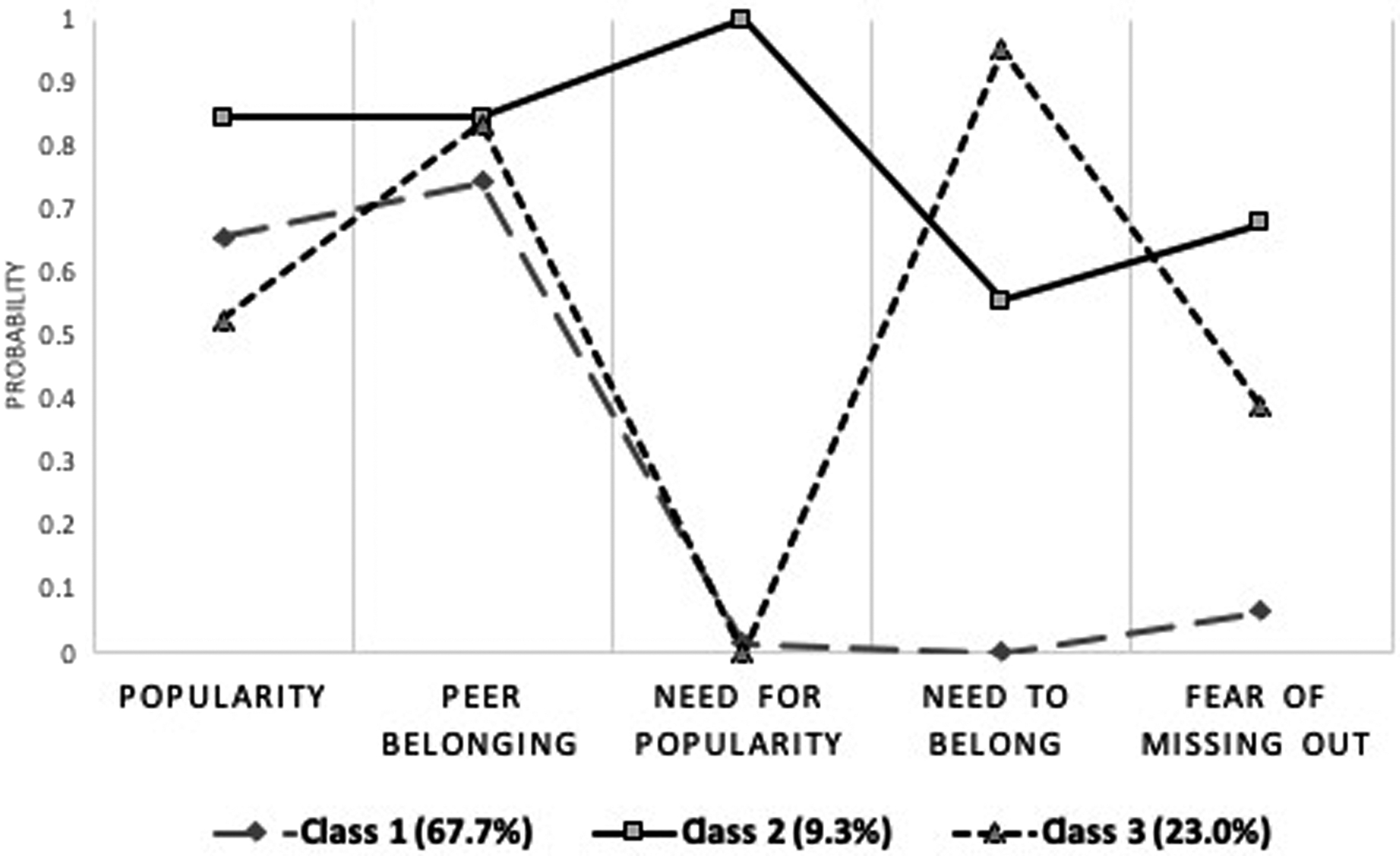
Item probability plot. Class 1 (stable social position, low social motives): 67.7 percent (n = 227). Class 2 (high perceived popularity and related concerns): 9.3 percent (n = 32). Class 3 (high need to belong): 23.0 percent (n = 72).
Engagement in RSMCs
Almost half (48.3 percent) of participants had engaged in at least one risky challenge. A two-factor analysis of variance revealed no significant gender [F(1, 327) = 0.91, p = 0.34] or ethnicity differences [F(1, 327) = 1.12, p = 0.29] in RSMCs.
Predicting engagement in RSMCs
For our latent class regression, we first chose Class 2 (high perceived popularity and related concerns) as the reference group, in line with our hypothesis. Youth in both Classes 1 (stable social position, low social motives) and 3 (high need to belong) had 21 percent lower engagement in RSMCs (B = −0.21, standard error [SE] = 0.09, p < 0.01 for both comparisons) than youth in Class 2 (see Table 4, Model 1). A second latent class regression with Class 3 as the reference group revealed no significant differences in engagement in RSMCs between Classes 1 and 3 (B = 0.03, SE = 0.06, p = 0.61). Number of disregarded nominations was the only covariate to significantly predict RSMC engagement (see Table 4, Model 1).
Linear Regressions Predicting Frequency of Engagement in Risky Online Challenges
Note: Reference category was Class 2, for gender it was male, for race it was non-White.
Bold: p < .01.
RSMC, risky social media challenge; SE, standard error.
Gender differences
The multigroup latent class regression with Class 2 (high perceived popularity and related concerns) as the reference group indicated that young women in Class 1 (stable social position, low social motives) and Class 2 did not differ significantly in RSMCs. Women in Class 3 (high need to belong), however, had 24 percent lower engagement in RSMCs than young women in Class 2, with results reaching significance (B = −0.24, SE = 0.13, p = 0.05). For young men, those in Class 1 (stable social position, low social motives) had 29 percent lower engagement in RSMCs than their counterparts in Class 2. Furthermore, in contrast to findings with the overall sample, young men in Class 2 and Class 3 did not differ in their RSMCs.
Discussion
Results demonstrated that 48 percent of emerging adults have engaged in RSMCs. As hypothesized, the class of participants characterized by high perceived popularity, popularity-related concerns, including FoMO, was most likely to have engaged in RSMCs, even after controlling for other predictors of risky behavior, including sensation seeking. This is consistent with research suggesting that popularity and motivations to achieve and maintain popularity are associated with risk behavior7,9,10; however, our findings provide a more nuanced understanding of how young adults' social profiles predict risky online behavior.
In the full sample and in our gender-specific analyses with females, the high perceived popularity and popularity-related concerns class engaged in significantly more RSMCs than the strong need to belong class. Presumably, the former class might also engage in more RSMCs as a way to fit in with peers, however, this was not the case, given no significant differences from the low social motives (need to belong and be popular) class. This suggests that engagement in RSMCs may be more about standing out than about fitting in. Indeed, a main reason for uploading content to SNSs is to attract attention. 11 By uploading more dangerous content, young people can increase the likelihood of desired attention and popularity.
Interestingly, among males only, participants in the high perceived popularity and popularity-related concerns class were more likely to engage in RSMCs than the low social motives class, but they did not differ from the strong need to belong class. Possibly more physically risky and destructive behaviors tend to be perceived as more normative and even encouraged among young males as opposed to young females.16,17 In contrast, females in the strong need to belong class may have been wary about engaging in RSMCs as they may actually hinder their attempts to fit in.
Limitations of this study include the correlational and cross-sectional nature of our data and use of self-reports that may have resulted in under-reporting engagement in RSMCs or desire to fit in and be popular. In addition, Mechanical Turk samples have been shown to be slightly less representative of the general population than national polls and probability samples; however, they are significantly more representative than standard university samples. 18
Limitations notwithstanding, these results have important implications for preventative efforts. Viewing, liking, or commenting on videos of RSMCs may have a powerful reinforcing effect given their social value. The social media site Instagram has recently experimented with the removal of visible “like” tallies to decrease competitive pressure. It is unclear whether this change has influenced individuals' attention-seeking behavior. However, it is critical to emphasize that all social media users play a role in reinforcing or dissuading specific content, including content, such as RSMCs, that can contribute to negative health outcomes.
Footnotes
Author Disclosure Statement
No competing financial interests exist.
Funding Information
No funding was received for this article.