




Abstract
Previous research on cyberbullying has focused almost entirely on examining its prevalence among dominant ethnic populations, leaving it unclear how common cyberbullying is among indigenous peoples. Our study draws on a large sample of Māori adults aged 18–83 years (n = 6,529) who completed the questionnaire-based Māori Identity and Financial Attitudes Study in 2017. We analyzed reports of cyberbullying according to demographic characteristics, namely gender, age, sexual orientation, and multiple ethnic affiliations. On average, 19.3 percent of participants reported ever experiencing cyberbullying, and 4.1 percent reported experiencing cyberbullying within the past month. Young adults (aged 18–25) experienced the most, and incidences progressively declined among older cohorts. Women and those identifying as a minority sexual orientation reported higher rates of cyberbullying than men and heterosexuals. Those identifying as Māori as one of their multiple ethnicities reported higher rates of cyberbullying than those who identified as Māori only. Together, these findings provide a detailed investigation of the prevalence of cyberbullying in a large national indigenous sample. Previous data show that cyberbullying is common among adolescents and adults in New Zealand; however, our data indicate an even higher prevalence among the Māori. Practical and theoretical implications are discussed in light of Māori mental health outcomes.
Introduction
Bullying through electronic means, or cyberbullying, has been defined as intentionally aggressive behavior 1 via digital communications such as e-mail, social media, or texting, 2 including written–verbal acts (e.g., name-calling), visual acts (e.g., posting embarrassing videos), exclusion, impersonation, and ridicule. 3 In this study, cyberbullying refers to a broader concept also encompassing the various negative behaviors of cyberbullying and cyber aggression. 4 Cyber victimization refers to online aggression targeting individuals or groups. 5
International research has linked cyberbullying with a range of negative mental health outcomes, occasioning distress, frustration, anxiety, and depression,6,7 suicidal ideation, and self-harm. 8 Burgeoning research on cyberbullying's incidences and impacts concentrates on adolescents and young adults from dominant populations, largely white and middle class.9–11 In the 90 articles on adults published between 2004 and 2016, 12 over 70 percent reported data from college students, and 61 percent of the studies originated from the United States.
Psychological science itself is criticized for bias toward American college samples and “Western, educated, industrialized, rich, and democratic (WEIRD)” populations.13,14 Indigenous people's experiences are seldom visible in psychological research,15,16 and there has been very little research on cyberbullying among indigenous peoples globally. We located only a handful of studies that included indigenous youth and adolescents.17–20 The only large-sample published study on cyberbullying we located (that isolated data for indigenous adults) was drawn from the New Zealand Attitudes and Values Study (NZAVS), which is a longitudinal national probability survey of New Zealanders' social attitudes, personality, and health outcomes. Drawing on NZAVS data, Wang et al. 21 investigated the relationship between reported rates of cyberbullying and two demographic factors (age and gender). Data from 20,849 participants aged 18+ were analyzed, including data from 2,481 Māori respondents. The current article extends Wang et al.'s research using a much larger sample of Māori and examining a broader range of demographic factors. Essentially, we ask how rates of cyberbullying among the Māori vary according to gender, age, sexual orientation, and multiple ethnic affiliations (i.e., identification as Māori and at least one other ethnic group). Next, after backgrounding Māori sociohistorical context, we review literature on demographic correlates of cyberbullying (noting gaps) before detailing our methods and results and presenting a discussion.
Literature review: New Zealand—a sociohistorical context
Formally colonized by Britain since 1840 and rapidly marginalized, the Māori are now New Zealand's largest ethnic minority at 16.5 percent of the 2018 population, behind heavily culturally dominant European New Zealanders (“Pākehā,” 71.76 percent). 22 Māori disadvantages vis-à-vis Pākehā include socioeconomic deprivation, high rates of discrimination, and poorer health and well-being outcomes. Mental health statistics is particularly dire for the Māori. For example, Māori adults are 1.5 times as likely as non-Māori (mainly Pākehā) adults to report a high or very high probability of having an anxiety or depressive disorder. Suicide and intentional self-harm are also much higher in the Māori population, 23 with Māori males committing suicide at nearly twice the rate of non-Māori males in New Zealand.
Māori rates of Internet access have historically been lower than Pākehā, although data suggest the “digital divide” may be closing.24,25 Whereas in 2015, 83 percent of all, and 68 percent of Māori, households had Internet access, a 2019 study of digital inclusion and well-being 26 found that 85.05 percent of Māori versus 90.98 percent of Pākehā students reported having home Internet access. Based on the OECD's Programme for International Student Assessment (PISA) survey, on average, 15 percent of New Zealand 15-year olds used the Internet for over 6 hours each weekday outside school. However, these data also revealed that Internet use outside of school for over 6 hours per day (on weekdays and weekends) is most predominant among Māori students: 27 percent of Māori students report using the Internet outside of school on weekdays for over 6 hours per day, with this rate rising to 32 percent on weekends. In particular, in 2015, social media were frequented by over 70 percent of Māori youth and adult Internet users.27,28
Drivers for high Māori social media participation may include connecting with far-flung families to preserve traditional whānau (extended-family) ties, letting users share, learn, and express cultural knowledge. 29 However, online interaction carries risks. For example, growing cyber racism 30 (racism expressed online) likely exposes Māori to frequent anti-Māori messages and images. 31 Considerable preexisting racism and discrimination make this population vulnerable to victimization in society generally, including online. 32 Overwhelmingly, published research neglects such social factors.
Age
Research consistently shows that cyberbullying and victimization proliferate among adolescents,33–35 and decline as individuals enter adulthood. 36 Data show alarming rates of cyberbullying among New Zealand teenagers and young adults. In a recent Ipsos Global Advisor Cyberbullying Study of over 20,000 respondents in 29 countries, 27 percent of New Zealand parents or caregivers reported their child had experienced cyberbullying at some point. This figure put New Zealand the third highest for cyberbullying after India and Brazil. Japanese and Russian parents reported the lowest incidence of cyberbullying at 4 percent and 0 percent, respectively. 37
Wide-ranging sources indicate that New Zealand adults experience extensive cyberbullying too. 38 Wang et al.'s study 21 found among New Zealand adults (n = 20,849) aged 18 and older, on average, nearly 14.9 percent reported ever being cyberbullied, and 2.2 percent reported being cyberbullied within the past month. Young adults (aged 18–25) fared worst, with 40.5 percent reporting having ever been cyberbullied. However, older respondents were not immune, although rates progressively declined: 26–35-year olds, 24 percent; 36–45-year olds, 15.1 percent; 46–55-year olds, 13 percent; 56–65 years, 11.4 percent; and those aged 66+, 6.5 percent. Research on a representative panel of 1,000 New Zealanders for Net Safe New Zealand in 2018 found 64 percent worried about cyberbullying's effects on society, with much greater concern among women, younger people, parents, and ethnic minorities. 39 These studies crucially highlight not only the prevalence of cyberbullying among New Zealand youth but also awareness of, and exposure to, cyberbullying among adults.
Gender
Research on the relationship between gender and cyberbullying does not show a consistent pattern. Some studies show that females are more likely to be victims of cyberbullying,2,40–42 while other studies indicate there are no gender differences in cyber victimization. 43 Among New Zealand women overall, Wang et al. noted that women reported slightly more cyberbullying than men (15.8 percent vs. 13.7 percent). 21 However, the starker gender gap among the Māori (22.8 percent vs. 16.4 percent) suggests greater vulnerability than women in the dominant ethnic group. However, they found this trend did not apply to all ethnic groups; specifically, Asian females reported lower rates of cyberbullying than Asian men. No additional data were collected in this study to explain the causes of ethnic differences in cyberbullying rates in New Zealand. Further research with adults is required.44,45
Sexual orientation
While associations with minority sexual orientation are inconclusive, adolescents and college students from sexual minorities appear more vulnerable to both face-to-face bullying and cyberbullying than those who identify as heterosexual. 46 No article we uncovered addresses sexual orientation differences in rates of cyberbullying among indigenous adults, and Wang et al. 21 did not address sexual orientation at all.
Ethnicity
The little research investigating ethnic differences largely considers Caucasians, Hispanics, and African Americans.33,47–50 Available data suggest indigenous peoples experience extensive cyberbullying and cyber racism.11,51–53 For example, the Cyber Racism and Community Resilience Survey 2013 (n = 2,086) showed far more Aboriginal Australians (one-fifth) than any other ethnicity surveyed recorded having been the targets of racism online. 54 Another study of indigenous Australians (mainly Aboriginal, and fewer Torres Strait Islanders) 55 drew on 60 interviews and another 75 survey respondents aged 18–60. Although the study did not quantify cyberbullying rates, 88 percent of respondents reported witnessing racism toward indigenous people on social media. Moreover, 52 percent reported selectively revealing their ethnicity online, overwhelmingly fearing “negative reactions that indigeneity could provoke,” and many having experienced “abuse or discrimination online.”(p4) Interestingly, some experiences of racism came from other social media users challenging their aboriginality, as (effectively) “‘too white’ to be Indigenous”(p14) or (in one case, explicitly) “pretending to be black.”55(p13)
Literature reviews note that research into intersecting multiple ethnic identities is lacking55–57 ; however, some data show that children who identify with multiple ethnicities may experience more bullying online. 58 Carlson and Frazer's 55 research suggests people who identify as indigenous but are perceived as inauthentic for looking “too white” may experience discrimination, at least online. Interestingly, New Zealand research shows the opposite for Māori of mixed ethnicity offline. Amidst pervasive interpersonal anti-Māori discrimination, Māori coidentifying as New Zealand European are less likely to report day-to-day discrimination, 32 suggesting that looking Māori predicts higher discrimination offline. To our knowledge, only Wang et al. 21 compare Māori with other ethnicities' cyberbullying rates. At 19.6 percent in their lifetime, Māori rates considerably exceeded New Zealand Europeans' (13.5 percent) and Asian peoples' (14.8 percent), but resembled Pacific Nations peoples' (20.9 percent). However, as noted above, this research examined only gender and age, not multiple ethnic identifications (or sexual orientation).
Summary
Overall, literature suggests females, sexual-orientation minorities, and ethnic minorities are more vulnerable to cyberbullying, which also seems to peak during adolescence. To date, only one study has examined cyberbullying rates among the Māori, who were sampled as part of a much larger population. Addressing gaps, our much larger all-Māori sample breaks down by age and gender, but also sexual minority and sole/multiple ethnicity status.
Method
Sampling procedure and participants
We analyzed data from the Māori Identity and Financial Attitudes Study (MIFAS), a longitudinal study of a nationally representative sample of the Māori. Its initial wave (September 2017) posted a pen-and-paper questionnaire to 100,000 people, randomly sampled from the electoral roll, claiming Māori descent. The survey includes over 340 individual items and takes ∼30–45 minutes to complete. Full information, including the MIFAS's detailed methodology, theoretical orientation, and first-wave response rates, is reported elsewhere.59,60
The data set we analyzed contained responses from 7,019 MIFAS participants, of whom 6,529 completed the relevant cyberbullying measures.a Of these 6,529, 62.5 percent were female and 37.3 percent male, and 39.5 percent reported Māori-only ethnicity, with 60.5 percent reporting one or more further ethnicities. Of the 3,948 participants reporting at least one other ethnicity, 94.1 percent reported New Zealand European/Pākehā, 7.8 percent Pacific, 3 percent Asian, and 2.2 percent reported some other ethnicity. Participants were aged 18–83 and broken into six cohorts: 18–25, 26–35, 36–45, 46–55, 56–65, and 66+ years.
Measures
Demographics
Participants furnished necessary demographic information, including employment status and socioeconomic status. However, the key variables provided were ethnicity, gender, sexual orientation, age, personal income, education level, and (inferred from address) the New Zealand Index of Deprivation (NZDep) score. 61
Cyberbullying items
For consistency with Wang et al., 21 participants responded “yes” or “no” to the two consecutive items also utilized there: “Has someone ever used the Internet, a mobile phone, or digital camera to hurt, intimidate or embarrass you” and “… has this occurred in the last month?” (However, see “Limitations” in the Discussion section below).
Results
Overall rates
Of those who responded to the relevant cyberbullying measures (n = 6,529), 1,261 participants (19.3 percent) said they had ever experienced cyberbullying, and 270 said they experienced cyberbullying within the past month (4.1 percent of respondents, and 21.4 percent of those ever experiencing cyberbullying). We next examine demographic variables potentially associated with experiencing cyberbullying.
Demographic differences
Table 1 displays the prevalence of experiences of cyberbullying across several demographics. Chi-square (χ 2 ) tests indicated significant differences in having ever experienced cyberbullying across gender (χ 2 (1) = 51.35, p < 0.001), Māori sole/multiple ethnic identification (χ 2 (1) = 25.98, p < 0.001), sexual orientation (χ 2 (1) = 7.17, p = 0.007), and age cohort (χ 2 (5) = 453.65, p < 0.001). However, only age cohorts differed significantly regarding the past month (χ 2 (5) = 38.87, p < 0.001), in contrast to the non-significant differences for gender (χ 2 (1) = 3.69, p = 0.055), ethnic identification (χ 2 (1) = 0.17, p = 0.678), and sexual orientation (χ 2 (1) = 1.01, p = 0.315).
Prevalence of Cyberbullying (Lifetime and Within the Past Month) Across Demographic Groups
n = 6,529. Asterisks denote significant differences within the demographic category.
p < 0.01; **p < 0.001.
As Table 1 shows (see also Fig. 1 for both lifetime and past month rates), women reported experiencing cyberbullying more than men (22 percent vs. 14.8 percent). Experiencing cyberbullying was less prevalent among those identifying solely as Māori (16.2 percent) than those identifying with at least one further ethnicity (21.3 percent). Experience of cyberbullying was also more common among those identifying as a minority sexual orientation (26.1 percent) than those identifying as heterosexual (20 percent). Age cohorts diverged most, with those aged 18–25 and 26–35 likelier to have experienced cyberbullying (44.6 percent and 30.4 percent, respectively) than older cohorts, where prevalence was lower yet notable (e.g., 7 percent of those aged 66+). As to experiencing cyberbullying in the past month, age cohorts followed a similar pattern to lifetime experiences: the 18–25 age group being the highest (8.3 percent) and the 66+ age group being the lowest (2.5 percent).

Prevalence (percentage) of participants ever experiencing cyberbullying, and experiencing it within the past month, among different demographic groups.
t-Tests assessed differences in education, deprivation, and personal income between those who reported having experienced versus never having experienced cyberbullying. As Figure 2 (which displays only lifetime experiences) depicts, average education level for those who had never been cyberbullied (M = 4.04, SD = 2.80) did not differ significantly from those who had (M = 4.11, SD = 2.62, t(5,766) = −0.77, p = 0.444). However, those who had experienced cyberbullying had slightly but statistically significantly higher deprivation (M = 6.68, SD = 2.83) than those who had not (M = 6.38, SD = 2.89, t(6,028) = −3.24, p = 0.001). Furthermore, those who had experienced cyberbullying had lower average personal income (M = $43,313.87, SD = $42,771.53) than those who had not (M = $53,566.72, SD = $53,613.42, t(1,762) = 6.40, p < 0.001).
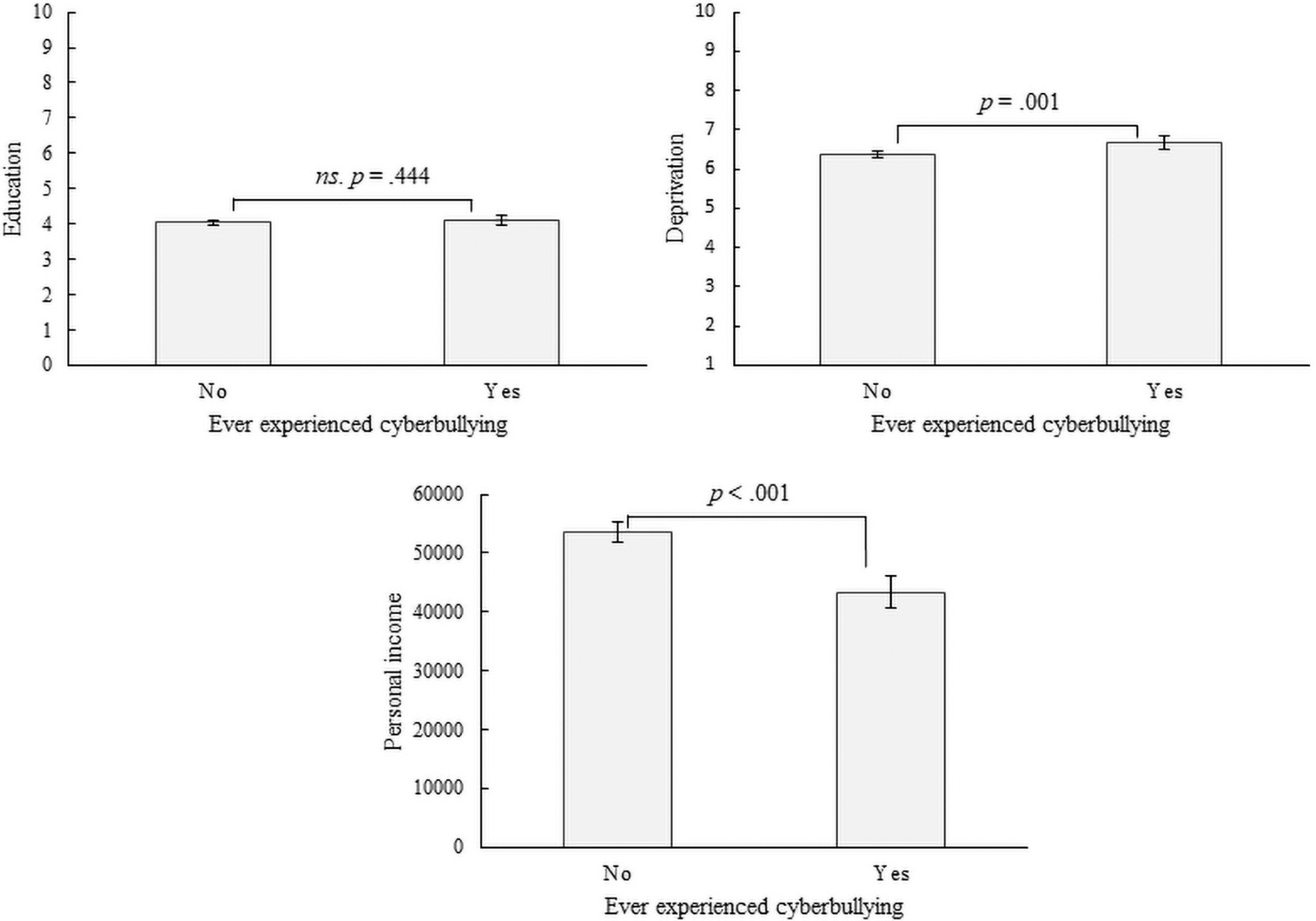
Average education, deprivation, and personal income for those who have and have not experienced cyberbullying.
Discussion
In a country that is third-worst overall among 29 for cyberbullying of youth and adolescents, this study examined differences in reports of cyberbullying among Māori adults according to gender, age, sexual orientation, and multiple ethnic affiliations. Increasing literature shows that rates of cyberbullying vary by age and gender, and our research confirmed this for Māori. Consistent with patterns in the only study that includes large numbers of Māori (i.e., Wang et al. 21 ; likewise of adults), we found cyberbullying most prevalent among the youngest age cohort (18–25 years), with 40.5 percent reporting experiencing it in their lifetime. Also consistent with Wang et al.'s study, women were much likelier than men to report cyberbullying. Extending previous research, those identifying as Māori and at least one other ethnicity reported more cyberbullying, as did members of sexual-orientation minority groups. While education demonstrated no influence, respondents with higher socioeconomic deprivation or lower personal incomes were likelier to report being cyberbullied. Our research matches Wang et al.'s findings suggesting that women report higher rates than men. 21 However, this may not apply to all ethnic groups, with the opposite result emerging for Asian New Zealanders reported previously (e.g., Wang et al. 21 ). Furthermore, these findings match prior international research suggesting higher rates of cyberbullying among lesbian, gay, bisexual, transgender and questioning (LGBTQ) than heterosexual participants, although those studies largely ignore ethnicity. 61
Overall, these data indicate that cyberbullying is a very significant problem among the Māori, exceeding indications by Wang et al. 21 Particularly among the most vulnerable, this is problematic since the Māori experience much more mental illness generally, and suicide.
Although we primarily aimed to report intragroup demographic differences for a large indigenous adult sample (namely Māori), a rarity in published psychological literature, the data's theoretical relevance also warrants comment. Cyberbullying is complex, multivariate, and multifactorial. 62 Following Bronfenbrenner's 63 ecological systems theory (predating cyber-phenomena), or the “socioecological approach,” both in-person bullying and cyberbullying would result from a confluence of factors at the individual, social environmental, and cultural levels. 64
Applying the socioecological theory to cyberbullying when reviewing a representative sample of 25,142 Internet-using European 9–16-year olds, Görzig and Machackova 65 found multiple correlates of being cyberbullied, including being female, lower socioeconomic status, speaking minority languages at home, membership of a discriminated-against group, and disability. These factors suggest that individuals vulnerable to discrimination or socioeconomic marginalization offline are also vulnerable online. For indigenous people, Carlson and Frazer 55 locate cyberbullying within widespread “systemic racism, intergenerational trauma, and economic disadvantage.”(p20)
The socioecological theory may make high overall Māori cyberbullying rates unsurprising, if online mirrors offline aggression. One finding, though, cracks the mirror's symmetry: those identifying solely as Māori reported less cyberbullying than those with at least one additional ethnicity. This reverses offline findings for individuals who identify as Māori only versus Māori and one other ethnicity (mainly New Zealand European).32,66 Why? Although our methodology did not answer that, we hark back to Carlson and Frazer's 55 quotes above that indigenous Australians reported being criticized by other members of their ethnic group who challenged their indigeneity based on physical appearance. Research should therefore explore various indigenous peoples' experiences of intersectionality and cyberbullying, including affiliation with dominant ethnic groups, alongside sexuality, age, and gender. For Māori, research, including qualitative data, into the experiences of cyberbullying targets could clarify who bullies whom online, and why.
Limitations
Our study has several limitations. To begin with, our study relied on self-assessments only and, in the absence of any universally agreed definition or measure of cyberbullying, like other researchers, we rely on respondents' perceived experiences and use a very broad measure to capture those perceptions. 67 Our study nevertheless replicated Wang et al.'s measure, 21 ensuring consistency with past research and an ongoing platform for future work.
Our data source, the MIFAS, is a lengthy (over 340 items), multitopic longitudinal survey concerning Māori financial attitudes as well as identity and well-being (see Houkamau et al. 59 ). The Māori participate in survey research much less than other New Zealanders68,69 and exit more from longitudinal studies. 70 Acutely aware of this, the MIFAS designers weighed each item to ease response fatigue. Certain variables, including cyberbullying, received only one or two items. Further research could confirm our findings, clarifying what cyberbullying is and what it is not, using observations or more comprehensive scales to measure distinctive dimensions of cyberbullying and cyber aggression, as well as the intensity of these experiences and the harm such experiences may create.
Our data do not disclose why the Māori report so much cyberbullying, or why women, sexual-minority members, and the Māori with multiple ethnic affiliations report still more. We have not considered how far participants may also be perpetrators of online bullying, or how far their exposure may have flowed from the interactions they initiated. If particularly younger Māori spend more time online and witness cyberbullying as normal, they may fall into defending themselves or others and next become victims. Only much more data can clarify the causes of the patterns in these findings.
Our study nevertheless enjoys several unique strengths. It is the first we know of from any country to examine cyberbullying experiences in a large-scale all-indigenous population (although the only study that included and teased out large indigenous numbers was also in New Zealand). Also, facilitated by our far larger Māori sample size, ours is the first to break the Māori or any indigenous population down by not only age and gender, but also by sexual orientation and sole/multiple ethnic affiliations. Indigenous experience goes generally underreported in international psychological literature, as do adult samples of any ethnicity. Conversely, since we surveyed only the Māori, generalizability to other indigenous populations or minority ethnic groups may be limited.
Conclusions
By international comparisons, cyberbullying rates are high in New Zealand. 37 Bullying is a major problem offline, too, across New Zealand, and not only among young people. In 2019, around 300,000 employees (over 11 percent of all workers) had experienced discrimination, harassment, or bullying at work in the past 12 months—women more than men, and Asians and Māori more than New Zealand Europeans or people of Pacific descent. 71
These studies point to overarching sociocultural drivers as contributing to New Zealand's high rates of bullying generally. In countries valuing freedom and self-expression 72 such as New Zealand, people may think it acceptable to say anything they want, particularly online. However, just because people can say certain things online to others, it does not mean they should, particularly if it crosses over the line to bullying or aggression.
Prevention efforts to reduce cyberbullying in New Zealand have focused primarily on the needs of children, adolescents, and young people, however, our data point to a need to consider the experiences of adults too. Existing measures to address cyberbullying as a nationwide problem have limited effectiveness, for example, New Zealand's Harmful Digital Communications Act 2015 aims to deter and mitigate harm and supply “quick and efficient means of redress,” 73 including taking down or disabling posts or messages, and is underutilized so far, and the 66 percent conviction rate 74 suggests it most efficaciously addresses only extreme, clear-cut cases.
Our Māori-dedicated research examining four demographic characteristics associated with cyberbullying has unearthed particularly high cyberbullying victimization rates in this population. This finding is a concern given the abundant evidence that the Māori already experience poorer mental health outcomes and the demonstrated toll cyberbullying exacts on mental health. While our data reveal the prevalence of cyberbullying, they do not explain why it occurs at such high rates among the Māori or the factors that perpetuate it. Further detailed research is needed to clarify these issues and to inform effective prevention efforts. Moreover, additional research is required to clarify the psychological implications of cyberbullying for victims and perpetrators and the broader societal costs of ignoring the prevalence and impacts of this potentially serious social problem.
Note
We set 10 observations to missing on both cyberbullying variables where participants reported “No” to ever experiencing cyberbullying but “Yes” within the past month.
Ethics Approval
The research was approved by the University of Auckland Human Participants Ethics Committee for the period May 16, 2016, until May 16, 2022. Reference Number: 017154.
Data Availability
Due to potentially identifying information, a copy of the anonymous data reported in each MIFAS publication is available from Chris Sibley, upon request from appropriately qualified researchers. Such data will be provided with the explicit understanding that they are used solely for the purposes of replicating or otherwise checking the validity of analyses reported in scientific articles analyzing MIFAS data. Mplus syntax for the models reported here will also be posted on the MIFAS website upon acceptance (
Footnotes
Authors' Contributions
This article was conceptualized by C.H., C.G.S., N.S., S.S., and R.W. based on data from the MIFAS of which C.H. is the lead. The data were gathered primarily by C.G.S. and C.H. All statistical analyses were conducted by N.S. who also wrote the methodology section of the article. C.H. wrote the introduction and discussion, which were reviewed by SS who edited the second draft. K.D., J.M., J.N., R.W., and C.G.S. reviewed the final draft of the article before submission. C.H. and N.S. attended to all the revisions, with David Thompson providing professional editorial assistance. K.D., J.M., J.N., R.W., S.S., and C.G.S. reviewed the final draft for approval before resubmission.
Author Disclosure Statement
No competing financial interests exist.
Funding Information
This research was supported by a Marsden Grant from the Royal Society of New Zealand awarded to the first author for “How great can we be? Identity leaders of the Māori economic renaissance” (15-UOA-316). The funders had no role in study design, data collection and analysis, decision to publish, or preparation of the article.