




Abstract
In response to calls for greater integration of research on the effects of visual images in the emotional and cognitive processing of health-related posts on Facebook, this study examined the questions of how gain-and-loss framed images, the valence of emoticon responses, and level of personal relevance of health topics contribute toward intentional engagement (e.g., sharing the posts) on Facebook. This study conducted a 2 (visual framing: gain vs. loss) × 2 (personal relevance of health topic: high vs. low) × 2 (emoticon valence: positive vs. negative) mixed-factorial experiment. A total of 187 college students were recruited to assess the impact of visual framing, personal relevance, and emoticon valence on sharing intention. Results showed that negative emoticons led to a higher intention to share health news posts than positive emoticons. Moreover, two parallel mediation models showed that (a) gain-framed images with high-relevance topics positively predicted perceived susceptibility but negatively predicted perceived severity that both positively impacted sharing intention; (b) loss-framed images with low-relevance topics positively predicted perceived severity but negatively predicted perceived susceptibility that both positively impacted the sharing intention. The implications regarding the contribution to the literature of visual framing and emotion on social media engagement and health communication are discussed.
Introduction
Nearly two-thirds of Americans regularly get news information on at least one social media platform, with Facebook most commonly used for news consumption, 1 information seeking, 2 and sharing health information during health crises. 3 Interaction on social media (e.g., posting and sharing behavior) is motivated by factors such as receiving approved rewards from others, evaluating genetic risk and environmental factors, 4 positivity bias (e.g., positive face concern), 5 and message content (e.g., valence of images).6,7
Images in health messages on social media both tell consumers about a topic and often convey its severity and susceptibility by showing consequences of action or inaction. Using the theory of social sharing of emotion 8 as the main theoretical framework, this article investigates how three characteristics of Facebook health messages—image framing, emoticon valence, and topic relevance—impact people's intention to share posts.
Framing health messages around potential benefits (gains) or harms (losses) of health-behavior choices influences recall and attention to health campaign messages, improves message comprehension and adherence to recommendations, and enhances the speed of information processing.9–11 Findings show that image valence on social media can have strong, although inconsistent, effects, such as positive images increasing social sharing, 6 and negative images leading to favorable attitudes toward companies and increased purchase intention. 12
Such effects of varying photo images in health campaigns extended beyond the motivation to shape users' understanding, including differences in risk perception and perceived importance of health issues. 13 Varying images can re-frame understanding of the post, not only shaping users' perceived susceptibility to and perceived severity of the related health issue, but also shaping the ultimate reach of the message by (de)motivating users to share the post.
A few health communication studies have manipulated images and text orthogonally to examine visual framing as distinct from textual framing, or the relationship between image framing and processing of adjacent text. One study found that loss-framed images significantly affected message processing through fear, and that gain-framed images increased recall about consequences. 14
In a similar vein, Verlhiac and collegues 15 showed that images of a diseased mouth increased smokers' intentions to quit irrespective of the gain- or loss-framing of accompanying text. Conversely, Lee and colleagues 16 found that a gain-framed image in a public service announcement increased young adults' intention to receive flu vaccine. These studies suggest that images framing health consequences more strongly influence health persuasion than text manipulation.
The effects of images on outcomes may still vary according to topic and the message recipient. Overall, health-related messages conveying a high level of personal relevance are more persuasive, and they are more likely to be shared.17,18 In the context of image-based persuasion, personal relevance moderates18,19 persuasive outcomes and leads to greater recall of pictures. 20 Thus, we sought to test whether image framing may have differential effects based on personal relevance.
Messages that seek to influence health-related behaviors commonly rely on shaping consumers' perceived susceptibility to a health issue and their perceived severity of its consequences. Previous studies have shown that images depicting negative consequences of certain health behaviors increased perceived severity of consequences,21,22 and health messages inducing personal relevance can impact judgement of perceived severity of health consequences 7 and subsequent behaviors. 23 However, other research has shown that manipulating images can have effects on desired outcomes without increases in perceived severity.24,25 An alternate pathway for image effects might be by increasing participants' perceived susceptibility, or how likely they think they are to the disease. Research has found that loss-framed low-frequency messages increased perceived susceptibility, which, in turn, augmented intentions to receive the HPV vaccine. 26 Regarding health behavior theories,27,28 risk perception consists of two components: perceived severity and perceived susceptibility. Given the present study's interest in the mechanisms behind message effects on social sharing, we sought to explore the degree to which these two components of risk perception might explain effects of gain-and-loss framing and level of personal relevance.
In 2016, Facebook added a feature allowing users to respond to posts by clicking emoticons corresponding to “like,” “love,” “haha,” “wow,” “sad,” and “angry.” According to the theory of social sharing of emotion, 8 emotion motivates information sharing and spurs secondary social sharing 13 whereby people share what they received. Content that elicits a strong emotional reaction is more likely to be shared, as is content containing images.29–32 Some studies showed social media posts arousing negative emotions increased sharing intention, 32 others found posts arousing positive emotions better predicted sharing 33 and clicking. 6 Based on these inconsistent findings, this study posits those emoticons, representing aggregated emotional response, might also trigger sharing on social media.
Materials and Methods
To test the RQs, researchers conducted a 2 (personal relevance of health topic: high vs. low) × 2 (visual framing: gain vs. loss) × 2 (emoticon valence: positive vs. negative) mixed-factorial experiment. Personal relevance of health topic and visual framing were between-subjects variables, and emoticon valence was a within-subjects variable. Each participant viewed four mock Facebook posts presenting persuasive health messages. After viewing the posts, participants completed dependent measures. The study protocol was approved by the researchers' institutional review board.
Participants
Participants were recruited from a pool of undergraduates at a public university in the Southeastern United States and they received credit for participation, totaling 187 undergraduate students (40 males, 133 females, 14 NA). A priori and post hoc power analyses were conducted before and after data collection in G*Power.
Results from G*Power showed alpha of 0.05, power of 0.96, and effect size F of 0.25, indicating the sufficiency of our sample. 34 The average age was 19.77 (standard deviation [SD] = 4.20). Racial distribution was 69.5 percent White, 10.2 percent Black, African American, 5.3 percent Asian, 3.2 percent Latinos, 0.5 percent Native American, 3.7 percent other, and 7.5 percent NA.
Stimulus materials
Topic relevance was chosen based on a pre-test in which demographically matched participants (n = 101) rated health topics on a 7-point scale measuring personal relevance (Appendix A1 and Table 1). A second pre-test (n = 75) identified images that could be seen as representing losses or gains. Utilizing pre-test results, four low-relevance topics (e-cigarette use, diabetes, drug use, and vaccine safety) and four high-relevance topics (skin cancer, dental health, stress, and insufficient exercise) were chosen (Table 2).
Pre-Test Results for Relevance of Health Topics
SD, standard deviation.
Pre-Test Results of Gain- and Loss-Framed Images for High- and Low-Relevance Health Topics
Researchers created 16 mock Facebook posts, each including a headline, news source (BuzzFeed Health), image, and text. Headlines maintained a neutral tone (e.g., “7 essential dental health tips”; “6 things you may not know about diabetes”). Participants were randomly assigned to one of four conditions: high-relevance topics and gain-framed images; high-relevance topics and loss-framed images; low-relevance topics and gain-framed images; and low-relevance topics and loss-framed images (Figs. 1 and 2).

Examples of gain- and loss-framed images and high-relevance health topics (e.g., dental health) with positive and negative emoticons. Notes: examples from left to right are

Examples of gain- and loss-framed images and low-relevance health topics (e.g., vaccine safety) with positive and negative emoticons. Notes: examples from left to right are
Emoticon valence was varied within subjects. Each participant viewed four mock Facebook posts, wherein two mock Facebook posts included positive emoticons and two mock Facebook posts included negative emoticons. The pairing of emoticon valence with specific posts and presentation order varied randomly (Figs. 1 and 2).
Procedure
Participants individually entered a campus lab. After providing informed consent, participants were randomly exposed to one of the four conditions. After looking at each post, participants filled out a questionnaire.
Dependent measures
Intention to share
Intention to share was adapted from previous research 35 and measured by asking “How likely would you be to share this post by clicking the share button?” with a 7-point Likert-type scale ranging from 1 = very unlikely to 7 = very likely (mean [M] = 2.10, SD = 1.17).
Perceived susceptibility
Perceived susceptibility was adapted from previous research 36 and measured by using a three-item, 7-point Likert-type scale where “1 = Strongly disagree” and “7 = Strongly agree.” Items included “Compared with others of my age, it is likely that I will experience this health issue.” Cronbach's alpha for perceived susceptibility was 0.95 (M = 3.15, SD = 1.78).
Perceived severity
A two-item measure of perceived severity utilized a 10-point semantic differential scale. 37 The question was “I think the consequence of the health issue that I just saw on the post is…” and scales ranged from “Not dangerous” to “Very dangerous” and from “Not a severe health problem” to “A very severe health problem.” The Cronbach's alpha for perceived severity was 0.91 (M = 5.48, SD = 2.38).
Data analyses
Univariate analysis (analysis of variance [ANOVA]), Paired-samples t-tests, and ordinary least squares (OLS) regression using the PROCESS macro (Model 4) 38 were used to answer the RQs. Due to the deviation from normal distribution of the dependent variable, we ran the analyses also with a Kruskal–Wallis nonparametric test. As the results did not change, we reported the results of a higher power ANOVA test.
Because our study focused on the relationships between observed variables, and we wanted to establish whether the mediation effects were significantly different from 0, we chose OLS-regression procedures rather than standard error of mean for testing the variable models.
Results
RQ1 examined how visual framing and level of personally relevant health topics together impacted intention to share. ANOVA results revealed no significant interaction effect [F(1,171) = 0.31, p = 0.58, partial ɳ 2 = 0.002] and no main effect of visual framing [F(1,171) = 1.09, p = 0.29, partial ɳ 2 = 0.01] and personal relevance [F(1,171) = 1.02, p = 0.32, partial ɳ 2 = 0.01] on intention to share.
RQ2 examined how perceived susceptibility and perceived severity mediated the relationship between visual framing and personal relevance on sharing intention. The results of PROCESS model 4 showed that perceived susceptibility and perceived severity parallelly mediated the relationship between gain-framed image and high personal relevance topics on sharing intention.
The significant indirect effect for parallel mediators of perceived susceptibility (point estimate = 0.31, standard error (SE) = 0.12, 95 percent confidence interval (CI) = [0.07–0.55]) and perceived severity (point estimate = −0.32, SE = 0.11, 95 percent CI = [−0.55 to −0.13]) was found, but the direct effect was not significant (point estimate = 0.31, SE = 0.25, 95 percent CI = [−0.18 to 0.80], p = 0.21) (Fig. 3).

Perceived susceptibility and perceived severity parallelly mediated the relationship between the gain-framed images and high-relevance topics, and intention to share.
In addition, findings showed that perceived susceptibility and perceived severity parallelly mediated the relationship between loss-framed image and low personal relevance topic on sharing intention. The significant indirect effect for parallel mediators of perceived susceptibility (point estimate = −0.30, SE = 0.10, 95 percent CI = [−0.51 to −0.13]) and perceived severity (point estimate = 0.17, SE = 0.07, 95 percent CI = [0.05 to 0.31]) was found, but the direct effect was not significant (point estimate = −0.04, SE = 0.22, 95 percent CI = [−0.48 to 0.40], p = 0.86) (Fig. 4).
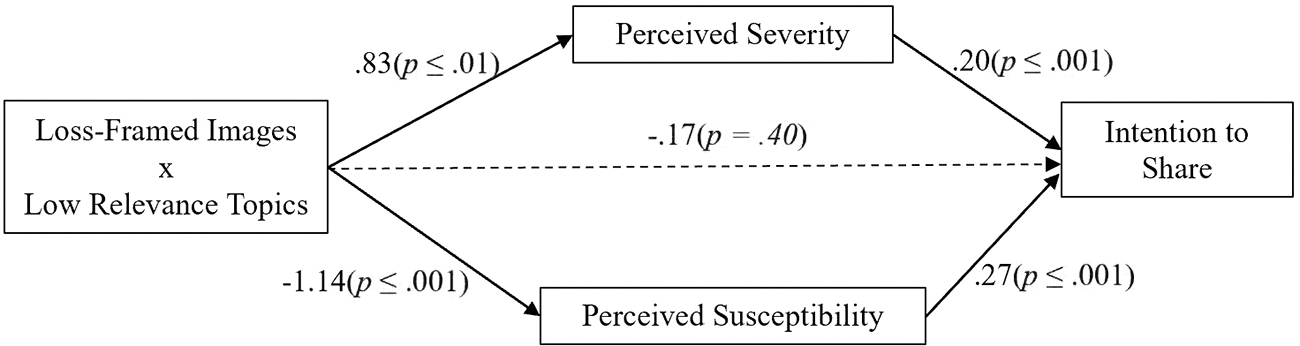
Perceived susceptibility and perceived severity parallelly mediated the relationship between the loss-framed images and low-relevance topics, and intention to share.
RQ3 examined how the valence of emoticons on the posts influenced intention to share. Paired-samples t-tests showed that negative emoticons (M = 2.18, SD = 1.25) significantly increased intention to share health posts than positive emoticons (M = 2.03, SD = 1.27), t(174) = 2.26, p < 0.05.
Discussion and Conclusions
The purpose of this study was to investigate how image framing, personal relevance topics, and emoticons influence persuasion outcomes of Facebook health news posts. The findings showed that negative emoticons more than positive ones increased people's intention to share posts. This study also found perceived susceptibility and perceived severity as parallel mediators for the effects of gain-framed images with high-relevance topics and loss-framed images with low-relevance topics on intention to share the health news posts in an opposite manner.
This study provides important implications regarding message framing when the feedback of others is displayed alongside health content. First, emoticons play a role in reinforcing the primary and secondary sharing of news posts. The findings are aligned with the theory of social sharing of emotions: Emotions play a significant role in the intention to share.8,31
In addition, findings support the primacy of negative emotions in shaping the intention to share on social networks. 32 More importantly, emoticons as emotional opinions can also shape viewers' judgments about whether other users approve or disapprove content, which further motivates viewers' secondary sharing. This finding implies the importance of visual framing content of health news posts for emotional responses. Results also suggest that emoticon valence might further strengthen the effect of visual images on sharing intentions, particularly when valence and visual images match.
Second, regarding the effects of gain and loss-framed images and level of personal relevance topics, the findings partially align with previous studies about the effects of loss-framed and personal relevance messages on perceived severity and perceived susceptibility.7,21,22,26 The results provide additional evidence about the gain- and loss-framed images and level of personal relevance that play different roles in increasing perceived severity and susceptibility, which, in turn, promote the sharing intention.
In addition, the findings provide supporting evidence of the content with a relative success of threat and emotional appeal strategy for motivating people to share posts. These findings contribute to the study of emotion-inducing visuals on digital media communication and digital journalism.
The generalizability of these findings is limited. Although college students are active social media users, future studies should include different populations. Second, this study utilized Facebook alone, whereas future studies should explore other platforms. Third, this study was conducted in a lab, so a longitudinal design with natural settings would be useful.
In line with insights that underscore the importance of the characteristics of content and visual emotional expression in health news posts, this study contributes toward a clear understanding of the roles of visual framing and valence of emoticons in the intention to share.
Findings hold considerable practical implications for health news journalists and health organizations focusing on image selection. In addition, findings encourage researchers to build a compelling body of literature and to develop nuanced theoretical models in the interdisciplinary area between visual communication and health communication on social media.
Footnotes
Author Disclosure Statement
No competing financial interests exist.
Funding Information
The author(s) received no financial support for the research, authorship, and/or publication of this article.
Appendix A1
To select the personal relevance of health topics and images to be used in the experiment, two pre-tests were conducted among undergraduates at a major university in the Southeast United States. First, to understand how participants perceive the relevance of health topics, a total of 101 participants were shown a list of health topics and asked to rate the relevance of health topics to their health with a 7 Likert-type scale (1 = very irrelevant and 7 = very relevant).
Based on the results, eight high-relevance and eight low-relevance health topics were chosen for inclusion. The high-relevance health topics each had mean relevance scores higher than the median above 4.2, and they consisted of skin cancer, flu and respiratory infections, dental health, stress, getting insufficient sleep, insufficient exercise, safe sex, and sexual health. Low-relevance health topics each had mean scores lower than 2.8, and they consisted of vaccine safety, coffee overconsumption, smoking e-cigarette, smoking traditional cigarette, diabetes, drug use, ebola, and zika (see Table 1).
A second pre-test was conducted to select images to be used in the experiment based on 16 health topics. A total of 75 participants were asked to rate 40 images with a semantic scale (1 = definitely shows a loss, and 7 = definitely shows a gain). The questions, for instance, were asked “To what extent would you say the image show something gained from protecting against skin cancer” and “To what extent would you say the image show something lost by without protection from skin cancer.”
Each topic included positive and negative images. Based on the ability to clearly identify gain- and loss-framed images, the list of health topics for inclusion in the experiment was reduced to four high-relevance topics and four low-relevance topics (see Table 2).