




Abstract
Recent studies have shown that Internet game disorder (IGD) is a significant risk factor of subjective well-being among adolescents. However, there are few studies about the mediating and moderating mechanisms underlying this relationship. This study examined the mediating role of sleep quality in the relationship between IGD and adolescent subjective well-being, and the moderating role of self-control in this mediational process. We collected data from 2,767 Chinese adolescents (mean age = 14.42 years, SD = 1.55) to test our theoretical model. Those adolescents completed self-reported questionnaires on IGD, subjective well-being, sleep quality, and self-control, respectively. After controlling for demographic variables, IGD was negatively associated with adolescent subjective well-being. Mediation analysis indicates that sleep quality partially mediates the association between IGD and adolescent subjective well-being. Tests of moderated mediation further reveal that the mediated path was also moderated by self-control. Specifically, these effects are stronger in adolescents with higher self-control, manifesting as cognitive dissonance. These findings advance our knowledge of how and when IGD relates to subjective well-being among adolescents. We discussed implications and limitations of this study.
Introduction
With video games gradually integrating into personal leisure activities and daily life, 1 the desire of playing Internet games becomes an obstacle in fulfilling individual goals, including education, relationship, and mental and physical health.2–4 As one of the negative consequences of Internet games, Internet game disorder (IGD, which was also called pathological online game use) was found to be high risk among Internet game players, especially for adolescents. 5 However, the studies reported that IGD co-occurred with depression, anxiety, and other mental disorders.6–8 There was a functional link between IGD and emotions such as depression or anxiety in the IGD criteria, 9 and some researchers suggested that IGD should be considered a comorbidity for research. 10 Recent research suggested that IGD played a harmful role in adolescents in pursuing their life goals, which influenced their growth and well-being. Thus, to explore the potential mechanisms of IGD is important for developing intervention methods.
Subjective well-being was taken as an important personal and societal goal. 11 Researchers found that higher levels of subjective well-being related to less mental illness, stronger interpersonal relationships, more prosocial tendencies, and more adaptive characters, which promoted the physical and mental health of adolescents.12–14 According to the telic approaches of subjective well-being, happiness lay with harmonious integration and achievement of one's life goals. 15 However, happiness of fulfilling long-term goals might be interfered by individuals' desires for short-term happiness, and this conflict finally led to a decline in subjective well-being. 14
The Diagnostic and Statistical Manual of Mental Disorders, fifth edition (DSM-5) listed IGD as a mental disorder to be confirmed in 2013. 16 IGD is defined as a pattern of persistent or recurrent gaming behavior (digital gaming or video gaming), including both online (i.e., over the Internet) and offline, 16 manifested by the following: (a) impaired control over gaming (e.g., onset, frequency, intensity, duration, termination, context); (b) increasing priority given to gaming over other life interests and daily activities; and (c) continuation or escalation of gaming despite the occurrence of negative consequences. 17 Some studies confirmed that higher IGD correlated with lower subjective well-being and its components, including lower life satisfaction and negative emotions such as anxiousness, irritability, guilt, or jealousy.18–20 In addition, reduced sleep was also a negative result of playing online games and interrupted daily life and activities. 21 Previous research suggested that poor sleep quality was one of the symptoms of IGD,22,23 and associated with decreased subjective well-being. 24 Therefore, we suppose that sleep quality serves as a mediating mechanism between IGD and subjective well-being.
According to the social cognitive theory, personal factors and behavioral factors interacted to determine human thoughts or feelings. 25 During Internet game playing, the self-control over Internet games interacted with Internet gaming behaviors to affect adolescents' experienced happiness. Self-control is defined as an ability to resist an impulse or the temptation to perform an action, it refers to a process of settling conflict between two competing goals.26,27 Self-control is taken as a stable personal trait by scholars. 28 A recent research found that self-control played a moderating role on the relationship between problematic online games and depression (the emotional facet of subjective well-being) in adolescents. 29 Furthermore, lacking of self-control strongly predicted the negative consequences of Internet game playing through sleep quality, including decreased subjective well-being. 30 Thus, we predict that self-control moderates the direct and indirect effects of IGD on adolescents' subjective well-being through sleep quality.
Considering the prevalence of Internet games and the importance of adolescents' mental health, it is necessary to explore the potential working mechanisms behind the relationship between IGD and subjective well-being. This study proposed a moderated mediation model to examine the mediating role of sleep quality and the moderating role of self-control between IGD and subjective well-being (Fig. 1). Based on the research reviewed above, we proposed the following hypotheses:
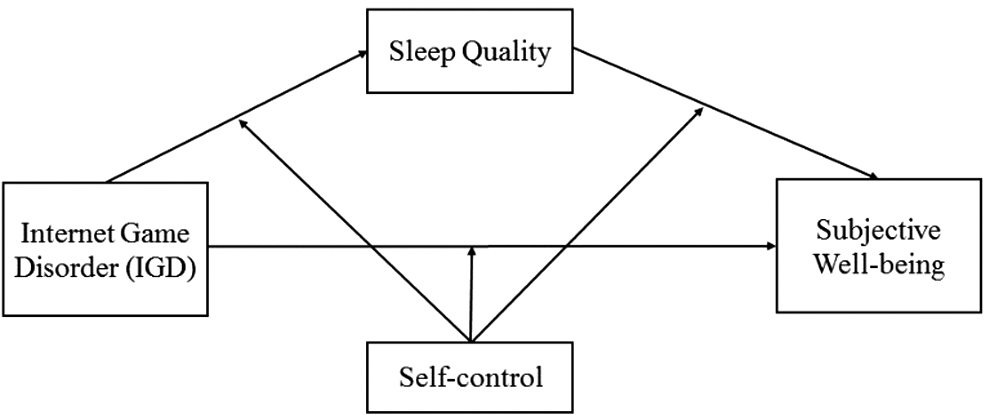
Moderated mediation model of associations between IGD, sleep quality, self-control, and subjective well-being. IGD, Internet game disorder.
Methods
Participants
Participants were randomly cluster sampled from several junior and senior high schools in Hubei Province, China. A total of 3,095 students participated in this study, 328 participants were excluded due to extensive missing data, this left a final sample of 2,767 participants (51.72 percent females) with an average age of 14.42 years (SD = 1.55, ranging from 11 to 19). All the participants were from 7th to 12th grade. A total of 64.37 percent of participants were the only child, and the majority of teenagers were two-parent families, accounting for 85.06 percent, while left-behind families and single-parent families accounted for 14.94 percent. This research is part of the master's thesis, the research proposal was approved by University leaders in 2018.
Measures
Demographics
Self-reported questionnaires were used to collect data. Gender, age, grade, whether the only child, and family's structure were collected in the survey. According to previous studies, these factors were controlled as covariables in the subsequent data analyses.31,32
Internet game disorder
IGD was assessed with the Chinese version of Pathological Online Game Use Questionnaire (POGU) compiled on the basis of the evaluation criteria for pathological gambling in DSM-5.33,34 This scale included 11 items (α = 0.79). Participants rated all the items on a three-point scale (1 = never, 3 = always). Based on the recommendations of previous studies, we converted the score to “never = 0, sometimes = 0.5, always = 1.” The total score ≥5 was reckoned as IGD.
Subjective well-being
Subjective well-being (SWB) was measured by three parts as follows: life satisfaction, positive emotion (PE), and negative emotion (NE). Life satisfaction was measured with the Satisfaction with Life Scale (SWLS), including five items (e.g., “In most ways my life is close to my ideal.” α = 0.82), 35 scored on a seven-point Likert scale (1 = strongly disagree, 7 = strongly agree). The Positive and Negative Emotions Scale consisted of nine emotional words (i.e., four positive emotional words including happy, joyful, pleased, and enjoyment; and five negative emotional words including angry, frustrated, anxious, depressed, and unhappy, αPE = 0.90, αNE = 0.82). 35 Participants were asked to report the degree to which they had experienced each of the moods during the past month on a scale of 1 (not at all) to 5 (extremely). Both of the two scales were proven to have good reliability and validity in the context of Chinese culture. We first standardized the scores of life satisfaction, PE, and NE. Then, we used the formula “SWB = ZSWLS + ZPE − ZNE” to calculate the total score. Higher total scores indicated higher levels of SWB.
Sleep quality
Sleep quality was measured with the Pittsburg Sleep Quality Index (PSQI) including the 1–18 self-rated items (α = 0.69). 36 This scale measured participants' sleep quality over the past month by the following seven components: subjective sleep quality, sleep latency, sleep duration, habitual sleep efficiency, sleep disturbance, use of sleeping medication, and daytime dysfunction. Each component was scored from 0 to 3. The total PSQI score was obtained by adding the seven component scores, ranging from 0 to 21. Higher total scores indicated worse sleep quality.
Self-control
Self-control was measured with the revised Self-Control Scale (SCS).37,38 Tan and Guo revised Tangney's full version of SCS among Chinese teenagers, and found that the revised scale had good reliability and validity. 38 The revised SCS reserved 19 items and consisted of five dimensions, namely impulse control, healthy habits, resisting temptation, focusing on working, and controlling entertainment. 38 Participants completed 19 items (α = 0.88) with a five-point Likert scale (1 = not at all, 5 = very much). Higher scores indicated stronger self-control ability.
Procedure
Before the data collection, we obtained approval from the Research Ethics Committee of the corresponding author's institution and informed consent from school principals, participants, and their parents. With standardized instructions, all participants voluntarily took 20 minutes to complete a set of self-reported questionnaires in their classrooms.
Statistical analyses
In this study, all the data analyses were conducted with SPSS.22.0 and Hayes's PROCESS macro3.3. 39 We first adopted descriptive statistics and correlation analyses to test the potential associations among IGD, subjective well-being, sleep quality, self-control, and demographic variables. Next, we used Hayes's PROCESS macro (Model 4) to test the mediation model. Then we used Model 59 to test the conditional process model. We adopted the bootstrap method to test the significance of conditional direct and indirect effect by generating 95 percent bias-corrected confidence intervals (CIs) from 5,000 random samples of the data. Finally, we conducted the simple slope analysis with the Johnson-Neyman technique. 40 All the analyses were performed after controlling for covariates.
Results
Preliminary analysis
A total of 137 (5.1 percent) participants met the IGD criteria. The descriptive statistics and correlation matrix are displayed in Table 1. The bicorrelations among IGD, subjective well-being, sleep quality, and self-control were significant. Specifically, IGD was negatively correlated with subjective well-being and self-control (r = −0.26, p < 0.01; r = −0.45, p < 0.01), and positively correlated with sleep quality scores (r = 0.26, p < 0.01); moreover, subjective well-being was positively correlated with self-control (r = 0.49, p < 0.01) and negatively correlated with sleep quality (r = −0.48, p < 0.01). There was also a significant negative correlation between self-control and sleep quality (r = −0.41, p < 0.01).
Descriptive Statistics and Correlations for All Variables
n = 2,767.
Gender was dummy coded such that 0 = female and 1 = male.
p < 0.05; **p < 0.01.
IGD, Internet game disorder.
Testing for mediation
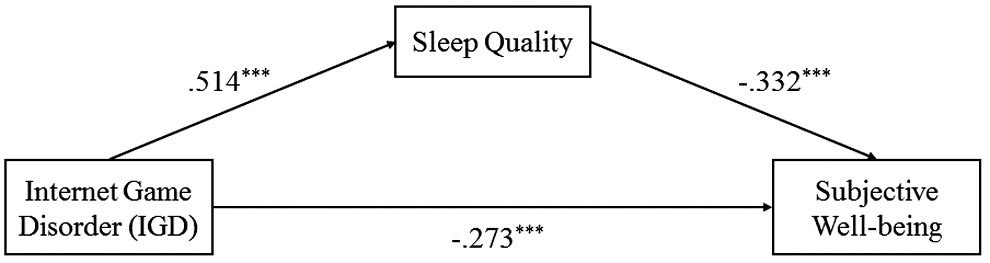
The mediating effect of sleep quality. Sleep quality mediates the relationship between IGD and subjective well-being. The path coefficients were reported. n = 2,767, ***p < 0.001. Indirect effect = −0.171, SE = 0.018, 95 percent CI = (−0.206 to −0.138). Grade, gender, the only child, and family's structure are treated as covariates, which have been omitted for simplicity. CI, confidence interval.
Testing for conditional process modeling
Testing the Moderated Mediation Effect of Self-Control on Subject Well-Being
n = 2,767. Unstandardized regression coefficients were reported. All continuous independent variables were mean centered before analysis. Bootstrap sample size = 5,000.
p < 0.05; **p < 0.01; ***p < 0.001.
LLCI, lower limit of the 95% confidence interval; SC, self-control; SQ, sleep quality; ULCI, upper limit of the 95% confidence interval.
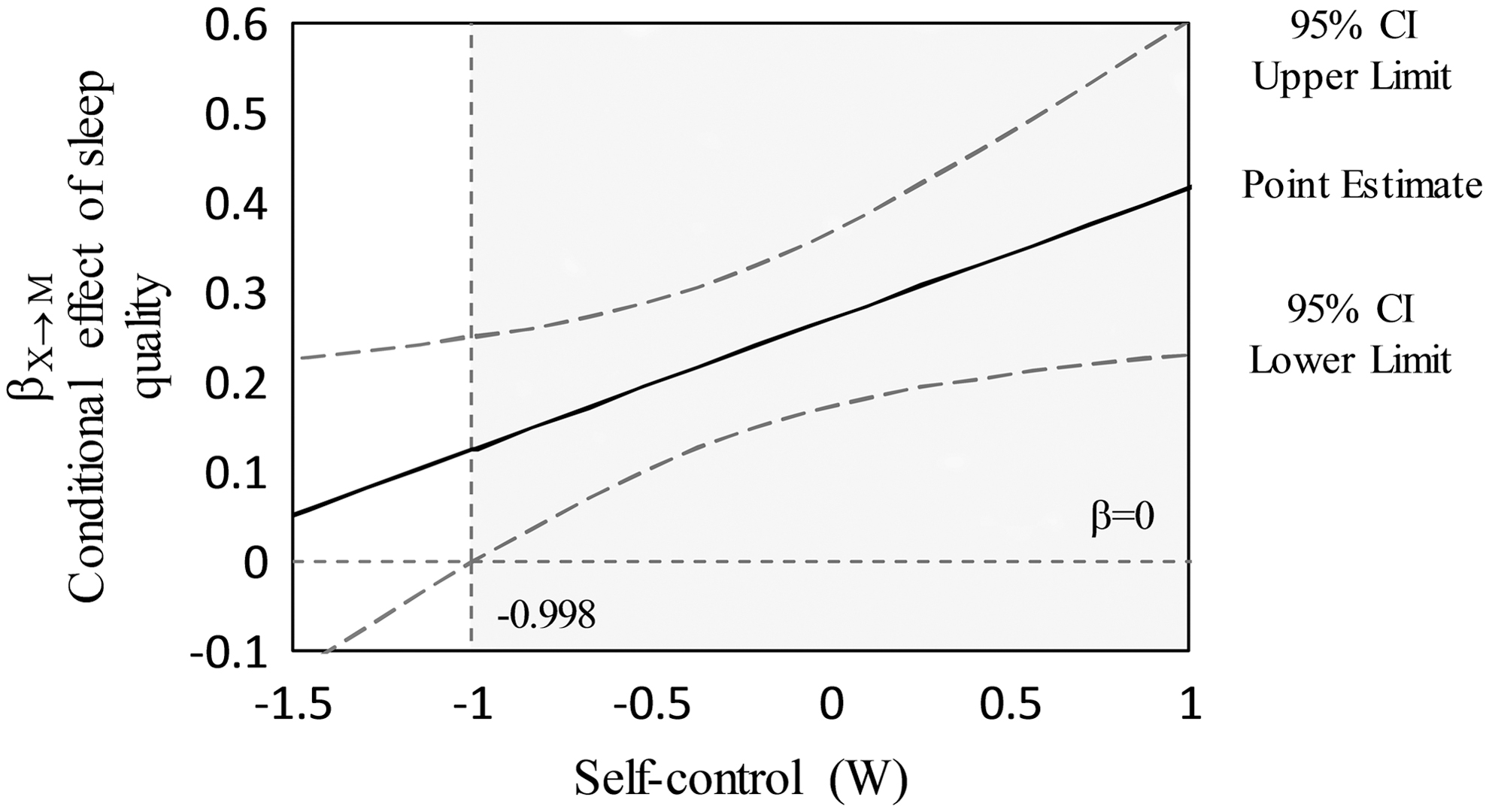
The moderated effect of self-control on the relationship between IGD and sleep quality. The straight line indicates the point estimate of simple slope of IGD on sleep quality. Shaded areas represent the regions of significance for the conditional association. The positive impact of IGD on sleep quality is stronger for adolescents with higher levels of self-control.
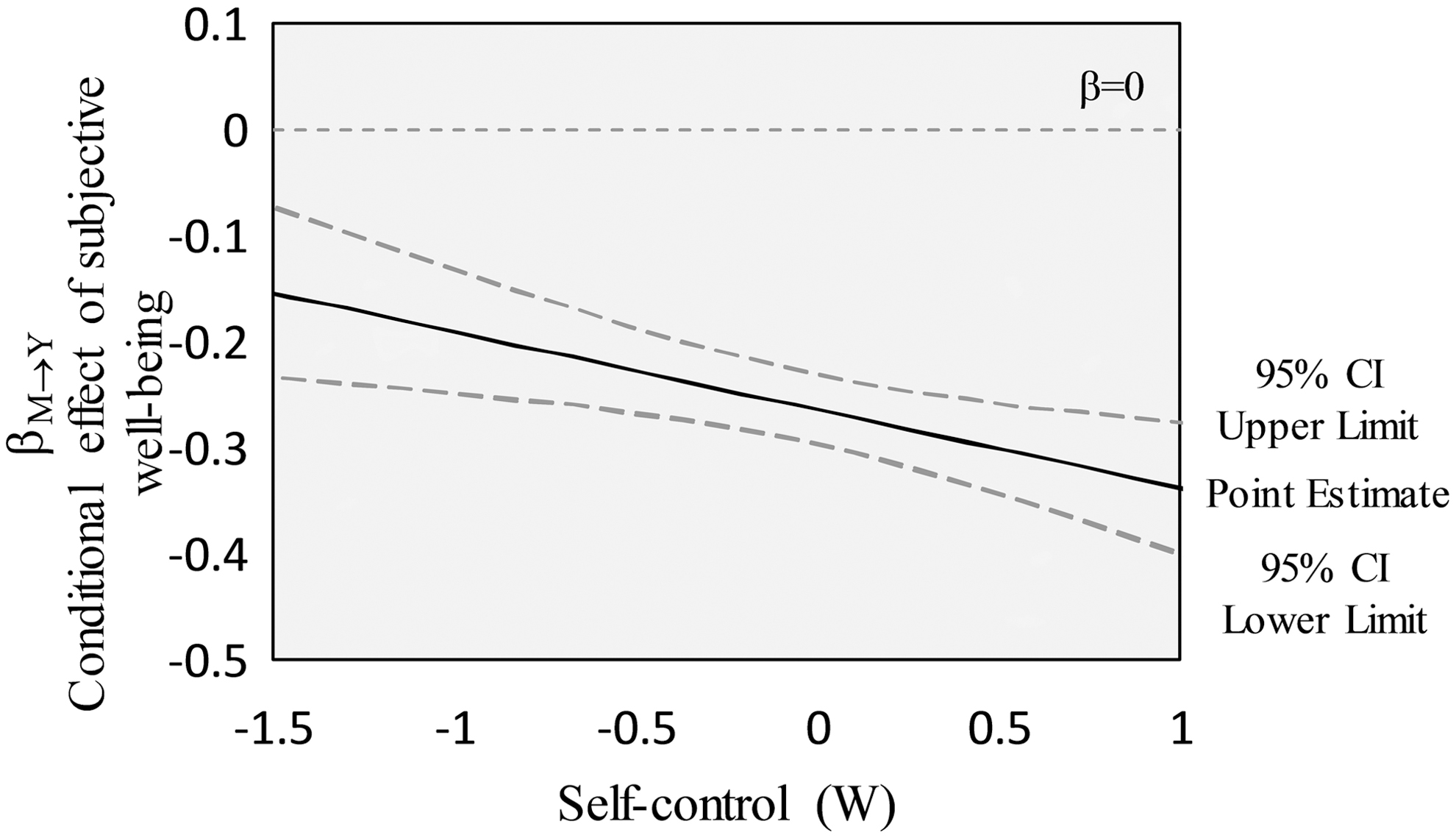
The moderated effect of self-control on the relationship between sleep quality and subjective well-being. The straight line indicates the point estimate of simple slope of sleep quality on subjective well-being. Shaded areas represent the regions of significance for the conditional association. The adverse impact of sleep quality on adolescents' subjective well-being was reflected in individuals with high and low levels of self-control, but adolescents with high self-control levels are obviously more affected.
Discussion
This study provides evidence that sleep quality partially mediates the relationship between IGD and subjective well-being, and this indirect process is moderated by self-control. IGD has an adverse impact on subjective well-being through poor sleep quality, and this appears to worsen more in adolescents with high self-control than those with low self-control. One possible explanation is that cognitive dissonance might be induced under high levels of self-control. These findings indicate that IGD can reduce adolescents' subjective well-being, but self-control over Internet games cannot serve as a buffering factor. The study findings advance our understanding of how IGD is associated with adolescents' subjective well-being.
Our results suggest that sleep quality is a crucial explanatory mechanism for the link between IGD and adolescents' subjective well-being. Consistent with previous studies, individuals with higher IGD reported poorer sleep quality compared with adolescents without IGD.23,41–43 There are several possible mechanisms responsible for this relationship. On a physiological level, online gaming before bedtime may cause physiological arousal so that adolescents find it difficult to relax.44,45 On a biochemical and neurological level, the amount of illumination from light exposure during Internet gaming suppresses melatonin—which helps the brain to enter a sleep state—and disrupts sleep patterns. 46 In addition, the increase in dopamine production and the activation of sympathetic nervous tone accompanying Internet gaming also impact sleep patterns.47,48 Adolescents with poorer sleep quality are more likely to report lower subjective well-being. This result is aligned with previous findings.49–51 Adolescents with poor sleep quality tend to have a deficit in psychosocial functioning 52 ; thus, they are more vulnerable to negative feelings and events, which lead to increased risk of mood disorders and a poor perception of life satisfaction. 53
This study is the first to explore the role of self-control in IGD and subjective well-being. The results suggest that self-control moderates the relationship among IGD, subjective well-being, and sleep quality, but cannot buffer the effect of IGD within these relationships. When participants with low self-control face conflicts between their desires (i.e., Internet games) and long-term goals (i.e., good sleep quality and subjective well-being) due to their failure to resist Internet games, they are inclined to approach it. Moreover, engaging in Internet games is an automatic, habitual, and priming behavior for them. 54 Thus, IGD participants find it difficult to stop playing Internet games and consequently experience negative symptoms such as poor sleep quality.22,41–43 Furthermore, people with less self-control usually fail to manage their sleep disorders effectively, and this inevitably leads to a decrease in subjective well-being.53,55
Adolescents who have higher levels of self-control and IGD suffer more from serious sleep problems and report lower levels of subjective well-being. This finding is consistent with Festinger's cognitive dissonance theory: that the more people think two cognitive elements are important or valuable, the greater the degree of dissonance between them. 56 In adolescents with high self-control who believe that they should be responsible for the negative outcomes of online gaming, their positive attitude toward Internet games is incongruent with the adverse consequences, and this triggers dissonance.57,58 Therefore, adolescents with internalized psychological conflict tend to develop uncomfortable levels of psychological tension and then induce physiological arousal that disturbs their sleep. 59 According to the reinforcement sensitivity theory, the system that detects conflict suppresses ongoing Internet gaming behavior while also generating feelings of negative affect, including worry and anxiety.60,61 These emotional states further lead to sleep disruption. 62 Based on this observation, it can also be said that IGD and some affect-based psychological disorders may be comorbid. 10
Cognitive dissonance theory further suggests that external justification is a key factor of perceived dissonance. 63 Dissonance occurs when people have no external justification for their attitude-behavior discrepancy. However, sleep disorders are more relevant to internalized problems than externalized problems. 64 Thus, for adolescents with high self-control, their motivation to maintain good sleep quality is in conflict with their sleep problems, and this induces cognitive dissonance and enhances negative affect (e.g., discomfort and anxiety). 65 Recent studies have confirmed that sleep quality is positively associated with life satisfaction.66,67 Therefore, compared with individuals with low self-control, high self-control adolescents' worsening sleep problems will also reduce their perceived life satisfaction. In fact, IGD is an extreme point in the bipolar continuum of self-control deficiency in media behavior; moreover, the occasional loss of self-control is included in the continuum. 68 This study only investigated the role of the self-control trait under a long-term condition; further research is needed to examine whether and when a state of self-control plays a protective role in accidental conditions.
Our study highlights that IGD is a risk factor in adolescents' subjective well-being. It is the first study to reveal the role of self-control in the effect of IGD on subjective well-being. Interventions such as reality therapy and mindfulness meditation could reduce problematic behaviors related to Internet gaming.69–71 Interventions may help adolescents to formulate good sleep habits and change the cognition aspect of self-control to alleviate the direct and/or indirect impact of IGD.
Our study's cross-sectional design was unable to draw causality conclusions. The direction of the relationship between IGD, sleep quality, and subjective well-being might be bidirectional.72,73 IGD and some mental disorders that are based on negative affect may be comorbid, but the internal mechanisms between them are still unclear; thus, longitudinal designs should be used in future research. 10 We collected data on how often adolescents felt anxious and depressed in one month without using professional diagnostic scales. Since anxiety and depression are key factors in adolescents' mental health,74–76 future studies need to include measurements of these variables. Self-reported questionnaires are subject to social desirability and recall bias. Future studies could use polysomnography to record participants' physiological index during sleep as objective information. 62 We regarded self-control as a kind of stable personal trait to compare interpersonal differences at a long-term level; future research should examine the protective role of stated self-control during moments of temptation (i.e., desire of playing online games). 27 In addition, because we selected Chinese adolescents as our sample, it is necessary to examine whether our findings can be generalized to other cultures and clinical samples.
Footnotes
Acknowledgments
The authors thank all the adolescents who participated in the study.
Authors' Contributions
Q.L. conducted the literature review and wrote the first draft of the article. Y.T. analyzed the data, and reviewed and edited the article. Y.C. collected data and conducted literature searches. C.L., X.M., L.W., and C.G. did vital work for the improvement of the article. All authors contributed to and have approved the final article.
Author Disclosure Statement
No competing financial interests exist.
Funding Information
This work was supported by the Research Program Funds of the Collaborative Innovation Center of Assessment toward Basic Education Quality (2021-04-014-BZPK01), Open Project of Key Laboratory of Adolescent Cyberpsychology and Behavior (Central China Normal University) (2019B07), and Self-determined Research Funds of Central China Normal University from the Colleges' Basic Research and Operation of MOE (CCNU19TS076).