




Abstract
The present study examined associations among adult romantic attachment, relationship quality, and electronic messaging frequency/preferences in 302 romantically partnered undergraduates. Anxious people desired more frequent messages than they received, whereas avoidant people desired less frequent messages than they received. Anxious people received fewer messages from their partners, whereas avoidant people sent fewer messages to their partners. Additionally, anxious people took less time to respond to their partner than their partners took to respond to them, whereas avoidant people took more time to respond to their partner than their partners did to respond to them. Finally, the relation between message frequency satisfaction and relationship quality was stronger for more anxious people. These results suggest that individual differences in attachment dimensions related to differences in romantic messaging behavior in theoretically consistent ways.
Introduction
Attachment affects a person's likelihood to seek support from a partner. For example, securely attached people tend to seek and provide support under distress, which may help maintain stronger interdependence and positive effects on their relationships. 1 Avoidantly attached people are less likely to ask for help or reach out to support their partners, which can result in weaker interdependence and more negative relationship effects. 1 Anxiously attached people often crave more emotional support from their romantic partners, view them as providing inconsistent support, which can lead to resentment and toxic relationships. 1 Regarding social networking sites, anxious-preoccupied and avoidant adults are more likely to monitor their current or ex-partner's Facebook page.2,3 More generally, attachment anxiety, but not avoidance, relates to problematic social media use. 4
Whether and which attachment dimensions relate to how people engage with their romantic partners via messaging has produced mixed findings. One study found that avoidant attachment was related to less frequent text messaging, 5 whereas another study found that text messaging was unrelated to either attachment dimension. 6 People who reported a greater percentage of their partner interactions were conducted over text had higher avoidant and anxious attachment, suggesting that people who are more anxiously or avoidantly attached tend to rely more on texting. 7 A recent study of young adult Americans in relationships found that smartphone use related to more affectionate communication between partners; however, smartphone dependency (addiction or excessive use) related to less affectionate communication and decreased relationship satisfaction. 8
Because communication via electronic messaging is an important part of relationship maintenance, the present study examined how attachment dimensions relate to relationship quality and messaging characteristics (frequency, emotional content, messages sent versus received, response latency, response interval). We aimed to expand on previous research by (a) examining the associations between attachment style and messaging frequency and (b) exploring how attachment relates to messages sent versus received, the amount of time it takes to respond to partners' messages, response intervals, and desired emotional content in messages. While prior research only examined texting in romantic relationships, 9 we examine all forms of computer- or smartphone-mediated communication. Based on the literature reviewed above and our own expectations, we developed six sets of specific hypotheses (Table 1).
Hypotheses
MFS, message frequency satisfaction.
Methods
Power and participants
We recruited introductory psychology students in romantic relationships at the University of Florida who participated in exchange for partial course credit. Using G*Power 3.1, 10 we determined a priori that ≥264 cases were needed to achieve adequate power (≥0.80 at α = 0.05), assuming a small effect size (f 2 = 0.03). We determined this effect size based on prior study 11 and because of the additional power needed to detect interactions involving continuous variables. 12
Participants were 329 undergraduates. Of these, we excluded 23 who were not in a romantic relationship, 3 older participants (age >45 years) to increase sample homogeneity, and 1 because of a nonsensical response. The analyzed sample of 302 participants ranged in age from 18 to 32 years (mean [M] = 19.52, standard deviation [SD] = 1.67). The median relationship duration was 9.0 months (M = 14.95, SD = 14.83, range: 0.25–76). Most student participants were heterosexual, White, and women (Table 2). Nine participants (<3 percent) had sporadic missing data; we used pairwise deletion for each model.
Sample Characteristics
Procedure
Participants completed the online survey study using Qualtrics. The survey was approved by our university's human-subjects institutional review board, and data collection occurred during 2019 and 2020. After giving informed consent, participants read the definition of messaging: “When we refer to ‘messaging,’ we are referring to any communication that occurs through the use of two or more electronic devices. Examples of messaging include SMS/texting, iMessage, WhatsApp, Facebook Messenger, and email.” They then completed the measures below.
Measures
Participants reported demographic variables including gender, age, relationship duration, physical distance between themselves and their romantic partner, and the percentage of the interactions with their partner that were conducted through SMS/texting, face-to-face, phone calls, video calls, email, and messaging applications. Participants also completed measures of romantic adult attachment,13,14 relationship quality, 15 messaging frequency, messages sent to and received from partner, message response latency to and from partner, and typical and ideal message interval (see Table 3 for scale properties and item examples).
Measures
αprior, Cronbach's alpha from a prior publication; αobs, Cronbach's alpha observed in the present data; ECR-R, Experiences in Close Relationships–Revised; RAS, Relationship Assessment Scale.
Data analysis
We tested our hypotheses using regression models. All six behavioral variables (i.e., messages sent or received, message response latencies and intervals) produced positively skewed distributions and were log-transformed to produce normal distributions [ln(x + 1)].16,17 For models involving interactions, relevant predictor variables were mean-centered before calculating interaction terms,
18
and all necessary interaction terms were included to avoid biasing the focal interactions.
19
Data appear here:
Results
Descriptive statistics and correlations
Table 4 shows correlations and descriptive statistics for the variables used in subsequent regressions. People who had been together with their partner for longer tended to be more securely attached as higher levels of anxious attachment and avoidant attachment were each negatively associated with relationship duration. Controlling for gender and relationship duration had no systematic effects on the results below.
Bivariate Correlations Among and Descriptive Statistics for Variables
Note: N = 293–302.
Log-transformed variable [i.e., ln(x + 1)].
Boldface: p < 0.05.
SD, standard deviation.
Messaging frequency satisfaction and attachment (H1)
We regressed message frequency satisfaction (MFS) onto both attachment dimensions, finding that anxious attachment was negatively related to MFS [b = −0.49, t(299) = −6.86, p < 0.001, rp = −0.37 (−0.46, −0.27)], whereas avoidant attachment was unrelated to MFS [b = −0.08, t(299) = −1.07, p = 0.285, rp = −0.06 (−0.17, 0.05)].
Attachment and desired messaging frequency (H2a and H2b)
Regressing ideal message frequency on both attachment dimensions showed that anxious attachment related to wanting more frequent messages [b = 0.32, t(298) = 6.18, p < 0.001, rp = 0.34 (0.23, 0.43)], whereas avoidant attachment related to wanting less frequent messages [b = −0.17, t(298) = −3.21, p = 0.001, rp = −0.18 (−0.29, −0.07)].
Attachment and messages sent versus received (H3a and H3b)
We examined log messages sent to partners and received from partners during the past 24 hours as a function of both attachment dimensions. People with higher avoidant attachment sent significantly fewer messages (Table 5, top), whereas people with higher anxious attachment received significantly fewer messages (Table 5, middle). Because log messages sent and received were highly correlated (0.96), we summed raw messages sent and received, log-transformed these sums (M = 4.27, SD = 1.16), and regressed them onto both attachment dimensions, finding that people with higher anxious attachment sent/received significantly fewer total messages, whereas people with higher avoidant attachment did not (Table 5, bottom).
Attachment and Messages Sent and Received
Note: N = 301–302.
Log numbers.
CI, confidence interval; LL, lower limit; rp, partial correlation; UL, upper limit.
Attachment and message response latency (H4a and H4b)
We examined the participants' reported message response latencies (log min) for both themselves and their partners as a function of both attachment dimensions. People with higher avoidant attachment reported taking significantly longer to write back to their partner (Table 6, top), whereas people with higher anxious attachment reported taking significantly longer to hear back from their partner (Table 6, middle). To examine differences between message response latencies, we regressed people's reported self latencies onto reports of their partner's latencies, finding that people with higher anxious attachment took significantly less time to write their partner than their partners did to write them, whereas people with higher avoidant attachment took significantly more time to write their partner than their partners did to write them (Table 6, bottom).
Attachment and Message Response Latency
Note: N = 302.
Log minutes.
Attachment and message response intervals (H5a and H5b)
We examined the participants' reported message response intervals from their partners (log min) and their ideal response intervals from their partners (log min)—each as functions of both attachment dimensions. People with higher anxious attachment reported significantly longer message response intervals from their partners (Table 7, top), whereas people with higher avoidant attachment wanted significantly longer message response intervals from their partners (Table 7, middle). To examine differences between actual and ideal message response intervals from partners, we regressed actual intervals onto ideal intervals, finding that people with higher anxious attachment reported significantly longer message response intervals from their partners than what they wanted, whereas people with higher avoidant attachment reported significantly shorter message response intervals from their partners than what they wanted (Table 7, bottom).
Attachment and Message Response Intervals
Note: N = 291–294.
Log minutes.
Attachment, messaging frequency satisfaction, and relationship quality (H6a and H6b)
To test whether either anxious or avoidant attachment moderated the association between MFS and relationship quality, we regressed relationship quality onto anxious attachment, avoidant attachment, MFS, and their three 2-way interactions (Table 8). Results showed that anxious attachment moderated the MFS effect in the expected direction (H6a; Fig. 1), but avoidant attachment did not (H6b). For people scoring 1 SD below the anxious attachment mean, the simple slope between MFS and relationship quality was nonsignificant [b = −0.068, t(295) = 1.49, p = 0.138, rp = 0.09 (−0.03, 0.20)]; for people scoring 1 SD above the anxious attachment mean, the simple slope between MFS and relationship quality was significantly positive [b = 0.169, t(295) = 6.14, p < 0.001, rp = 0.34 (0.23, 0.43)].
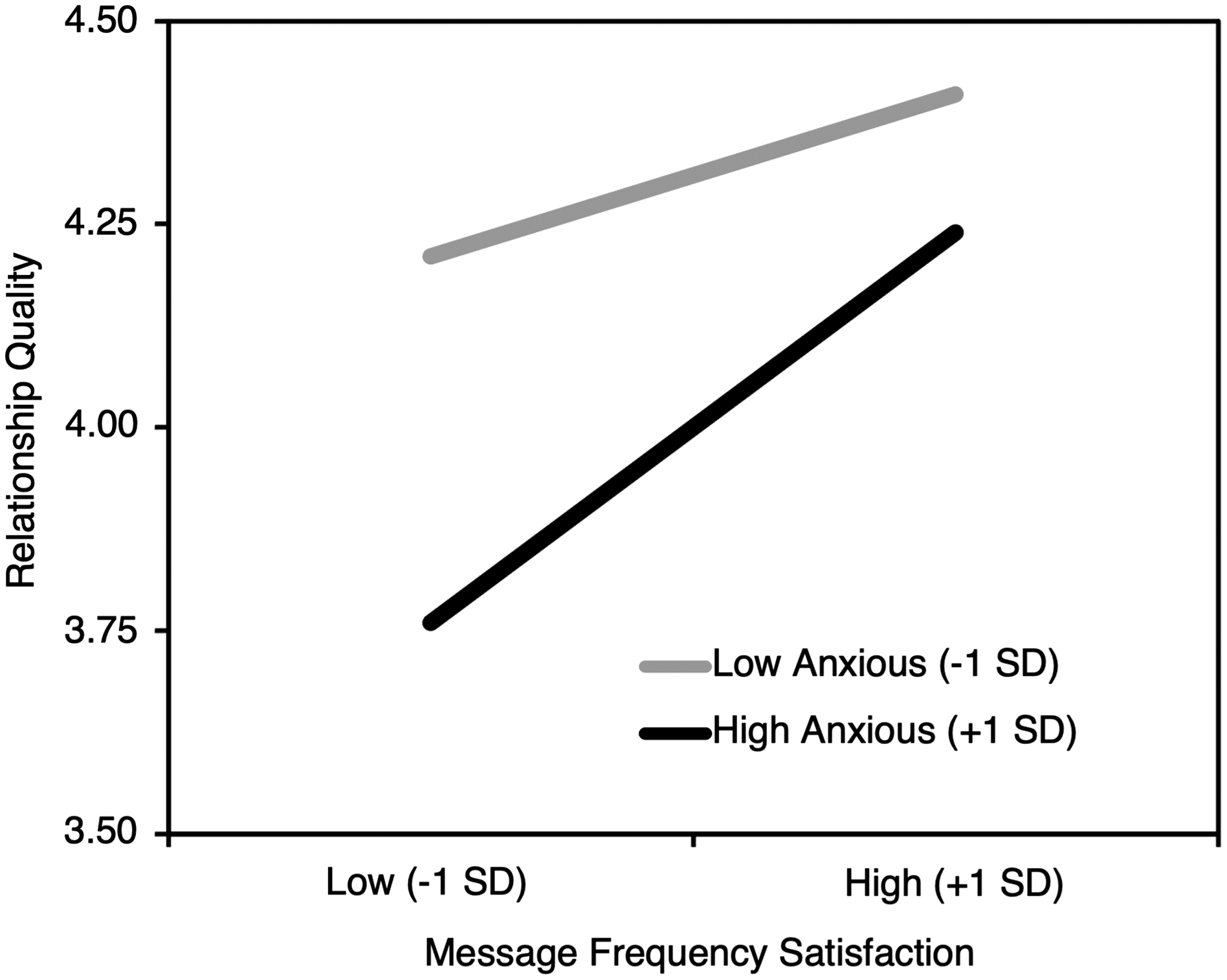
Relationship quality as functions of anxious attachment and MFS. MFS, message frequency satisfaction.
Relationship Quality as Functions of Attachment and Message Frequency Satisfaction
Note: N = 302.
Discussion
Our findings are unique in showing that the actual numbers of messages that people send to and receive from their romantic partners—and the latencies between them—correlate with anxious and avoidant attachment in theoretically consistent and meaningful ways. These findings are important because people's attachment dimensions may influence expectations about their own and their dating partner's electronic communication frequency. Thus, attachment mismatches (e.g., combining anxious and avoidant partners) may suffer from poor electronic communication expectations, and hence, relationship dissatisfaction.
Our findings were more consistent with prior research showing that avoidant attachment related to less frequent text messaging 5 than other research showing no association. 6 Because people who are more anxiously or avoidantly attached tend to rely more on texting (vs. other forms of communication) to interact with their partners, 7 our findings suggest that understanding how attachment differences relate to communication are especially important as electronic romantic interactions become increasingly frequent. Our findings also advance adult attachment theory in at least two ways. First, they show that individual differences in both attachment dimensions have specific behavioral signatures regarding electronic communication—or lack thereof—among romantic partners. Second, they indirectly bolster theoretical accounts linking attachment to relationship satisfaction via effective communication.
Limitations and constraints on generality
Because recall memory is subject to cognitive biases and heuristics, 20 there is doubtlessly some nonsystematic measurement error in participants' estimates of message response latencies and intervals. Furthermore, the generalizability of our findings is limited to our convenience sample of students enrolled in introductory psychology courses at the University of Florida, who were mostly White heterosexual women. 21 Thus, these findings may not generalize to other more diverse populations or cultures. For example, greater attachment avoidance is more strongly linked to heightened conflict, less perceived support, less investment, and poorer relationship satisfaction in societies that are more collectivist than the United States. 22 Moreover, because emojis can facilitate interpersonal connections by directly conveying emotional romantic content, future studies could explore how attachment is related to emoji use in romantic relationships. 23
Conclusions
We hope that this study will enable a better understanding of how attachment relates to messaging frequency and how they interact in relation to relationship satisfaction. This study is important because it provides insight into how messaging and attachment dimensions relate to estimates of actual messaging behavior, including response latencies and intervals. The present results not only highlight the importance of messaging in romantic relationships but also show how individual differences in anxious and avoidant attachment relate to people's expectations about messaging and even actual messaging frequency. We urge future researchers to focus on metrics including messages exchanged and response latencies because people's perceptions of their partner's messaging frequency—and how long it takes their partner to respond—are crucial to relationship communication and satisfaction.
Footnotes
Acknowledgments
This article is based on the honors thesis of the first author (now at Miami University in Oxford, Ohio), which was supervised by the second author (now at the University of British Columbia in Vancouver, Canada), and indirectly supervised by the third author.
Authors' Contributions
The first author designed and conducted the research, analyzed the data, and contributed to writing the article. The second author contributed to conducting the research, analyzing the data, and writing and revising the article. The third author contributed to analyzing the data and writing and revising the article.
Author Disclosure Statement
No competing financial interests exist.
Funding Information
No funding was received for this article.