




Abstract
With a novel multilingual approach, this cross-cultural meta-analysis study investigated the associations between personality traits and Internet addiction. Articles were identified and retrieved by searching through general and language-specific databases, and thereafter reviewed for inclusion based on the selection criteria. Random effects models with the Hartung–Knapp–Sidik–Jonkman method were used to examine the associations of Internet addiction with seven personality traits: Openness, Conscientiousness, Extraversion, Agreeableness, Neuroticism, Psychoticism, and Lie (OCEAN-PL). Forest plots with summary statistics were produced to inspect the between-study heterogeneity. Subgroup analysis was performed to further determine the contributions of moderators (geographic region, population subgroup, scales for assessing personality traits and Internet addiction, and language of publication) to the observed between-study heterogeneity. Funnel plots and Egger's test were used to detect possible small-study effects. A sample of 34,438 participants from 37 studies (24 from Asia) were included for data analysis. The major languages of publications of the selected articles were English and Asian languages. According to the pooled results, Internet addiction was associated positively with Neuroticism and Psychoticism, but negatively with Conscientiousness, Extraversion, Agreeableness, and Lie. Geographic region and language of publication significantly moderated the associations of Internet addiction with Agreeableness and Neuroticism, and Openness and Extraversion, respectively. No significant small-study effect was present for all OCEAN-PL personality traits, except Neuroticism. In conclusion, the Internet addiction group is relatively more neurotic and psychotic, and less conscientious, extraverted, agreeable, and untruthful than the nonaddiction group. A multilingual approach is useful for improving the search strategies for systematic reviews, cross-cultural meta-analyses in particular.
Introduction
The American Psychiatric Association (APA) has defined the diagnostic criteria for Internet gaming disorder, a subtype of Internet addiction disorder, in the Diagnostic and Statistical Manual of Mental Disorders, 5th Edition (DSM-5). 1 Moreover, the World Health Organization (WHO) has included gaming disorder in the 11th Revision of the International Classification of Diseases (ICD-11). 2 According to a recent meta-analysis among 53,184 subjects from 113 studies, the prevalences of general Internet addiction and Internet gaming addiction were 7.02 percent and 2.47 percent, respectively. 3 Recent electroencephalography studies have provided evidence to support the biological plausibility of the associations between personality traits and Internet addiction. For example, a significantly lower functional connectivity in the major brain networks linking to personality traits, including central executive network, salience network, and anterior default model network, was revealed among the Internet game disordered group in comparison with the healthy control group. 4
In psychological trait theory, the big five personality traits, also known as OCEAN, are a widely used taxonomy of personality traits. 5 This five-factor model (FFM) 6 has provided the basis for the dimensional classification of personality disorders in DSM-5. 7 Each of these five traits represents a continuum of trait disposition: Openness (O) is the trait disposition of willingness to venture into new experiences, Conscientiousness (C) is the trait disposition of self-discipline and diligence, Extraversion (E) is the trait disposition of sociability and assertiveness, Agreeableness (A) is the trait disposition of compassion and trust, and Neuroticism (N) is the trait disposition of susceptibility of anxiety and depression. In addition to the FFM, Psychoticism (P) from the Psychoticism, Extraversion, and Neuroticism model 8 and Lie (L) from the Eysenck personality inventory 9 are two commonly assessed personality traits for understanding different facets of personality. Psychoticism (P) is the trait disposition of aggression and impulsivity, and Lie (L) is the trait disposition of dishonesty for social desirability.
No single addictive personality is common to all addictive behaviors, but individuals with outlying personality traits could be prone to addiction due to emotional dysregulation. For instance, a meta-analysis has reported that a higher level of Openness (r = 0.018) and lower levels of Conscientiousness (r = −0.155) and Agreeableness (r = −0.092) were significantly related to alcohol drinking. 10 Another meta-analysis indicated a higher level of Neuroticism (r = 0.11), and lower levels of Conscientiousness (r = −0.16) and Agreeableness (r = −0.12) were significantly associated with smoking. 11 Regarding Internet addiction, Floros and Siomos' systematic review on personality traits and Internet disorder symptoms suggested that Internet addiction symptoms were generally positively associated with Neuroticism and Psychoticism, but negatively with Conscientiousness and Extraversion. 12 To date, only one relevant meta-analysis study has been conducted. Its results suggested that Internet addiction was significantly and positively associated with Neuroticism (r = 0.18), but negatively with Openness (r = −0.06), Conscientiousness (r = −0.21), Extraversion (r = −0.15), and Agreeableness (r = −0.18). 13 Nonetheless, this previous meta-analysis suffered from limited comprehensiveness. Non-English publications were not reviewed in the literature review process. Moreover, a limited number of studies (n = 12) with only adult samples were included for data analysis. Furthermore, only the FFM personality traits were examined. Lastly, potential moderators of the associations were not investigated.
About 25 percent to 65 percent variations of personality traits could be accounted for by genetic inheritance, 14 but environmental factors, including cultures, should not be neglected. Languages are sine qua nons to gain insights into cultures. They not only bind people to cultures but also shape individuals' attitudes toward behaviors. Meta-analysis per se is a fundamental quantitative method for conducting systematic reviews. Cross-cultural meta-analysis is a special type of meta-analysis with two main branches, namely culture-mediated meta-analysis and culture-inclusive meta-analysis. 15 Currently, there is no protocol for conducting cross-cultural meta-analyses. The major guidelines for reporting meta-analysis, namely preferred reporting items for systematic reviews and meta-analyses (PRISMA) 16 and its latest version 17 ; as well as meta-analysis of observational studies in epidemiology (MOOSE) 18 do not have specific items for multilingual literature searches and reviews in cross-cultural meta-analyses. Although non-English native speakers may still prefer publishing in English to other languages to gain better academic recognition, 19 publications in Asian languages are becoming prevailing. 20 At the same time, nonmainstream academic languages such as Nordic languages 21 did not receive sufficient attention in meta-analyses. For these historical reasons, most researchers would assume English is the lingua franca of academic publications and exclude studies with abstracts in other languages from their meta-analyses.
The aims of this study were twofold. First, it examined the associations between personality traits Openness, Conscientiousness, Extraversion, Agreeableness, Neuroticism, Psychoticism, and Lie (OCEAN-PL) and Internet addiction, and the moderators including cultural groups. Second, it illustrated a novel multilingual approach to conduct a cross-cultural meta-analysis for the improvement of comprehensiveness.
Methods
Keywords were shortlisted by the panel members. Since our scope was general Internet addiction, specific Internet behaviors were not enlisted. These keywords were then classified into two keyword sets: (a) personality traits (Openness, Conscientiousness, Extraversion, Agreeableness, Neuroticism, Psychoticism, and Lie); and (b) Internet addiction (problematic Internet use, and addictive Internet behaviors). Combinations of keywords from each set were used for database searching. The same sets of keywords were also translated to major languages for iterations of the searching processes through language-specific databases for Asian and non-Asian languages (Table 1). Abstracts of candidate articles, regardless of their languages, were identified and retrieved by the multilingual author team independently. Full texts were then reviewed and selected for inclusion into data analysis according to the following inclusion and exclusion criteria.
List of Language-Specific Databases
Inclusion and exclusion criteria
We included all empirical studies that (a) were published in both peer-reviewed and nonpeer-reviewed journals, and degree theses published between January 2000 and December 2020; (b) were written in English and other major academic languages (Chinese, Japanese, Korean, German, French, Spanish, and Nordic languages); (c) examined big-five personality traits using major scales, including but not limited to (i) Big Five Inventory (BFI), (ii) Eysenck Personality Questionnaire (EPQ), (iii) NEO Five-Factor Inventory (FFI)/Revised NEO Personality Inventory (NEO PI-R), (iv) Quick Big Five (QBF), (v) Ten Item Personality Inventory (TIPI); and (d) provided sufficient information (from the articles or after contacting the authors) of summary statistics to calculate effect size measures.
We excluded studies that (a) did not specify or used nonstandard big-five personality measures; (b) did not specify or used nonstandard Internet addiction measures; (c) lacked sufficient information for calculating effect size measures; and (d) were nonempirical, such as case reports. The literature selection process is displayed in a PRISMA flow chart (Fig. 1).
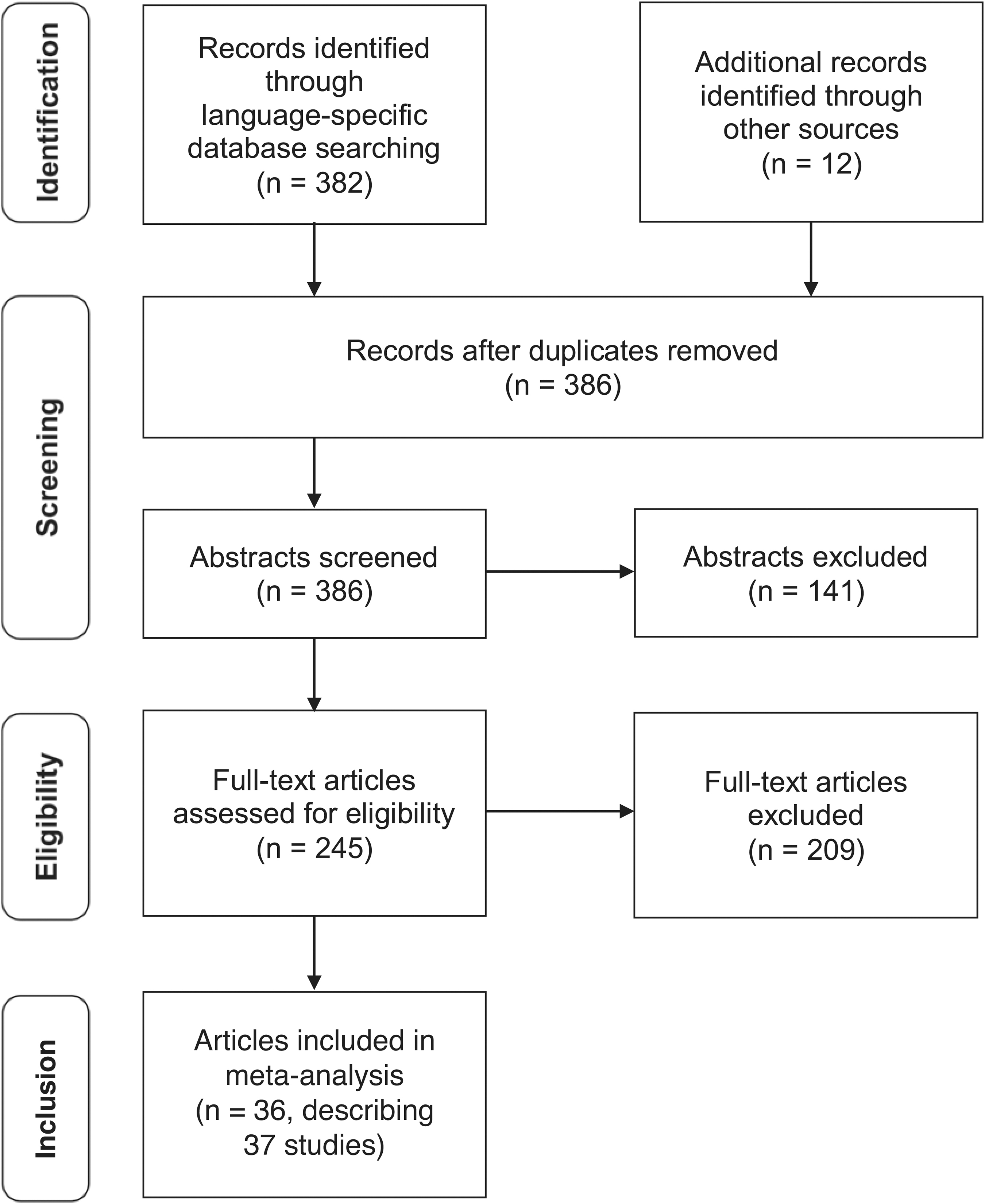
PRISMA flow diagram. PRISMA, preferred reporting items for systematic reviews and meta-analyses.
Effect size calculation
Data extracted from the selected articles were used to compute the effect size measures, according to their summary statistics. Standardized mean differences (SMD) were calculated from the mean personality trait scores. Hedges' g statistic was then used to obtain the unbiased SMD as a corrected effect size. 22 When mean personality trait scores were not available, correlation coefficient was used directly as an effect size.
Between-study heterogeneity estimation and subgroup analysis
With a conservative approach, both fixed and random effect estimates, and their corresponding variances were calculated for comparisons. To produce refined variance estimators, the Hartung–Knapp–Sidik–Jonkman method was used for adjustment. 23 The summary statistics and associated confidence intervals for both fixed-effect and random-effects models are shown in forest plots. Cochran Q statistic 24 and I2 statistic 25 were used to estimate the between-study heterogeneity. The I2 statistic value could range from 0 to 100 percent (25 percent is low, 50 percent is medium, 75 percent is high).
As post hoc tests, both sample-level and study-level factors were tested as categorical moderators of the associations between individual personality traits and Internet addiction. Sample-level moderators tested were geographical region (as a proxy of culture) and population subgroup. Moreover, study-level moderators tested were scale for assessing personality traits, scale for assessing Internet addiction, and the language of publication. Q statistics for between-subgroup heterogeneity were computed to determine the possible moderating effects.
Small-study effect examination
Funnel plots were produced for the mean difference studies, as a visual aid for asymmetry inspection. Egger's test for funnel plot asymmetry was, thereafter used to examine the presence of significant small-study effects. The R packages metafor 26 and dmetar 27 were used for this meta-analysis.
Results
Study characteristics
After abstract screening, 245 full-text articles with 146 in Asian languages and 99 in non-Asian languages were selected for review. A total of 36 articles describing 37 studies were included into the final data analysis. Among these 36 selected articles, 13 were in Asian languages (10 in Chinese, 2 in Japanese, 1 in Korean), 21 were written in English, 1 in German, and 1 in Spanish (Table 2).
Articles Identified and Included by Languages
One article included two studies.
The study characteristics including sample gender and age distributions, language of publication, and country are listed with stratification by geographical region in Tables 3 and 4. The overall sample size for data analysis was 34,438. There were 24 studies from Asian (n = 20,329) and 13 studies from non-Asian (n = 14,109) regions. In terms of summary statistics, 23 studies reported the mean differences of personality trait scores between Internet addiction and non-Internet addiction groups. At the same time, 14 studies reported the correlation coefficients between personality trait scores and Internet addiction scores. All 37 studies were cross-sectional, except 1 study that used a longitudinal study design. Moreover, 17 were among college and 10 were among secondary school students. Besides, the assessment scales for measuring personality traits and Internet addiction are recorded in Tables 5 and 6. The most frequently used personality assessment scales were EPQ (n = 16), BFI (n = 8), and NEO FFI/NEO PI-R (n = 7). Furthermore, the majority of scales used for determining Internet addiction were Internet Addiction Test (IAT) (n = 15), Young Diagnostic Questionnaire (YDQ) (n = 10), as well as Revised Chen Internet Addiction Scale (CIAS-R) (n = 7).
Basic Characteristics of Participants in the Included Non-Asian Studies
Personality Trait and Internet Addiction Assessments in Asian Studies
BFI, Big Five Inventory; CIAS-R, Revised Chen Internet Addiction Scale; EPQ, Eysenck Personality Questionnaire; FFPQ, Five Factor Personality Questionnaire; IAT, Internet Addiction Test; NEO-FFI, NEO Five-Factor Inventory; NEO-PI-R, Revised NEO Personality Inventory; YDQ, Young Diagnostic Questionnaire.
Personality Trait and Internet Addiction Assessments in Non-Asian Studies
ABPT, Adjective Based Personality Test; CIUS, Compulsive Internet Use Scale; IPIP, International Personality Item Pool; ISS, Internetsuchtskala [Internet Addiction Scale]; NEO-FFI-R, NEO Five-Factor Inventory-Revised; OCS, Online Cognition Scale; OSVe-S, Skala zum Onlinesuchtverhalten [Scale for Online Addictive Behavior]; QBF, Quick Big Five; SDI, Self-Description Inventory; TIPI, Ten Item Personality Measure; TPUI, Test Problematycznego Używania Internetu [Problematic Internet Use Test].
Basic Characteristics of Participants in the Included Asian Studies
Pooled effect sizes and between-study heterogeneity
High I2 values (>50 percent) were obtained for all OCEAN-PL personality traits across studies with mean differences and correlation coefficients as the summary statistics. As a result, random effects models, instead of fixed effects models, were regarded as appropriate for result interpretations.
According to the random effects model results (Fig. 2 Panels A to G) among the mean difference studies, the SMD between addiction groups was positive for Openness (SMD = 0.07, 95% CI = −0.26 to 0.39, p = 0.61), Neuroticism (SMD = 0.54, 95% CI = 0.38 to 0.69, p < 0.0001), and Psychoticism (SMD = 0.52, 95% CI = 0.35 to 0.69, p < 0.0001); but negative for Conscientiousness (SMD = −0.36, 95% CI = −0.68 to −0.04, p = 0.03), Extraversion (SMD = −0.22, 95% CI = −0.35 to −0.09, p = 0.002), Agreeableness (SMD = −0.28, 95% CI = −0.46 to −0.09, p = 0.01), and Lie (SMD = −0.42, 95% CI = −0.57 to −0.28, p < 0.0001).
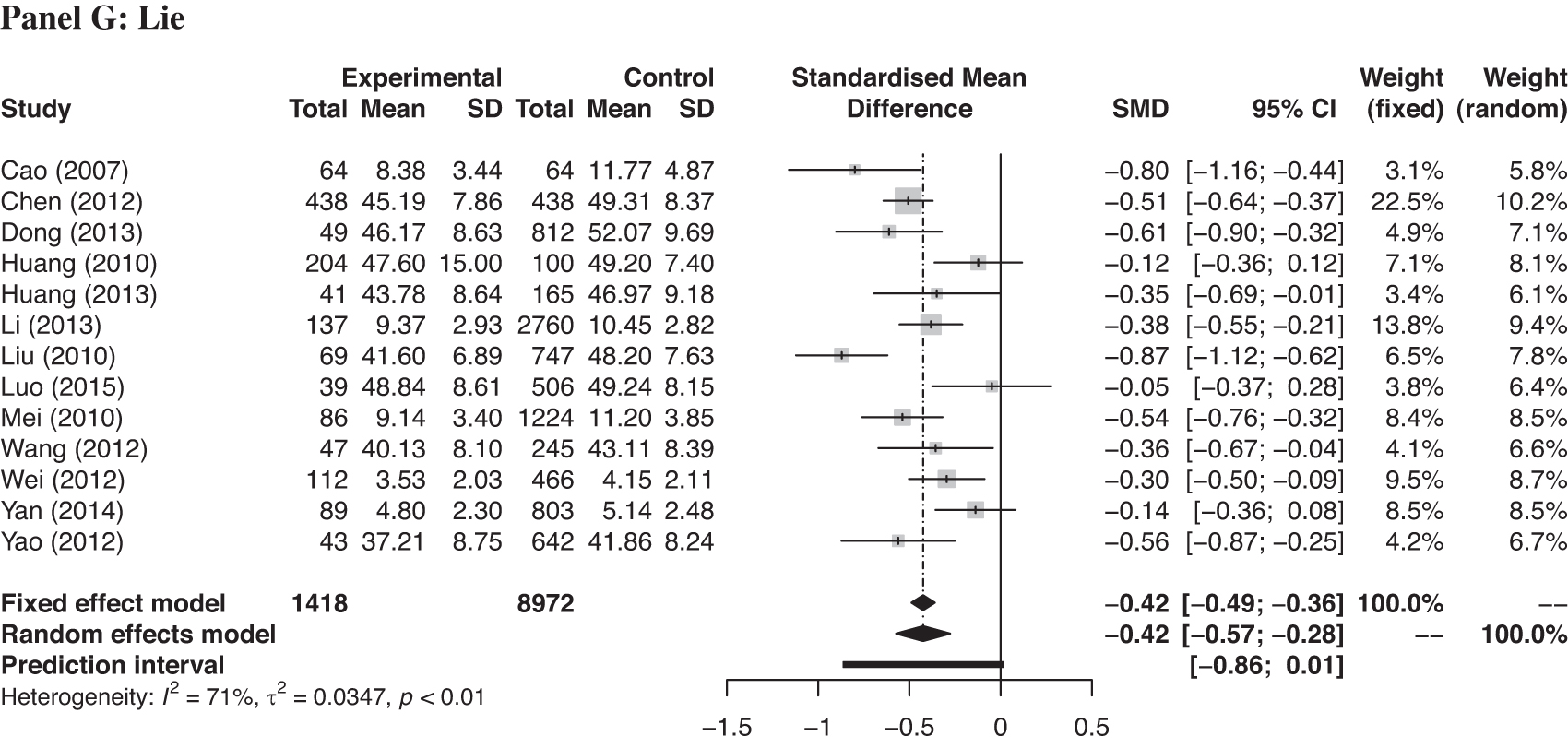
Forest plots for the OCEAN-PL personality traits produced from random effects models. Studies with SMDs and correlation coefficients as the effect size measures are shown on the top and bottom, respectively, in each panel. Panel A: Openness; panel B: Conscientiousness; Panel C: Extraversion; Panel D: Agreeableness; Panel E: Neuroticism; Panel F: Psychoticism; Panel G: Lie. SMD, standardized mean difference.
Moreover, the between-study heterogeneity was moderate to substantial for all those seven personality traits: Openness (I 2 = 96 percent, τ 2 = 0.1259, p < 0.01), Conscientiousness (I 2 = 92 percent, τ 2 = 0.0543, p < 0.01), Extraversion (I 2 = 83 percent, τ 2 = 0.0441, p < 0.01), Agreeableness (I 2 = 74 percent, τ 2 = 0.0136, p < 0.01), Neuroticism (I 2 = 93 percent, τ 2 = 0.1159, p < 0.01), Psychoticism (I 2 = 82 percent, τ 2 = 0.0621, p < 0.01), and Lie (I 2 = 71 percent, τ 2 = 0.0347, p < 0.01).
Besides, the random effects model results (Fig. 2 Panels A to E) among the correlation coefficient studies show that the pooled correlation coefficient was positive for Neuroticism (r = 0.22, 95% CI = 0.08 to 0.34, p = 0.0047), but negative for Openness (r = −0.09, 95% CI = −0.14 to −0.05, p = 0.0008), Conscientiousness (r = −0.30, 95% CI = −0.36 to −0.24, p < 0.0001), Extraversion (r = −0.16, 95% CI = −0.25 to −0.06, p < 0.001), and Agreeableness (r = −0.22, 95% CI = −0.27 to −0.16, p < 0.0001).
Furthermore, the between-study heterogeneity was moderate to high for all those five personality traits, with I2 = 64 percent, τ 2 = 0.0049, p < 0.01 for Openness, I2 = 93 percent, τ 2 = 0.0099, p < 0.01 for Conscientiousness, I2 = 94 percent, τ 2 = 0.0293, p < 0.01 for Extraversion, I2 = 78 percent, τ 2 = 0.0083, p < 0.01 for Agreeableness, and I2 = 99 percent, τ 2 = 0.0554, p < 0.01 for Neuroticism.
Between-subgroup heterogeneity
Based on the subgroup results among the mean difference studies (Table 7), geographic region was a significant moderator in the associations of Internet addiction with Agreeableness (Q = 8.13, p = 0.004). Moreover, population subgroup significantly moderated the association of Internet addiction with Extraversion (Q = 7.99, p = 0.02) and Agreeableness (Q = 7.66, p = 0.02). In addition, scale for assessing personality traits was a significant moderator for the associations between Internet addiction and Openness (Q = 53.16, p < 0.0001), Conscientiouness (Q = 10.47, p = 0.005), and Extraversion (Q = 24.06, p < 0.0001). Furthermore, scale for assessing Internet addiction was a significant moderator of Neuroticism (Q = 8.92, p = 0.03) and Psychoticism (Q = 16.81, p = 0.0002).
Subgroup Analysis Results of Studies with Standardized Mean Difference As An Effect Size
N/A, not applicable.
At the same time, subgroup results among the correlation coefficient studies (Table 8) show that geographic region was a significant moderator in the association between Internet addiction and Neuroticism (Q = 7.66, p = 0.02). Moreover, language of publication significantly moderated the associations of Internet addiction with Openness (Q = 4.93, p = 0.03) and Extraversion (Q = 4.38, p = 0.04). In addition, population subgroup was a significant moderator in the association between Internet addiction and Extraversion (Q = 7.94, p = 0.02). Furthermore, scale for assessing Internet addiction was a significant moderator in the association between Internet addiction and Conscientiousness (Q = 6.04, p = 0.049). No significant moderator was found in the association between Lie and Internet addiction.
Subgroup Analysis Results of Studies with Correlation Coefficient as An Effect Size
Small-study effects
Funnel plots corresponding to the OCEAN-PL personality traits are displayed (Fig. 3 Panels A to G). Egger's test results did not indicate significant small-study effects for all personality traits: Openness (p = 0.95), Conscientiousness (p = 0.23), Extraversion (p = 0.94), Agreeableness (p = 0.58), Psychoticism (p = 0.96), Lie (p = 0.99), except Neuroticism (p = 0.03).

Funnel plots for studies with SMD as an effect size. Panel A: Openness; Panel B: Conscientiousness; Panel C: Extraversion; Panel D: Agreeableness; Panel E: Neuroticism; Panel F: Psychoticism; Panel G: Lie.
Discussion
To our knowledge, this is the first cross-cultural meta-analysis adopting a multilingual approach to assure the comprehensiveness of the literature searching and reviewing processes. Internet addiction is prevalent in Asia, from where extensive research interests were drawn. 28 Including publications in Asian languages into systematic reviews on Internet behaviors is, therefore, becoming a necessary procedure.
From our results, Internet addiction was significantly associated with six personality traits; positively with Neuroticism and Psychoticism; as well as negatively with Conscientiousness, Extraversion, Agreeableness, and Lie. The results relating Internet addiction to Openness were inconsistent among mean difference and correlation coefficient studies. In the following, interpretations of the results on the arrays of individual personality traits and Internet addiction are provided.
Openness and Internet addiction
Existing findings on the associations between Openness and addictive Internet behaviors are mixed. Openness was negatively associated with Facebook addiction among adults in the United Kingdom, 29 as well as Poland, Turkey, and Ukraine, 30 but no significant association was found among adults in Italy 31 and college students in India. 32 Moreover, no significant association between Openness and smartphone addiction was reported in another meta-analysis. 33 Our study verified the association between Openness and Internet addiction and found no significant association.
Conscientiousness and Internet addiction
Previous studies mostly suggested negative associations between Conscientiousness and addictive Internet behaviors. For example, Conscientiousness was significantly and negatively correlated with Facebook addiction in German children and adults, 34 as well as other European adults. 30 Similarly, a significant negative association between Conscientiousness and smartphone addiction was found in another meta-analysis. 33 Our meta-analysis results endorsed these results and showed a negative association between Conscientiousness and Internet addiction. Conscientious individuals are less likely to engage in addictive Internet activities than others, probably due to their better self-regulation ability. 35 As stated in another systematic review, impaired self-awareness could lead to addictive behaviors. 36
Extraversion and Internet addiction
Available results on the associations between Extraversion and addictive Internet behaviors are inconsistent. On one hand, Extraversion was significantly and negatively related to Facebook addiction in adults from three European countries. 30 On the other hand, a significant and positive association between Extraversion and smartphone addiction was concluded in another meta-analysis. 33 Results from our meta-analysis showed a negative association between Extraversion trait and Internet addiction. Extroverts may prefer a social life with more face-to-face than virtual interactions, as reported in a college student study. 37
Agreeableness and Internet addiction
Most study findings suggested negative associations between Agreeableness and addictive Internet behaviors. For instance, Agreeableness was significantly and negatively associated with Facebook addiction in adults from three European countries. 30 A college student survey also found a significant negative association between Agreeableness and Instagram. 38 Likewise, a significant and negative association (r = −0.13, p < 0.001) between Agreeableness and smartphone addiction was determined in another meta-analysis. 33 Our meta-analysis results affirmed these observations, showing a negative association between Agreeableness and Internet addiction. Agreeable persons tended to be empathetic and altruistic. Low empathy level was also related to Internet addiction in German and Chinese adolescents. 39 These results were supported by an electroencephalogram (EEG) study stating an impaired capacity for empathy among the Internet addiction disordered group. 40
Neuroticism and Internet addiction
Past findings generally showed positive associations between Neuroticism and addictive Internet behaviors. For instance, higher Neuroticism was associated with Internet addiction in Chinese 41 and Taiwanese 42 college students. In another Chinese college student study, Neuroticism was positively associated with Internet addiction directly and indirectly through impulsivity. 43 Moreover, a previous meta-analysis suggested a significant and positive correlation between Neuroticism and smartphone addiction. 33 In our meta-analysis, a positive association between Neuroticism trait and Internet addiction was also observed. Individuals with a high level of Neuroticism may be emotionally unstable and less able to develop self-control. 35 A study among Polish high school students also reported a higher Internet addiction risk among those with a lower emotional intelligence level than others. 44
Psychoticism and Internet addiction
The majority of literature reported positive associations between Psychoticism and addictive Internet behaviors. For instance, psychotic university students in Turkey 45 and psychotic Korean adults 46 were more likely to have Internet addiction. In a 2-month followup study among young U.S. adults, decreasing psychotic experience was found to improve addictive Internet behaviors. 47 Likewise, a significant and positive association between Psychoticism and phone addiction was reported in another meta-analysis. 33 In alignment with these findings, our meta-analysis results showed a positive association between Psychoticism and Internet addiction. Psychotic individuals may be perceived as hostile and aggressive in real life, and perceived better popularity in virtual environment. Such a high level of aggressiveness was related to a higher chance of Internet addiction, as shown in a Korean adolescent study. 48
Lie and Internet addiction
No relevant finding regarding the associations between Lie and addictive Internet behaviors is available for discussion. Our meta-analysis results showed a negative association between the Lie and Internet addiction. Social desirability was found to moderate the associations of social media use status and frequency with problematic social media use among Turkish university students. 49 Various forms of lying exist, 50 which could be difficult to be captured by scales in questionnaires. Furthermore, participants with a high level of Lie may be deceitful and not disclose the actual Internet behaviors in studies.
OCEAN-PL personality traits and Internet addiction
In summary, neurotic and psychotic individuals may experience negative emotions more often than others and thus have a higher Internet addiction risk. In reverse, conscientious, extrovert, and agreeable individuals may be less likely to experience negative emotions and become addicted to Internet activities than others. The directions of our findings are by and large consistent with the previous systematic review 12 and meta-analysis, 13 regarding the associations of Internet addiction with OCEAN personality traits, except Openness. Indeed, opposite directions of the association between Internet addiction and Openness were reported in these two studies. The present cross-cultural meta-analysis enriched our knowledge on this topic with additional personality traits and cultural moderators.
Moderators
Population subgroup was found to be a significant moderator in the associations between Internet addiction with Extraversion and Agreeableness. It is possible that different age groups used different ways to adapt Extraversion and Agreeableness personality traits. According to a meta-analysis of 16 longitudinal studies, the trajectories of big five personality traits varied across countries. 51
Moreover, results from the mean difference and correlation coefficient studies, respectively, indicated that the significant associations of Internet addiction with Agreeableness and Neuroticism could be moderated by geographical regions. The respective negative and positive associations of Agreeableness and Neuroticism with Internet addiction were stronger in Asian than in non-Asian countries. Individualistic cultures in Western and collectivist cultures in Asian countries were always construed as the underlying factors of cross-cultural variations of behaviors. 52 A 56-country study reported different Agreeableness and Neuroticism among Asian people from their counterparts in other regions. 53 A recent meta-analysis also suggested that dimensions of culture values, collectivism and individualism, may moderate the associations between big five personality traits and problematic mobile phone use. 33
Furthermore, significant moderating effects of the language of publication on the associations of Openness (nonsignificant in the pooled results) and Extraversion (significant in the pooled results) with Internet addiction were observed. Although the language of publication may not necessarily represent the spoken language of a study sample, non-English publications are usually based on studies in non-English speaking samples with limited cultural competence. 54 Open-minded people and extroverts participated in a wide range of real-life activities from physical to mental, and social ones and could less likely to rely on Internet activities due to time competition. 55 Perhaps such protective effects of Openness and Extraversion on Internet addiction were more prominent among less culturally competent populations than those with better cultural competence.
In addition, scales for assessing personality traits and Internet addiction showed moderating effects on the associations between several personality traits and Internet addiction. Further investigations of these equivocal observations may be warranted.
Small-study effects
Regarding the funnel plot asymmetry detection, Egger's test results may not be interpretable for those cases with less than 10 studies. A possible reason for the observed significant small-study effect for Neuroticism could be publication bias.
Strengths and limitations
Results of this meta-analysis should be interpreted with caution. This study tried to include studies published in major Asian and non-Asian languages, however, it was by no means exhaustive. Culling all the search terms in these languages is also implausible. Candidate articles were reviewed by authors speaking different languages. Most of the included studies in this meta-analysis were cross-sectional studies. Moreover, their results were mainly based on self-reported data. Besides, possible mediators between personality traits and Internet addiction were not examined in this meta-analysis. Owing to incomplete information from the original studies, gender as a potentially important moderator was not included in the subgroup analysis. Although exact ages were not available from all included studies, the population subgroup served well in representing the age groups. Some included studies did not report the Internet addiction prevalence, therefore, could not be included in the subgroup analysis and funnel plots.
Random effects model results had to be computed with stratification by two effect size measures (i.e., SMD and correlation coefficient), due to the insufficient information from the included studies for combining results. Nonetheless, the directions of the significant associations between Internet addiction and the OCEAN-PL personality traits were consistent, regardless of the effect size measures.
Implications
This cross-cultural meta-analysis provides a reference for future Internet behavior research and methodology development. Assessing personality traits will be beneficial to the screening of high Internet addiction risk groups in epidemiological studies and designing behavioral therapies. Language biases can be more prominent in cross-cultural meta-analyses that require information generated from culturally diverse populations. Using a conventional approach will exclude non-English articles, and may hence induce unintentional “language biases” and defeat the original purposes of conducting a meta-analysis. Building a multilingual research team for searching and reviewing non-English articles in meta-analyses will be a vexing challenge, but a new trend.
Conclusion
Internet addiction group is more likely to have higher levels of neuroticism and psychoticism, and lower levels of conscientiousness, extraversion, agreeableness, and lying when comparing with others. Cross-cultural meta-analyses are useful to understand the associations between personality traits and Internet behaviors. Adopting a multilingual approach will improve the comprehensiveness of the conventional search strategies for systematic reviews, especially cross-cultural meta-analysis studies.
Footnotes
Acknowledgment
Translation support was provided by Arlette Melo, National Autonomous University of Mexico, Mexico (Spanish language) and Joonas Niinistö, Lappeenranta-Lahti University of Technology, Finland (Nordic languages).
Authors' Contributions
K.K.M.: Development of the research concepts, literature search, study selection, data analysis, interpretation of results, development of manuscript drafts, and approval of final version for submission.
B.S.: Literature search, study selection, data analysis, interpretation of results, and development and review of manuscript drafts.
C.H.Y.: Literature search, study selection, preparation of illustrations, and review of manuscript drafts.
J.K.N.: Interpretation of results, and development and review of manuscript drafts.
S.O.: Literature search, study selection, interpretation of results, and review of manuscript drafts.
Author Disclosure Statement
No competing financial interests exist.
Funding Information
No funding was received for this study.