




Abstract
Nomophobia (no-mobile-phone phobia) is a relatively new term that describes the growing fear and anxiety associated with being without a mobile phone. Our study aims to determine the prevalence of nomophobia among the undergraduate students of Pakistan, and to determine its correlation with age and gender. It also aims to determine the contributory factors of nomophobia. A cross-sectional study was conducted through an online survey from March 25 to April 25, 2021. The snowball sampling technique was used for data collection. The Nomophobia Questionnaire (NMP-Q) developed by Yildirim and Correia was circulated among the target population. It was a 7-point Likert Scale that was analyzed on the basis of age and gender using IBM SPSS version 22 and MS Excel 2007. The contributing factors were also analyzed. Of the 483 responses we received, 28 were discarded due to incompleteness and respondents being out of age under study that is, 15–25 years. Most of the respondents were women (n = 314, 69.01 percent). Men were less in number than women (n = 141, 31 percent). The ages of most of the respondents lied between 15 and 25 years. Twenty was the mode age. One hundred eighty-six (40.88 percent) had severe, 221 (48.57 percent) had moderate, and 48 (10.55 percent) had mild nomophobia. Average factor-wise scores and individual item scores were also added. Our findings reached a conclusion that the majority of the undergraduate students in Pakistan suffer from nomophobia ranging from its mild to severe form. Nomophobia can possibly be included as a recognized phobia in the DSM. Wider research on the subject to investigate it further and evaluate the clinical significance should be done.
Introduction
Nomophobia (no-mobile-phone phobia) is a relatively new term that explains the increasing psychological dependence of people, especially young and adolescents, 1 on mobile devices the distress that follows when such contacts are lost. Although not enlisted in DSM 5, 2 it has been proposed as a phobia.
Smart phones are widely used for constant access to various services and features in both developed and developing countries alike. This increased use of smartphones for academic and nonacademic purposes, especially among teenagers (undergraduates), is giving rise to dependence along with other health concerns such as headaches and psychological concerns. 3 For example, a survey conducted by SecurEnvoy showed that 77 percent of the participants aged 18–24 years reported nomophobia. 4 A similar study in Australia revealed that the incidence of nomophobia and related psychological issues were proportional to the participants' frequency of use and onscreen time. 5
Nomophobia is associated with emotional anxiety and mood disorders. 6 Agitation and impulsive tendencies have also been reported in nomophobic individuals. 7
Lack of understanding and research of nomophobia in a gender-stratified society such as Pakistan makes this study crucial both statistically and analytically. This research also undertakes an inquiry into causative factors for nomophobia. Pakistan currently ranks 153rd out of 156 countries in gender gap ranking. 8
At the same time, Pakistan stands at eighth position globally by the number of mobile phone users. 9 This huge disparity between mobile phone users and gender equality raises questions about the impact of mobile phone use and its proposed role in creating awareness and progression toward a more gender-balanced society. Accepting de Beauvoir's conception of gender being a social construct 10 (One is not born, but rather becomes, a woman), this study highlights how the trends in mobile phone usage correlate with assumed gender roles in a patriarchal society such as Pakistan.
Materials and Methods
A cross-sectional study design with purposive sampling was used.
The participants were the English-literate and Internet accessing undergraduate students of Pakistan aged 15–25 years.
Owing to Covid-19 restrictions, an online Google form was generated and disseminated through social media platforms such as Facebook and Whatsapp to targeted individuals. Voluntary completion of the questionnaire was considered informed consent.
The responses were collected from April 5, 2021 to April 19, 2021. Nomophobia Questionnaire (NMP-Q) developed by Yildirim and Correia was circulated, and responses were recorded on 7-point Likert scale.
IBM SPSS version 22 and MS Excel 2007 were used for analyses.
Institutional Review Board of King Edward Medical University, Lahore, Pakistan, gave ethical approval for the research.
Results
A total of 483 responses were received during the 2-week time. Twenty-eight responses were discarded being incomplete or because of exclusion criteria.
The presence of nomophobia corresponded to the total score on NMP-Q being higher than a minimum of 20 (Table 1). Responses were recorded on a 7-point Likert scale with “1” denoting that the respondent “Strongly Disagrees” with the statement and 7 being a response of “Strongly Agreeing” with each item on the NMP-Q.
Nomophobia Assessment Scale
NMP-Q, Nomophobia Questionnaire.
Any respondent could theoretically score between 20 and 140.
The classification of nomophobia was obtained from Yildirim and Correia. 11
The responses obtained demonstrated that all of the respondents were nomophobic (n = 455, 100 percent). The lowest score was 21 (n = 1), and the highest obtained score was 140 (n = 4) (Table 2).
General Overview of the Results
● The most commonly reported total score, that is, Mode, was 84 (n = 12), lying in the Moderately Nomophobic category.
● The mean total score was 92.87, with a standard deviation (SD) of 24.90967 (Table 3).
● The median NMP-Q score was 93 (Fig. 1).
Mean Obtained Total Scores on Nomophobia Questionnaire
SD, standard deviation.
Results based on age
Since most of the respondents were undergraduate students, the ages of most of the respondents lied between 15 and 25 years. Twenty was the mode age (Fig. 2).
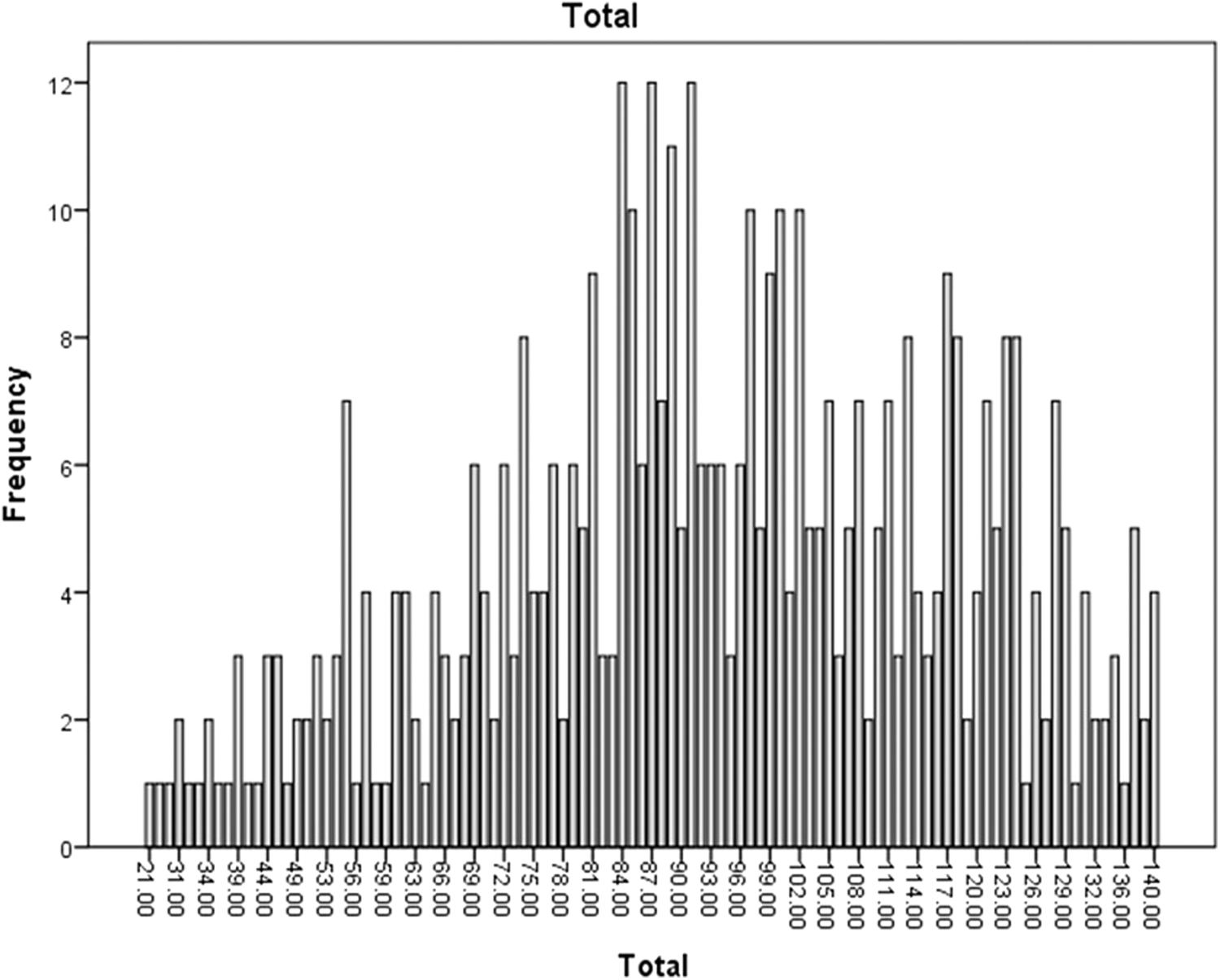
The score obtained on Nomophobia Questionnaire is plotted along X-axis, whereas the frequency of responses obtained against each score is plotted along Y-axis. The bell curve shows that the maximum responses were concentrated in the moderate nomophobia range with scores ranging from 60 to 99. Twelve people scored 84, 87, or 92, these being the most frequently obtained scores.
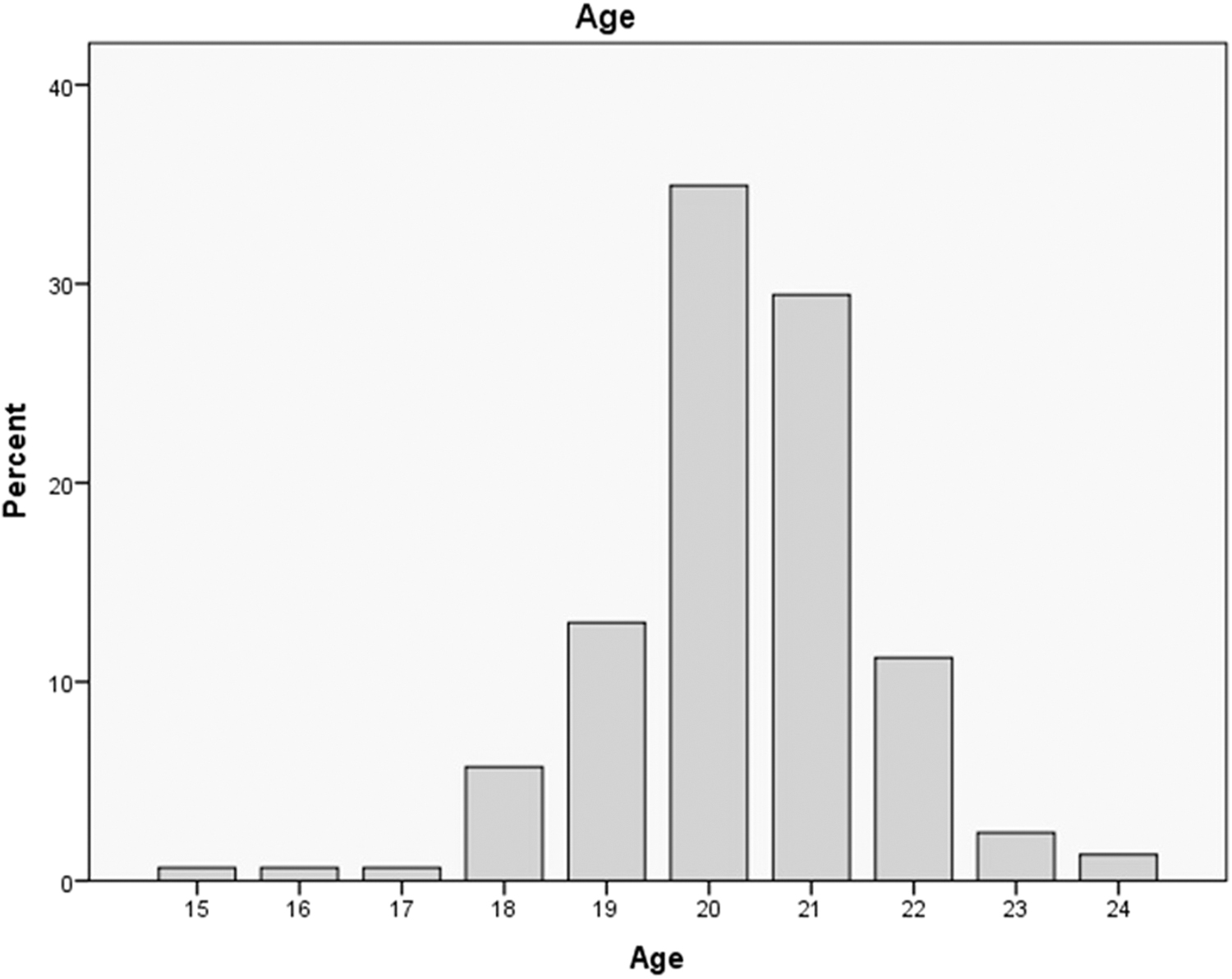
This bar graph shows the age distribution of the respondents. Ages in years are plotted along the X-axis and the percentages of the total respondents belonging to that particular age are plotted along Y-axis. Most of the respondents (around 35 percent) were 22 years of age.
Results based on gender
Most of the respondents were women (n = 314, 69.01 percent). Men were less in number than women (n = 141, 31 percent) (Fig. 3).

The pie chart shows the gender distribution of respondents. Female respondents are shown in light gray, making the majority (69 percent) of the total respondents. Male respondents are in minority (31 percent) shown in dark gray.
An effort to find any gender correlation with the presence or absence of nomophobia was also made (Table 4). It was found that women were more likely to report higher NMP-Q scores (mean = 94.14) (Table 5) than men (mean = 90.04) (Table 6). The p value came out to be 0.0480, which was statistically significant.
Evaluation of Gender Correlation to Total Score on Nomophobia Questionnaire
Women's Score on Nomophobia Questionnaire
Men's Score on Nomophobia Questionnaire
The results were notably lower for men than for women. The finding is consistent with other reported results to find the prevalence of nomophobia in two genders. 12
Average score factor wise
The original authors of the questionnaire found four aspects that contributed toward nomophobia in an individual. Similar factors were observed by those who developed other questionnaires of similar nature, investigating similar variables, such as mobile phone involvement questionnaire.
Among these, a significant correlation between a factor and its role in giving rise to nomophobia was observed. For example, on average, respondents got a score of 4.97 per question in items of factor 3, not being able to access information. This means that the biggest fear of respondents was that they might not be able to access information instantaneously if they lose touch with their phones. In contrast, the lowest average scores (4.10) were observed in responses to items of factor 4, giving up convenience (Table 7). This means that the fear that the respondent might have to give up convenience, in case of losing the phone, is not as important.
Average Score Corresponding to the Factors Contributing Toward Nomophobia
Results of individual items on the NMP-Q
A similar trend was observed while analyzing the scores of respondents on individual questions (Table 8). Item 2 “I would be annoyed if I could not look information up on my smart phone when I wanted to do so” elicited the strongest mean response, with respondents averaging a score of 5.60 with the lowest SD (1.54) in response to this item. Most of the respondents heavily rely on their phones to look up information on the Internet. Item 2 contributes toward factor 3 of not being able to access information, again confirming the underlying trends.
Item-Wise Average Scores on the Nomophobia Questionnaire
The lowest average score (3.79) was in response to Item 16. I would be nervous because I would be disconnected from my online identity. This means that respondents were not concerned with their online identity, and they did not fear losing touch with their online identity that much.
Discussion
The correlations between mobile phones and connectedness have been widely studied. 13 One important phobia is “Nomophobia.” 1 Recent researches have declared undergraduate and university going students to be the “at-risk” population of phone addiction. 14
One hundred percent of the studied individuals were nomophobic, with the majority (221, 48.57 percent) being moderately nomophobic.
An analysis of the compounding factors indicates that the following might be responsible for increased dependence on mobile phones in undergraduate students. This research was conducted during the Covid-19 pandemic. Similar researches2,15 show that staying at home increased due to social restrictions and heavy reliance on phones for academics and access to information.
The moderate level of nomophobia is also in line with similar research conducted worldwide, which shows that the level of nomophobia observed in students was statistically higher than graduates and employed youth. 16 In relation to gender, our results showed a direct relation of nomophobia being more prevalent in the female population than in the male population. These results are in line with the findings of other researches conducted in regions with similar sociocultural (India) or religious (Turkey) fabric similar to that of Pakistan. These include the studies done by Bhattacherjee et al., 17 Yildrim et al., 18 and Moreno-Guerrero et al. 19
The findings can be explained because the women are more likely to stay indoors in Pakistan for the better part of the day. The women's labor force participation rate in Pakistan stands at 21.67 percent, less than half compared with the world average of 47.23 percent. An increased time spent indoors means an individual is more likely to spend more time on the phone to decrease loneliness. 20 In the seminal study titled “Addressing the mobile gender gap in Pakistan”, research showed that between 2017 and 2019, the gender gap in phone usage decreased by a staggering 17 percentage points. 21 This indicates that mobile phone usage is increasing in favor of women in Pakistan.
Regarding gender roles and feminine expectations from women, Pakistan is seen as a conservative society with limited opportunities for diversification for women and other gender orientations. 22 Conventional gender roles dictate that women and girls have limited outdoor activities, as shown by Dr Bari's study. 23 This feminine orientation makes them more dependent on mobile phones while they are bound most of the time indoors. This finding falls impeccably in line with the main premise of the feminist epistemology of the socioeconomic as well as psychosocial gendering of the cyberspace. 24 These findings also support the cyberfeminist narrative that “there are differences between men and women specifically in digital discourses.” 25
Thus, the gender bias observed in nomophobia prevalence seems to stem from the sociological and cultural structures of the observed data sample, underpinning the reflection of sociocultural attitudes in the online world.
Regarding age as an influential factor, a distinct correlation could not be drawn since all the respondents ranged from 15 to 25 years. Furthermore, since most students were undergraduate university students, no significant correlation was found with age. Analyzing the four dimensions cited earlier, we found out that the two biggest contributing factors of nomophobia were [Factor I]: The fear of not being able to communicate (mean score per item = 4.89) and [Factor III]: The fear of not being able to access information (mean score per item = 4.97). The item that elicited the strongest affirmative reaction was item 2, which reads, “I would be annoyed if I could not look information up on my smart phone when I wanted to do so.”
This shows that the dependence on mobile phones is more for information access than for communication. Similar studies conducted worldwide corroborate the findings. 26
In Pakistan, where most people belong to lower socioeconomic backgrounds and the Human Development Index is among the lowest in the region, 27 affording multiple devices is not easy. Facts by the Pakistan Telecommunication Authority (PTA) show that cell phone users are twice the users of broadband in Pakistan (PTA reports). Even in developed countries such as the United States, the reliance on mobile phones for information has shot up because of ease and accessibility. 28 Item 9 elicited a high average score of 5.36 and an SD of 1.67 compulsive desire to check smart phones. Similar studies have cited OCD symptoms related to smart phone usage. 29 Item 11 also had a high average score of 5.33 with an SD of 1.69.
This also underlines that for the average undergraduate student, the use of a phone as a means of connectivity is secondary to its primary use as a means of information access. When we compared this with Item 10, which elicited a mean response score of 4.99 (SD 1.99), it became clear that the fear of “losing Instant access” measured by Item 10 was less significant. This can mean that although phones are used for staying in touch (Item 11), their utility as a means to get instant access (Item 10) to your closed ones is somewhat disputed. Item 16 recorded the lowest average response score of 3.69, which means that the population of Pakistan did not concern itself much with online identity and updating it continuously.
In the social context of Pakistan, the undergraduate population probably does not care much about it since this factor is populated by a more settled segment of the society. The influencer culture and maintaining an online identity, distinct from offline identity, are still not prevalent in the population under study. Item 8 had the highest variation in responses, with the SD standing at a staggering 2.03. This means that the use of navigation services and map utilities in smartphones is not uniform. Some people heavily rely on phones for navigation, whereas others rarely do so. This makes sense as Pakistan does not support Street View and many other features, the routes are often not accurately mapped and, the traffic data are also not always accurate.
Other researchers reaffirm the fact of not being able to communicate with friends and family.17,30 Moreover, the prevalence and severity of nomophobia are lower with other dimensions.11,31,32
Conclusion
Our findings concluded that the majority of the undergraduate students in Pakistan have nomophobia ranging from its mild to severe form. Furthermore, our results showed a greater prevalence of this phobia among females, consistent with similar studies conducted to explore this correlation. Since no significant prevalence was seen in terms of age, we can deduce that nomophobia could be seen equally common in adolescents and young adults. The fear of loss of communication and inability to access information were the important factors contributing to nomophobia.
This research aims to inform the educational institutes, from schools to universities, about nomophobia among the students in Pakistan. Hopefully, the administration will utilize this to adopt measures to set up awareness and prevention programs so that the current magnitude of this phobia can be minimized. Psychologists can also help understand the sociodemographic aspect of this phobia better so that it can be tackled well. Moreover, in line with similar research, nomophobia can be included as a recognized phobia in the DSM. Therefore, wider research should be done to investigate it further and evaluate its clinical significance.
Limitations
Our study was limited to only undergraduate students of Pakistan concerning their age and gender. Moreover, the research was limited to online questionnaires with only those participants that use smart phones regularly. A better comparison can be drawn if we add the population that does not use smart phones frequently. Then, researchers can go to these populations and record their feedback themselves. In a nutshell, other demographics can also be added to study and draw conclusions about nomophobia at a larger scale. Moreover, our study was conducted during the covid-19 pandemic, and many people were bound indoors and were heavily reliant on their mobile phones for access to information and communication. Therefore, more studies overtime should be conducted to evaluate what responses during normality are.
Footnotes
Authors' Contributions
All authors, including the coauthors, are responsible for a significant part of the article. All authors and coauthors have taken part in writing the article, reviewing it, and revising its intellectual and technical content. All authors assume full responsibility and accountability for the results. Mohammad Ashraf supervised the research project. Minaam Farooq, Musa Ali Rizvi and Waaiz Ali Wajid conceptualized the study, contributed to the study design, statistical analysis and verification of the analytical methods. Hamza Muhammad Jafar, Haseeba Javed, Mehdi Ali Rizvi and Farooq Hameed helped with the collection and compilation of data and analysis of references. Mukarram Farooq, Muhammad Ahmad Sadiq, Aalia Tayyba reviewed the manuscript to make corrections for any potential errors. All authors approved the final manuscript. All authors contributed to the original draft preparation.
Declarations
Author Disclosure Statement
No competing financial interests exist.
Funding Information
No funding was received for this article.