




Abstract
Research shows that reduced exposure to natural contexts is associated with an increase in psychophysical disorders. Recent evidence suggests that even a brief experience in natural scenarios can positively affect people's health and well-being. However, natural contexts are not always easily accessible. This study investigates the effects of natural and indoor virtual environments (VREs) on psychophysiological and cognitive responses. Following a within-subject design, 34 healthy participants were exposed to two VREs (i.e., a forest and a living room) in a counterbalanced order through a head-mounted display (Oculus Rift). Participants were asked to explore the scenarios and execute a modified version of the Paced Auditory Serial Addition Test. Physiological parameters (heart rate, skin conductance level [SCL], and respiration rate) were recorded during the whole session. After the exposure to VREs, participants filled a set of visual analog scales to rate their subjective experience of presence, relaxation, and stress. Participants reported a higher perceived sense of relaxation in the virtual forest. Moreover, their SCLs were significantly higher in this environment, showing that the forest elicited higher physiological arousal than the living room. Furthermore, their SCLs were significantly higher during the attentional task in the virtual living room. The results suggest that a natural virtual environment can make people feel more relaxed and physiologically engaged than an indoor scenario. The latter instead can be linked to a performing venue, as reported for real contexts. However, these changes were not related to modulations of attentional performance.
Introduction
Various international studies, including a report of the World Health Organization (2016), 1 revealed a positive correlation between exposure to natural environments, even for a brief amount of time, and the beneficial effect on humans' mental health and general well-being.2,3 Contact with natural environments can promote health and reduce stress by regulating the autonomic nervous system activity (e.g., heart rate [HR] and electrodermal activity [EDA]).4,5 Furthermore, Attention Restoration Theory6,7 suggests that urban environments can induce directed attention fatigue; nevertheless, people can find relief in natural settings that offer restorative benefits and consequently improve cognitive performances.8–10
Access to natural contexts is not always feasible: disabilities, prolonged hospital stays, and even work or family duties can preclude it. Therefore, recently, there has been a growing interest in alternative modalities to replicate, at least temporarily, natural environments' experiences. Virtual reality (VR) could replicate those scenarios and the illusion of feeling immersed in them 11 and the consequent complex evoked emotions such as awe. 12 VR might be promising for promoting relaxation and fostering emotional well-being.8,10,13 Staying in a natural environment, even in a virtual dimension, seems to contribute to lower stress, helps recover from emotional distress, preserves attentional resources and cognitive performance.14–20 In fact, biophilia hypothesis 21 suggests that humans have an innate connection to nature, which may also affect their productivity. 22 The topic of investigating the impact of different VR environments is also relevant for defining new work standards related to performing in digital spaces.
This research aims to compare the effect of two virtual scenarios, a domestic indoor (a living room) and a natural outdoor (a forest), on relaxation, psychophysical reactions, sense of presence, and cognitive performance.
Materials and Methods
Participants
Thirty-four healthy participants (mean age 28.18 years, SD = 13.22, 24 females) participated in the experiment. Most participants (78.8 percent) were naive to VR technologies. This research was performed according to the Declaration of Helsinki and was approved by the local committee.
Measures
Physiological measures
EDA, HR, and respiration rate (RR) were recorded as measures of sympathetic nervous system arousal7,11,17,23–25 through the ProComp 5 Infiniti™ system (Thought Technology, Montreal, QC, Canada) and a desktop computer.
Electrodermal activity
The EDA was recorded by attaching two Ag–AgCl electrodes to the participant's index and ring fingers of the nondominant hand. EDA was sampled at a frequency of 32 Hz.
Heart rate
HR was recorded using a blood volume pulse (BVP) sensor attached to the middle finger of the nondominant hand and sampled at 2,056 Hz.
Respiration rate
The RR was recorded through a respiration sensor belt strapped around the participant's torso. It detected the chest expansion/contraction and converted it into the respiration waveform signal.
Self-report measures
Three visual analog scales (VAS)26–28
(range −5: not at all to 5: very much) were used to assess subjective reports after each experimental session regarding the following:
Sense of presence: How much present did you feel in the virtual scenario? Sense of relaxation: How much relaxed did you feel while exploring the virtual scenario? Perceived stress: How much stressed did you feel during the cognitive task?
Cognitive performance measure
Attentional task
An adaptation of the Pace Auditory Serial Addition Task (PASAT 29 ) was used as a measure of attentional function that assesses auditory information processing speed, flexibility, and calculation ability. 30
Recorded audio tracks ensured the standardization in the frequency of stimulus presentation: 40 single digits, randomly generated from 0 to 9, were presented every 3 seconds. All participants underwent two variants of the same task, which differed for the digit series (Table 1).
Cognitive Task 1 (First Row) and Task 2 (Second Row)
Materials and stimuli
Virtual environments
We used two immersive virtual environments (VREs), which were built in Unity 3D*: (a) Forest (Fig. 1); (b) Room (Fig. 2). The Forest scenario, chosen from previous work, 31 displayed a natural scene, including green grass and trees land. The Room scenario, selected from a prior work 32 as a prototype of an urban interior environment, consisted of a living room furnished with a table, chairs, a painting on a wall and a plant. No sounds were added to the VREs.

Forest environment: frontal view.
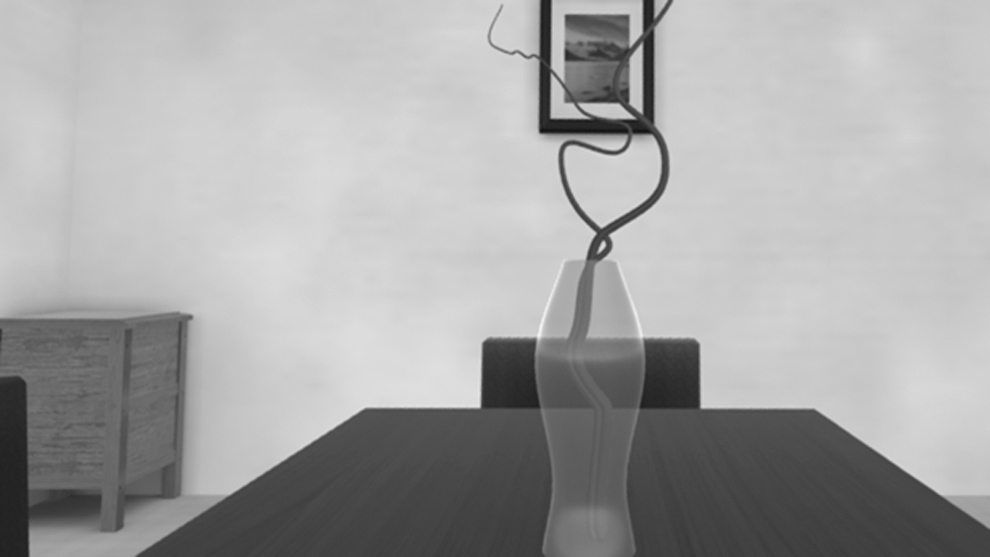
Room environment: frontal view.
Head-mounted display
The VREs were displayed by means of an Oculus Rift 1, which is a head-mounted display (HMD) with a 1,080 × 1,200 pixels resolution per eye (refresh rate of 90 Hz). The same VREs were also visible on a desktop computer (through Unity 3D graphic engine) to ensure they started correctly.
Procedure
Participants were comfortably seated in front of the experimenter in a silent room. They were asked to wear the HMD as a habituation phase to the equipment. Then, they took off the HMD and underwent a short version of the cognitive task, consisting of 10 single digits, to verify the correct understanding of the assignment. After this preliminary phase, the EDA and BVP sensors were attached to the participants' nondominant hand. The participants were also asked to wear the respiration sensor around their chest.
The experimental phase was composed of two sessions, which varied only for the VRE presented. Each session consisted in
(a) baseline phase (i.e., psychophysiological data recording for 2 minutes)
(b) navigation phase (i.e., watching the VRE for 2 minutes)
(c) cognitive task (i.e., executing one of the two series of the modified version of the PASAT, while still being in the VRE)
(d) VAS assessment (i.e., filling the VAS, without HMD).
Five-minute breaks between the first and the second session were included to avoid prolonged exposure to the virtual environment. The presentation order of the VREs was counterbalanced and pseudo-randomized: order 1: (a) forest, (b) room; order 2: (a) room, (b) forest. The presentation order of the two types of the cognitive task was also pseudo-randomized.
Results
Statistical analyses were performed with the software R 3.4.0 and Jamovi. Data were modeled using multilevel analysis using the nlme package inR, 33 adopting maximum-likelihood estimation (Satterthwaite approximation for p value). The skin conductance level (SCL) was further elaborated using the Matlab-based script Ledalab (version 3.4.8) by adopting a continuous decomposition approach. 34 A random coefficient was used for each participant (as ID intercept) in the self-report measures, whereas baseline covariate as random effect in the SCL, HR, and RR analyses.
Physiological parameters, cognitive task performance, and each VAS were analyzed by a 2 × 2 design, with the main factors of Order [2: (a) 1° room–2° forest, (b) 1° forest–2° room] and Environment [2: (a) room, (b) forest]. Pseudo R2 of significant effects were reported following the Nakagawa formula. 35
Electrodermal activity
Navigation phase
A significant main effect of Environment [b = 1.86, t(30) = 7.49, p < 0.001, R2 = 0.08] and Order [b = 1.52, t(30) = −8.89, p < 0.001, R2 = 0.12] were found. SCL mean was higher in the forest (estimate = 1.41) than in the room (Fig. 3) and in the first exposure than in the second one (estimate = 1.59). No interaction Order × Environment was found [b = −0.13, t(30) = −0.39, p = 0.696].

Navigation phase: results of electrodermal activity. Main effect of Environment for electrodermal activity. On the x-axis the two levels of the variable environment are represented, whereas SCL is shown on the y-axis. SCL, skin conductance level.
Cognitive task
A significant main effect of Environment [b = −1.43, t(30) = −7.92, p < 0.001, R2 = 0.09] was found. SCL mean was higher in the room (estimate = 1.43) than in the forest (Fig. 4). No significant effect of Order [b = 0.22, t(30) = 1.30, p = 0.197] or interaction Order × Environment [b = 0.20, t(30) = 0.53, p = 0.592] was found.
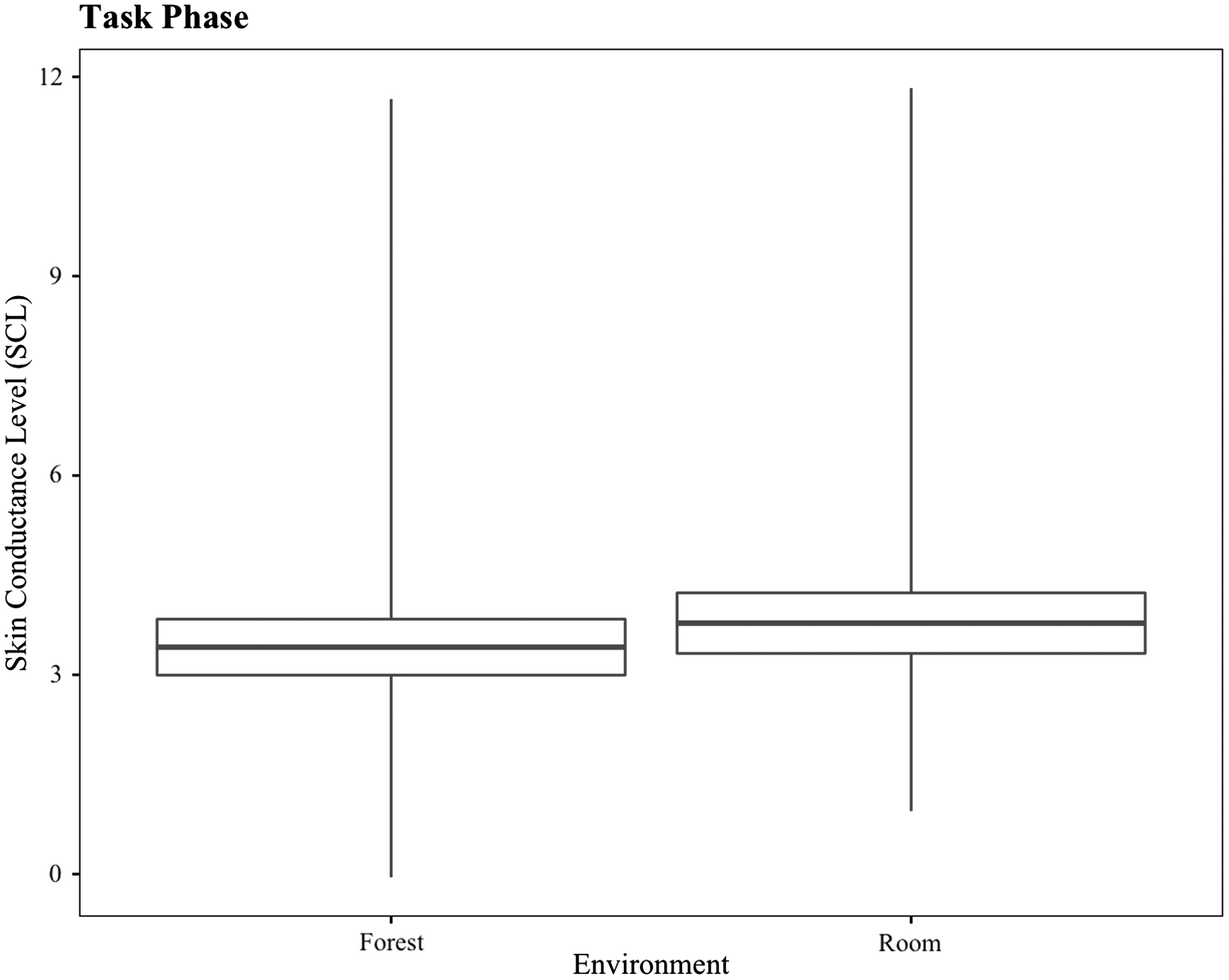
Cognitive task: results of electrodermal activity. Means of electrodermal activity. On the x-axis the two levels of the variable environment are represented, whereas SCL is shown on the y-axis.
Heart rate
No main effect or significant interaction was present neither in the navigation phase (Environment p = 0.697, Order p = 0.262, Environment × Order p = 0.407) nor during the cognitive tasks (Environment p = 0.915, Order p = 0.463, Environment × Order p = 0.254).
Respiration rate
No main effects or significant interactions were present neither in the navigation phase (Environment p = 0.084, Order p = 0.141, Environment × Order p = 0.793) nor during the cognitive tasks (Environment p = 0.587, Order p = 0.435, Environment × Order p = 0.322).
Sense of presence
A significant main effect of Order [b = 1.00, t(31) = 2.52, p = 0.017, R2 = 0.06] was present. The second exposure elicited a greater sense of presence than the first one (estimate = 0.984). No main effect of Environment [b = 0.34, t(31) = 0.87, p = 0.387] or significant interaction Order × Environment was present [b = 1.01, t(31) = 0.80, p = 0.429].
Sense of relaxation
A significant main effect of Environment [b = 1.56, t(31) = 3.46, p = 0.002, R2 = 0.13] was found (Fig. 5). The perceived sense of relaxation was higher in the forest than in the room (estimate = 2.08). No other main effect of Order [b = 0.256, t(31) = 0.565, p = 0.576] or significant interaction Environment × Order was found [b = −0.429, t(31) = −0.387, p = 0.701].
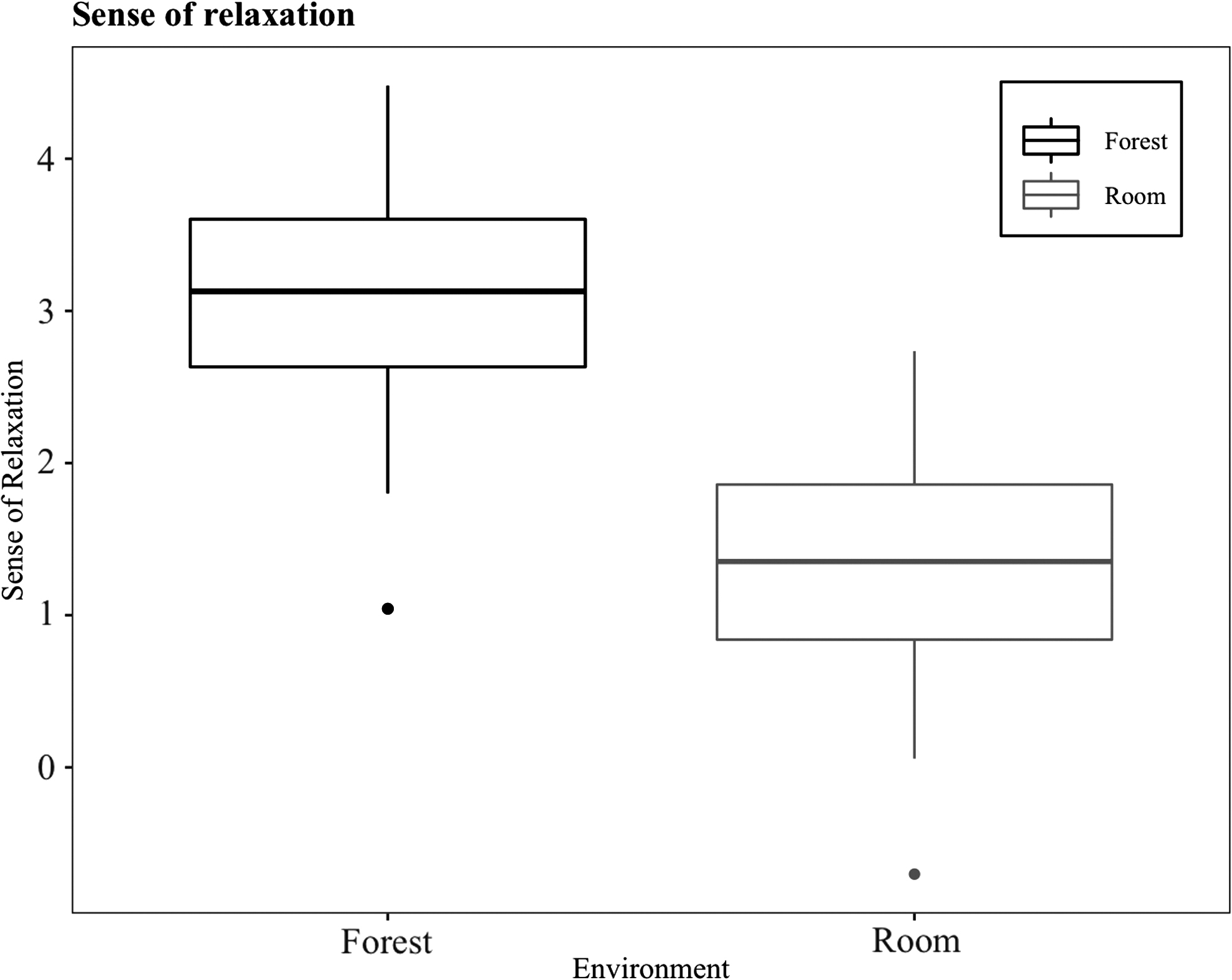
Results of sense of relaxation. Main effect of environment for sense of relaxation. On the x-axis the two levels of the variable environment are represented, whereas sense of relaxation is shown on the y-axis.
Sense of stress
No main effects or significant interactions were present (Environment p = 0.466, Order p = 0.478, Environment × Order p = 0.319).
Cognitive performance
No main effects or significant interactions were present (Environment p = 0.522, Order p = 0.276, Environment × Order p = 0.143). See Supplementary Data S1 and S2 for more detailed analysis.
Discussion
This research investigated the effects of exposure to two different virtual scenarios on the participants' physiological responses, cognitive performances, and subjective experiences. Although few data points for each participant could be a limitation, the results showed that EDA changed as a function of the experimental phase (navigation vs. cognitive task) and of the environment explored. SCL and feeling of relaxation were significantly higher when participants were exposed to the virtual forest than the indoor environment in the navigation phase. This finding is congruent with the previous studies12,13 showing a greater perceived sense of relaxation in natural scenarios. 24 The increase of SCL found in the forest could be linked to the emotion of awe 36 : given that this kind of environment has already been proved to elicit this emotion.12,31 Moreover, the forest was a more complex scenario, rich in details that could stimulate curiosity, making participants feel more engaged.37,38
During the cognitive task, the room environment elicited greater SCL responses, than the forest. This effect might be linked to performing a cognitive task in an anthropic environment (a work-compatible situation), where higher performance is required. Nevertheless, the indoor scenario was not perceived as more stressful than the natural outdoor or affected cognitive performance. Perhaps the exposition time to the VREs was possibly too brief to show significant effects on performance. 10 Moreover, the task did not assume progressive difficulty levels; the shortness and the simplicity of the task likely were not capable to affect performance. In this case, the effect of a restorative environment might not be so crucial, also because, in everyday life, people are generally accustomed to concentrating in indoor environments.
Our results confirm that natural environments, even if virtual, are perceived as more relaxing 26 ; nevertheless, virtual urban indoor environments may not be perceived as stressful enough to impair cognitive performance.
Participants reported a greater sense of presence during the second (rather than first) exposure to VR. This effect might be due to familiarization with the device and the overall virtual experience, considering that most participants were naive to VR. 39 Interestingly, the second exposure elicited a lower level of SCL during the navigation phase. The relationship between physiological arousal and sense of presence is still controversial. 40 The reduction of SCL found in the second exposure might reflect a greater sense of immersion and a lower level of alert related to this novel experience.
In conclusion, this research suggests that a natural outdoor VRE can lead people to feel more relaxed and physiologically more engaged than an indoor scenario. These findings represent a further step to explore VREs as compensating and beneficial tools, at least temporarily, for people deprived of outdoor life and natural exposure for a long time or those who usually work under stressful conditions in indoor environments.
Footnotes
Acknowledgment
The authors thank Letizia Nava for her help in data collection. Authors ensure that data were collected before the Covid-19 pandemic.
Authors' Contributions
Conceptualization, data curation, formal analysis, investigation, methodology, software, validation, writing—original draft, writing—review and editing, and visualization by I.F. Conceptualization, data curation, formal analysis, investigation, methodology, software, and writing—review and editing by G.M. Data curation, formal analysis, methodology, software, and writing—review and editing by M.G. Conceptualization, data curation, formal analysis, investigation, methodology, software, validation, writing—review and editing, and supervision by R.E. Software development and writing—review and editing by G.W.S., F.F., A.C., and An.G. Conceptualization, funding acquisition, writing—review and editing, and supervision by Al.G.
Author Disclosure Statement
No competing financial interests exist.
Funding Information
No funding was received for this article.

References
Supplementary Material
Please find the following supplemental material available below.
For Open Access articles published under a Creative Commons License, all supplemental material carries the same license as the article it is associated with.
For non-Open Access articles published, all supplemental material carries a non-exclusive license, and permission requests for re-use of supplemental material or any part of supplemental material shall be sent directly to the copyright owner as specified in the copyright notice associated with the article.
