




Abstract
With the pervasive nature of social media and Internet use among young adults, researchers have begun to explore experiences of online disinhibition, defined as reductions in restraint in online versus face-to-face settings. In contributing to this literature, this study aimed to test whether perceptions of the Internet as a place where one has the ability to be invisible, anonymous, and exercise control over interactions promotes greater online disinhibition. A sample of Australian young adults (N = 687; 59.8 percent female; Mage = 19.45 years, SD = 2.07) were included in the study. The sample was split to enable exploratory and confirmatory factor analyses on the measures of Internet perceptions, with results finding two subfactors; (a) perceptions of the ability to be protected, invisible, or feel safe online (labeled protection), and (b) perceptions of control over interactions and self-presentation online (labeled control). Links between perceptions of protection and control, and online disinhibition were then examined, before testing social anxiety as a moderator of these links. Results demonstrated that perceptions of protection, but not control, significantly predicted online disinhibition in young adults. Furthermore, this relationship was moderated by social anxiety such that young adults high in both social anxiety and perceptions of protection reported the highest online disinhibition. This study highlights novel perceptions of online contexts, illustrates their links with online disinhibition, and demonstrates how social anxiety may interact with perceptions of protection in predicting online experiences.
Introduction
Internet use is integral in the lives of young adults (aged 17–25 years), with this age group reporting the highest prevalence of Internet use and accessing multiple social media platforms (e.g., Facebook, Instagram, and Snapchat 1 ). Indeed, more than 90 percent of Australian young adults report using the Internet multiple times per day, 2 and almost 50 percent of American young adults report that they are “almost constantly” online. 3 With the pervasiveness of young adults' Internet use comes questions about the opportunities and risks of lives lived online, how young adults engage in different behaviors online, and the impact of digital technologies on cognition, affect, and behavior. This study contributes to an emerging area of research concerning young adults' perceptions of digital environments and online disinhibition.
Perceptions of digital contexts and online disinhibition
A variety of features and affordances of online settings have been proposed as fostering distinct interpersonal contexts that may transform the thoughts and behaviors of young people online.4,5 Importantly, and relevant to this study, anonymity, invisibility, and controllability are key affordances of online settings that are suggested to change behavior,5–7 or act as antecedents of online disinhibition. 8
Online disinhibition is defined as experiences or perceptions of reductions in restraint online, whereby individuals think, act, and feel differently online, as compared with offline. 9 Experiences of online disinhibition are associated with a range of personal and behavioral outcomes, including harmful online behaviors such as cyber aggression, trolling, and inauthentic self-presentation.9,10
Although some Internet affordances have been proposed as antecedents of online disinhibition, little research has empirically examined these relationships, with a much larger literature focusing on the outcomes of online disinhibition. In this study, we posit that it is not simply the affordances of online settings, but rather, individuals' perceptions of the digital context that encourage disinhibition online. Past research has similarly suggested that perceptions of Internet affordances, rather than the affordances themselves, predict psychological experiences and online behaviors. 11
A variety of measures and methods have previously been used to examine the large range of proposed Internet features and affordances.8,11–14 For example, Schouten et al. 11 measured the perceived relevance of nonverbal cues and controllability online, and Kamalou et al. 15 examined control over self-presentation and personal information as features of online settings that may contribute to perceptions of online safety. However, available measures tend to be brief, specific to instant messaging or particular online platforms, and are thus not suitable for generalized use.
Furthermore, some measures fail to separate individuals' perceptions of digital environments from their resulting behaviors, or from disinhibition (e.g., “It is easier to communicate online because you can reply anytime you like” 14 ), and thus confound the relationships between such constructs. This may be because the available literature on Internet features and affordances lacks clarity, and “features” and “affordances” are terms often used interchangeably. We propose the following definitions: Internet features are static attributes unique to online environments—including reduced nonverbal cues and asynchronicity—that operate along a continuum and vary across platforms and tools within online communication.4,16
Internet affordances—including invisibility, anonymity, and control online—emerge from the dynamic interplay between an individual's characteristics, needs, and goals, and their perceptions of Internet features.16,17 As such, affordances constitute perceived experiences or opportunities in digital settings that may modify or enable communication and behavior online. This study aimed to explore young adults' perceptions of the Internet as related to these affordances, and to test the relationships between perceptions of the Internet and online disinhibition. We hypothesized that young adults who perceived the Internet as affording more opportunities for invisibility, anonymity, and control, would report greater online disinhibition (H1).
The role of social anxiety
Although previous research indicates an association between Internet affordances and online disinhibition, this relationship may not be the same for all young adults. Research highlights the importance of considering dispositional and social factors of media users as buffering or exacerbating the effects of online contexts on cognitions, attitudes, and behaviors. 18 One important characteristic emerging in the literature is social anxiety.
Specifically, research suggests that young people higher in social anxiety may perceive digital environments as providing enhanced control over social interactions, reducing the risk of negative evaluation, and providing greater comfort and safety for social interaction online, relative to offline settings.15,19,20 Social anxiety also facilitates greater online disinhibition through perceptions of fewer nonverbal cues and controllability within online interactions. 11 Therefore, we hypothesized a moderating effect whereby the positive associations between perceptions of the Internet and online disinhibition would be significantly stronger for young adults higher in social anxiety, than for those lower in social anxiety (H2).
The current study
Young adults may perceive online contexts to offer novel opportunities to control their interactions and self-presentations, or to behave differently than they do offline. This study furthers research in this area by empirically testing the associations between perceptions of Internet affordances and online disinhibition. More specifically, we aimed to (a) operationalize a measure of perceptions of the Internet as related to invisibility, anonymity, and the ability to exercise control online, (b) test the hypothesized positive relationships between perceptions of the Internet and online disinhibition, and (c) examine the role of social anxiety in moderating these associations.
Methods
Participants and procedure
A large sample of young adults (N = 687) was recruited from an Australian university. Participants were invited to complete the study as part of a first-year psychology course if they were aged between 17 and 25 years, and were active social media users. Purposive sampling was employed to recruit a relatively even gender split; as women were overrepresented in the sample, the study purposively recruited male participants in the later stages of data collection. The final sample of young adults (M = 19.45 years, SD = 2.07) included 411 (59.8 percent) respondents who identified as female. The ethnicity of the sample was reported as 78.5 percent Caucasian (White), 10.9 percent Asian, 1.7 percent Indigenous Peoples (First Nations), 1.7 percent African, and 7.2 percent from other backgrounds.
Before data collection, ethical approval was obtained from the University Human Research Ethics Committee. After providing informed consent, participants completed an anonymous online questionnaire, ∼30 minutes in duration, as part of a larger research project of young adults' Internet use, friendships, and well-being (see Scott et al. 21 for more information). Measures pertinent to this study are detailed as follows. Participants completed the questionnaire in their own time and received course credit for their involvement.
Measures
Internet perceptions
An initial pool of 28 items that measured perceptions of the Internet as related to invisibility, anonymity, and control online were developed from the literature4,5,11,14 and co-designed with a sample of university students. 9 Participants were asked to indicate their agreement with the items along a 5-point scale (1 = Strongly disagree to 5 = Strongly agree). After exploratory and confirmatory factor analyses (Supplementary Materials), two factors emerged.
Six items comprised protection (α = 0.86), with participants indicating the extent to which they perceived the ability to be protected, invisible or feel safe online. Example items include “The internet allows me to be invisible,” and, “I feel protected online because I am physically removed from others.” Five items comprised control (α = 0.85), with participants indicating the extent to which they perceived control over their interactions and self-presentation online. Example items include “The internet allows me to reply to messages when I feel ready,” and “The internet allows me to control what information I present to others about myself.”
Social anxiety
The 19-item Social Interaction Anxiety Scale 22 was used to measure social anxiety and fears of face-to-face social interaction. Participants indicated the degree to which each of the items were true of them on a 5-point scale (0 = Not at all true of me to 4 = Extremely true of me). Example items include “I have difficulty making eye-contact with others,” and “I have difficulty talking with other people.” The measure demonstrated high internal reliability (α = 0.94).
Online disinhibition
The 12-item Measure of Online Disinhibition 9 was used to measure whether individuals think, feel, and act differently in the online versus offline environment. Example items include “I act differently online than I do offline,” and “I say things on the internet that I would not say in person.” Responses were recorded along a 5-point scale from 1 = Not at all like me, to 5 = Very like me. The scores were averaged, and the scale demonstrated good internal reliability (α = 0.93).
Time online
Participants were asked two items about how many hours per day on average they used the Internet for social interaction and leisure (entertainment) purposes, respectively. Participants responded through a drop-down list, with response options that ranged from 0 to 24 hours. The average score of both items was used to assess Time Online.
Data analysis strategy
Data analyses were conducted using Mplus Version 8 23 and SPSS Version 27. After exploratory and confirmatory factor analyses that established and validated the factor structure of the Internet perceptions scales, reliability and descriptive statistics of the protection and control measures were calculated, and bivariate correlations with other measures were conducted. Finally, a moderated multiple regression model was conducted to test the hypotheses; that is, the associations between the Internet perceptions of protection and control, and online disinhibition, as moderated by social anxiety. Covariates entered at step 1 were gender, age, and time spent online.
Participants were asked to report their gender by selecting one of four closed items: 1 = Male, 2 = Female, 3 = Other, 4 = Prefer not to say. One participant selected “Prefer not to say” in response to the question and was listwise deleted from analyses when gender was transformed to a binary coded variable (0 = Male, 1 = Female). Step 2 included the main effects of protection and control, followed by social anxiety at step 3. In step 4, three 2-way interaction terms between protection, control, and social anxiety were added to the model. Independent and moderating variables (protection, control, and social anxiety) were centered before analyses. Where interactions were found to be significant, these were examined by graphing and calculating simple slopes.
Results
Correlations and descriptive statistics
Bivariate correlations and descriptive statistics are presented in Table 1. The measures of protection and control were positively correlated and were each positively correlated with social anxiety and online disinhibition. Furthermore, perceptions of protection, social anxiety, and online disinhibition were positively associated with time spent online.
Descriptive Statistics and Pearson Correlations Among Internet Perceptions Measures, Social Anxiety, Online Disinhibition, and Covariates (N = 687)
Gender: 0 = male, 1 = female. Time online: hours spent online for social and leisure purposes.
p < 0.01; ***p < 0.001.
SD, standard deviation.
Predictive model: online disinhibition
At step 1, 7.4 percent of the variance in online disinhibition was explained by gender, age, and time spent online, F(3, 683) = 18.26, p < 0.001 (Table 2). Time online was significantly positively associated with online disinhibition. Gender and age did not significantly contribute to the model. Step 2 explained an additional 24.4 percent of the variance in online disinhibition, Fchg(2, 681) = 121.60, p < 0.001. Perceptions of protection were significantly positively associated with online disinhibition, although control did not significantly contribute to the model.
Summary of Moderated Multiple Regression Analysis, Testing the Effects of Social Anxiety on the Association Between Internet Perceptions and Online Disinhibition (N = 687)
Gender: 0 = male, 1 = female. Time online: hours spent online for social and leisure purposes. Significant effects are presented in bold text.
At step 3, an additional 9.5 percent of the variance in online disinhibition was explained, Fchg(1, 680) = 109.75, p < 0.001. In this step, social anxiety was significantly positively associated with online disinhibition. Step 4: including the two-way interaction terms (protection × control, protection × social anxiety, and control × social anxiety) explained an additional 0.9 percent of the variance in online disinhibition, Fchg(3, 677) = 3.49, p = 0.02. However, only the interaction between protection × social anxiety was significant. A total of 42.2 percent of the variance in online disinhibition was explained by the final model, F(9, 677) = 54.83, p < 0.001.
To probe the significant interaction, simple slopes analyses were conducted using the process macro 24 in SPSS for low, moderate, and high levels of social anxiety using the pick-a-point technique of 1 standard deviation (SD) below the mean, the mean, and 1 SD above the mean. A significant positive relationship was found between protection and online disinhibition, at low (B = 0.32, p < 0.001), moderate (B = 0.40, p < 0.001), and high (B = 0.48, p < 0.001) levels of social anxiety. The positive association between perceptions of protection online and online disinhibition was stronger for young adults higher in social anxiety (Fig. 1).
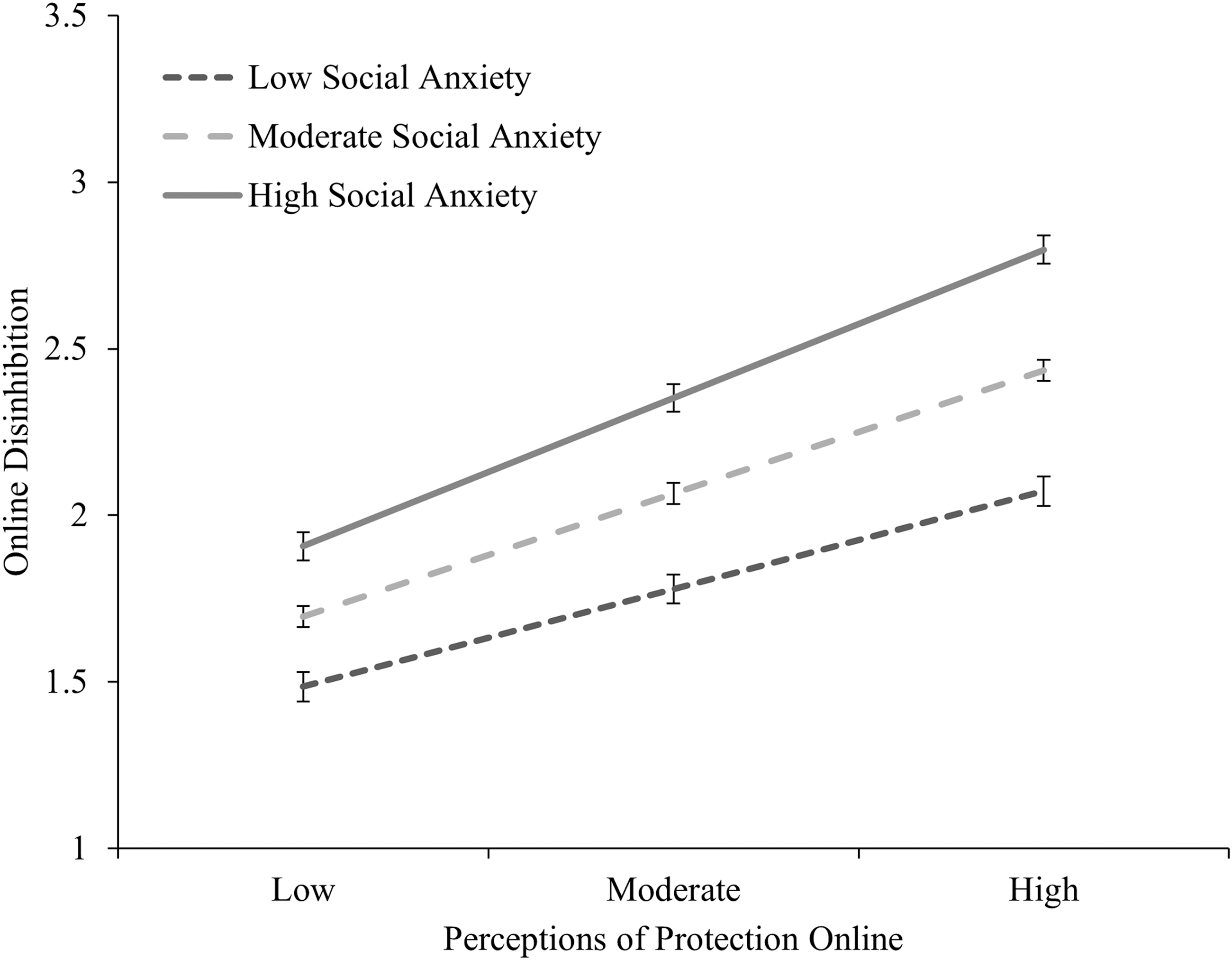
The conditional relationship between perceptions of protection online and online disinhibition (controlling for covariates) at low, moderate, and high levels of social anxiety (N = 687). Error bars represent standard errors.
Discussion
This study aimed to contribute to available literature regarding young adults' experiences of online disinhibition by (a) characterizing young adults' perceptions of the Internet, (b) examining the relationships between Internet perceptions and online disinhibition, and (c) testing the role of social anxiety in moderating these associations.
In addressing these aims, and in an extension of past research, we found that when measuring young adults' perceptions of the Internet as related to invisibility, anonymity, and the ability to exercise control online, two key factors emerged: protection and control. Furthermore, we demonstrated that young adults who reported higher perceptions of protection in online environments also reported higher levels of online disinhibition, and revealed an interaction between perceptions of protection online and social anxiety in predicting online disinhibition among young adults. Each of these key contributions are discussed as follows.
Perceptions of protection and control online
Extending previous research on Internet affordances, this study demonstrated that young adults perceive protection and control as two key affordances of digital environments. Consistent with past research, our measure of control considered individuals' perceptions of control over social interactions and self-presentation online, which are regarded as fundamental elements of computer-mediated communication (see Walther's 25 hyperpersonal model). However, contrary to more commonly investigated factors, we also found that protection emerged as a key component of Internet perceptions.
Although our measure of perceptions of protection in the online environment includes elements of invisibility (i.e., the ability to engage in communication in which one need not be directly seen or observed), it is novel and distinct from past conceptualizations of anonymity online. Specifically, the literature concerning anonymity is oriented toward the ability to conceal one's real name or identity online, such that online communication cannot be linked back to that specific individual, 12 or is linked to invisibility and reduced nonverbal cues online (referred to as audiovisual anonymity 7 ).
In this study, protection concerned participants' perceptions of the Internet as affording the ability (of themselves or others) to be protected, invisible, or feel safe online. Importantly, although the measures of protection and control online were initially developed from available literature by exploring factors such as invisibility, anonymity, and control, research into Internet affordances has been predominantly theoretical. Through assessing individuals' perceptions of Internet affordances, these new measures overcome a number of aforementioned limitations with existing instruments and operationalize long-standing theoretical constructs in a way that reflects contemporary online experiences.
Protection, control, and online disinhibition
In testing the associations between Internet perceptions and online disinhibition, we demonstrated three key findings. First, although control was positively associated with online disinhibition at the bivariate level, it was not significantly associated with online disinhibition when accounting for the other variables in the regression model. We suggest that the ability to strategically exercise control online may be more directly associated with specific online behaviors or activities (such as instant messaging) in which control over social interactions and self-presentation may be perceived as advantageous, rather than explaining young adults' disinhibited thoughts and feelings online.
Second, the perceived ability to be protected and invisible online appears to play a more immediate role in fostering a sense of online disinhibition, and in reducing constraints online that are typically associated with concerns about self-presentation or judgment from others. 11 Indeed, participants who reported higher perceptions of protection online reported higher levels of online disinhibition. This funding suggests that believing the Internet affords the ability to be protected is an important contributing factor toward the disinhibition experienced by some young adults online.
There are both positive and negative outcomes associated with online disinhibition. As online disinhibition has been associated with harmful online behaviors,9,10 it is possible that perceptions of being protected online may also predict negative outcomes. We propose that although distinct from anonymity, perceptions of protection online may be similarly associated with deindividuation effects and a reduced sense of personal responsibility, as being removed from others online may protect individuals from experiencing others' reactions to harmful online behaviors, or protect them from the consequences of their actions. 26
Alternatively, we note that online disinhibition may enable individuals to express thoughts and feelings online that they feel unable to express offline,5,6 and highlight that online disinhibition has previously been associated with online self-disclosure, 11 which itself has positive implications for social well-being. We suggest that future research should aim to extend the nomological network of these Internet perceptions measures with other online outcomes.
Finally, beyond establishing a link between perceptions of protection and online disinhibition, we demonstrated a significant moderation of this association by social anxiety. Specifically, the positive association between protection and online disinhibition was strongest for participants higher in social anxiety, suggesting that there are attributes of online settings that are both appealing to, and meaningful for, online outcomes among more socially anxious youth. Indeed, social anxiety has previously been linked to online disinhibition 27 and preferences for online communication, 28 possibly because individuals higher in anxiety perceive reduced social threat during online versus offline interactions. 19
Thus, young adults higher in social anxiety may perceive the online environment as more protective, and when this is the case, report higher online disinhibition than their less-anxious counterparts. This finding has implications for clinical practice, whereby professionals delivering online interventions for socially anxious individuals should be aware of factors that might contribute to disinhibition within online settings, drive a reliance on the Internet for social connection, or explain the association between social anxiety and problematic Internet use. 19
Future directions
Strengths of this study include the large sample size and relatively even gender distribution. Importantly, the measures of protection and control online are applicable to multiple online channels and distinct from past measures of Internet perceptions and affordances in that they distinguish between individuals' perceptions of digital environments and online disinhibition. However, although acknowledging the novel contribution of the current research, there are also limitations that must be considered.
First, the data were cross-sectional and as such, causal links cannot be determined. It is possible that bidirectional relationships exist between Internet perceptions and online disinhibition and, therefore, longitudinal work is needed to determine the directionality of these effects. Second, our measures of protection and control are yet to be broadly validated and exploratory and confirmatory analyses were conducted with distinct groups of participants from the same overall sample. Furthermore, although our findings were in the expected directions, our sample was predominantly comprising first-year psychology students from an Australian university and, therefore, has limited generalizability.
Future research should seek to confirm the factor structure and assess reliability of the measures in diverse samples. We also suggest that future research should endeavor to explore other factors that were removed in the course of our factor analyses, such as perceptions of the ability to engage in inauthentic self-presentation online. Finally, although self-report measures are critical when assessing individuals' perceptions of Internet affordances, future research should include behavioral measures and a focus on specific tools, platforms, and ways of interacting online that may elucidate additional outcomes of perceptions of protection and control online.
Conclusion
It is imperative that research understands the impacts of social media and Internet use on the cognitions and behaviors of youth, particularly as young adults' lives are now conducted almost seamlessly across online and offline contexts. This study has advanced the available literature and offers an enhanced understanding of young adults' experiences within online contexts by exploring perceptions of protection and control online, and how they are related to self-reported changes in behavior and cognition in online as compared with offline contexts.
We encourage further exploration of perceptions of protection and control online, and how social anxiety may interact with Internet perceptions in predicting online or social experiences. Our findings suggest that although perceptions of protection online are generally a key factor in predicting online disinhibition among young adults, the link between protection and online disinhibition is strongest for young adults higher in social anxiety.
Footnotes
Acknowledgments
The authors would like to thank the participants involved in the study.
Data Availability Statement
The data used in the research will be shared with legitimate researchers on a case-by-case basis in light of confidentiality and ethical considerations. The materials used in the research cannot be publicly shared but are available on request, from the first author.
Author Disclosure Statement
No competing financial interests exist.
Funding Information
This research was funded by an Australian Government Research Training Program (RTP) Scholarship, granted to the first author.

References
Supplementary Material
Please find the following supplemental material available below.
For Open Access articles published under a Creative Commons License, all supplemental material carries the same license as the article it is associated with.
For non-Open Access articles published, all supplemental material carries a non-exclusive license, and permission requests for re-use of supplemental material or any part of supplemental material shall be sent directly to the copyright owner as specified in the copyright notice associated with the article.
