




Abstract
The long-term uncertainty and persistence of isolation caused by the COVID-19 pandemic created prolonged emotional distress individually and collectively. As the pandemic progressed, the dynamic ride of emotional experience was expressed live and shared online, particularly on social media. In this study, we collected posted messages on Twitter for a longitudinal investigation to determine how emotional experiences changed over time during the pandemic. In total, we analyzed 41,868,013 COVID-19-related tweets in English posted from January 21 to July 31, 2020. Using a stage model, the results demonstrated that there were three stages during the pandemic characterized by distinct emotional changes. The first stage features high anxiety and negative emotions compared with the other stages, possibly due to the lack of information about the disease. The second stage shows the dynamic ride of all emotions and an increase in negative emotions (particularly anger) as the COVID-19 pandemic proceeds. In the third stage, most emotions are stabilized, except for depression, despite the protracted pandemic.
Introduction
COVID-19,
As the pandemic has progressed, the dynamic ride of emotional experience has been shared online, particularly on social media. Social media provides a convenient interface where people can easily express their emotions and efficiently share them with a large number of people. As Rimé stated, 9 emotions are socially shared through words, and people have shown a pattern of active social sharing of emotions through the use of media. Ellis et al. 10 and Liet al. 11 observed a surge in the number of social media messages in the physically isolated situation caused by COVID-19.
Emotional experiences during the COVID-19 pandemic expressed on social media have been investigated in several studies.12–14 For example, Saha et al. 15 compared Twitter posts before and after the COVID-19 pandemic to show that anxiety, depression, stress, suicidal ideation, and support to others increased during the COVID-19 period. Crocamo et al. 14 conducted sentiment analysis on longitudinal Twitter data (from January 19 to March 3, 2020) and revealed that the amount of both positive and negative emotions increased, and a proportion of negative emotions was particularly pronounced after the occurrence of key events, such as the pandemic declaration by the World Health Organization (WHO) and the rapid increase of cases in Europe. Yet, there is still a dearth of information regarding the patterns of emotional experiences.
Thus, we have three purposes in this study: (a) to quantitatively measure the various emotions and mental health-related indicators that were shared on social media, (b) to analyze whether there are any patterns of emotional changes in the early period of the pandemic based on the stage model of how humans react to unfortunate events, and (c) to derive practical guidelines to better prepare for the public's emotional response based on the observed emotional trajectory.
Literature Review
Social sharing of emotion on social media
It is a natural behavior to share one's emotions with others, whether the emotions are positive or negative. 16 Rimé et al. defined social sharing of emotion as an interpersonal process in which a narrator shares emotions about their experience of specific situations with others.17,18 Emotionally arousing information is especially likely to be shared with others. 19 Recent studies have demonstrated that the valence of emotion also matters. Positive emotions tend to promote social sharing20,21 because individuals are motivated to manage their online impressions by sharing positive posts. 22
However, in a public health crisis such as a pandemic, sharing negative emotions may become more common, 20 as individuals easily presume that many people are concurrently experiencing negative emotions and may think sharing such emotions will not harm their online impression. In addition, social sharing of emotions provides several benefits. Talking about stressful events significantly decreases psychological distress23,24 while increasing emotional relief. 25 Compared with restrained emotional conditions, people who express their emotions report a lower level of perceived stress. 26 Furthermore, sharing emotions about traumatic experiences or major negative life events, such as the death or illness of a close person or a serious accident, helps people to cope both cognitively and socio-affectively with the psychological distress caused by the event. 27 Sharing emotions allows people to gain empathy and sympathy because receiving attention, feedback, support, or validation 28 strengthens social bonds and support. 27
Explaining the pandemic using a stage model
Individuals go through a series of emotional stages in the face of unexpected and unfortunate events, such as terminal illness, natural disaster, or loss of loved ones.29–33 Many researchers have attempted to explain the process of devastating experiences in terms of emotional stages. For example, in a study of parents who lost their child, Davidson 34 proposed a four-dimensional model of the grieving process: shock and numbness, yearning and searching, disorientation, and reorganization. Rando 35 argues that there are three dynamic stages with varying fluctuations and properties: avoidance, confrontation, and accommodation.
Among many stage models, Kübler-Ross's five stages of grief31,36,37 is perhaps the most widely known model that describes the stages of emotional change. It outlines the process of accepting the situation for patients who are about to die or individuals who have experienced bereavement or loss. The model comprises five stages of emotions: denial, anger, bargaining, depression, and acceptance. Denial is the stage that deals with grief and distrust about what has happened. In the anger stage, individuals look for someone or something to blame while questioning the fairness of their situation. The bargaining stage is also referred to as the trade-off stage. Individuals seek to make a deal with fate to earn more time with lost loved ones. Individuals in the depression stage experience extreme sorrow and helplessness. In the acceptance stage, the individuals have a sense of understanding and can continue on their grief journey. 38 However, not all grief-stricken individuals have to go through this process the same way or follow a set of sequence. Some individuals go through all stages, but others can skip one or more steps or go back to previous stages. 39
Recent studies have expanded the use of the stage model to explain situations beyond personal loss or an individual's experience. For example, Whaley 40 explained how Hurricane Katrina survivors deal with a natural disaster and the related trauma. Pennebaker and Harber 41 suggested a social stage model of collective coping by studying individuals who experienced the Loma Prieta Earthquake and the Persian Gulf War. They showed that collective coping stage had three phases: emergency, inhibition, and adaptation.
There have been a few attempts to explain emotional experience during the COVID-19 pandemic by looking at COVID-19-related news, 42 medical school students and professors' reactions, 43 and official White House documents. 44 However, similar to previous stage-based studies that are largely based on qualitative observations, there is a lack of quantitative evidence for the stage model for the COVID-19 pandemic.
Recently, Li et al. 45 conducted a four-wave survey in both China and the United States to investigate the relationship between emotion, information acquisition, and preventive behaviors. They identified four stages: prepandemic, onset of viral outbreak, ongoing risk, and contained risk. As their study was conducted using a survey, it has methodological limitations that any survey studies would have. The survey is based on the answers to the survey questions prepared by the author, so the information may be limited to the structure of the questionnaire. In addition, the data collection points are predetermined by the researchers, so the period of stages has to be confined to the data collection points and may not reflect the actual period of stages.
To fill the gap in the literature, this study conducted a computational analysis to examine messages on Twitter in a longitudinal investigation to determine how emotional experiences changed over time during the pandemic. The research question that guided this study is proposed as follows:
RQ: How do emotions and mental health status change over time during the pandemic?
Materials and Methods
Data collection
COVID-19-related tweets posted on Twitter during the COVID-19 outbreak were collected for this study. We used the open-source Twitter API to collect tweets that included COVID-19-related terms, such as “COVID” or “corona,” from January 21 to July 31, 2020. We excluded tweets that were not written in English. Our final dataset contained 38,226,795 tweets. Table 1 summarizes the data used in this study. This cross-sectional study was approved by the Institute Review Board (IRB No. 2020-10-021). Informed consent from participants was exempted as all the data are publicly available, and the personal information such as usernames was anonymized.
Dates, Total Number of Tweets, and Average Number of Words During the COVID-19 Outbreak
Data preprocessing
To clean the text data, we removed emojis, special characters such as “#” or “*,” and URL links in each tweet. To analyze the sentiments revealed in tweets each day, we divided the data into 192 days' data for 2020. This retrospective study did not require approval from an Ethics Committee and did not violate the terms of the Twitter platform.
Data analysis
Sentiment analysis
We performed sentiment analysis on the collected tweet data using Linguistic Inquiry and Word Count (LIWC). 46 LIWC is a dictionary-based tool that can analyze grammatical, psychological, and content word categories for a given text. Following simplistic working principles, this tool provides researchers with an automated and objective way to extract insights through language. 47 The LIWC dictionary used in this article is the LIWC2015 version, which consists of a total of 6,549 labeled words and word stems. 48 LIWC codes each word or word stem based on one or more word categories. For example, the word “cried” receives scores in four-word categories: sadness, negative emotion, overall affect, and a past tense verb. 49 Hence, if the word is found in the target text, each of these four category scores will be incremented. In our analysis, the following psychological categories provided in LIWC were analyzed: positive and negative emotions, anger, anxiety, and sadness.
Mental health state analysis
In addition to emotions, mental health states, such as stress, depression, and suicidal ideation, were analyzed. We calculated the stress score using an additional customized LIWC dictionary. 50 For the suicidal ideation score, we applied a previously developed suicidal ideation detection model 51 that is designed to identify whether a given social media post includes suicidal ideation by using suicide-oriented word embeddings and attention mechanisms. 52 To calculate the depression score for each tweet, we developed a depression classifier that identifies whether a given text includes a depression state. To learn the context of depression from the text, we collected posts of the subreddits related to depressive disorder from Reddit, including r/bipolar, r/BipolarReddit, and r/BipolarSOs, which are associated with the depressive disorder category 53 in the Diagnostic and Statistical Manual of Mental Disorders Fifth Edition (DSM-5). The proposed depression classifier was trained using pretrained language models such as Word2vec 54 and fastText 55 for post representation by applying long short-term memory. 56
Results
To answer the research question, we investigated how emotion and mental health indicators changed over time during the pandemic. The pattern of shared emotion changed significantly on the basis of two important dates during the pandemic: the WHO's official declaration of the global pandemic (March 11, 2020) and the easing of the shutdown policy (June 10, 2020). Based on these two dates, the pandemic was divided into three periods. Overall, the result demonstrates the significant changes of emotions and mental health indicators across the three stages.
The first stage extended from the first confirmed case of COVID-19 (January 21, 2020) to the WHO's official declaration of the global pandemic (March 11, 2020). After COVID-19 was first identified in December 2019 in Wuhan, China, the situation quickly worsened, and the U.S. government became cautious about the situation. When the first confirmed case was reported, it triggered a burst of uncertainty about the unfamiliar disease, arousing greater anxiety. At this stage, the number of confirmed cases had been growing gradually, but the major pandemic had yet to come.
This stage is characterized by a high level of anxiety (Fig. 1). Among all the emotions, anxiety was the only sentiment that was significantly higher than the ones in the other stages (Fig. 2). Tweets in this period included: “We are panicking too much over Coronavirus, but the panic is something to panic about.” and “Potential Coronavirus scares are the new potential terrorist plots. Scary times and false alarms will abound.” It is unique in that negative emotions prevail over positive emotions, unlike in other stages. More accurately, negative emotions were more pronounced in this stage because the positive emotion scores were significantly lower than in the other stages (Fig. 2).
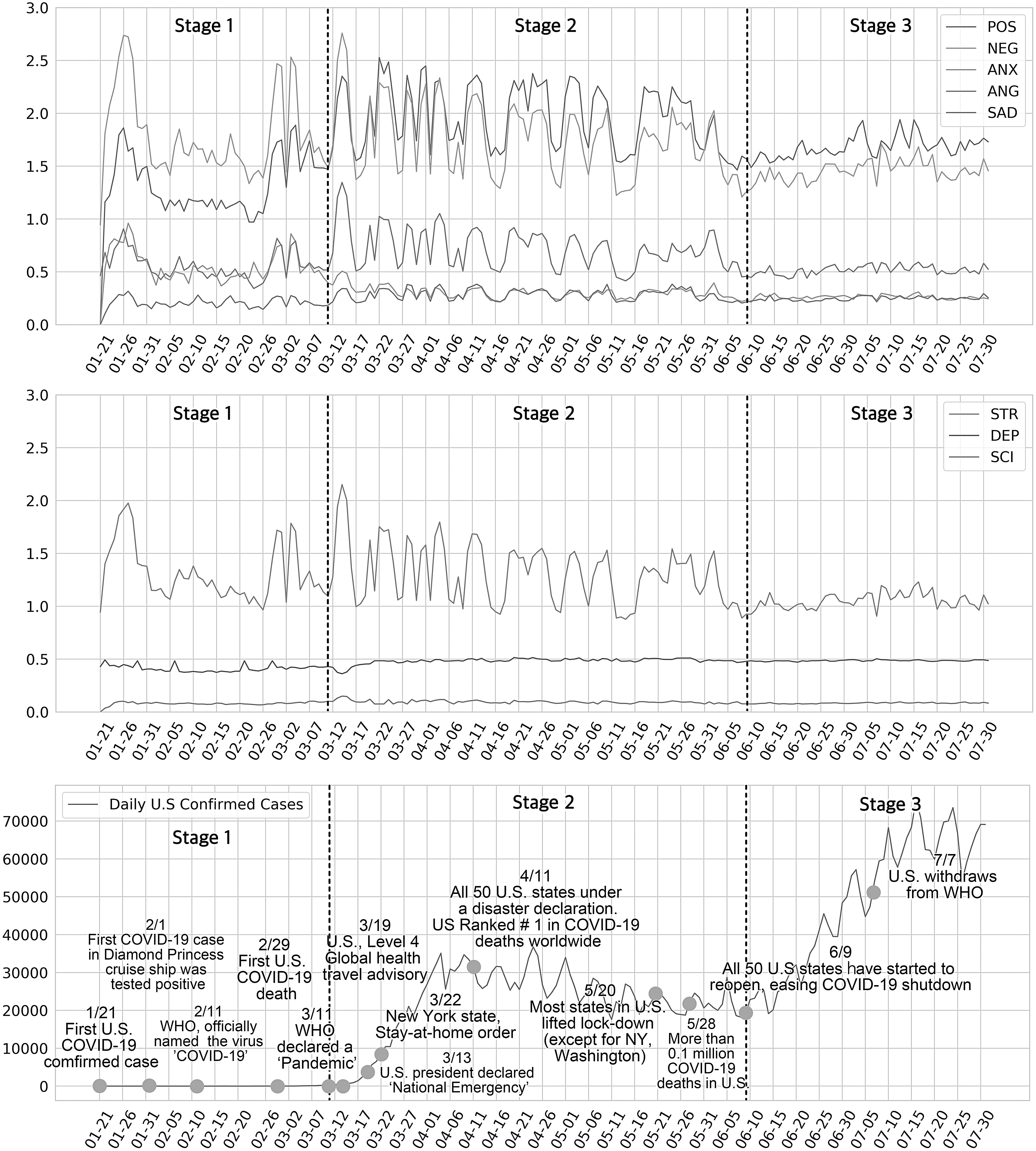
Sentiments, mental health-related scores, and the U.S. COVID-19 daily confirmed cases for each stage. ANG, anger; ANX, anxiety; DEP, depression; NEG, negative emotion; POS, positive emotion; SAD, sadness; SCI, suicidal ideation; STR, stress.

Bar plot for all sentiments and mental health states for each stage (NS stands for groups with nonsignificant results, p > 0.05).
The second stage started on the day after the first stage and ended June 9, 2020, when the lockdown was declared. This period started with President Donald Trump's declaration of a national emergency (March 13), and a variety of social distancing measures were implemented throughout the United States; most of the states in America announced the stay-at-home order and the level-4 travel advisory that asked citizens not to travel around the world. In about a month, the United States ranked number one in COVID-19 deaths worldwide, and all 50 states declared an emergency. To make matters worse, there were confusing guidelines from the government regarding mask regulations and ways to prevent the virus (e.g., bleach and sunshine).
During this stage, there was a sharp increase in anger and dynamic emotional ride (Fig. 1) Anger, a highly negative emotion, showed the most prominent change. The average score of anger was high and the level of anger fluctuated on a daily basis. For example, individuals mentioned: “I am so angry today. Angry at COVID, angry at racist murdering cops, angry at those who refuse to wear masks,” “The stupidity surrounding COVID-19 is literally making me so mad. People are so annoying, so dumb, and so greedy,” and “stupid coronavirus locking everyone inside. stupid stupid.” In addition, both negative and positive emotions show deep ups and downs to show dynamic emotional changes during this period. Peak stress and depression scores were also found in this period. Figure 2 shows a considerable increase in anger, sadness, depression, positive emotions, and suicidal ideation in stage 2 compared with stage 1. In particular, anger, stress, suicidal ideation, and positive emotions were significantly higher than in the other periods. At the same time, the heightened level of anxiety decreased during this stage.
Finally, in the third stage after the lockdown policy was eased in most states, emotions remained stable as people adapted to the “new normal.” Sample tweets during this period include: “For the past 2 months I've spent Thursday nights helping facilitate a weekly COVID-19 town hall webinar for community pediatricians. We're spacing those out as the pandemic reaches a new equilibrium locally. We ended each meeting in a moment of gratitude.,” “We have been looking for the silver lining in this dark, depressing, and dire COVID19 cloud, more compassion may well be it.,” and “Thank God for summer! I have to admit, after a bleak, cold, depressing no good winter, spring, and coronavirus nonsense, didn't expect the economy to recover so quickly. I'd been expecting traumatized consumers and skittish businesses. But maybe not.”
Similarly, the quantitative data also indicated a stabilized pattern. Most indicators showed a significant decrease in negative emotion during the third stage. Stress, anxiety, and negative emotions showed the lowest levels at this stage, and stress showed the biggest drop. Positive emotions also decreased and stabilized. Unlike other indicators, depression did not decrease significantly; it had increased significantly from the first stage to the second stage, and the heightened level of depression remained almost the same in the third stage. As COVID-19 continued to proliferate, individuals seemed to be adjusting to their new daily life. Issues unrelated to COVID-19, such as the Black Lives Matter movement and the Hong Kong protests, received more attention. In this period, even though the number of confirmed COVID-19 cases almost doubled, all emotions and mental health-related indicators remained stable without a drastic change. People tended to express relatively low levels of negative emotions during the last stage.
Discussion
Overall discussion
This study investigated emotional experiences shared on Twitter during the COVID-19 pandemic. The results showed dynamic changes in sentiments over time. For 6 months starting from the day when the first confirmed case was reported in the United States, there were clear stages showing distinct emotional patterns from each other.
In the first stage, anxiety levels were significantly high. Many individuals expressed anxious feelings about a relatively unknown disease and what would happen in the future. This finding supports the strong relationship between uncertainty and anxiety as demonstrated in studies conducted in various contexts.57,58 Noticeably, negative emotions significantly surpassed positive emotions in this period. This pattern has rarely been observed in previous studies on social media. Social media users tend to post positive messages in an effort to manage their online impression, 22 and positive messages are more likely to be retweeted. 20 Nevertheless, our findings showed that negative emotions were quite stably high during the pandemic, while positive emotion was low in stage 1. In stage 2, although the numbers of both deaths and confirmed cases rose, positive emotions increased to a surprising degree. It is interesting that positive emotions were suppressed more before than after something bad actually happened.
In the second stage, anger scored prominently high. It was the emotional indicator that increased the most, perhaps due to the insurmountable pandemic situation and insufficient government responses. This finding aligns with Kübler-Ross's model, which identifies the second stage as anger and fixating on asking who is to blame and why the situation happened. Similarly, during the pandemic, there were widespread riots, protests, hatred toward specific groups, and criticism of the government. As more information about the pandemic was revealed, individuals seemed to start asking, “Why this is happening to me?” Nevertheless, while all emotional indicators significantly increased, anxiety decreased, perhaps because anxiety is related to uncertainty and anticipation about something that has not yet occurred. That is, as more information about COVID-19 was revealed in stage 2, anxiety subsided.
In the last stage, most emotions show a stabilized pattern, indicating that individuals started to accept the “new normal.” Most emotions were significantly reduced in stage 3; however, depression continued to be at a similarly high level. In our study, depression was high in stage 2, but it was not very prominent because other emotions were greatly heightened. Depression was more visible in stage 3, when all other emotions subsided. Similarly, in Kübler-Ross's model, depression and acceptance are the last two stages in which people finally accept the situation. Stage models have consistently suggested that individuals accept the new situation in the final stage, although these stages may have different names such as reorganization, 34 accommodation, 59 or adaptation. 41
Implications
This study has important theoretical and practical implications. The findings make a theoretical contribution by adding quantitative evidence for the stage model. As many stage model-based investigations have largely relied on case studies or qualitative observations, it is meaningful that this study demonstrates quantitative evidence for emotional experiences. In addition, this study expands the application of the stage model by studying a fairly unique context. The experience of the COVID-19 pandemic situation may be largely different from that of personal loss in that the latter is individual and the former is collective.
In addition, the COVID-19 pandemic is different even from other contexts of collective experience, such as natural disasters, in that the emotional experience affected not just some people but virtually everyone. For example, Pennebaker and Harber's 41 social stage model of coping explains that there is a social dilemma in talking about an upheaval because the disaster was experienced only by the victims, not by the listeners. While victims of trauma from a natural disaster want to share their experiences with others as a way to release their stress, disclosure is often deterred because of “listeners' efforts to maintain emotional repose.” Thus, sharing the emotional experience would be very much different when all societies experience the pandemic together. Our study analyzed publicly expressed and shared emotions on social media and we were able to apply the data into a stage model to build a helpful framework to understand the patterns of socially shared emotions on social media during the pandemic.
Our findings provide practical implications for helping medical professionals and government officials to predict the emotional response of the public, which can serve as the basis of guidelines for making plans and policies in crisis situations such as a pandemic. In particular, as other studies revealed that mental health issues gained importance during the pandemic,60–62 being able to predict how the public would react ahead of time would help future planning of related countermeasures.
Limitations
This study has several limitations. First, emotional experiences may differ depending on societal factors, such as government responses and policies 63 and cultural factors. It would be meaningful to conduct an analysis using social media posts in different languages and about events occurring in different countries. We believe that the stage model can become more robust in light of the analysis of quantitative data collected from various societies. Second, this study analyzed the “expressed and shared” emotions revealed in social media; hence, understanding of “unexpressed and unshared” voices was limited. For instance, our results showed a relatively low score for depression. Perhaps individuals with depressive emotions may feel too lethargic to post something on social media. In addition, individuals or their families with COVID-19 may feel stigmatized and refrain from sharing their emotions openly on social media.
Footnotes
Author Disclosure Statement
We have no conflicts of interest to disclose.
Funding Information
This research was supported by the framework of international cooperation program managed by the National Research Foundation of Korea (NRF-2020K2A9A2A11103842) and the MSIT (Ministry of Science and ICT), Korea, under the ICAN (ICT Challenge and Advanced Network of HRD) program (IITP-2021-2020-0-01816) supervised by the IITP (Institute of Information & Communications Technology Planning & Evaluation).