




Abstract
Although media production is a critical concept in communication theory, we know surprisingly little about the timing, content, and context of individuals' production behavior. Intensive observation and analysis of 94 American adults' smartphone use over 1 week showed that although time spent in producing content was on average only about 6 percent of the amount of time spent on smartphones, the production content was more purposeful, expressive, articulate, condensed, confident, personal, and emotionally charged than consumption content. Analysis of the temporal dynamics of production suggests that the content consumed in the minute before individuals' production began to resemble the subsequently produced content. Other results suggest that content production on smartphones was fragmented, idiosyncratic, and purposeful, highlighting the impact of individuals' quick interactions with media, and the need to develop user-centric theories about how, when, and why individuals produce digital content.
Introduction
Modern digital media facilitate interactivity by allowing people to fluidly switch between the roles of consumer and producer. This switching is the essence of media interaction. 1 Interactivity critically differentiates newer forms of media from the old ones,2,3 and the communication processes these media afford.4,5 Although acknowledged theoretically, researchers know surprisingly little empirically about how and when people produce information, largely because production is difficult to observe as it naturally occurs. Approaches such as self-reports,6–9 laboratory experiments,10–13 and shadowing14,15 are not suitable for studying most interactions, either because of difficulties in recreating real-world situations in laboratory settings or recall limitations at fast timescales.
More recent studies have embraced logging methods based on web browsing history 16 or commercial platform logs, 17 but many of these approaches cannot capture interactions in individuals' everyday media use as they move rapidly across platforms or applications. Table 1 summarizes approaches for studying digital media interactions and their primary limitations. As technology develops, new approaches that mitigate the drawbacks of platform or application-specific methods and protect data privacy are emerging. 18
Comparing Common Approaches for Studying Digital Media Interactions
This study aims to fill a gap in the literature by providing an accurate picture of how media interactions unfold naturally across platforms and applications during everyday smartphone use. Using Screenomics 19 data obtained from 94 participants over 1 week, we examine the sequencing of content that appears on individuals' smartphone screens as they switch between consumption and production behaviors.
We analyze switches using three features central to media psychology: (a) timing, frequency, and duration of production to help differentiate effects that depend on the psychology of different timescales; 20 (b) content of production to describe what is created and why, including commercial categories of media such as websites; 21 and mobile applications,22,23 text and visual features such as emotions, 24 arousal, 25 words, 26 image complexity, 27 and faces; 28 and (c) context to describe what occurs before and after a message is produced in recognition of the importance of situations and sequencing; for example, in research about priming, framing, 29 and agenda-setting. 30 Through analyzing intensive smartphone data collected unobtrusively, this study adds to the literature on digital media interactions and may guide future research on functions of smartphone use and user-produced digital content.
Methods
Participants and procedure
Participants were 94 adults recruited via a commercial research firm between April and July 2017 who used their personal devices normally while the Screenomics software unobtrusively collected screenshots every 5 seconds that the devices were activated 31 (Cho MJ, Reeves B, Yang X, et al. Rhythms of smartphone use: Balancing media selections over time as a function of emotional valence, informational content, and processing effort; in review). Details of the participant sample are included in Supplementary Appendix S1. This study was approved by our institution's IRB (protocol #38485).
Measures
A specialized pipeline 32 wrapped around open-source optical character recognition 33 and image processing 34 tools was used to derive 128 textual and graphical features from each screenshot. Using ground truth data consisting of 27,000 manually labeled screenshots, an extreme gradient boosting model 35 was trained to identify the presence of a touch screen keyboard (99.2 percent accuracy, Cohen's κ = 0.924) to represent production content.
Timing
Total time (minutes), frequency (segments per time period), and length (seconds) of production and consumption segments were derived from screenshot time stamps.
Content
Using ground truth data consisting of 10,664 manually labeled screenshots, a random forest classifier 36 (121 features, 600 trees) was trained (6.8 percent out-of-bag error rate) and used to propagate mobile application labels to the entire set of screenshots. 27 Textual content was summarized using Linguistic Inquiry Word Count (LIWC), 37 the NRC-Canada Emotion Lexicon, 38 and the sentimentr package in R.39–41 Visual content was summarized using image entropy and the number of faces appearing on the screen. Further details are included in Supplementary Appendix S2.
Context
The context surrounding each segment of production behavior was examined using multiphase growth models 42 that track how each aspect of screen content changed across three time periods: (a) the 60 seconds before a production segment; (b) the first 60 seconds of a production segment; and (c) the 60 seconds after the end of a production segment.
Results
Timing of production and consumption segments
Timing of production and consumption behavior is shown in Figure 1. First, the data show considerable idiosyncrasy across people in the total amount, frequency, and length of individuals' production behavior. Sample distributions are summarized in Table 2. In general, total time spent consuming material each day was about 15 times as long as time spent producing content. Frequency and length of production, and consumption segments differed similarly. Overall, individuals engaged in production behaviors less frequently, in shorter segments, and for less total time than they did in consumption behaviors.
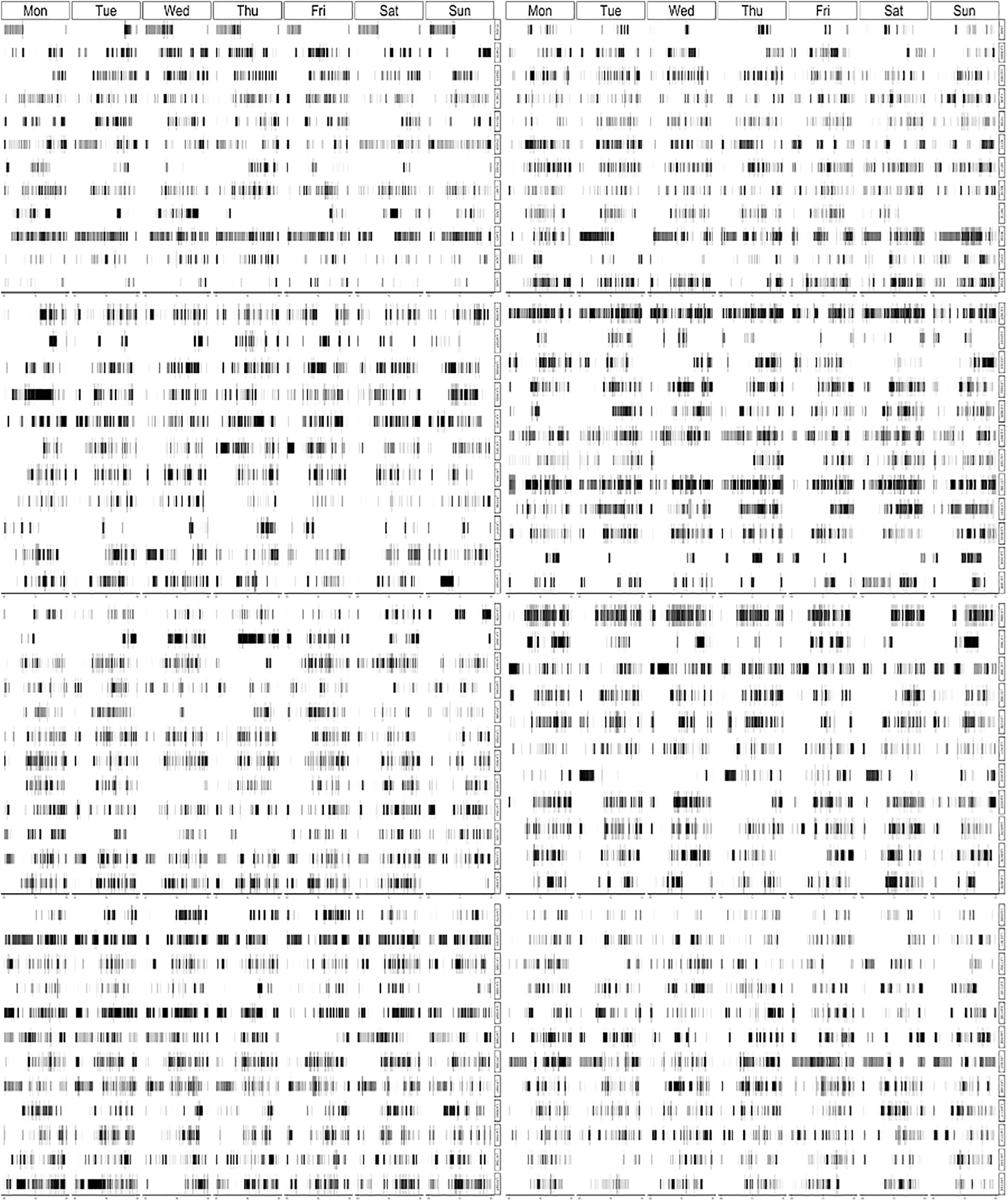
Timing of 94 individuals' production (long ticks) and consumption (short ticks) behavior on smartphones during 1 week (Monday–Sunday). Note: Each of the two panels (left and right) shows the behavioral sequences of 47 individuals' smartphone behavior during 1 week. Each tick mark represents the onset of a production segment (long ticks) or a consumption segment (short ticks).
Distributional Statistics of the Timing of Production and Consumption Behavior
Production behaviors showed evidence of entrainment to typical diurnal sleep–wake rhythms, as shown in Figure 2. There were, however, as indicated by the random effects, substantial between-person (and hour-to-hour) differences in the regularity of the diurnal trends. Results of the distributional and growth model analyses indicate that production behavior is rapid and fragmented at the seconds timescale and exhibits diurnal patterns at the hours timescale. These results highlight the importance of considering both intraindividual change and interindividual differences in how temporal dynamics of interactions are structured at multiple timescales.

Diurnal trends in frequency of production behavior across the 24 hours of the day derived from latent basis growth model based on Screenome data obtained from 94 individuals during 1 week of observation.
Content of media production and consumption segments
Figure 3 shows the top eight mobile application categories used during production and consumption segments. More than 50 percent of production behavior occurred on messaging services, another 30 percent on social media platforms, and small amounts (<5 percent) on a variety of other applications. Consumption behavior occurred in similar applications categories but was less concentrated. The high concentration of production behavior on messaging and social media applications indicates the unique functions of media production behavior in social interaction, self-disclosure, and interpersonal communication.

Content of consumption and production behavior: Proportion of total consumption (left) and production (right) time spent in each of the top eight mobile applications/categories.
Figure 4 shows that production content had a lower word count than consumption content, but more noun or noun phrases (pronoun), and more words that describe or modify other words (adjective, adverb, verb). Produced content also exhibited higher levels of confidence (clout), and a more honest and personal style (authentic) than consumed content, but also lower levels of formality and logical thinking (analytic). In the social domain, production content included more family words and fewer friend words than consumption screens. Produced content contained more informal language (swear) and fewer words related to personal concerns (leisure, work).
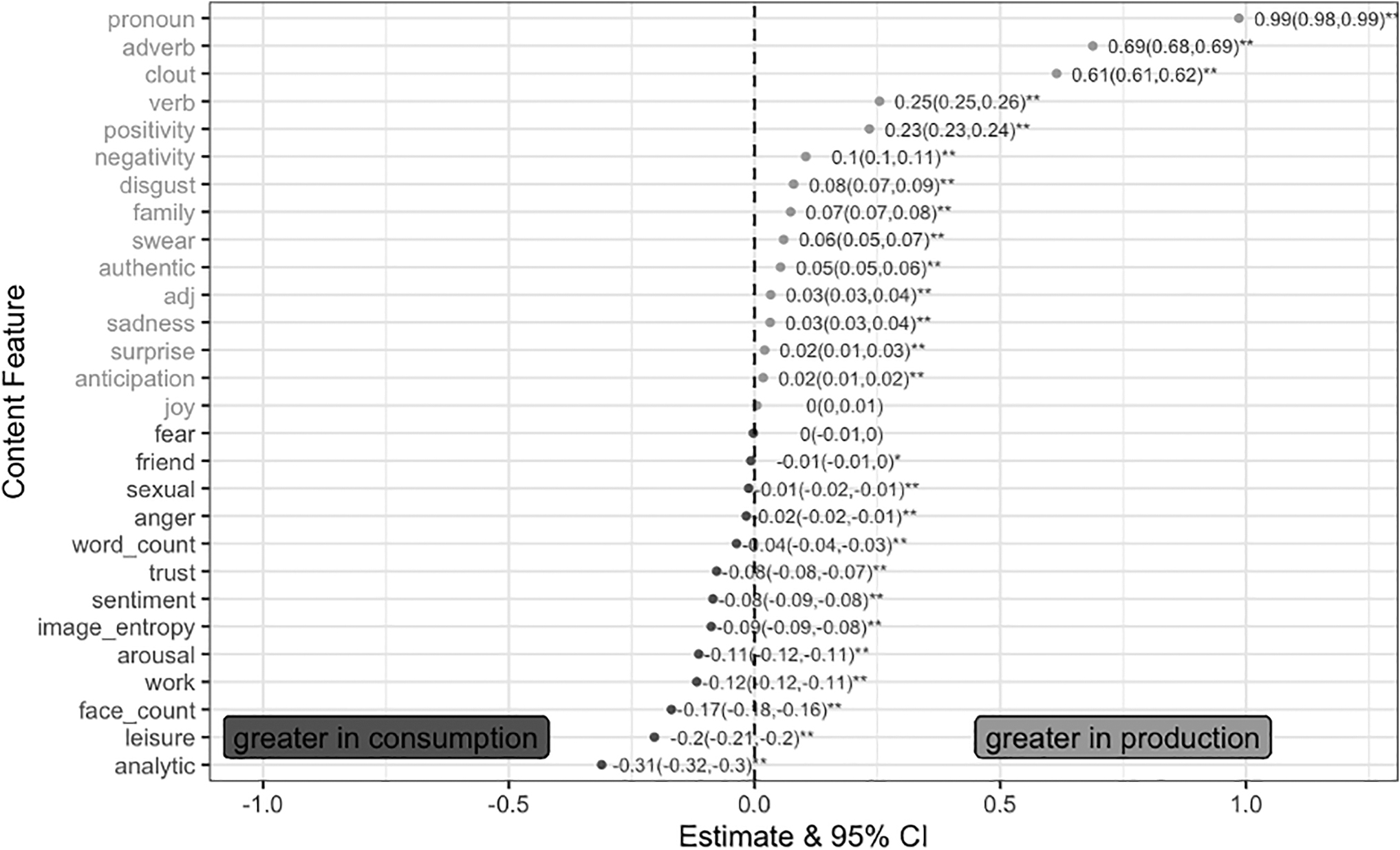
Differences in textual and visual features of production and consumption screens. Results obtained from a series of multilevel models. Point estimates >0 indicate greater presence in production screens, and estimates <0 indicate greater presence in consumption screens. Note: 95 Percent confidence intervals are listed and shown as whiskers extending from the parameter estimate, but in no case extend beyond the width of the dot. **p < 0.01, *p < 0.05.
Production content was richer emotionally, containing both more positive emotion and negative emotion words, with the emotion-specific lexicons indicating that production content had more negative sentiment and less arousing words than consumption screens. Production content contained fewer visual social cues (as measured by face count) than consumption content and were less visually complex (as measured by image entropy). Production content tended to be more articulate and condensed, an indication that production behavior may be associated with greater use of cognitive resources. Production content was also more emotionally rich and less formal, suggesting that production behavior satisfies different emotional and social needs.
Context before, during, and after production segments
Results from multiphase growth models examining the context surrounding media production segments are shown in Figure 5 (full set of results are shown in Supplementary Appendix S3). Panel 1 of Figure 5 shows, for example, that word count decreased in the minute before production and increased both during the production segment and in the minute after production. Notably, there were substantial between-person differences in how word count changed in all three phases.
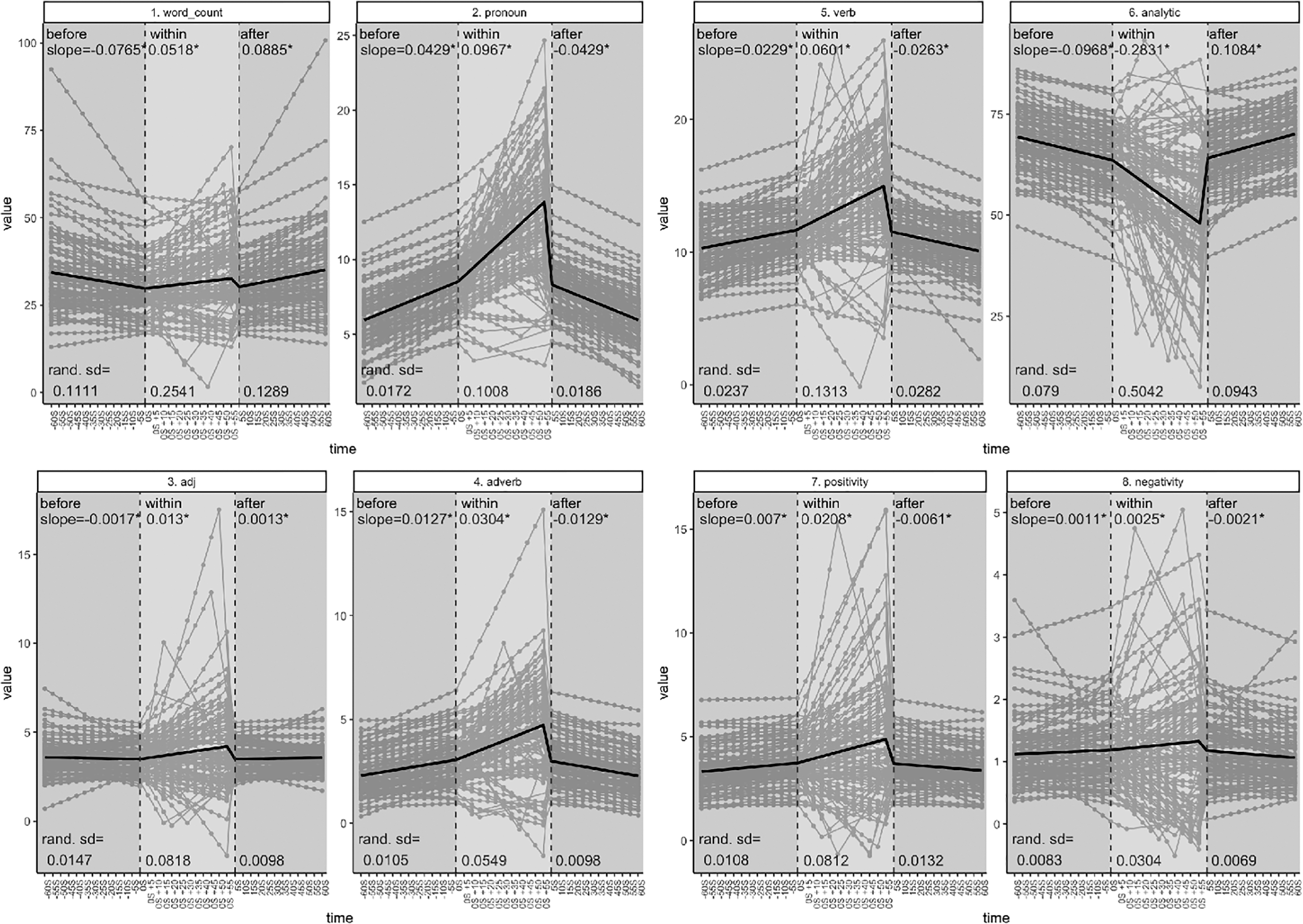
Context: prototypical (bold line) and individual (dotted lines) changes in text and visual features in the periods before (dark gray background), during (light gray background), and after (dark gray background) production segments, as obtained from multiphase (spline) growth models.
Generally, the psycholinguistic features of the text (Panels 2, 4, and 5) exhibited a pattern of change wherein the feature increased before and during production and then decreased after production. Exceptions include adjectives (Panel 3) and analytic words (Panel 6). Two general patterns of change emerged in all the models. First, content features that resemble the forthcoming production increase in the minute before that production segment. For example, word count (which was generally higher during consumption segments) decreased in the minute before production. Second, the preproduction trend is reversed after production. For instance, an increase of positivity occurring before production is complemented by a decrease in positivity after production. These patterns indicate that production behavior is more likely to occur in contexts that resemble production behavior and may guide theorizing about smartphone interactions at fast timescales.
Discussion
This study identifies and describes the specific timing, content, and context surrounding individuals' everyday media production behavior on smartphones. We highlight three conclusions useful for new theory about digital media interaction and smartphone use.
Production behavior is infrequent but purposeful
Production is a proportionally small but significant category of personalization in digital media. Production content is more expressive, articulate, and condensed than consumption content. Production content is also more confident and emotionally charged than consumption content. A one-word summary of production behavior may be purposeful, meaning that production is associated with specific tasks and higher user agency. Production behavior may be more intentional and goal-directed, reflecting social interaction and self-disclosure goals. This result has important implications for the literature on the social interaction and self-disclosure functions of digital media.
Recent research on self-disclosure shows how these functions can reduce stress and loneliness, 43 increase the persuasiveness and marketing value of user-generated content (UGC), 44 and support coping with pandemic stressors. 45 Our granular descriptions add to this literature by demonstrating that digital traces of these functions also manifest in the creation of short messages, contributing to a better understanding of the relationships between functional uses of smartphones, psychological health, and the marketing value of interactions.
Production behavior is fragmented and idiosyncratic
There were considerable between-person differences evident in how features of the context that surrounds production segments changed over time. Parallel to the idiosyncrasy seen in other granular assessments of media use,31,46–48 timing of and content changes during production behavior were highly idiosyncratic. This finding suggests that further understanding of individuals' media experiences requires theories that describe and explain intraindividual changes.
Theories of production behavior should be user-centric
The trends in the data suggest that theories about production behavior should be user-centric, specifically postulating how and why individuals differ in their use patterns over time. For instance, the multiphase growth modeling results indicate that contexts that start to look like production behavior are more likely followed by actual production behavior and that there are significant between-person differences in production behavior. Theories about priming may explain this finding, suggesting that the salience and accessibility (in memory) 29 of contextually and temporally proximate production-related information will increase the likelihood of production behavior. To better explain these results, researchers also need to consider user-centric versions of priming theories. A user-centric version of the theory would suggest not only why contextual proximity increases production likelihood but also how media users may vary in their psychological responses to contexts.
A user-centric view of digital media interactions also has implications for research on UGC. Recent research in this area has demonstrated the value of UGC in identifying challenges of remote work 49 and developing digital marketing strategies. 50 A user-centric understanding of UGC may enable better design for remote work environments and online marketing systems through personalization and analytic models driven by user-generated data.50,51 Our findings show the potential of using user-produced content to theorize about digital media interactions.
Conclusion
This study examined the timing, content, and context of individuals' everyday media production behavior on smartphones. Using intensive but unobtrusive observation of interactions, we analyzed real-world interactions across platforms and applications. Our results indicated that production behavior is faster, shorter, and more infrequent than consumption behavior. Produced content differs from consumption behavior in ways that suggest its unique media use functions. We found that production behavior is more likely in context that resembles it. We discussed how our findings help provide empirical foundations for new theories about digital media interaction and smartphone use.
Limitations and future research
Limitations of the study include reliance on a convenience sample. Screen content was sampled every 5 seconds, an interval considerably shorter than the sampling intervals in most studies, but possibly still not short enough. Because production content was identified by the presence of a touch keyboard, we may have missed other interesting types of touch input interactions. Additional analysis is also needed to understand the relationships between user-level characteristics with the results we demonstrated in this study. Overcoming these limitations will usefully broaden the range of theories that might be informed by knowledge gained thus far. Future research may investigate how user characteristics are related to the various aspects of production behavior, for example, whether certain users are more likely to generate content in given similar contextual conditions.
Theoretical and practical implications
Through analyses of key aspects of production behavior, this study demonstrates how research can benefit from methods that permit analysis at flexible timescales and that allow examination of both interindividual and intraindividual variation. New research may benefit the most by focusing on the intraindividual level analysis to examine user-specific differences with respect to content and context of behavior. Our findings suggest how established theories about digital media interaction and smartphone use may need to accommodate the fast pace of smartphone production, and perhaps most importantly, they point to a need for research on interactions that are short but psychologically important. The finding that production behavior is purposeful and affords important media use functions has practical implications for measuring and quantifying media use intention, which is a critical concept in assessing smartphone users' psychological state 52 and improving digital well-being.53,54
Footnotes
Author Disclosure Statement
We have no known conflict of interest to disclose.
Funding Information
This research was funded by grants from the Cyber Social Initiative at Stanford University (SPO#125124), the Knight Foundation (G-2017-54227), the Stanford Maternal and Child Health Research Institute (MCHRI), the Stanford University PHIND Center (Precision Health and Integrated Diagnostics), and the Pennsylvania State University Colleges of Health and Human Development and Information Science and Technology.

References
Supplementary Material
Please find the following supplemental material available below.
For Open Access articles published under a Creative Commons License, all supplemental material carries the same license as the article it is associated with.
For non-Open Access articles published, all supplemental material carries a non-exclusive license, and permission requests for re-use of supplemental material or any part of supplemental material shall be sent directly to the copyright owner as specified in the copyright notice associated with the article.
