




Abstract
This study examines how being envious toward social media influencers (SMIs) relates to users' affective well-being. An online survey was conducted in which 305 U.S. participants viewed to 20 posts of an SMI and subsequently measured their affective well-being, envy, and inspiration toward the SMI, and self-esteem levels. The results revealed a direct negative relationship between envy and affective well-being, but a positive indirect effect through inspiration. Furthermore, individuals' self-esteem moderates the relationship such that the positive relationship between envy and affective well-being through inspiration is stronger among those with high levels of self-esteem. Moreover, inspiration varies between different influencer categories, that is, participants who viewed fitness influencers reported the greatest amount of inspiration, followed by fashion, beauty, and entertainment influencers.
Social media influencers (SMIs) establish an influential online identity by constructing compelling and attractive social media profiles.1–3 SMIs are ordinary users who gradually gain notoriety for sharing engaging content on social media. People perceive SMIs more similarly, feel closer, and identify more easily with SMIs than traditional celebrities. 4 Many users even feel that their favorite SMI understands them better than their actual friends 5 because SMIs prioritize parasocial relationship to promote psychological closeness. 6 Consequently, users engage in social comparison with SMIs 7 since people are intrinsically motivated to accurately evaluate themselves by comparison with similar others. 8
In this regard, prior research has shown that the experience of envy, or the painful emotion that stems when one feels inferior compared to another, is prevalent during the consumption of SMIs' contents. 7 This is not surprising, given that one of the most common features of successful SMIs' contents is exhibiting a glamorized lifestyle.3,9 Users look up to SMIs' lofty statuses and idealistic persona, 10 which stimulate upward social comparison and a feeling of envy.7,11
Due to such prevalence of SMI envy, it is worth exploring how it associates with users' subjective well-being. Previous findings on social media envy have been inconsistent. While some studies revealed that envying other users could result in undesirable consequences such as decreasing users' life satisfaction 12 and affective well-being, 13 as well as elevating depression, 14 other studies found that it could also lead to positive and productive outcomes such as encouraging motivation for self-improvement14,15 and increasing subjective well-being overall.16,17 Such inconsistency warrants further investigation as to why envy produces such contradicting outcomes. Focusing on SMIs, this study therefore explores the relationship between SMI envy and users' affective well-being (i.e., mood), which best captures the momentary and fluctuating affective reactions 18 soon after being exposed to SMIs' content.
To further gain a better understanding of the role of SMI envy, we used the concept of inspiration, which is defined as a motivational state that facilitates transcendence of restrictions, 19 or “a breathing in or infusion of some idea, purpose, etc. into the mind; the suggestion, awakening, or creation of some feeling or impulse, especially of an exalted kind.” 20 Inspiration serves as a powerful mechanism because it promotes positive well-being due to increased gratitude and the installment of a sense of purpose and direction in life.19,21 Prior research has documented a strong association between envy and inspiration.16,17,22 Meier et al. 16 revealed that Instagram users who experience benign envy from an acquaintance's post have a higher sense of inspiration, which in turn fosters both hedonic (e.g., positive affect) and eudaemonic (e.g., self-actualization) well-being.
In our research context, we thus contend that envy toward SMIs can have a positive relationship with affective well-being through inspiration as it motivates people to improve and imitate SMIs, rather than propelled to belittle and harm them (i.e., malicious envy). 23 SMIs are talented experts who create and disseminate high quality content, and users assimilate themselves with SMIs during social comparison. This is because individuals tend to assimilate with the superior person when they identify and sense a connection (“we”), all of which are defining characteristics of the SMI-follower relationship.4,5 Given that envy toward role models like SMIs induces self-improvement motives, 22 we therefore posit that feeling envious toward an SMI will be positively associated with inspiration, which in turn will correlate with more positive affective well-being.
H1: There will be a positive indirect association between SMI envy and affective well-being through inspiration.
Despite their positive consequences, SMIs may not be universally appealing to users. We contend that the arousal of inspiration should hinge on individuals' self-esteem. 23 Upward comparison leads to inspiration and self-improvement motives when the envied person's achievements or qualities seem attainable. 24 Individuals who have high self-esteem possess an optimistic outlook and a sense of mastery or greater self-efficacy for self-improvement. 25 This implies that individuals with high self-esteem are more confident that they can become better versions of themselves, while individuals with low self-esteem are likely to experience motivational deficits and display symptoms of helplessness from upward comparisons, 26 thus validating the moderating effect of self-esteem on the positive relationship between envy and inspiration.
H2: Self-esteem will moderate the positive relationship between envy and inspiration. Specifically, the positive envy-inspiration association will be stronger for those with high (vs. low) self-esteem.
The question whether users' experiences of envy and inspiration would differ based on the influencer's area of specialization (i.e., beauty, fashion, fitness, and entertainment) is also raised. Despite the fact that people follow SMIs to gratify specific wants and needs10,27 and users' responses vary based on SMIs' area of expertise, 28 dearth of studies takes this into account. Users may experience varying degrees of inspiration for different categories of SMIs as the underlying theme behind their content differs, that is, content that revolves around notions of self-expression fosters an appealing self, is inspirational, and leads to a positive mood. 29 For example, beauty and fashion influencers cover topics such as makeup tutorials, trendy outfits, and high-end lifestyles—all of which are tactics for promoting an idealistic self. 30 Fitness influencers share their best workout and diet tips, acquiring the term “fitspiration,” to project motivational attributes.31,32
Conversely, SMIs specializing in entertainment might have less to do with inspiration, as they generate playful and buzzworthy content that users engage in to pass their time. We thus explore whether SMI categories moderate the relationship between envy and inspiration to parse user's experiences of SMI envy and inspiration. Figure 1 shows the conceptual design of this study.
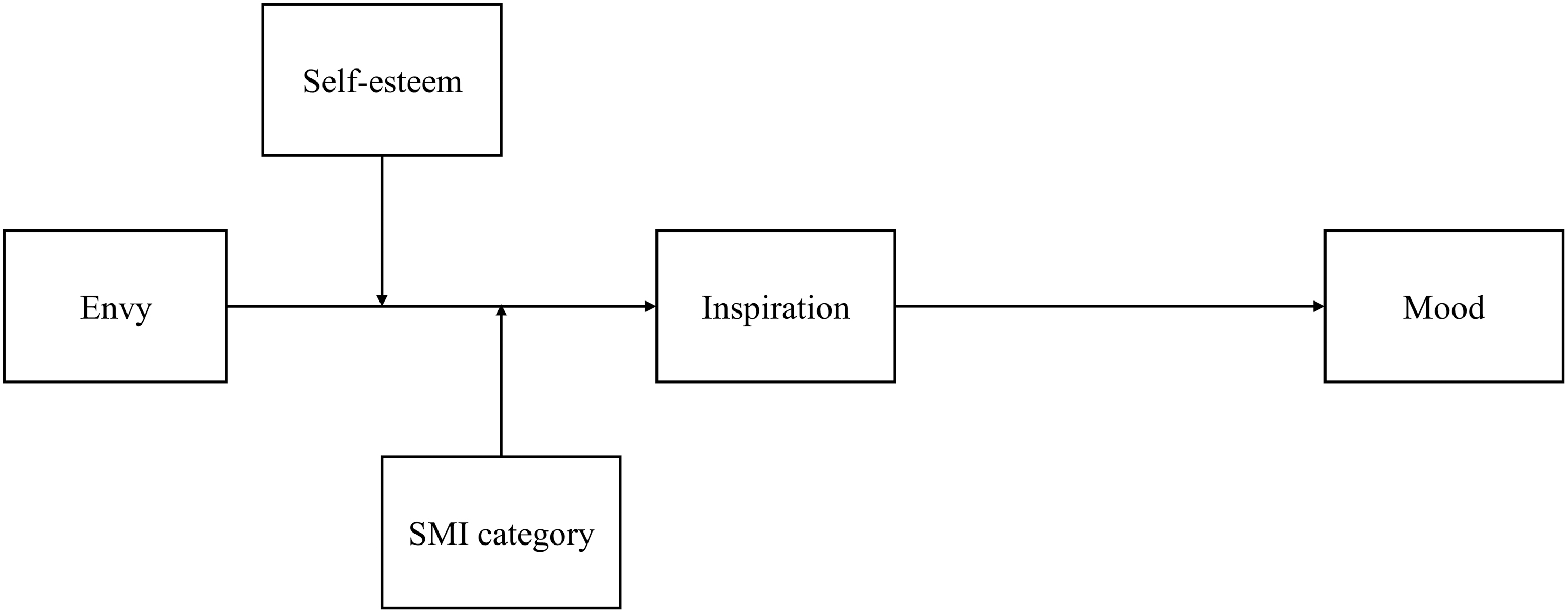
Conceptual model. SMI, social media influencer.
RQ1: How do certain categories of SMI influence the positive relationship between envy and inspiration?
Method
Procedure and respondents
We recruited current followers of the Instagram SMI(s) from the Qualtrics online panel in May 2020. A total of 305 U.S. residents (Mage = 23 years, 253 females) completed the survey. Fifty-one percent of the participants were Caucasian (51 percent), followed by Asian (15 percent), African American (14 percent), Hispanic (12 percent), Other (4 percent), Multiracial (3 percent), and Native American (3 percent).
Participants were asked to indicate the topic they engaged with the most, choosing from the following four categories: entertainment (n = 138), beauty (n = 102), fashion (n = 35), and fitness (n = 30). Participants were shown twenty most recent Instagram posts of a randomly assigned SMI who specialized in the relevant category. Each of the posts was embedded in the online survey so that participants could interact (i.e., click or play) with the content as they would on Instagram. For each category, one male and one female SMI were selected from Forbes's list of top influencers 33 : jefreestar and nikkietutorials for beauty, shanedawson and lelepons for entertainment, chiaraferragni and bryanboycom for fashion, and michellelewin and joewicks for fitness. The university's institutional review board (IRB) granted ethical approval before we collected the data.
Measures
After viewing the assigned SMI's Instagram posts self-paced, the post-questionnaire first measured participants' affective well-being using the mood short-form scale 34 (e.g., “Currently, I am in a good mood,” “As I answer these questions I feel very cheerful”; 4 items, M = 5.00, SD = 1.29, α = 0.83).
Then, participants reported how much they envied this SMI 7 (3 items; e.g., “I envy this influencer's life,” “My life is inferior to this influencer”; M = 2.82, SD = 1.38, α = 0.77), felt inspired 19 by them (“I feel inspired by this influencer”; 1 item, M = 3.97, SD = 1.92), and were familiar with their content (i.e., “Not familiar at all: Very familiar”; 1 item, M = 4.25, SD = 2.41). Subsequently, participants assessed their self-esteem levels 35 (M = 4.14, SD = 1.16, α = 0.93, 20 items). All items were measured on a 7-point Likert scale (1 = strongly disagree and 7 = strongly agree). Refer to Table 1 below for bivariate correlations between variables.
Pearson Correlation Among Variables, Means, and Standard Deviations
**p < 0.01.
Results
Model 9 of PROCESS Macro 3.5 was performed using a bias-corrected bootstrap procedure (5,000 bootstrap) to test the hypotheses and the research question. SMI envy was an independent variable, inspiration was the mediator, and affective well-being was the dependent variable. Self-esteem and influencer category were the moderators. Influencer category was a multicategorical moderator in which the beauty category was used as the reference group to compare with the other three categories (i.e., fitness, fashion, entertainment). Gender and familiarity with the SMI were entered in the model as covariates.
The results revealed that envy is negatively associated with affective well-being (b = −0.29, SE = 0.05, t = −5.72, p < 0.001). In support of H1, however, envy was positively related to affective well-being through inspiration. Specifically, envy was positively associated with inspiration (b = 0.60, SE = 0.13, t = 4.69, p < 0.001), which was positively correlated with affective well-being (b = 0.19, SE = 0.04, t = 4.88, p < 0.001). Regarding the covariates, familiarity was positively associated with inspiration (b
H2 was supported as self-esteem moderated the relationship between envy and inspiration (b
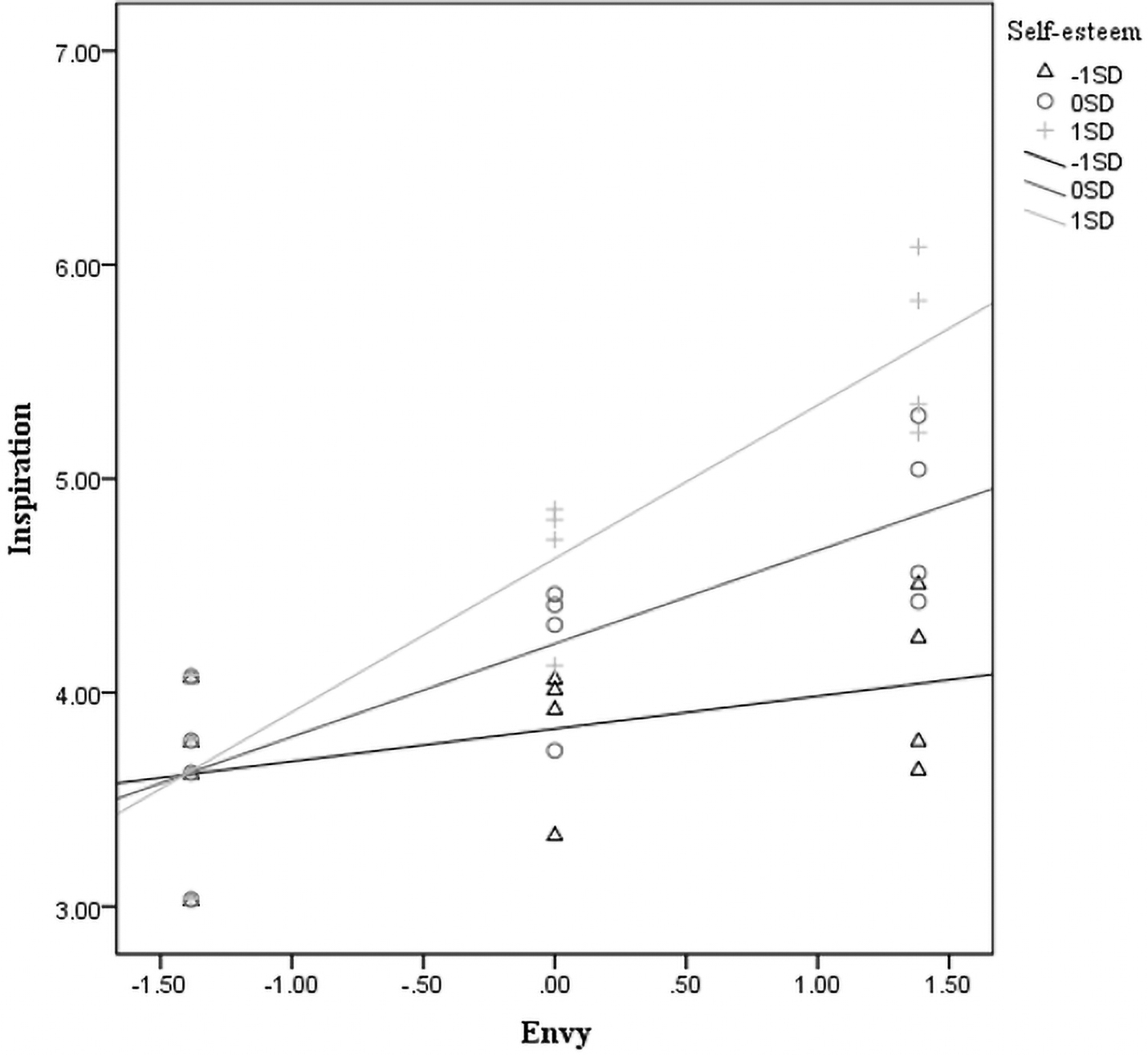
Envy × self-esteem interaction on inspiration.
In terms of RQ1, the data indicated that the influencer category does not moderate the relationship between envy and inspiration. None of the interaction effects was significant (p's >0.05). However, the main effect of beauty versus entertainment was significant (b = −0.73, SE = 0.24, t = −3.00, p < 0.01), which suggests that beauty influencers were associated with greater inspiration than entertainment influencers. A summary of conditional indirect effects is presented in Table 2. An ANCOVA was performed (controlling for gender and familiarity) to further investigate how the four categories differed in inspiration.
Conditional Indirect Effects of Envy on Mood Through Inspiration Depending on Users' Self-Esteem and Social Media Influencer Categories
SMI, social media influencer; LLCI, low limit confidence interval; ULCI, upper limit confidence interval.
The main effect of the influencer category was significant [F (3, 299) = 5.12, p < 0.01, η 2 = 0.05]. Participants who evaluated a fitness SMI reported the greatest amount of inspiration (M = 4.54, SE = 0.35), followed by fashion (M = 4.41, SE = 0.32), beauty (M = 4.26, SE = 0.20), and entertainment (M = 3.52, SE = 0.16). A Bonferroni post hoc test showed that the mean scores for fitness and beauty SMIs were significantly higher than those for entertainment SMIs (p's <0.05), while the difference between fashion and entertainment SMIs was not significant (p = 0.08).
Discussion
This study examined how envying SMIs relates to users' affective well-being. Findings indicate that the overall association between envy and mood is negative, while there is also a positive indirect association through inspiration. Our findings not only corroborate the stream of research that has found that social media-induced envy relates to undesirable well-being outcomes12–14 but also shed light as to why previous studies have documented various positive effects of SMI envy in the marketing context, such as more positive evaluations toward SMIs 36 and greater intention to purchase their brand endorsements. 11 Thus, this article contributes to the SMI literature by closing the research gap regarding the inconsistent relationship between envy and users' well-being.12–17 In addition, by highlighting inspiration as a psychological mechanism, our findings extend the stream of literature that acknowledges SMIs as sources of inspiration, 37 more than ordinary brand endorsers and opinion leaders.
Another significant finding is that users' self-esteem played a central role in moderating the link between envy and inspiration: individuals with higher self-esteem were more likely to feel inspired by envy as they had a greater self-efficacy for self-improvement. In other words, envy toward SMIs is positively associated with mood through inspiration, especially in individuals with high self-esteem. Previously, Chae 7 documented in her two-wave online study that users with low self-esteem report feeling more envious toward SMIs. Our study extends this finding by demonstrating that the relationship between envy and affective well-being also hinges on self-esteem as it is associated with varying levels of inspiration.
Regarding our research question, entertainment influencers elicited the least amount of inspiration between the four influencer categories. This could be due to entertainment influencers focusing on creating amusing and stimulating content, while fashion, beauty, and fitness influencers actively share informative knowledge in their area of expertise, thereby becoming inspirational role models. In addition, content related to fashion, beauty, and fitness may have been more esthetically pleasing, which was found to be a key factor that promotes inspiration among Instagram users. 16 Moreover, these findings contribute to the increasing body of research that seeks to parse out the effects of SMIs into different categories, spanning across features from audience size (i.e., micro-, macro-, mega38,39) to areas of expertise. 28
Although this study's findings offer important insights, our research is limited in several ways. First, given the cross-sectional nature of the study, we cannot infer causation, but only correlation. Experimental designs that could more rigorously test the effects should be conducted to substantiate the study's findings. Second, the sample skewed heavier toward females because we recruited current followers of Instagram SMIs from the Qualtrics online panel and some of the most popular SMI categories that dominate the market (i.e., fashion and beauty) are rather female heavy.40,41
Although gender disparity appears to be somewhat common in SMI-related studies,10,28 future studies should test whether our conceptualization can be applied to male-dominant SMI categories such as automobiles or electronics. Finally, data were collected during the early stages of the pandemic (May 2020) when the public's psychological health was declining due to COVID-19 preventive measures such as quarantine, social distancing, wearing masks, or testing. People spent much more time on social media to stay informed and reduce uncertainty around the novel disease. SMIs gratified the repressed social needs of users by generating entertaining and informative content, as well as encouraging lively interaction. In fact, many SMIs saw an increase in the number of likes and comments since COVID-19. 42
This suggests that, in many ways, our findings could have been impacted by the unique COVID-19 situation such that the negative association between envy and mood may have been more magnified due to the overall increase in ill-being of users. Also, being inspired by SMIs may have had a more enthralling effect because it could rejuvenate users by taking their attention away from COVID-19. This research did not capture the extent to which participants' affective well-being is impacted by COVID-19. As COVID-19 will continue to affect daily life and mental health in unprecedented ways, future research should consider potential effects of COVID stress and risk on people's reactions to SMI content.
In conclusion, this article shows that SMI envy is a double-edged sword in that although it may reduce users' mood, it can be an effective strategy to lure and inspire users. 11 Indeed, users are habitually accessing these visual platforms for the daily dose of digital inspiration as evidenced by the rising number of studies that have begun to explore the antecedents, mechanisms, and consequences of social media inspiration.16,17,22,43 Focusing specifically on SMIs who are today's most influential digital opinion leaders, this article elaborates on how inspiration functions as a key mechanism underlying the affective process that is triggered when browsing through their content. Our examinations of self-esteem and different influencer category as moderators also enrich our understanding of how envying SMIs and affective well-being are associated.
Footnotes
Author Disclosure Statement
No competing financial interests exist.
Funding Information
This work was supported by the Ministry of Education of the Republic of Korea and the National Research Foundation of Korea (NRF-2021S1A3A2A02090597).