




Abstract
Research assessing online trolling—a behavior designed to trigger or antagonize other users for entertainment—has largely focused on identifying individual differences that underlie the behavior. Less attention has been given to how situational factors influence trolling, such as the disinhibiting effects of anonymity. In this study, we evaluated the roles of both individual differences and levels of anonymity in online trolling. We assessed these through experimentation, a relatively novel approach in trolling research. Australian undergraduate students (n = 242, 167 women, 75 men, Mage = 21.18) were allocated to one of three conditions: an anonymous condition where they were not visible to one another, an identifiable condition where they were visible to one another, or an external condition where they completed the study outside of a controlled laboratory environment. Participants first read a short news article before interacting in an online group discussion where participants could chat freely. The first comment participants wrote was later coded for trolling. Participants also completed assessments of psychopathy, sadism, and a global assessment of trolling. As predicted, participants in the anonymous condition trolled more than those in the identifiable condition. No differences were seen between these two conditions and the external condition. Analyses also revealed that sadism and global trolling were positively associated with trolling in the chat room, but psychopathy showed no association. These results demonstrate the importance of both individual differences and the disinhibiting effects of anonymity when investigating the complex nature of trolling.
Introduction
Online trolling is a deliberate behavior that aims to deceive, disrupt, or aggress against others online, with the intention of triggering or antagonizing other users, typically for one's own personal entertainment.1–3 Trolling can be emotionally distressing to its victims so its presence in online communities is of concern. 4 Researchers have commonly explored trolling through the lens of individual differences, finding that certain traits predict engagement in trolling.5,6 Less research, however, has focused on whether situational factors, such as anonymity, also predict trolling. This study aimed to assess the effects of situational anonymity and individual differences in trolling in an online chat.
Individual differences and trolling
Research on trolling has largely focused on the psychological profile of online trolls. Trolling is related to increased sadism, psychopathy, and negative social potency, a lack of affective empathy, and dysfunctional impulsivity.5–8 Men are also more likely to troll, compared with women.5,6 Of these, psychopathy (a callous lack of empathy) and sadism (an enjoyment of seeing others suffer) have shown the most robust relationship with trolling. 7 For sadism specifically, some have argued that trolling may be an Internet manifestation of sadism, as trolls use the Internet to perpetuate the suffering of others. 5
Although the relationships between individual differences and trolling are well understood, past research has relied on self-reported trolling rather than using direct behavioral observations. One limitation of assessing trolling through self-report is trolling is a socially undesirable behavior. This could lead to a reporting bias as people may be less willing to endorse perpetrating such antisocial behaviors. Using a behavioral assessment of trolling may address this limitation by being less prone to social desirability bias. Furthermore, using both self-report and behavioral assessments of trolling may provide unique insight into how individual differences, such as psychopathy and sadism, can predict trolling while also testing the construct validity of both assessments.
Anonymity as an affordance
One study has attempted to experimentally investigate how situational factors influence trolling. 9 That study found participants were more likely to engage in trolling when the discussion they joined was antisocial, or when primed to have a negative mood. The researchers concluded anyone can become a troll, given the right situation. Indeed, specific environmental affordances have been found to influence online behavior.10–12 The term affordance—the action possibility available in a situation—is useful in describing the relationship between organisms and their environments.13,14
One affordance that is often mentioned, yet seldom investigated in relation to trolling, is anonymity. 5 Anonymity is defined as a continuum ranging from identifiability to unidentifiability.15,16 Unidentifiability may stem from visual cues such as reduced eye contact or invisibility, both resulting in the source of information being unknown to others.17,18 Without these visual cues people may feel more anonymous. 19
Affordances are often explained through their outcomes. For anonymity, this can be feelings of disinhibition.12,20 Disinhibition refers to a feeling of reduced constraint and reduced concern for social norms. 21 In online environments, this has been labeled as the online disinhibition effect. 12 Although disinhibition can lead to positive social outcomes,11,22,23 more problematically disinhibition can lead to the amplification of antisocial behavior.18,24,25 Therefore, anonymous situations leading to disinhibition may explain additional variance in why people troll. To date, no research has attempted to experimentally manipulate the level of anonymity and assessed its effects on trolling in an online chat room.
The present research
We investigated how anonymity can influence trolling in an experimenter-controlled online chat room. Furthermore, we investigated how self-reported global trolling was related to trolling in an online chat, and finally, whether sadism and psychopathy are associated with both global trolling and trolling in an online chat. Participants first read a news article before joining an online chat room where they could leave comments for other participants to see. These comments were coded for trolling.
Participants were assigned to one of three conditions: an anonymous laboratory condition where participants were not visible to one another, an identifiable laboratory condition where participants were visible to one another in a well-lit classroom, or an external condition where participants completed the study outside of a controlled laboratory environment completely anonymous to other participants. Participants also completed measures of psychopathy, sadism, and a global assessment of trolling.5,26,27
We predicted that trolling in an online chat room would be higher in the anonymous condition compared with the identifiable condition, as anonymity will increase disinhibition. Furthermore, we predicted that trolling in an online chat room would be higher still when participants completed the study externally, as participants should feel anonymous to other participants, along with having no contact with other participants before the study began. Second, we predicted that global trolling would be positively associated with trolling in an online chat room. Third, we predicted that psychopathy and sadism—two traits that have previously shown a robust relationship with global trolling—would be positively associated with both global trolling and trolling in an online chat room.
Method
This study was approved by an institutional ethics review board. We report all measures and manipulations. Interested readers may also access the preregistration at (
Participants
We recruited 242 (167 women and 75 men) undergraduate students to participate for course credit. Ages ranged from 18 to 44 years (M = 21.28, SD = 3.79). All participants were fluent in English. A chi-square test of independence found no difference in the proportion of men and women across conditions χ 2 (2, N = 242) = 4.55, p = 0.103. A sensitivity analysis (analysis of variance [ANOVA], one way, three groups, α = 0.05) was conducted using G*Power, 28 finding the minimum detectable effect size was η 2 = 0.038 at 80 percent power, indicating good power to detect small-to-medium effect sizes.
Materials
Articles
Two articles used for the discussion were taken from the website The Daily Mail. The first article was titled “Kylie Jenner looks slender in tight shorts as she's seen for the first time since welcoming daughter Stormi 10 days ago.” 29 The second article was titled “Kanye West calls slavery ‘a choice’ and states that black people are ‘mentally imprisoned’ as rapper implodes during interview.” 30 Both articles were similar in style, content, and length. In total, 56 participants viewed the first article, and 186 participants viewed the second article. The article was changed to ensure all participants were engaged in the study, as some participants expressed disinterest toward the first article. Supplementary analysis found trolling did not differ for each article F(1, 216) = 0.89, p = 0.344.
Online chat room
An online chat room was programmed to show the news article at the top of the page and the chat box at the bottom (Fig. 1). Participants were randomly given a generic username that could not be changed (e.g., Anon1254). Seven comments—a mix of positive, negative, and neutral comments—were included at the beginning of the chat room to stimulate discussion. Participants were informed that these seven comments were not written by other participants. Participants were able to write and respond to other participants' comments during the experiment.
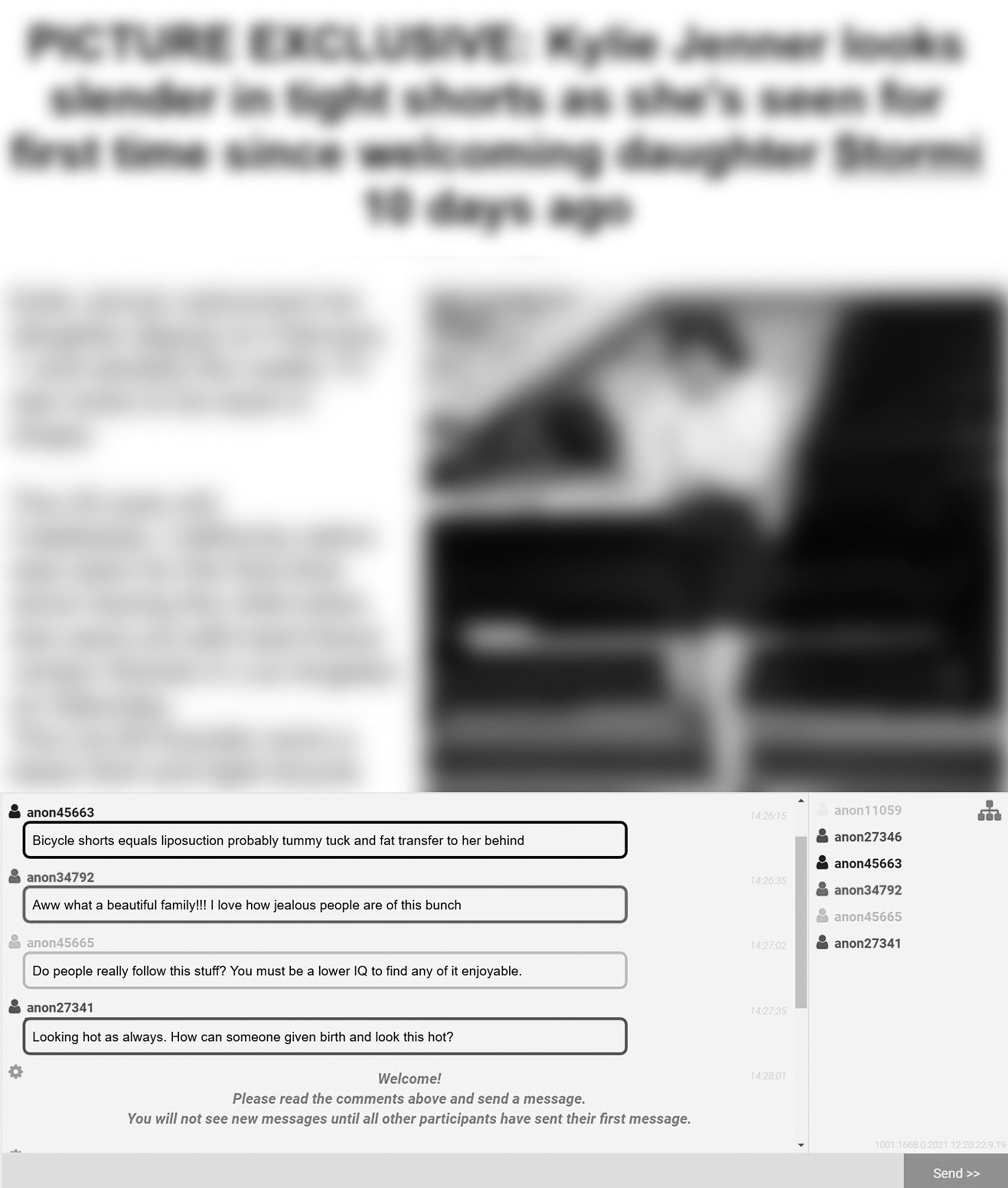
Example of article layout and experimental online chat room. Participants were able to scroll to read the full article. The online chat room was located at the bottom of the article.
Measures
Three manipulation checks were used to measure participants' perceived anonymity. Questions were measured on a 7-point scale ranging from 1 (Strongly disagree) to 7 (Strongly agree). These included “The other persons who had commented on the article have been anonymous to me,” “I felt anonymous when commenting in the chat room,” and “I am confident others do not know who I am.” The 27-item Short Dark Triad was used to assess psychopathy, along with narcissism and Machiavellianism.a,26 Items were assessed on a 5-point scale ranging from 1 (Strongly Disagree) to 5 (Strongly Agree). Participants also completed measures of sadism and global trolling. The 18-item Comprehensive Assessment of Sadistic Tendencies is an assessment of participants' sadistic tendencies. 27 Items were assessed on a 7-point scale ranging from 1 (Strongly Disagree) to 7 (Strongly Agree).
Finally, to assess global trolling an extended version of the Global Assessment of Internet Trolling scale (GAIT) was used. 5 Ten new items were added to the original 4-item scale to better address content validity. The new items are available in the Supplementary Data. The 14-item scale was assessed on a 7-point scale ranging from 1 (Strongly Disagree) to 7 (Strongly Agree). The revised GAIT measure showed strong internal consistency (α = 0.81). Scale reliabilities for all measures can be found in Table 2. Participants were also asked a number of contextual questions and completed two questionnaires that were not included in this report. These were the Big Five Inventory 31 and a scale in development assessing anonymous motivations.
Descriptive Statistics and Bivariate Correlations for Variables of Gender, Psychopathy, Sadism, Global Trolling, and Trolling in the Chat Room
Note: N = 242. Gender is coded as women = 0, men = 1; correlations corrected using the Benjamini–Hochberg procedure. Cronbach's alphas are included in italics on the diagonal.
p < 0.05.
p < 0.001.
Procedure
Depending on the timeslot participants signed up for, participants were allocated into one of three conditions: an identifiable condition, an anonymous condition, or an external condition. Participants were unaware of their assigned condition and timeslots for each condition were randomized. All participants were required to meet the experimenter before the study began. For the identifiable or anonymous conditions, the experimenter directed participants to the study's location. For the external condition, participants were given a link and a specified time to complete the study later that afternoon. The average group size for a discussion was 9.25.
Anonymous and identifiable conditions
In the anonymous condition, participants (N = 85) completed the study in a windowless darkened room with individual cubicles that were not visible to other participants. Participants' anonymity was stressed before the study begun. In the identifiable condition, participants (N = 83) completed the study in a well-lit classroom where participants were visible to each other. Their anonymity was not stressed. For both conditions, after obtaining consent, participants sat in front of an individual computer and were redirected to an online waiting room.
External condition
Participants (N = 74) in the external condition first met the experimenter at the time they signed up for. After receiving the study information, participants were asked to complete the experiment externally at a designated time later that day. The designated time was in the late afternoon as this allowed for most participants to be at home completing the study; however, participants were told they could complete the study wherever they want. At the designated time, participants entered the link given by the experimenter on an electronic device and read the study's information sheet, before giving informed consent.
Online chat room: procedure
Once all participants had entered the waiting room, they were directed to begin reading a short news article. Once participants read the article, they could engage in the online chat room. Participants were told they were unable to view other participants' comments until they wrote one comment themselves. Once all participants had written a comment, or 8 minutes had passed, the experimenter allowed participants to read each other's comments and chat freely. A total of 15 minutes was given to read the article and interact in the chat room. Next, participants were redirected to fill out a short questionnaire before being debriefed.
Coding for trolling in the chat room
To control for possible extraneous variables influencing trolling—such as the effect of reading other participants' comments—only the first comment a participant wrote was coded for trolling. Two coders rated comments based on the question: “Is this user trying to troll other users with their comment?” A definition of trolling was also included for reference: “a deliberate behavior that aims to deceive, disrupt, or aggress against others online, with the intention of triggering or antagonizing other users, typically for one's personal entertainment.” Comments were rated on a 3-point scale (1 = no, 2 = somewhat, and 3 = yes). The coders independently evaluated each comment. Comments were provided without condition information to blind coders to the experimental conditions. Disagreements were resolved through discussion. Interrater agreement was κ = 0.749, indicating a moderately high level of agreement. 32
Data analysis
The design of the study was both experimental and correlational. First, a one-way (identifiable, anonymous, and external) between groups ANOVA was used to test the differences in trolling across conditions. Second, correlational analyses between gender, psychopathy, sadism, global trolling, and trolling in the chat room were conducted. To control the false discovery rate, correlations were corrected using the Benjamini–Hochberg procedure. 33
Results
Preliminary checks
For means and standard deviations of each manipulation check across condition (Table 1). One-way ANOVAs revealed significant effects of condition on each manipulation check: with condition affecting perceptions of others' anonymity, F(2, 238) = 6.29, p = 0.002, η 2 = 0.050, feelings of one's own anonymity, F(2, 238) = 5.00 p = 0.007, η 2 = 0.040, and confidence in one's own anonymity, F(2, 238) = 6.06 p = 0.002, η 2 = 0.048. Post hoc analyses showed that relative to participants in the identifiable condition, those in the anonymous and external conditions thought others were more anonymous (p = 0.005 and p = 0.009, respectively), felt more anonymous (p = 0.025 and p = 0.014, respectively), and were more confident in their anonymity (p = 0.009 and p = 0.007, respectively). No significant differences were found between the anonymous and external conditions (ps > .05). Finally, additional checks found that scores of psychopathy, sadism, and global trolling did not differ between conditions (ps > 0.05).
Means (SD) for Trolling in the Chat Room and Manipulation Checks by Condition
Note: N = 242 within each row, variation in superscript indicates that means are significantly different from each other.
Trolling and visual anonymity
A one-way ANOVA revealed an effect of condition on trolling in the chat room, F(2, 216) = 3.29, p = 0.039, η 2 = 0.029. Post hoc analyses showed that participants in the anonymous condition were more likely to write a trolling comment than those in the identifiable condition. Neither the anonymous (p = 0.393) nor identifiable (p = 0.467) condition significantly differed from the external condition. For means and standard deviations of trolling across conditions (Table 1).
Individual differences and trolling
Descriptive statistics and bivariate correlations between gender, psychopathy, sadism, global trolling, and trolling in the chat room are shown in Table 2. Gender (male) and sadism were positively associated with both global trolling and writing a trolling comment. Psychopathy was only positively associated with global trolling.b
Discussion
Although past research has sought to understand the individual differences that underlie trolling, the aim of this study was to experimentally assess how the disinhibiting effects of anonymity influence trolling. Furthermore, we aimed to investigate the relationships between individual differences, trolling in a chat room, and global trolling. We found that participants were more likely to write a trolling comment in the anonymous compared with identifiable condition. This result partially supported our hypothesis that anonymity can lead to feelings of disinhibition, resulting in increased antisocial behavior. 12 However, the external condition showed no differences between the anonymous and identifiable conditions. The potential for uncontrollable distractions in these unstandardized environments may have led to lower engagement with the study. Although this condition is more ecologically valid, in future studies, more controls and guidelines may be necessary to test these effects outside of a laboratory setting.
Individual differences and trolling
Global trolling was positively associated with trolling in the chat room. Our study is the first to assess this relationship. These results provide support for the construct validity of both assessments. Generally, the relationship between sadism, psychopathy, and trolling supports previous research. Sadism was positively associated with global trolling, supporting the notion that trolling is an Internet manifestation of sadistic tendencies, 1 as sadists find intrinsic appeal in hurting others. 34 Importantly, we extend this finding by showing that sadism is positively associated with trolling in the chat room. Similarly, men, compared with women, were more likely to self-report having trolled and to troll in the chat room.
Psychopathy was positively associated with global trolling, but not associated with trolling in the chat room. It is possible that although people with psychopathic tendencies show deficits in empathy and self-control,26,35 their appetite for harming others is context dependent and largely instrumental. 26 Although individuals with psychopathic tendencies have the ability to troll others, they may not exhibit trolling in an experimental setting. Conversely, those with sadistic tendencies are willing to expend time and energy to hurt others, and thus would be more likely to troll in an experimental online chat room. 36 In sum, by testing both self-report and behavioral assessments, we were able to discern novel differences between focal variables previously associated with trolling. These results indicate the importance of assessing trolling through multiple methodological approaches.
Implications, limitations, and future directions
Using a laboratory paradigm, this study demonstrates that trolling is not only predicted by individual differences, but also partly through the disinhibiting effects that anonymity can afford. This finding is worthy of consideration as existing research has largely focused on building the psychological profile of an online troll. Experimental methods are infrequently used in online research, and it is hoped that this study further establishes the viability of such designs. Future research should also continue to explore how situational, cultural, and contextual factors influence trolling. Specifically, our study used an article that predominantly featured a person of color. Given that people of color often experience increased antisocial online behavior, future research should assess the effects of article content on trolling. 37
One limitation of our study is the larger proportion of women compared with men in our sample. However, since men typically troll more than women, this provides a stronger test of our main predictions.5,6 A second limitation is that participants were limited to a psychology undergraduate sample. Psychology undergraduates are typically younger, less diverse, and more empathic than the broader population, which potentially limits the generalizability of our findings.38,39 Future research should, therefore, aim to examine a more diverse adult population when exploring trolling, a behavior that is, in part, typified by empathic deficiencies.
Conclusions
We have demonstrated that trolling can be predicted by both individual differences and situational factors, such as anonymity. Specifically, people trolled more when they felt anonymous, and furthermore, trait sadism positively predicted both global trolling and trolling in the chat room. Trolling can cause significant distress to its victims and online environments would greatly benefit from more civil online discourse. To achieve this, however, we believe it is important to consider both individual differences and the disinhibiting effects of anonymity to better reflect the complex nature of trolling.
Footnotes
Acknowledgments
The research team would like to thank Deanna Varley for assistance in data coding, Paul Jackson for the creation of the online chat room software, and all the participants who took part in the study.
Authors' Contributions
Conceptualization and methodology by L.N. and E.V. Data collection and writing original draft by L.N. Formal analysis and writing—review and editing by L.N., S.T., and E.V. Project administration by E.V. Supervision by S.T. and E.V.
Notes
Author Disclosure Statement
No competing financial interests exist.
Funding Information
No funding was received for this article.

References
Supplementary Material
Please find the following supplemental material available below.
For Open Access articles published under a Creative Commons License, all supplemental material carries the same license as the article it is associated with.
For non-Open Access articles published, all supplemental material carries a non-exclusive license, and permission requests for re-use of supplemental material or any part of supplemental material shall be sent directly to the copyright owner as specified in the copyright notice associated with the article.
