




Abstract
Social media (SM) are crucial channels for the spread of information on COVID-19. However, they have rarely been explored. This study examined three types of social media use (SMU): SM usage time, passive SMU (PSMU), active SMU (ASMU) and investigated the relationships among three type of SMU, anxiety, and coping strategies. We recruited 1,150 adults in Taiwan for this study. Although past research found that ASMU is associated with well-being and that PSMU is associated with negative emotions, the findings of this study indicated that only ASMU could significantly predict anxiety; PSMU and SM usage time could not predict anxiety. The reason may be that individuals with unmet basic needs may depend on ASMU to satisfy their need for relatedness, competence, and autonomy. However, compared with PSMU, ASMU is more likely to be immersed anxiety due to its continuous exposure to COVID-19 news. The results regarding the paths between SMU and coping strategies were similar; a greater predictive coefficient existed between ASMU and avoidant coping, whereas the other two types of SMU were non-significant or weak predictors of coping strategies. Individuals may post things indicating that the pandemic is slowing down or is not scary to reduce their anxiety, deny the severity of issues, and cope with stress. On the whole, this study found that ASMU involving the pandemic can be used to predict psychological consequences and avoidant coping.
Introduction
Researchers have yet to reach a conclusion regarding the influence of social media (SM) on mental health during the COVID-19 pandemic. Some studies 1 showed that no significant correlation exists between social media use (SMU) and psychological consequences (e.g., well-being and ill-being). However, other studies revealed that SMU was positively correlated with both positive2–5 and negative2,4 indicators of mental health.
In the positive psychological outcomes of SMU, some research has found SMU to be associated with well-being.3,4 and social support. 5 SM can also be effectively used to communicate health information to the general public during a pandemic. In addition, SM use may improve individual's well-being, as they feel more connected to the world, especially for individuals having limited face-to-face social interactions. 6
However, research has also found that SMU may contribute to mental health problems during the COVID-19 outbreak. 7 Li et al. found that SMU is associated with low life satisfaction. 8 Muñiz-Velázquez et al. also found that people who reported greater well-being spent less time using social network sites. 9 Research on disaster-induced trauma has also indicated that engaging with trauma-related SM content may prolong acute stress experiences. 10 More media exposure was found to be related to increased fear. 11 This shows that the recurring appearance of information regarding the pandemic or disasters on SM may provoke negative emotions.
The inconsistent findings cited earlier may be the result of different types of SMU having different psychological effects. Past studies divided SMU into two major categories: passive SMU (PSMU) and active SMU (ASMU).12,13 The ASMU involves individuals creating content on SM, sharing links, and responding to the posts of others. In contrast, PSMU means passive browsing (also referred to as “lurking”) and posting little in response to others. 12
Researchers found that PSMU and ASMU provoke different emotions. 14 PSMU is associated with anxiety because it tends to arouse upward social comparison and envy. In contrast, ASMU involves the exchange of information with others, which creates positive feedback and social connectedness and enhances positive emotions and a sense of well-being. 15 Escobar-Viera et al. investigated adults in the United States and found that PSMU increase depressive symptoms, whereas ASMU decrease depressive symptoms. 13
Thorisdottir et al. reported similar findings among adolescents in Iceland. 1 PSMU was related to increased anxiety and depression among adolescents, and ASMU was related to decreased symptoms of anxiety and depressed mood. Chen et al. also observed that PSMU was negatively associated with subjective well-being. 12
However, some research found that ASMU is not necessarily related to positive outcomes and that PSMU is not necessarily linked to anxiety. 14 The connection between PSMU and anxiety is only present within a small proportion of people. 15 We believe that past studies may have advocated that PSMU causes anxiety because PSMU arouses upward social comparison and envy.
However, during the pandemic, PSMU may only have served as a method to obtain information; browsing information regarding severe epidemics and diseases on SM provoked downward social comparison and not necessarily anxiety. Further, ASMU is characterized by active information spreading. Unlike in the past, when people spread positive personal information on SM, people spread more negative news regarding disease during the pandemic, and such news aroused anxiety rather than positive emotions.
We also argue that the relationship between ASMU, PSMU, and anxiety can be explained by the Self-determination theory (SDT). 16 The SDT proposes that people have three basic needs for autonomy, competency, and relatedness. From the perspective of SDT, SMU is the satisfaction of basic needs. 17 This study argues that the correlations between ASMU and anxiety would be higher than those between PSMU and anxiety.
The possible reason is that the COVID-19 has brought inconvenience, reduced social interaction, and anxiety. Individuals with unmet basic needs tend to use ASMU to proactively meet their needs, but actively creating or forwarding COVID-19 messages keeps individuals immersed in negative emotions and triggers anxiety. However, the inferences cited earlier still require further investigation.
No conclusion has been drawn regarding the relationship between SMU and coping strategies. Researchers 18 have divided coping strategies into two categories: avoidant coping (e.g., denial, substance use, self-blame, and behavioral disengagement) and approach coping (e.g., active coping, emotional support, and reframing). Cauberghe et al. 19 found that during the COVID-19 lockdown, young people used SM for approach coping (e.g., emotional support), which implies that SMU is associated with approach coping. Studies have also found a positive correlation between SMU and active coping and observed that SMU helps people cope with stress.5,15 Escobar-Viera et al. 13 also found that active coping and planning were the most reported online coping strategies.
However, other studies have found a higher correlation between SMU and avoidant coping strategies.7,19,20 The SM posts often induce improper imitating behavior and promotes negative coping methods. 21 Little research exists on whether some types of SMU trigger more approach coping or whether some types of SMU become a means of catharsis for avoidant coping.
This study argues that the Transactional model of stress and coping theory of Lazarus and Folkman 22 can be used to infer the relationship between SMU and coping. Individuals will adopt escape-avoidance/Emotion-focused coping if the pressure faced by the appraisal exceeds the load. Compared with PSMU, ASMU has more escape-avoidance and emotion-focused coping, so compared with PSMU, ASMU and avoidance coping should have a higher correlation. Whether different types of SMU are associated with different types of coping strategies still requires further investigation.
In sum, we divided SMU into three types, namely, SM usage time, PSMU, and ASMU. Also, we divided coping strategies into approach and avoidant coping and investigated the following research questions:
What is the relationship between different types of SMU and anxiety? What is the relationship between different types of SMU and different types of coping strategies?
Methods
Participants and procedure
Participants were 1050 adults in Taiwan obtained by convenient sampling (706 women and 344 men, mean age = 34.71 with SD = 10.91). The data were collected from October 2020 till January 2021 in Taiwan. Google Forms links to our questionnaire were posted on SMs (i.e., Facebook, LINE, Twitter) and online forums. The present study has been ethically approved by the Institutional Review Board (IRB) of National Chung Cheng University (Ref: CCUREC- 109051101).
Measures
SM usage survey
We surveyed the three major categories of SM usage:
SM usage time: the total amount of time spent on common SM (e.g., Facebook, Instagram, Twitter) and SM messaging (e.g., WhatsApp, Facebook Messenger, Telegram, LINE, WeChat) per day. The number of COVID-19-related posts seen by an individual on SM every day, used to measure PSMU. The number of COVID-19-related posts shared by an individual on the earlier cited SM, used to measure ASMU per day. Socio-demographic variables: age, gender, education background, and marital status. Participants' sociodemographic characteristics and SMU were summarized in Table 1. Summary of Participants' Social Media Use and Sociodemographic Characteristics ASMU, active social media use; PSMU, passive social media use.
The general anxiety disorder 7-item scale
The general anxiety disorder 7-item (GAD-7) is commonly used as a measure of general anxiety symptoms across various populations. 21 The GAD-7 scale measures the anxiety perceived by the respondent during the previous 2 weeks. To fit the scale to our purpose, we added “During Covid-19 pandemic,” before the GAD-7 instructions.
The GAD-7 had good reliability and validity.18,23 For our study, based on confirmatory factor analysis (CFA), the composite reliability was 0.94 and average variance extracted was 0.68. The Cronbach's alpha was 0.93, and it also showed good reliability.
The carver Coping Orientation to Problems Experienced Inventory (Brief COPE)
The Coping Orientation to Problems Experienced Inventory (Brief COPE) is a 28-item multidimensional measure of strategies used for coping or regulating cognitions in response to stressors. 24 The Brief COPE has 14 subscales, including: (a) self-distraction, (b) active coping, (c) denial, (d) substance use, (e) use of emotional support, (f) use of instrumental support, (g) behavioral disengagement, (h) venting, (i) positive reframing, (j) planning, (k) humor, (l) acceptance, (m) religion, and (n) self-blame.
The Brief COPE was shown to have adequate factor structure. 21 Eisenberg et al. conducted factor-analysis and found two major factors: avoidant coping and approach coping. 18 However, some studies found three factors: Problem-focused coping, Emotion-focused coping, and Avoidant coping. 26
We used a two-stage factor analysis 27 to explore the higher factor structure of the 14 subscales of Brief COPE in this study. The total sample (N = 1050) was randomly split into the calibration sample (N = 525) for exploratory factor analysis (EFA) and the validation sample (N = 525) for confirmatory factor analysis (CFA). The analytical results of EFA by SPSS 27.0 showed that the 14 subscales of Brief COPE exhibited a two-factor structure, namely the avoidant coping and the approach coping, as shown in Table 2.
Factor Loadings for Exploratory Factor Analysis of Coping Orientation to Problems Experienced Inventory (Brief COPE) Scale
Extraction method: principal component analysis.
Next, we run CFA via statistical software LISREL 8.80 on the calibration sample based on the factor structures provided by EFA and found good goodness of fit (chi-square = 313.39, df = 71, Root Mean Square Error of Approximation (RMSEA) = .080, 90 percent CI for RMSEA = (0.071–0.090), Comparative Fit Index (CFI) = 0.97, Standardized Root Mean Square Residual (SRMR) = 0.077), indicating good construct validity.
Therefore, the two-factor structure (i.e., the avoidant coping and the approach coping) of the Brief COPE in this study was verified. Besides, The Cronbach's alpha for the avoidant coping, the approach coping, and the whole Brief COPE were 773, .910, and .897, respectively, also indicating good reliability.
Results
The associations between SMU and anxiety
Instead of traditional regression, we applied structural equation modeling (SEM)4,27,28 to analyze the relationships between SMU and anxiety. We used the anxiety as the latent dependent variable (DV) whereas SM usage time, ASMU, and PSMU were seen as observed independent variables (IVs). The results of SEM were described as follows:
The model showed good fit (Chi-Square = 235.63, df = 31, RMSEA = 0.079, 90 percent CI for RMSEA = (0.070; 0.089), CFI = 0.98, SRMR = 0.023). The results were presented in Figure 1.
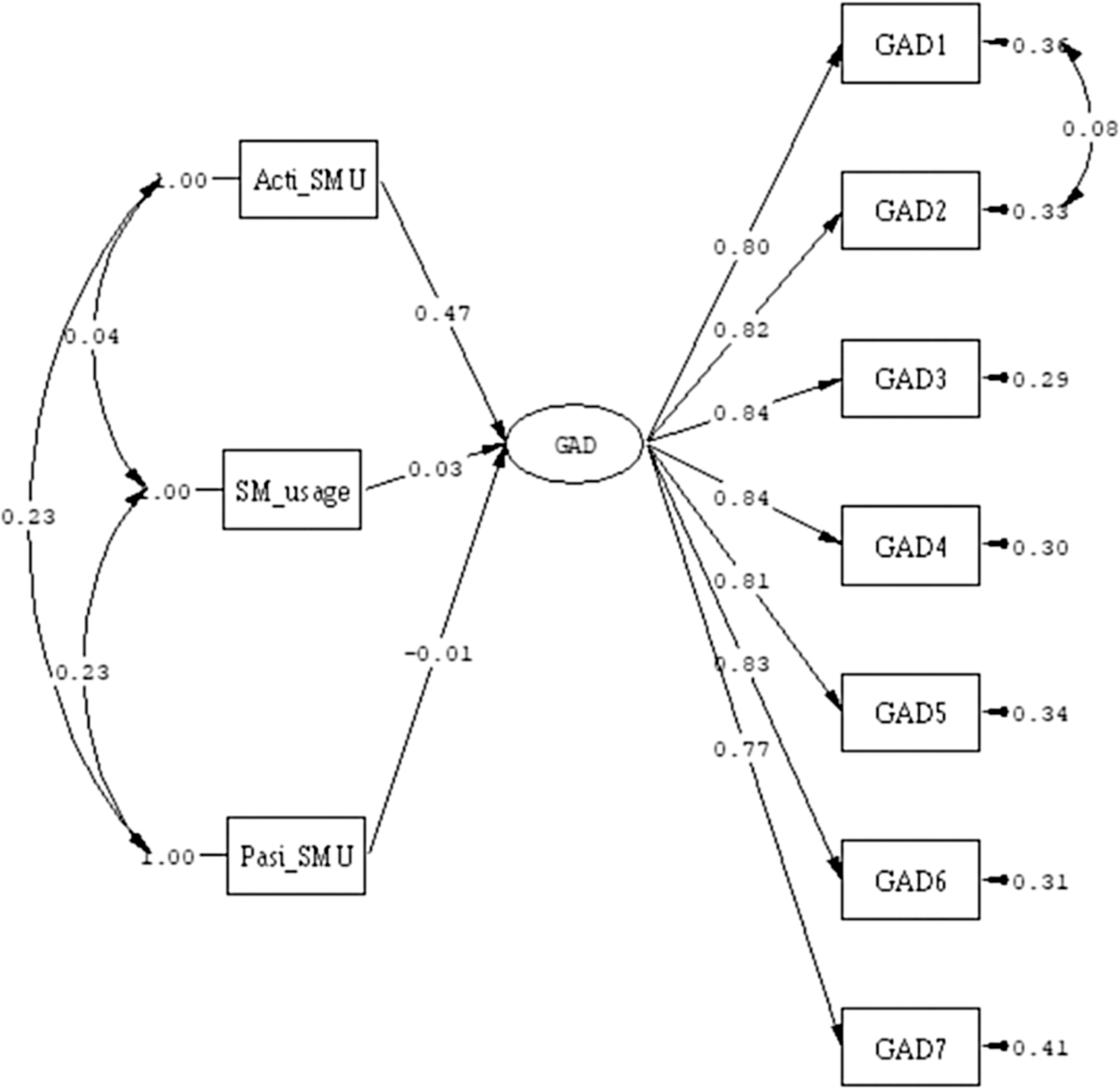
The SEM of SMUs on GAD. GAD, General Anxiety Disorder; SEM, structural equation modeling; SMU, social media use.
The results showed that only ASMU significantly predicted anxiety (B = 0.47, p < 0.05), but SM usage (B = 0.03, p > 0.05) and PSMU (B = −0.01, p > 0.05) did not significantly predict anxiety.
The associations between SMU and coping strategies
We used the avoidant and approach coping as the latent DVs whereas SM usage time, ASMU, and PSMU were seen as observed IVs. The results of SEM were described as follows:
The model showed a mediocre fit (Chi-Square = 481.59, df = 110, RMSEA = 0.080, 90 percent CI for RMSEA = (0.073–0.087), CFI = 0.96, SRMR = 0.11). The results showing the standardized solution of SEM were presented in Figure 2, and the standardized coefficients of IVs to DVs were listed in Table 3.
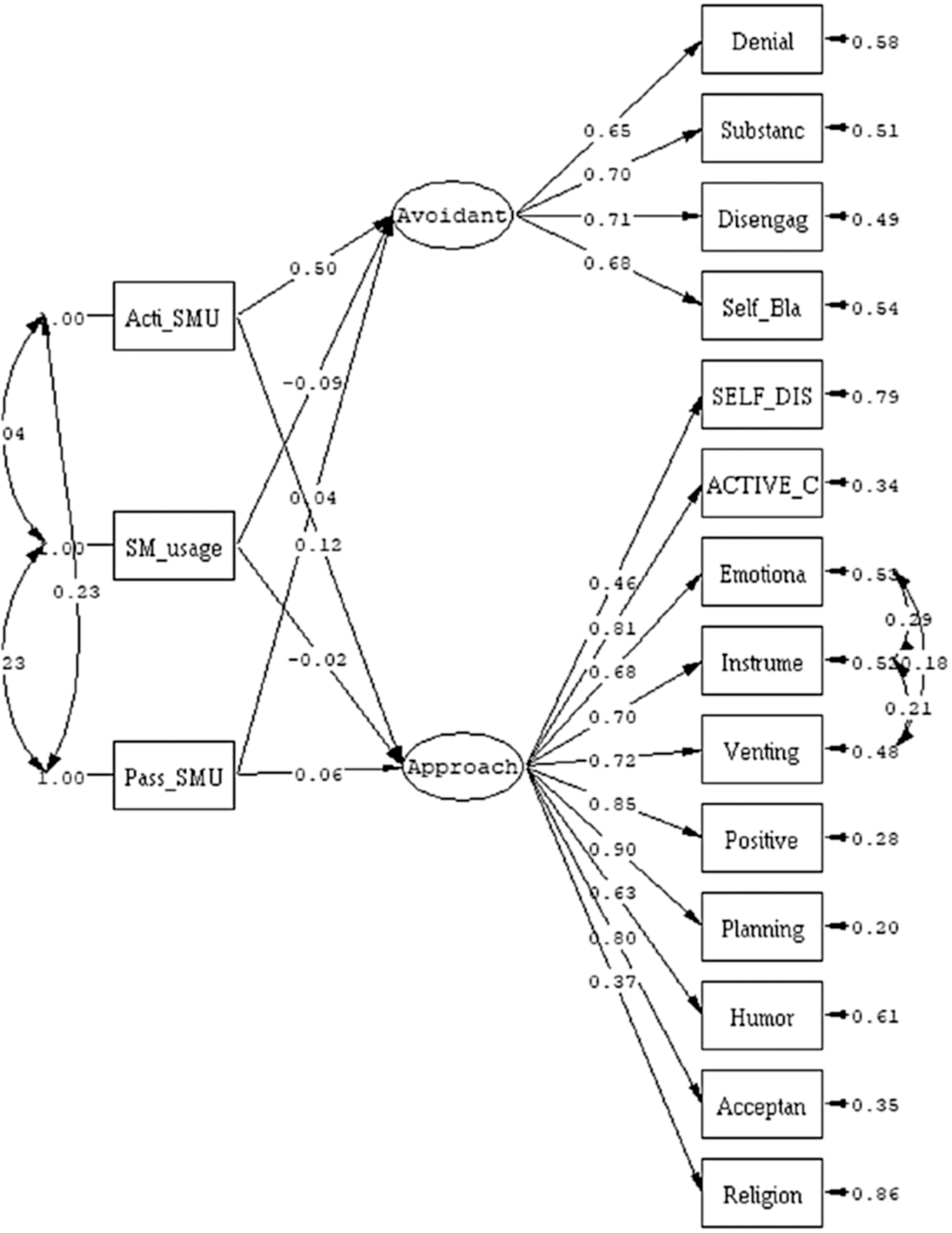
The SEM of SMUs on coping strategies.
Summary of the Standardized Coefficients Between Coping Strategies and Social Media Uses
p < 0.05; ***p < 0.001.
SM_Usage, social media usage.
The results showed that ASMU significantly predicted avoidant coping (B = 0.50, p < 0.05) and approach coping (B = 0.12, p < 0.05). The SM usage time significantly predicted avoidant coping (B = −0.09, p < 0.05) but failed to predicted approach coping significantly (B = −0.02, p > 0.05). PSMU was a non-significant predictor for avoidant (B = 0.04, p > 0.05) and approach coping (B = 0.06, p > 0.05).
Values of correlation/standardized regression coefficients or factor loading should exceed 0.3 to reach a practical significance. 27 Concerning these three significant prediction coefficients, only those of ASMU-to-avoidant coping reach a medium magnitude of linear relationship/correlation 27 (B > 0.30). The other two coefficients only reach a low magnitude and are lacking in practical significance. 27 These small but significant coefficients were caused by large samples, which tend to transform small differences into statistically significant differences. 27
Discussion
This study investigated the relationships among three types of SMU, anxiety, and coping strategies. The results showed that only ASMU could significantly predict anxiety, but SM usage and PSMU did not. Besides, ASMU was a significant predictor of avoidant coping, whereas the other two types of SMU were non-significant or weak predictors of coping strategies. We discussed the results as follows:
The relationship among SMU, and anxiety
Among the three types of SMU considered, only ASMU could significantly predict anxiety. This study found no correlation between the time spent on SM daily and anxiety. This result is similar to that derived by Sigurvinsdottir et al., 29 in which general SM browsing was not associated with psychological symptoms. Longitudinal research conducted by Stevic et al. 30 in Austria during the COVID-19 pandemic also found that non-communicative SMU or smartphone use had no longitudinal effects on anxiety.
Research in the past found a connection between ASMU and positive psychological consequences, whereas for PSMU this often led to negative outcomes such as anxiety and depression.12–14 However, the results of this study indicated the opposite: During the COVID-19 pandemic, not PSMU, but ASMU is related to anxiety.
The analytical results showed that frequent post and sharing news of COVID-19 pandemic correlated with anxiety. Individuals considered SM as a source of both seeking social support and stress-releasing. 31 Those who are extremely anxious about the pandemic may be more likely to share the pandemic-related information they receive to their friends and family via SM for the sake of additional social connectedness, information exchange, and social support.
Due to the cross-sectional data characteristics in this study, another possibility is that for active uses, high Covid-19 news involvement and co-rumination with friends or strangers (as the result of sharing news) can intensify anxieties. Research on disaster-induced trauma 10 has demonstrated that continuously receiving disaster news brings anxiety. The results involving the current COVID-19 pandemic in this study are similar. As active SM users continue to pass on COVID-19 news, individuals are continuously exposed to pandemic news, which can create anxiety.
This result can also be explained using the SDT, 16 in which active sharing indicates that the individual has greater autonomy to decide on the importance and relatedness of information than passively receiving information does. Individuals with unmet basic needs may depend on ASMU to connect with others to satisfy their need for relatedness, competence, and autonomy.
However, to write or forward epidemic posts has caused individuals to have more anxiety. In other words, ASMU might satisfy autonomy in momentary positive effects but backfires later because the pandemic still brings a lot of uncertainty and negative emotions. Eventually, individuals who shared more COVID-19 news experienced more anxiety.
The relationship among SMU and coping strategy
The results of this study indicated that ASMU was associated with avoidant coping whereas PSMU showed no significant effects to avoidant and approach coping. Avoidance coping involves cognitive and behavioral efforts oriented toward avoiding, denying or minimizing stressful stressors. 32
We believe that the relationship between ASMU and avoidant coping can be explained using the Transactional Model of Stress and Coping. 22 This model divides coping with stress into primary appraisal, secondary appraisal, coping, and reappraisal. In the primary appraisal phase, individuals regarded COVID-19 as stressful events, characterized by harm or loss, threat and challenge. Next, in the secondary appraisal phase, individuals assessed their own resources and determined whether they had the capacity to process the situation. The rapid spread of COVID-19 presented a wide-ranging threat to the entire world, and individuals lacked adequate resources to deal with this situation, which created stress.
Finally, in the coping stage, people tended to use more problem-focused strategies (typically associated with approach coping) when the situation was appraised as changeable and more emotion-focused strategies (typically associated with avoidance coping) when the situation was appraised as not or less changeable. Due to the severity of the pandemic, individuals adopted emotion-focused coping and more negative escape-avoidance; they shared information to reduce their anxiety, escape reality, or deny the seriousness of the pandemic. The SMU is a means of achieving escape-avoidance. Avoidant coping includes denying, behavioral disengagement, and substance use, which we discuss separately below.
In terms of denying, we believe that as the pandemic has yet to be effectively controlled, individuals will continue to feel anxious about the disease but may share posts regarding things such as “The pandemic is temporarily under control,” “The disease itself is not scary,” or “COVID-19 is just a cold” to negate the severity of the pandemic and other related matters so as to reduce their own anxiety. The sharing cited earlier encompasses cognitive and behavioral denial at the same time. Behavioral disengagement means reducing one's effort to deal with the stressor and reflects an individual's anxiety and helplessness. Sharing information reflects an individual's anxiety.
In substance use, the findings of this study were similar to those of Litt et al. 25 They observed that when people post photos of drinking to relieve stress on SM, it induces imitation among peers, who then drink to relieve their stress and share photos of themselves doing so, forming a vicious circle and triggering negative coping strategies. A non-recursive relationship may exist between sharing on SM and imitating. During the COVID-19 pandemic, individuals may have posted about drinking to relieve stress on SM, which may have induced substance use such as drinking to avoid anxiety.
With regard to self-blame, the results of this study were similar to those obtained by Zsido et al. 33 They also found a positive correlation between self-blame and SMU. Individuals criticize themselves on SM to avoid negative emotions.
Some researchers believe that general SMU strengthens the benefits of some approaches/active coping to mental health. The SM can be used as a constructive coping strategy to deal with anxious feelings during the COVID-19 quarantine,5,19 but some researchers believe that SMU has nothing to do with active coping and may have negative psychological consequences.7,19,21
For instance, Sriwilai and Charoensu kmongkol discovered that individuals who used SMU to excess tended to use emotion-focused coping and were prone to negative consequences (e.g., higher emotional exhaustion). 21 The recurrent appearances of news associated with the pandemic or disasters on SM may provoke negative emotions. 7 The results of this study indicated that the coefficient between SM usage time and avoidant coping and approach coping were only 0.09 and .02, thereby lacking in practical significance.
Limitations
This study is subject to the following limitations. The SEM of SMU-Coping showed only a mediocre fit. Modification index provided by LISREL suggested that setting “religion” cross load on both approach and avoidant factors will significantly improve model fit. Whether religion was considered both approach and avoidant coping strategies in collectivism culture, such as Taiwan, needs further examination.
Correlated errors are commonly used in model re-specification strategies of SEM methodology.4,27 The possible causes of correlated errors include: items using similar wordings or appearing near to each other on the questionnaire, acquiescent response, and common method effects.4,27,34 In this study, correlated errors were set to items appearing near to each other (i.e., GAD1-GAD2, as well as Emotional Support-Instrumental Support-Venting). We suggested changing the order of items or reducing the length of the questionnaire to improve the situation cited earlier and avoid an acquiescent response.
Further, with regard to SM, anxiety, and coping strategies, we only conducted a cross-sectional study on correlation. Whether non-recursive relationships exist among these variables requires further longitudinal research. Besides, this study is limited by the limitations of convenience sampling and self-reported measurements, so caution is needed in making inferences.
Existing studies (e.g., Escobar-Viera et al. 13 and Thorisdottir et al. 1 ) defined ASMU and PSMU in broader terms and included many behaviors suited to SM. This study focused on active and PSMU involving COVID-19 news, so the results are only applicable to COVID-19 news.
Footnotes
Acknowledgments
The authors would like to thank the Ministry of Science and Technology of Taiwan, R.O.C, for financially supporting this research under Contract Nos. MOST-107-2511-H-142 -011 -MY3 and MOST 110-2511-H-142 -010 -MY3.
Author Disclosure Statement
No competing financial interests exist.
Funding Information
The Ministry of Science and Technology of Taiwan, R.O.C, for financially supporting this research under Contract Nos. MOST-107-2511-H-142-011-MY3 and MOST 110-2511-H-142-010-MY3.