




Abstract
Cyberbullying has become a critical issue in many parts of the world. Children affected by bullying in cyberspace may also experience various other problems in their daily lives, such as emotional and behavioral issues. Despite the well-documented positive correlation between digital technology use and cyberbullying experiences in adolescents, a paucity of research has explored the association between digital technology use and cyberbullying, and the extent to which digital literacy (DL) and parental mediation moderate these relationships among primary school-aged children. This study addressed these research gaps. A total of 736 children (third grade, female = 52 percent) in Hong Kong, selected through stratified random sampling, reported on their digital technology use, parental mediation of technology use (i.e., active mediation and restriction), and cyberbullying experiences. A performance-based assessment measured children's DL. Results showed a positive association between children's digital technology use (both for leisure activities and for schoolwork) and cyberbullying experiences (both as perpetrator and victim). These positive associations were more pronounced among children with low levels of DL (only victims) as well as among children with highly restrictive parents (both perpetrators and victims). Implications for digital citizenship education and parental intervention are discussed.
Introduction
Cyberbullying is prevalent among children growing up in the digital era. 1 Bullying is defined as aggressive behavior intended to cause harm through repeated actions to someone who cannot defend himself/herself, and bullying perpetrated through cyberspace is called cyberbullying. 2 Previous studies on cyberbullying have primarily focused on adolescents older than 13 years, as cyberbullying peaks in middle school and declines in high school. 3 However, a growing number of studies indicate that cyberbullying can occur as early as primary school age, 4 highlighting the need to examine cyberbullying in younger samples before its prevalence peaks. This study examined the association between digital technology use and cyberbullying, and how digital literacy (DL) and parental mediation moderate these relationships among primary school-aged children.
Young children's digital experiences
Digital technologies accord many benefits for children by allowing instant access to information, rapid communication, and extensive social networking. However, despite the advantages of these technologies when used appropriately, various problems can arise from their misuse. One such problem is cyberbullying. According to surveys, up to 31 percent of children 6–14 years of age in Europe, 5 more than a quarter (27 percent) of primary school children (8–10 years of age) in Turkey, 6 13.4 percent of Spanish children (10 and 12 years of age), 7 and 26.8 percent of Canadian children (10–12 years of age) 8 have encountered cyberbullying. Longitudinally, early cyberbullying experiences are predictive of cyberbullying later in life,9,10 which, in turn, can lead to isolation, depression, and stress.11,12
Increased digital technology use has been positively associated with the experience of cyberbullying 13 either as a perpetrator or victim, or both.14,15 Children use digital devices for various purposes, including entertainment (e.g., social media, online games) and schoolwork (e.g., online classes), and different activities may vary in the extent to which they expose children to the risks of cyberbullying. Studies of adolescents found that intensive online social activities and exposure to violent media were directly associated with cyberbullying involvement.9,12,16 Digital information activities (e.g., surfing the Internet) were positively associated with cyberbullying (both as perpetrators and victims) among adolescents, while studying online was negatively correlated with cyberbullying victimization. 17 However, no study has examined these associations in younger children.
DL and cyberbullying
DL is the capacity to access, manage, integrate, evaluate, and create information using digital technologies.18,19 As media literacy has been found to help reduce the harmful effects of exposure to mass media, 20 scholars have also suggested that DL could be a means to mitigate online risks such as cyberbullying. 21 Indeed, the positive association between digital technology use and online risks (e.g., exposure to violent content) appeared weaker for children (10–15 years of age) with high levels of DL. 22 Unfortunately, that study had not included cyberbullying as a potential online risk. As children with better DL may have a better capacity to protect their privacy and solve online problems, 23 the positive association between digital technology use and cyberbullying experiences is likely weak for children with higher levels of DL. However, such a statistical moderation has not yet been examined.
Parental mediation
In addition, researchers have acknowledged the role of parental mediation in influencing and regulating children's behaviors, 24 especially for younger children. 25 Active mediation occurs when parents provide guidance and advice about digital media use, while restriction refers to regulating online activities, such as controlling children's time spent online. 26 Active mediation has been considered a positive strategy for risk prevention because it is likely to improve the child's DL and establish a supportive bond between parents and child. 27 Restriction could have positive and negative effects as it correlates with fewer online opportunities (which means fewer risks) and lower DL (which indirectly means more risks).28,29
Among adolescents, active parental mediation lessened the likelihood of cybervictimization,30,31 while restriction was negatively associated with cyberbullying perpetration 32 and positively with cybervictimization. 30 For younger children, both forms of parental mediation were negatively associated with cyberbullying. 25 However, it is unclear which role parental mediation plays in the association between digital technology use and cyberbullying for younger children.
Current study
This study examines (a) the associations between digital technology use for different purposes and cyberbullying experiences and (b) the moderating role of DL and parental mediation on these relationships in primary school children. The purpose of digital technology use was conceptualized into two major categories: socialization and leisure activity (leisure activity in short, e.g., social networking services, online games) and schoolwork (e.g., e-learning, homework), to investigate whether the relationships are different for entertainment or formal learning activities. Many previous studies have relied on children's reports of DL, 22 even though self-reports are particularly prone to bias as children tend to overestimate their DL. 33
Therefore, a notable strength of this study is using a performance-based assessment of DL. Finally, numerous studies have examined cyberbullying in adolescents. 34 This research targeted primary school children as it appears critical to intervene early and assist children in handling cyberbullying to minimize prolonged cyberbullying experiences and its adverse effects. It was hypothesized that,
digital technology use for both leisure activities and schoolwork were positively associated with cyberbullying experiences (both as perpetrators and victims), and
this association between digital technology use and cyberbullying would be moderated, being (a) more pronounced for children with lower DL and less pronounced for children with higher DL and (b) stronger for children whose parents exert less parental active mediation and weaker for children whose parents exert more parental active mediation. (c) Due to the mixed findings regarding parental restriction, no specific prediction was made for this moderator.
Materials and Methods
Participants and procedure
This study was approved by the institutional review board of The University of Hong Kong before data collection. Stratified random sampling with replacement was adopted. First, 4 districts were randomly selected from all 18 Hong Kong districts based on geography (1 district in each of the smaller territories Hong Kong Island and Kowloon, and 2 districts in the populous New Territories [1 district in New Territories East and the other in New Territories West]) and socioeconomic status (median monthly income). Subsequently, primary schools were randomly selected within each of the sampled districts.
For each school that declined to participate, a replacement school was randomly selected from the same district to replace the nonparticipating school. In total, 18 primary schools participated in the study. Two intact classes were then randomly sampled from among the third-grade classes in each participating school to take part in the study. One of these schools arranged for two classes different from the sampled ones to participate in the study due to administrative reasons. In addition, one school arranged for three classes and another for four classes to participate in the study (i.e., the whole third grade).
Before data collection, written consent was obtained from school principals and children's parents, and informed assent was obtained from the children. Finally, test administrators went to the respective schools to conduct the assessments and surveys. A total of 736 children completed an online survey, while physically present at school using digital devices connected to the Internet; 715 of these children also completed a DL assessment at school in the 2018/2019 school year (Table 1). Children could choose to complete the materials in English or Chinese. The age-appropriateness of all items was validated through cognitive interviews and a pilot study before the main study (see Appendix A1 for details on these procedures, and Appendix A2, Appendix Tables A1–A3, for all survey items used in the analyses below; the DL assessment instrument has been reported elsehwere 35 ).
Descriptive Statistics of Student Characteristics
Materials
Digital technology use
Children were asked: “How much time per day do you spend using digital devices for the following activities?” Two items each measured time using digital devices for schoolwork (at home and in school) and leisure activities unrelated to schoolwork (at home and in school). Children responded on a 4-point Likert scale (1 = <1 h/day …4 = more than 3 h/day). Two scales were computed (digital usage for schoolwork and for leisure).
Cyberbullying
Children indicated on a dichotomous scale (1 = no, 2 = yes) whether they had ever cyberbullied someone (e.g., posted something mean about another person) or been a victim of cyberbullying (e.g., rumors about themselves were spread electronically). The 12 items were adapted from an instrument validated in other cultural contexts. 36 Two mean scales were computed, yielding a score from 1 (no experience of cyberbullying) to 2 (experienced all six conditions of cyberbullying) with good reliability (α[perpetrator] = 0.88 and α[victim] = 0.87).
Digital literacy
Children completed a 45-item performance assessment to measure their DL.35,37 This instrument adopted the Digital Competence Framework 18 as the assessment framework, measuring DL in five competence areas: information and data literacy, communication and collaboration, digital content creation, safety, and problem-solving. The assessment data were scaled using a two-parameter logistic model, producing a highly reliable DL score (expected a posteriori reliability = 0.84). 35
Parental mediation
Children reported parental mediation using items adapted from the EU Kids Online study. 38 The parental restriction subscale contained four items following the question, “As far as you know, does your parent/do your parents make use of any of the following on any of your digital devices, including smartphones?” (e.g., parental control software or other means to block or filter some types of websites). The parental active mediation subscale contained six items following the question, “Has your parent/either of your parents ever done any of these things with you?” (e.g., helped you when something is difficult to do or find on the Internet). Children rated their parents' mediation on a ternary scale (1 = no, 2 = yes, 3 = don't know). Mean scales were computed (excluding “don't know” responses [<3 percent]; α[active mediation] = 0.89 and α[restriction] = 0.89).
Data analysis
Preliminary analyses determined the descriptive characteristics and correlations among the key variables. In addition, independent sample t tests with Bonferroni corrections examined possible gender differences in digital technology use, DL, and parental mediation. Moderated regression analyses were conducted in SPSS PROCESS 39 using listwise deletion; children's gender and socioeconomic status were control variables. In moderation analyses, the independent variable was digital technology use (i.e., leisure activity and schoolwork), and cyberbullying experience (i.e., perpetration and victim) was the dependent variable. DL and parental mediation were defined as moderators in two separate models. The moderation effects of parental mediation were examined for leisure activity only because the concept of parental mediation was built upon online entertainment. 28 Simple slope tests were conducted for significant interaction effects (p < 0.05).
Results
Table 2 shows the descriptive statistics and correlations. About one-third of children reported using digital devices for <1 h/day for each purpose (34.1 percent for leisure and 35.4 percent for schoolwork), and more than half of the children spent 1–3 hours daily on digital devices for each purpose (55.2 percent for leisure and 56.6 percent for schoolwork). A quarter of children reported having been victims of cyberbullying, and a quarter reported the experience as a perpetrator. About 17 percent of children reported experience of being both victims and perpetrators. Data from boys and girls were pooled together as there was no significant difference between both genders regarding the independent variables and moderators (Bonferroni-adjusted ps > 0.05).
Valid Cases (N), Means (M), Standard Deviations (SD), and Correlations of Key Variables
p < 0.05; **p < 0.01 (two tailed).
DL, digital literacy; DUL, digital usage for socialization and leisure activity; DUS, digital usage for schoolwork; SES, socioeconomic status.
Correlation and regression analyses showed a positive association between children's digital technology use (both for leisure activity and schoolwork) and cyberbullying experiences (both as perpetrator and victim, ps < 0.01). Furthermore, children's DL significantly moderated the relationship between digital technology use and being a cyberbullying victim (Table 3). Specifically, the positive association between digital technology use (both leisure activities and schoolwork) and being a victim of cyberbullying was stronger for children with low DL (i.e., 1 SD below the mean, Fig. 1; p < 0.001). Parental restriction (but not active mediation) also significantly moderated the relationship between digital usage for leisure activity and cyberbullying experiences (Table 3). The positive association between digital leisure activity and cyberbullying experiences (both perpetrators and victims) was more pronounced among children with high parental restriction (i.e., 1 SD above the mean, Fig. 2; p < 0.001).
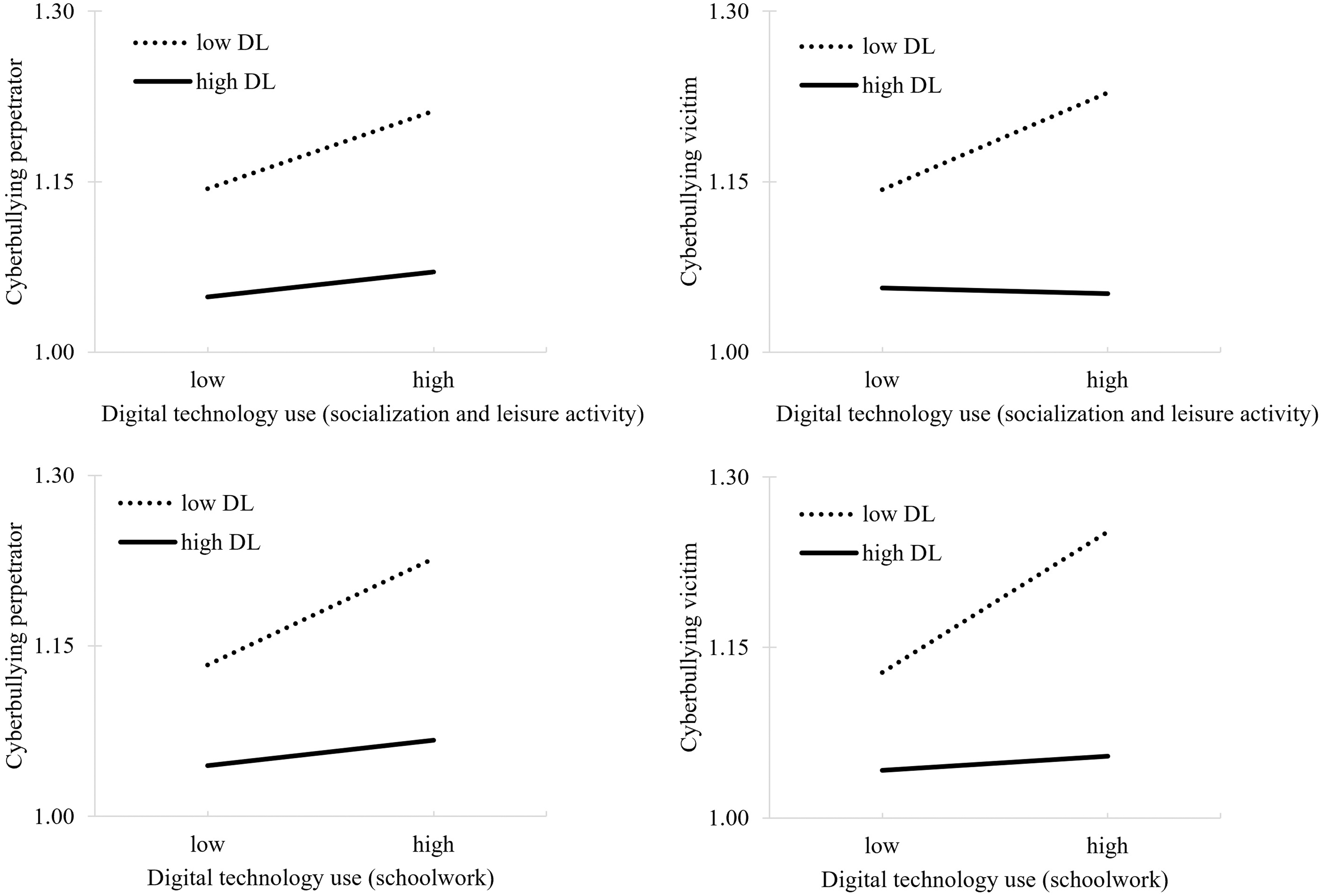
Interaction plots for DL as moderator. This figure displays the level of cyberbullying (left: perpetrator, right: victim) as a function of digital technology use (top: socialization and leisure activity, down: schoolwork) at low and high levels of DL. p < 0.001 for all low DL paths (two tailed). DL, digital literacy.

Interaction plots for parental restriction as moderator. This figure displays the level of cyberbullying (left: perpetrator, right: victim) as a function of digital technology use for socialization and leisure activity at low and high levels of PR. p < 0.001 for both high PR paths (two tailed). PR, parental restriction.
The Moderating Effects of Digital Literacy and Parental Mediation on the Associations Between Digital Usage and Cyberbullying Experience
p < 0.05. **p < 0.01. ***p < 0.001 (two-tailed).
PM, parental active mediation; PR, parental restriction; SE, standard error.
Discussion
This study examined the association between digital technology use and cyberbullying experiences and the factors moderating this association. Participants were grade 3 children in primary school, who reported digital usage for leisure versus nonleisure purposes and parental mediation of digital technology use. Notably, this study assessed DL through a performance-based assessment, addressing concerns about self-report data.33,40 The results showed that the more time children spent using digital devices (both for leisure and for schoolwork), the more likely they were to experience cyberbullying (both as perpetrators and as victims). These positive associations were stronger among children with low levels of DL (only victims) and among children with highly restrictive parents (both perpetrators and victims).
More digital technology use is associated with more cyberbullying
As hypothesized, both digital leisure activity and digital schoolwork were positively associated with cyberbullying experiences for primary-school-age children, congruent with prior research indicating the positive association between digital technology use and cyberbullying for adolescents.14,15 Children spending more time on digital devices are likely to be exposed to more online risks such as cyberbullying. 41 The positive association between digital schoolwork and cyberbullying contrasts with a previous study reporting a negative association between studying online and cyberbullying. 17 This discrepancy may be due to a comparatively narrow definition of “studying online” in the previous study, as more interactive e-learning could yield a stronger link to cyberbullying. Given a global trend toward online learning, efforts to curb cyberbullying should include online learning activities.
DL moderates the associations between digital technology use and cyberbullying victim
Consistent with previous findings that indicate children with higher levels of DL are exposed to fewer risky online behaviors than those with lower levels of DL, 22 DL was negatively associated with cyberbullying experiences in this study. It even negatively predicted children's experience of being a victim of cyberbullying when the frequency of digital technology use was high. On the one hand, children with high DL have better knowledge of data privacy and possess better online problem-solving skills.18,19 Hence, they are better equipped to avoid situations where they may become victims of cyberbullying even when using digital devices frequently.
On the other hand, primary school children with high levels of DL might be less addicted to digital devices than those with low levels of DL, as the negative correlation between DL and digital usage indicates. As a result, these children may be less involved in cyberbullying. Importantly, more frequent usage of digital devices, whether for leisure or schoolwork, does not necessarily lead to higher levels of DL. Thus, targeted efforts to improve children's DL are needed to protect children against cyberbullying.
Parental restriction moderates the associations between digital technology use and cyberbullying
Contrary to previous research, 27 parental active mediation was not a moderator in the relationships between digital technology use and cyberbullying experience. One plausible reason is that parents of children in primary school may underestimate their children's experiences in cyberbullying42,43; often, cyber victims do not tell their parents about their negative cyber experiences. 30 Parents' use of active mediation might discourage online risk behaviors. Still, it may not have much to do with children learning from their parents how to deal with cyberbullying if parents lack awareness of their children's cyberbullying experiences.26,44 In contrast, parental restriction moderated the positive relationships between digital technology use and cyberbullying experiences.
Children whose parents were more restrictive reported more cyberbullying experiences the more time they spent on digital devices. Restrictions probably prevent children from acquiring DL needed to navigate safely through the digital world, which indirectly means more risks. Whether active mediation or restriction, parental mediation does not appear to reduce the risk of cyberbullying from digital technology use. Consequently, the parenting practices examined in this study cannot offset the cyberbullying risks from digital technology use to their children. Instead, DL is the most important protective factor. Yet, neither type of parental mediation correlated with improved DL. Thus, there is a need for parental education that includes DL to prevent their children from being adversely affected by cyberbullying.
Implications
This study contributes to the literature by revealing associations between digital technology use for different purposes (i.e., leisure and schoolwork) and cyberbullying and the moderating role of DL and parental mediation in these relationships in primary school children. Supplementing previous studies that focused only on online entertainment, this study identified positive associations of digital leisure activity and schoolwork with cyberbullying experiences. Hong Kong's government has been promoting the use of information technology to improve learning and teaching since 1998. 45 An important implication is that children inevitably spend more time on digital devices, increasing their exposure to cyberbullying. As cyberbullying experiences in the early years predict later involvement in cyberbullying, early prevention/intervention to reduce cyberbullying in childhood and adolescence is recommended.
Notably, DL moderated the above relationships. Hence, a significant purpose of cyberbullying prevention programs should be improving children's DL as it can equip children with the competences required to avoid cyberbullying situations. In addition, educators should pay careful attention to children's DL and their interactions with peers when assigning schoolwork requiring the use of digital technologies to prevent cyberbullying. Finally, the moderation analyses also indicate that restriction may not be the most appropriate type of mediation for children's leisure-related digital technology use in the fast-developing world. 46 Considering that parents may be unaware of their children's cyberbullying experiences, 47 parents should have the opportunity to learn about the occurrence, consequences, and intervention strategies of cyberbullying among young children. 48
Strengths, limitations, and future directions
This study has strengths and limitations. First, the cross-sectional design does not allow causal interpretations of the observed associations. Future studies might collect data on children's actual device use or monitor their social media usage over a period to provide further evidence on the mechanisms behind the associations between digital usage and cyberbullying. Second, the sample came from Hong Kong primary schools and the results may not be generalizable to other regions in China or other countries.
Despite these limitations, this is the first study to examine the associations between cyberbullying and digital technology use for different purposes in primary school children. The use of a performance test eliminated self-report bias, thus increasing the validity of findings. The study implications can help prevent cyberbullying experiences early on. The examination of the moderating role of DL and parental mediation also contributes to the literature by revealing how these individual-level (i.e., DL) and family-level (i.e., parental mediation) factors could buffer the negative influences of digital technology use. However, more research is needed to further our understanding of how DL may moderate or mediate other risk and protective factors. Researchers could explore the interactive effect of DL with individual-level (e.g., experiences of traditional bullying) and family-level factors (e.g., emotional support from family members) as promising directions for future studies.
Footnotes
Acknowledgments
The research team would like to thank the students and schools who generously shared their time, experience, and response for this project.
Authors' Contributions
The authors listed are the joint authors of the article. All authors have made a significant contribution to the reported research and have read and approved the article. All statements, claims, and conclusions are true and jointly agreed upon.
Author Disclosure Statement
No competing financial interests exist.
Funding Information
This work was supported by the Research Grants Council of the Hong Kong Special Administrative Region, China (Project No. T44-707/16-N).