




Abstract
With the growing popularity of social media, people are sharing more personal information online. This study explored how online self-disclosure post valence (positive vs. negative) affects participants' willingness to interact with the discloser. In a between-subjects online experiment, 382 CloudResearch participants were randomly assigned to view either positive or negative fictitious Facebook self-disclosure status updates. Participants rated the social attractiveness of the discloser and reported their reactions to the posts. As predicted, they perceived the positive discloser as more socially attractive. Additionally, they were more likely to react to positive posts and ignore negative posts. Specifically, participants were more likely to react to the positive self-discloser with a like/emoji. However, they were more willing to private message the negative self-discloser. The perceived social attractiveness of the discloser mediated the relationship between post valence and participants' willingness to ignore or react to the posts. Our results suggest that, compared with negative self-disclosers, positive self-disclosers may receive more public reactions to their posts because they are perceived as more socially attractive. Despite being perceived as less socially attractive, participants reported a higher willingness to private message the negative self-discloser, which we believe indicates their will to help. The results of the study provide further insight into computer-mediated communication norms and suggest that the valence of self-disclosures may elicit different reactions.
Introduction
Computer-mediated communication (CMC) is an important mechanism for creating and sustaining relationships, especially during the COVID-19 pandemic. Self-disclosure is an essential ingredient in building and maintaining intimate relationships.1,2 It is imperative to understand the reactions elicited by online self-disclosure to gain insight into their influence on individuals' self-presentation and self-concept.
Online self-disclosure
Self-disclosure is the act of revealing personal information to others. 3 Social networking sites, a form of CMC, provide people with ample opportunities for self-disclosure. 4 For example, research suggests that people commonly form personal relationships characterized by high levels of self-disclosure in online environments. 5 Interestingly, people tend to disclose more information in CMC than face-to-face contexts due to visual anonymity.6,7 Specifically, it is believed that visual anonymity in CMC decreases feelings of accountability and public awareness, allowing one to feel more comfortable disclosing personal information. Based on Goffman's theory of identity, social media can act as a looking glass, where one's sense of self is dependent on the online reactions of others. 8 Therefore, reactions to online self-disclosure are important to study.
One central dimension of self-disclosure is the valence/emotionality of the disclosed information. Research demonstrates a “positivity bias” in online self-disclosure, where people prefer disclosing and viewing positive information. 9 Self-disclosure on social media platforms may lead to idealized self-presentation because one wishes to appear favorable and gain reactions.10,11 Since self-disclosure in CMC targets a social network of online friends, a lack of reactions to self-disclosure can reduce the user's sense of belonging, meaningful existence, self-esteem, and feeling of control. 12 Additionally, research has shown that posting negative over positive information may have adverse effects on the discloser, such as lower perceived social, physical, and task attractiveness, 13 and less social support through likes and comments. 14
Social attractiveness
While these studies suggest that people prefer making positive self-disclosures and interacting with positive self-disclosers, few studies examine the reasons behind this preference. A possible factor explaining online users' positivity bias is the social attractiveness of the discloser. Social attractiveness refers to one's friendliness, likability, and the extent to which one fits into social groups. 15 Self-disclosure often leads to more familiarity-based liking—higher social attractiveness. 1 However, self-disclosure can lead to less social attractiveness if the discloser reveals inappropriate or negative information. 15 People may be extrinsically motivated to associate with socially attractive individuals to present themselves favorably. 16 Research has found that when participants perceived a Facebook user to be low in social attractiveness, they had a higher intention to unfriend and hide the user's future posts. 17 Thus, social attractiveness holds important implications for one's willingness to interact with disclosers. 18
Despite the importance of social attractiveness in online self-disclosure, no research, to our knowledge, has examined whether social attractiveness explains the “positivity bias” on social media. Exploring the mediating effect of social attractiveness is important because it can help us understand how online self-disclosure influences self-presentation and self-concept, which are associated with important outcomes, such as confidence19,20 and life satisfaction.21,22
The present study
In the present study, we investigate how negative and positive Facebook self-disclosure posts differ in terms of participants' perceived social attractiveness of the discloser, their willingness to react to or ignore the post/discloser, and their preferred reaction. We also test whether the perceived social attractiveness of the discloser mediates the effect of self-disclosure valence on participants' reactions to the discloser.
Based on past research and a pilot study (Supplementary Data), we made several hypotheses. First (H1), we expect that participants will perceive the discloser of positive Facebook status updates as more socially attractive than the discloser of negative updates. Second, we anticipate that participants in the negative self-disclosure condition will be more likely to ignore the posts (H2) and less likely to react to the posts (H3) compared with those in the positive self-disclosure condition. Furthermore, we hypothesize that social attractiveness will mediate the relationship between self-disclosure valence and participants' willingness to react to (H4) and ignore (H5) the post/discloser. We also predict that participants' preferred reactions to the posts will differ based on self-disclosure valence. Specifically, we expect that participants will prefer to react privately (private message) to the negative disclosure and publicly (like and comment) to the positive disclosure posts (H6). 23 The current study was preregistered.
Methods
Participants
Based on G*Power analysis (α = 0.95, small to medium effect size = 0.35), 400 participants were recruited from CloudResearch to complete our study (compensated $.50 USD). After exclusions, our final sample included 382 participants (see Table 1 for demographic data). We screened for participants who regularly use Facebook. On average, participants estimated that they had 381.62 friends on Facebook. Most participants (86.65 percent) reported that they had used Facebook for 6 or more years.
Demographic Data
M, mean; SD, standard deviation.
Materials
For complete materials and manipulation check data, see the Supplementary Data.
Positive and negative self-disclosure posts
We created mock Facebook posts that denoted positive or negative self-disclosure. To eliminate the effects of the discloser's race, gender, or age, the profile had the gender-neutral name “Sam” with a stock picture of a pet dog to avoid eliciting personality judgments. 24 There were three negative and three positive self-disclosure posts (for an example, see Fig. 1). To make the posts applicable to a wide range of participants, they centered around experiences at work without defining a specific type of occupation or workplace. The posts were the same in both conditions, except for the manipulation of valence.
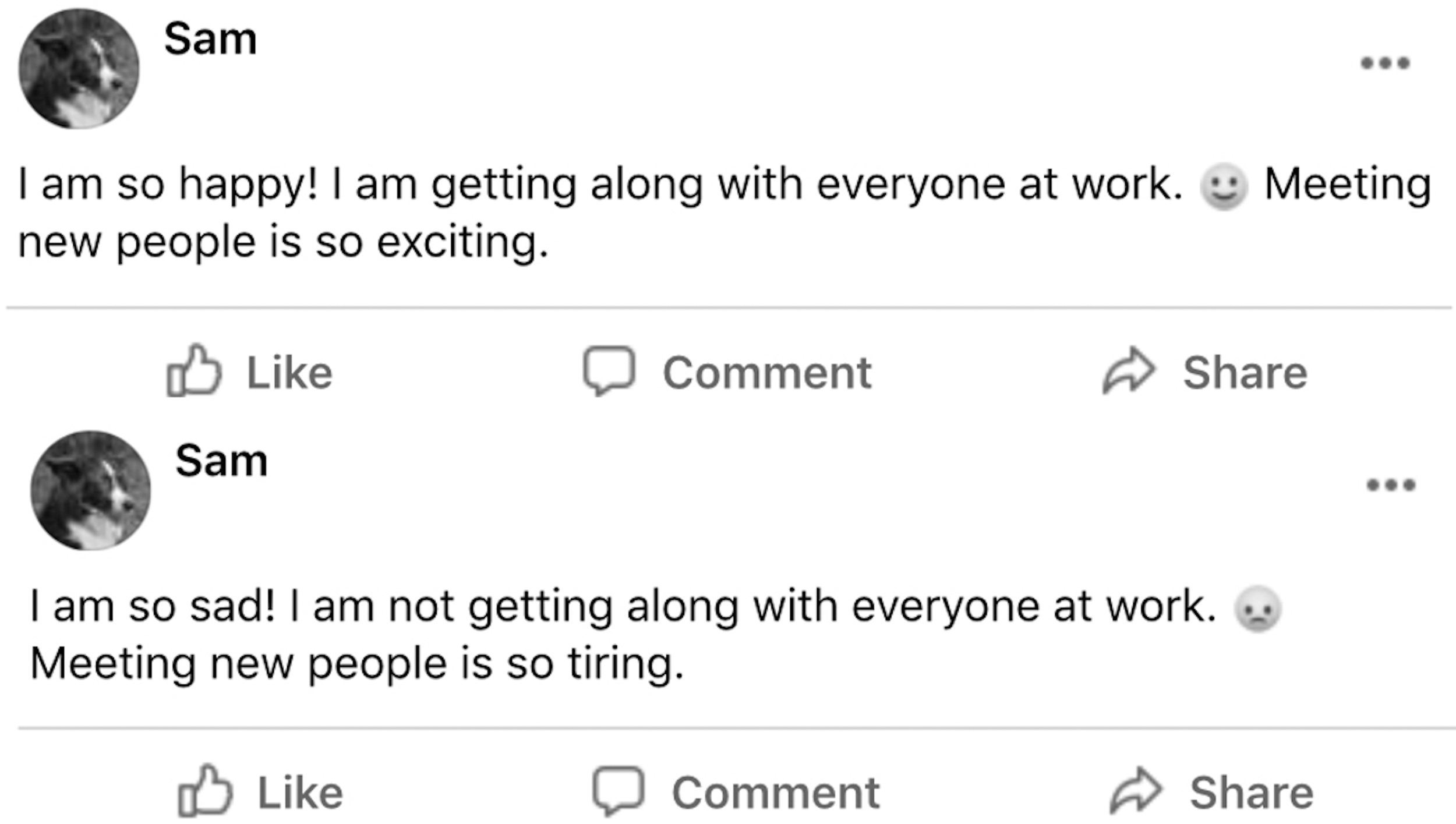
An example of a fictitious positive (above) and negative (below) self-disclosure.
Social Attractiveness Scale
We used the previously validated25–27 social attraction items from the McCroskey and McCain Interpersonal Attraction Scale to measure the perceived social attractiveness of the discloser. 28 Participants were asked to select from 1 (strongly disagree) to 5 (strongly agree) the degree to which they agreed with the 6 items of the scale. The mean scores were computed (Cronbach's α = 0.93).
Willingness to Ignore Scale
We asked participants how willing they were to ignore the three posts on a scale of 1 (very unlikely) to 5 (very likely). The mean score was calculated.
Willingness to React Scale
Three items asked participants how willing they were to like/react with an emoji, comment, and private message the self-discloser of the posts on a scale of 1 (very unlikely) to 5 (very likely). The mean scores were computed (Cronbach's α = 0.74).
Preferred reaction option
We asked participants to select the one reaction they were most likely to use (from the Willingness to Ignore/React scales). We were interested in preferred reactions because research has proposed that they are qualitatively different, such as in their levels of cognitive/affective drives 29 and engagement. 30
Procedure
Hosted via Qualtrics, this study was introduced as an online experiment on people's reactions to Facebook posts. After providing informed consent, participants were randomly assigned to view either three positive or three negative self-disclosure posts. They were told to imagine that Sam was a co-worker with whom they were acquainted to establish baseline intimacy. After reading the posts, participants completed the Social Attractiveness Scale, followed by the Willingness to React Scale and the Willingness to Ignore Scale (counterbalanced to avoid order effects). Next, participants selected their preferred reaction option. Upon completing the study, participants responded to demographic and Facebook use questions. Including debriefing, participation lasted an average of 166.07 seconds.
Results
Experimental effects
Using independent samples Welch's t tests with a Bonferroni-corrected alpha of 0.0167, we found support for H1, H2, and H3. For detailed results, see Table 2.
Results of t Test Analyses
df, degrees of freedom; d, Cohen's d.
Mediation analyses
To test H4 and H5, we computed two separate mediation models using the medmod package in jamovi. The relationship between disclosure valence and participants' willingness to ignore was significantly mediated by the perceived social attractiveness of the discloser (indirect effect b = −1.12, standard error [SE] = 0.12, 95 percent confidence interval [CI −1.35 to −0.89], z = −9.63, p < 0.001; Fig. 2).

Mediation models for willingness to ignore (above) and willingness to react (below). Unstandardized path coefficients are presented. The numbers inside the parentheses represent standard error. ***p < 0.001.
In addition, the relationship between disclosure valence and participants' willingness to react was significantly mediated by the perceived social attractiveness of the discloser (indirect effect b = 0.84, SE = 0.09, 95 percent CI [0.67 to 1.01], z = 9.56, p < 0.001; Fig. 2). Supporting H4 and H5, results show that positive self-disclosure posts were evaluated as more socially attractive than negative posts, which predicted greater reaction and less likelihood of ignoring the posts.
Frequency analyses
To test H6, we compared the observed and the expected frequencies of the various preferred reaction options (Table 3). Consistent with H6, our analysis indicated that the preferred reaction options in the positive self-disclosure condition differed significantly from those in the negative self-disclosure condition (Fisher's exact test, two-tailed, p < 0.001). Specifically, we found that participants preferred liking or reacting with an emoji to the positive over the negative self-disclosure posts. However, more participants chose to ignore the post or send a private message to the discloser in the negative over the positive self-disclosure condition. Surprisingly, we found no difference between the expected and the observed frequencies for commenting in either experimental condition. Therefore, we found partial support for H6.
Frequency of Expected and Observed Counts for Each Response By Self-Disclosure Valence
Discussion
The present study replicated past findings and provided further insight into reactions to self-disclosures. To the best of our knowledge, our study is the first to investigate whether disclosers' social attractiveness mediates the relationship between disclosure valence and willingness to ignore/react. Our findings hold implications for understanding social media's influence on individuals' self-presentation and self-concept.
Self-disclosure and self-presentation may not always overlap; one may disclose without considering public impressions. However, due to public feedback on social media, self-presentation concerns often govern self-disclosure. 31 Our results suggest that negative self-disclosures receive little public feedback compared with positive self-disclosures, which may indicate a failure to manage one's self-presentation. Thus, negative self-disclosures may lead to negative self-presentation consequences. For example, our study shows that negative self-disclosers are viewed as less socially attractive. Social attractiveness is important for developing social relationships. 32 As such, individuals may edit their self-disclosures to present themselves positively and appear socially attractive. Dishonest self-presentation creates divergence in one's offline and online self, which may erode one's self-concept clarity and self-esteem. 33
While negative self-disclosure is linked with undesirable feedback, vulnerable individuals with low self-esteem and low self-concept clarity share negative information online more often. 34 Therefore, they are at risk of self-presentation failure, which may lead to detrimental effects on their self-concept, such as lower self-esteem and psychological well-being. 35 Overall, our findings offer insight into how reactions to self-disclosure can influence social media users' self-presentation and self-concept.
Even though we found that the negative discloser was perceived as less socially attractive, participants indicated a greater willingness to private message them compared with the positive self-discloser. A potential explanation for this result is that participants associated the negative self-disclosure posts with a need for help and chose to reach out directly. Aside from the extrinsic motivation to associate with socially attractive disclosers, people may be motivated intrinsically to provide social support to negative self-disclosure—deriving internal happiness from helping others. 16
Consequently, negative online self-disclosure may be used to seek social support. 36 Research further shows that people tend to disclose more in private messages than public posts.37,38 Thus, negative public self-disclosure can lead to more private self-disclosure and relationship building through messaging. Alternatively, research suggests that adults experience cyberbullying in the workplace. 39 As such, private messaging may potentially be used to cyberbully a negative self-discloser. Future research should investigate the messages' content.
Limitations and future directions
Although our sample was large and diverse, it was exclusively from the United States. Research suggests that, across cultures, people exhibit different patterns of reactions. 40 For example, Indonesian Facebook users were less likely to disclose positive information and more likely to comment than Polish users. 41 Future research should investigate people's reactions to online self-disclosures in different cultures. Studies could also explore the role of personality and social media use patterns (e.g., lurkers vs. posters) on reactions to positive and negative self-disclosure posts. Additionally, research should consider varied social media platforms. Studies show that negative versus positive emotion expressions vary across Facebook, Twitter, and Instagram. 42 Therefore, people's willingness to interact with posts on different social media platforms may differ.
Conclusions
The results of our study suggest that the perceived social attractiveness of a discloser mediates the relationship between disclosure valence and willingness to react or to ignore. The findings have implications for self-concept and online self-presentation.
Footnotes
Acknowledgments
The authors would like to thank Katherine P. Smith and Hazel H. Tankard for their contributions to the pilot study.
Author Disclosure Statement
No competing financial interests exist.
Funding Information
This research was funded by the Undergraduate Research Grant of Psi Chi, The International Honor Society in Psychology.

References
Supplementary Material
Please find the following supplemental material available below.
For Open Access articles published under a Creative Commons License, all supplemental material carries the same license as the article it is associated with.
For non-Open Access articles published, all supplemental material carries a non-exclusive license, and permission requests for re-use of supplemental material or any part of supplemental material shall be sent directly to the copyright owner as specified in the copyright notice associated with the article.
