




Abstract
With the drastic expansion of the games industry, psychological research is concerned with the question as to why certain genres might be more addictive than others. Besides specific games characteristics and motivational profiles of gamers, skills that are relevant to play certain games and genres might provide more insights for answering this question. An exploratory online survey was designed, asking for played genres, subjective relevance of required skills to play the game, gaming motives, and symptom severity. The analyses aimed at investigating which genres are associated with higher and lower symptoms of their players and the relationship between the relevance of skills required for certain genres and the symptom severity of players. In total, 727 data sets were collected. Descriptive results indicated that the most pronounced difference between genres associated with low and high symptom severity appeared among the indicated relevance of communicating with others, the social motive for gaming, and among the relevance of required executive function skills such as attentional vigilance. The communication skill is discussed as a vulnerability factor for maintaining problematic gaming behaviors despite the occurrence of negative consequences, whereas certain executive functions could be constitutional factors of the experience of a flow state. The association between flow and addictive gaming tendencies is a topic yet to be investigated in future research.
Introduction
Through rapid developments of the gaming industry, the world of video games offers a diverse range of kinds and genres of games that are able to fulfill a variety of preferences and motives that gamers might have for their favorite game. In this sense, game genres describe categories for games that are similar in certain characteristics, the most important of which is the core activity within the game (e.g., shooting, fighting, jumping, puzzling).
In answering the question as to why certain games and genres are so hooking, different player motivations and their correspondence to the requirements within the games could play a decisive role.1–6 That is, besides the games industry, several psychological areas such as media psychology, educational sciences, or addiction psychology have interest in systematizing characteristic motivational profiles of gamers to be able to differentiate between different player types.7–10
Disentangling different player motivations and requirements in the realm of gaming research is a fundamental step in understanding why and how the motivation of gamers is related to the experience they have while playing. That is, disentangling the motivational regulation of gamers might explain the extent of gratification and compensation that is experienced through gaming; and this might give insight into which motives and needs contribute to persistence in gaming despite the occurrence of negative consequences.11–13 Thus, it might stand to reason that by satisfying the motivational structure and skill-challenge balance of gamers, some games and genres might meet gamers' needs more satisfactorily and might therefore contribute to the development of addictive tendencies.
A first attempt of a theoretical approach to gaming motivations proposed four dimensions of multi-user dungeon players: the achievers, explorers, socializers, and killers. 14 These categories were tested in a sample of massively multiplayer online role-playing game (MMORPG) players using a questionnaire that was designed based on Bartle's model. Ten categories were identified that are subsumed under three generic components, namely achievement (advancement, mechanics, competition), social (socializing, relationship, teamwork), and immersion (discovery, role playing, customization, escapism). 15
As an attempt to overcome the genre restrictions of the samples used to systematize and test Bartle's model, a motivational classification for all types of online games and genres was developed. 16 Since the publication of the corresponding measure for gamers' motives to play (Motives for Online Gaming Questionnaire [MOGQ]), 16 the motivational structure has been set into relation to addictive tendencies in gamers. Socialization, escapism, and achievement are components repeatedly associated with the symptoms of gaming disorder.17–19
We assume that these associations might be genre-specific since different genres might consist of different characteristics and might therefore be played for different reasons or motives. Besides this, different genres also require different skills and knowledge for playing the games. 20 Since this is a rather under-researched area, this short communication aims at giving a first descriptive insight into cognitive and motoric skills that gamers rate as being relevant for their favorite game and how these skills, together with gaming motives, might differ among games associated with higher and lower symptom severity of players.
Objectives
The aims of this article are to (a) evaluate which genres are associated with higher and lower addictive symptom severity of gamers, leading to the formation of “distant genres,” (b) how the motivational constitution of gamers differs among these distant genres, and (c) how the skills indicated to be relevant for playing the favorite game differ among distant genres.
Methods
Procedure
For the purpose of this study, an online survey was advertised throughout Germany in university hallways, on conferences and other social events, and via social networks between December 2019 and January 2021. Participants were asked to complete the survey if they were older than 18 years and considered themselves as gaming regularly.
Participants
A total of 889 participants showed interest in the study, among whom 727 (217 female, 9 diverse; Mage = 27.06, standard deviation [SD] = 7.44) remained after data cleaning (e.g., incomplete data sets, participants older than 60 to ensure representativeness of a German gaming community).
Instruments
Gaming genres
Participants were asked to indicate the genre of their current favorite game out of multiplayer online battle arena (MOBA; e.g., League of Legends, Dota), MMORPG (e.g., World of Warcraft, Guild Wars), first person shooter (FPS; e.g., Counter Strike, Overwatch), action and adventure (e.g., Red Dead Redemption, Tomb Raider), sport and beat'em ups (e.g., Super Smash Bros, Rocket League), online trading card games (e.g., Hearthstone, The Elder Scrolls), location-based games (e.g., Pokémon Go, Ingress Prime), simulation video games (e.g., Stardew Valley, The Sims), jump'n'run games (e.g., Super Mario Maker, Yoshis), puzzle games (e.g., Candy Crush), role playing games (e.g., EverQuest), and strategy games (e.g., Crusader Kings). Special versions of certain games (e.g., Dota 2) were disregarded.
Relevance of skills needed in favorite game
To operationalize skill sets of gamers, participants were then asked to estimate on a 10-point Likert scales how relevant certain cognitive, motor, and social skills are for their indicated favorite game, with anchors ranging from 1 not at all relevant to 10 highly relevant and higher scores mirroring a higher relevance of a certain skill for the favorite game. The 16 skills were created based on expert considerations, discussions, and ratings. They subsume reaction ability, spatial thinking/orientation ability, knowledge about physical phenomena and rules, motoric ability, memory, multitasking ability, problem solving, coordination, attention, vigilance, inhibition of actions/reactions, adaptability to changing circumstances, tactical action, patience, creativity, and communication.
Motives for gaming
To assess the motivational basis for playing video games, we used the MOGQ 7 adapted for video games without a special focus on online games. This questionnaire measures on 7 subscales (i.e., social, escape, competition, coping, skill development, fantasy, and recreation) and with 27 items (e.g., I play video games because it improves my concentration) that different motives drive people to engage in video gaming. Items are rated on a 5-point Likert scale, with anchors ranging from 1 almost never/never to 5 almost always/always.
Subscale scores for the different motives are calculated via mean scores of respective items, with higher subscale scores indicating a higher expression of a certain motive. This questionnaire has been validated and shows good psychometric properties. 7
Symptom severity due to gaming
The extent as to which gamers experience negative consequences and impairments in daily life due to gaming was measured using the short Internet Addiction Test (s-IAT 21 ) modified for video gaming. 22 In the s-IAT, 12 items on 2 subscales craving/social problems (e.g., How often are you trying to hide how long you have played games?) and control/time management (e.g., How often do you neglect daily obligations to spend more time on gaming?) are rated on a 5-point Likert scale ranging from 1 never to 5 very often, resulting in a sum score ranging from 12 to 60 and higher scores indicating greater impairments. Internal consistency in this sample was good, with Cronbach's alpha = 0.84 for the whole scale.
Data analysis
Descriptive values, outlier analyses, and inferential results on differences were obtained with SPSS v27 for macOS Monterey v12.2.1. Correlational analyses were conducted using Pearson's correlation coefficient. Mean differences were obtained by conducting one-way ANOVAs with Bonferroni corrections for post hoc tests. Net diagrams were created using Microsoft Excel for Mac v16.59.
Results
In the following, we report the descriptive statistics and correlative analyses for the skills needed for the participants' favorite games, motives for playing games in general, and symptom severity (Table 1). Table 2 shows, amongst others, a set of six genres in bold (three associated with the highest, and three associated with the lowest symptom severity among players) to compare these distant genres with regard to symptom severity. The rationale for depicting the most distant genres was the descriptive expression of symptom severity among participants (Table 2).
Descriptive and Correlational Statistics on Skills, Gaming Motives, and Symptoms of Addictive Gaming
p < .05, **p < .01.
M, mean; SD, standard deviation.
Genres of Indicated Favorite Games and Associated Impairments Due to Gaming
↑three genres with highest impairments due to gaming (p < .01); ↓three genres with lowest impairments due to gaming (p < .01); FPS, first person shooter; MMORPG, massively multiplayer online role-playing game; MOBA, multiplayer online battle arena; s-IAT, short Internet Addiction Test.
Accordingly, MOBA, MMORPG, and FPS show the highest expression, whereas simulation games, jump'n'run games, and puzzle games show the lowest expression of symptom severity among players. Figure 1 shows the expression motives among these distant genres, whereas Figure 2 shows the expression of skills. According to the visual analysis of the radar chart in Figure 2, we extracted four skills that appeared to differ between the most distant genres and conducted ad hoc analyses to test these differences statistically (Fig. 3).
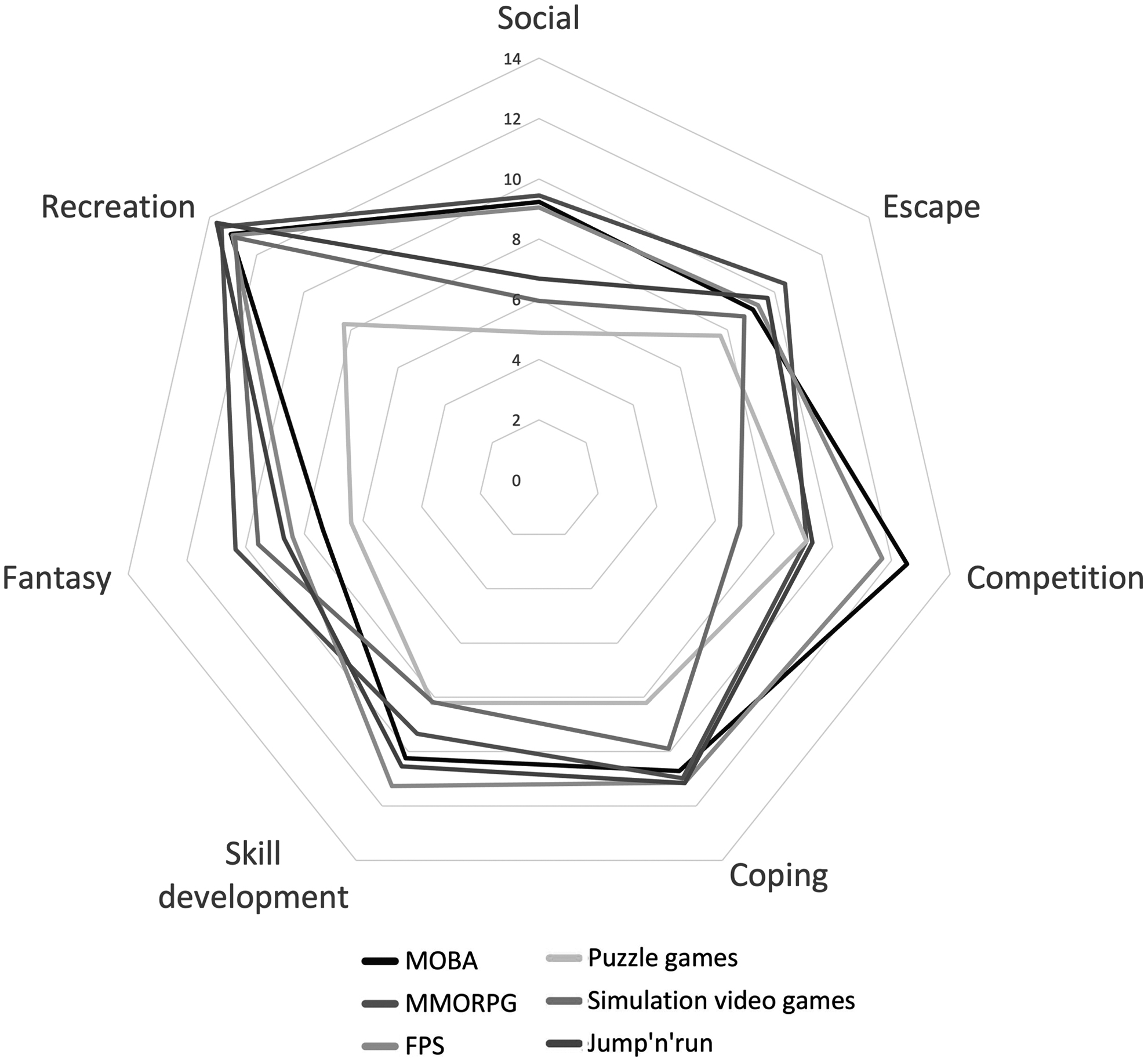
Radar chart showing the gaming motives for distant genres. Note: The radar charts show the expression of all seven gaming motives among the six genres that show the highest (MOBA, MMORPG, FPS) and lowest (puzzle games, simulation video games, jump'n'run) expression of symptom severity among players (as indicated in Table 2). FPS, first person shooter; MMORPG, massively multiplayer online role-playing games; MOBA, multiplayer online battle arena.

Radar charts showing the skills for distant genres. Note: The radar charts show the expression of all skills among the six genres that show the highest (MOBA, MMORPG, FPS) and lowest (puzzle games, simulation video games, jump'n'run) expression of symptom severity among players (as indicated in Table 2).
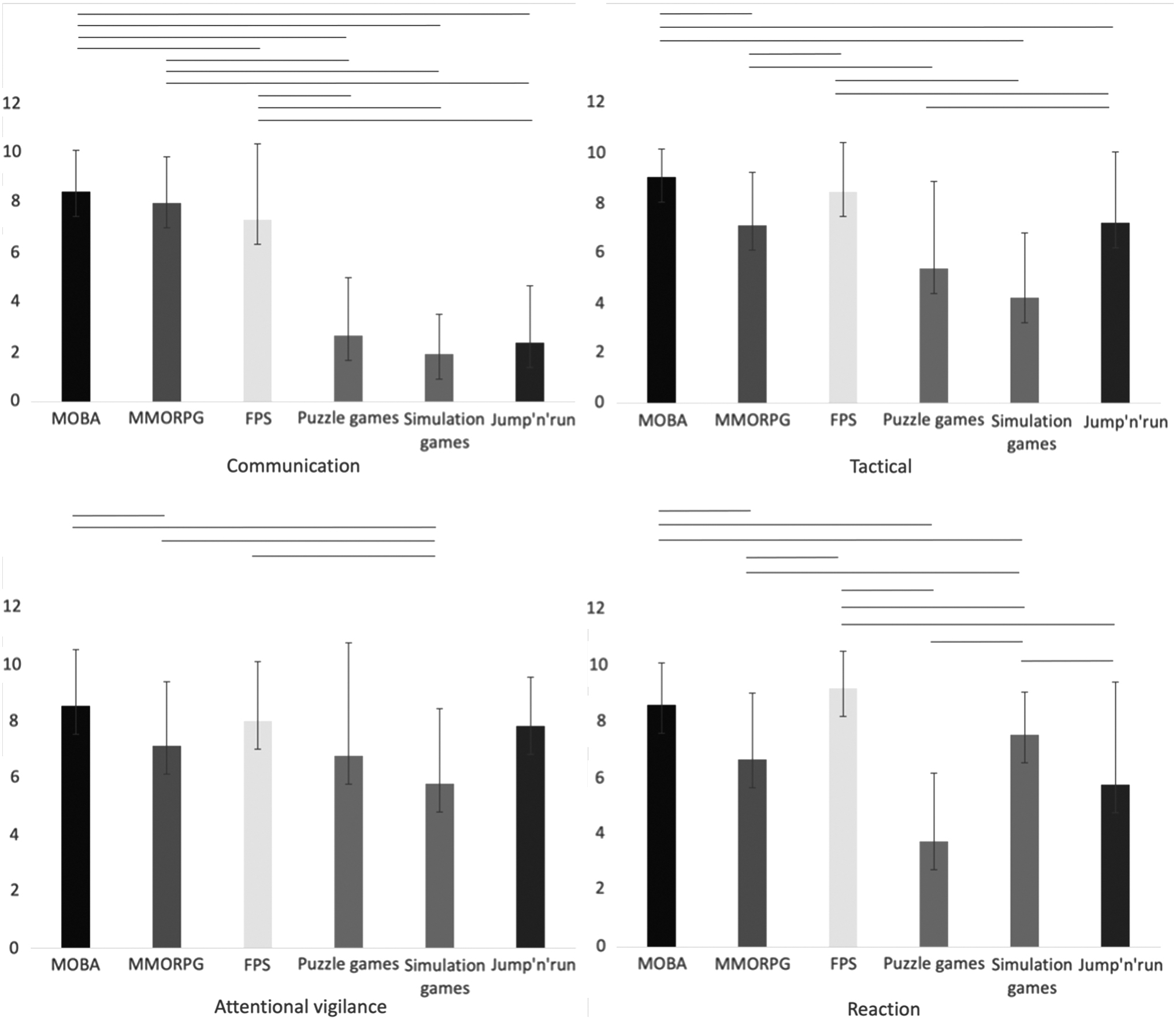
Differences of relevance of skills between distant genres. Note: Horizontal bars indicate differences with p < 0.05 between the six genres that show the highest (MOBA, MMORPG, FPS) and lowest (puzzle games, simulation video games, jump'n'run) expression of symptom severity among players (as indicated in Table 2).
Discussion
Our analyses revealed that players who indicated that their favorite game belonged to the genre MMORPG show the highest symptom severity, followed by MOBAs and FPS. The lowest symptom severity was found among simulation games, jump'n'run games, and puzzle games. This finding is congruent with psychological research that assumes an increased addictive potential of these genres,23–25 which is often discussed as being due to their reinforcing and social character. 23
The descriptive radar-diagrams of the three genres with the highest against the three genres with the lowest symptom severity then revealed that socialization is a component that seems to differ most between genres associated with high and low symptom severity: The skill of communicating with others to play one's favorite game and also the social motive were rated higher among MMORPGs, MOBAs, and FPS (Figs. 1 and 2).
Besides these descriptive results, we find significant differences in the expression of the communication skill between some high and low symptom severity genres (Fig. 3). Thus, it might be these genres that particularly captivate the players due to their social character and could be the reason why gaming might be initiated or continued although, or precisely because negative consequences occur. However, the association of the socialization motive with problematic video gaming reveals controversial results.
That is, one study could indicate that playing for social motives decreases the risk for gaming disorder, 26 whereas another deduced the opposite from their data. 27 Instead, the fact that motives such as escapism and achievement motives are more consistently associated with addictive gaming tendencies17–19 is also roughly recognizable in our descriptive results: These motives were more pronounced in gamers who indicated that their favorite game belonged to either MOBA, MMORPG, or FPS (Fig. 1)—genres that were associated with a higher symptom severity of their players (Table 1).
However, our results support existing research that motives cannot be treated the same among all existing genres but that they should be cautiously interpreted as risk factors according to the genre the individual is playing.
Besides the communication skill, tactical actions within the game, attentional vigilance, and the ability to react quickly seem to be more pronounced in higher symptom severity genres (Figs. 2 and 3). A higher pronunciation of these skills does not mean that a genre requiring these skills is per se more addictive than others. Rather, we hypothesize based on our results that the skills we found to be more pronounced in higher symptom severity games could contribute to a stronger immersion and flow experience, 28 which might facilitate the experience of gratification and/or compensation and subsequent addictive tendencies.29–31
More specifically, immersion describes the state of feeling present in the played game, as if the virtual environment feels like or becomes part of one's reality that might be facilitated by high social engagement, 32 attentional processes, 33 as well as tactical and reaction challenges. 34 Immersion might again be a precursor of a flow state. 35 Flow is an experience of complete devotion in an activity where the requirements of an activity match the skills of a person and therefore creates a pleasurable feeling of capableness. 36
Flow has already been investigated as a vulnerability factor for gaming disorder since it might benefit the rewarding effect of a game. 37 How flow is specifically established in the gaming context and how it influences gratifying and compensating experiences while playing could be a focus for future research.
Our conclusions are not without limitations since we present mainly descriptive cross-sectional results that do not allow for causal or prospective interpretations. In our use-time query, we found that participants were sometimes indicating hours and sometimes minutes of playing games, making it impossible to trace back when to treat numbers as “hours” and when as “minutes.” We, therefore, refrained from reporting this information.
Moreover, the measurement for required skills is not validated but might be an interesting component to look at in future research in a more standardized way. Especially the interaction between player motivations (rather general and within the individual) and required skills (rather specific with regard to a certain game) might be beneficial in understanding immersion, flow, and addictive tendencies better.
Footnotes
Author Disclosure Statement
No competing financial interests exist.
Funding Information
The study was carried out in the context of the Research Unit ACSID, FOR2974, funded by the Deutsche Forschungsgemeinschaft (DFG, German Research Foundation)—411232260. The work of Annika Brandtner was supported by Villigst e.V.