




Abstract
Consumption is undergoing a digital revolution brought about by virtual technology, and the emergence of virtual spokespersons has changed the pattern of advertising endorsement sales. Are virtual character spokespersons better than real celebrity spokespersons? This article aims to explore the relationships between different types of advertising spokespersons, different types of advertising scenarios, and consumers' purchase intentions. The results of 2 pilot experiments and 4 formal experiments show that compared with spokespersons by real people, virtual character spokespersons have a greater positive impact on consumers' purchase intentions, which is achieved through the mediating role of psychological need satisfaction. In addition, different advertising scenarios provided by virtual technology have a moderating effect on this process. This empirical study investigates the possible positive effects of virtual character spokesperson compared with real character spokesperson and expands the results of spokesperson category based on self-determination theory.
Introduction
The advancement of media technology has continuously promoted changes in the form of human society, and human civilization has entered the eve of the metaverse. 1 Many scholars consider the metaverse to be a virtual shared space, 2 and the maturation of virtual reality technology makes virtual characters more vivid.3–6
Real celebrity endorsement consists of the strategic use of real celebrities from real society as brand ambassadors to promote brand value,7–9 and the success of celebrity endorsements is supported by the results of multiple studies that show celebrity spokespersons not only have a positive impact on consumer attitudes but can also increase purchase intention.10–16 However, Klein et al. argue that brand ambassador scandals can influence consumer attitudes and behaviors. 17 With the development of social networks, the image of celebrities has begun to collapse, which has in turn damaged brands' characters in the minds of consumers. 18
The endorsement of virtual characters has recently begun to win favor among brand owners.
15
This type of character is synthesized by computer technology.
7
Over the past few decades, both academic research and the popular media have noted that these avatars help to build unique and favorable brand evaluations.19–26
The qualities embodied by these characters, including affinity and perceptual expertise, help shape brand perceptions,
18
in addition to research showing that even when attribute recall is adversely affected, they produce a more favorable brand attitude.
21
In this regard, the first hypothesis of this study is as follows:
Ryan and Deci found that the motivation for optimal psychological growth and self-determination of individuals depends on the satisfaction of three basic psychological needs: autonomous, ability, and relationship. 27 The psychological experience is unique to each individual. 28 Early psychological need satisfaction is mostly used in research fields such as student psychology and adolescent growth psychology.29–31
Lavidge and Steiner's (1961) 32 model pointed out that advertising affects consumers on two basic psychological dimensions: cognition and emotion.33–35 In addition, existing studies have shown that external factors affect consumers' personal attitudes toward brands or products.36–38 Moreover, when Li (2008) 39 studied the relationship between the basic psychological need satisfaction and the sense of happiness, he concluded that the factors that promote the satisfaction of autonomous need, ability need, and relationship need in the situation will promote the production of happiness. And individuals are stimulated to meet different psychological needs in different situations. Different types of character spokesperson advertisements are external factors that affect consumers. Therefore, different types of character spokespersons 37 can affect individual consumers' attitudes toward the brand. Following these premises, hypotheses 2 and 3 are proposed.
Moreover, the in-advertising scene has long been a research hotspot.41–43 Phillips and McQuarrie discussed the influence of the extended meaning contained in advertising images on consumer attitudes. 42 However, the scene classification of advertising shooting is less discussed.44,45 Advertising could be considered a sort of bridge connecting the information transmission between products and consumers since different scenarios in advertisements convey different information46–49 to consumers and ultimately have different effects on consumers' purchase intentions. The advertisement shooting scene is the background in which the advertisement is shot. The combination of virtual reality and marketing has become a hot topic, and virtual reality marketing has been called the most promising marketing innovation method in the 21st century. 50
The combination of virtual reality and marketing includes the use of virtual reality technology to build advertising shooting scenes. Studies divide advertising shooting scenarios into real scenarios (real advertising scenarios) and virtual scenarios (advertising scenarios constructed by virtual technology) through virtual reality technology.50–52 With the help of virtual reality technology, advertising shooting scenes can also be created.53–56 The advertising shooting scenes created by virtual reality technology have the three characteristics of immersion, interactivity, and imagination, 57 which to a certain extent realize the self-satisfaction of consumers. Jin et al. 58 defined immersion as the participation of consumers in the consumption process, which leads consumers to forget time and emphasizes the consumption process rather than the consumption result, which promotes consumers' purchase intentions.59,60 Accordingly, our fourth hypothesis can be put forward:
In summary, the specific research model is shown in Figure 1.

Research model diagram.
Materials and Methods
Participants
The number of participants of this study's experiments was determined according to the number of items in the questionnaire, the sample size of the scale questionnaire is about 5 to 10 times that of the items (questions) of the scale.61,62 One hundred university students participated in pilot Experiment 1. Seventy-seven netizens from all over the country participated in pilot Experiment 2.
A total of 120 students participated in Experiment 1, and 107 valid questionnaires were collected, including 54 questionnaires in the celebrity spokesperson group and 53 questionnaires in the virtual spokesperson group. Among them, there were 36 males, accounting for 34.95 percent, and 67 females, accounting for 65.05 percent.
A total of 130 students were randomly divided into two groups to participate in Experiment 2, and 124 valid questionnaires were collected, including 69 valid questionnaires in the celebrity spokesperson group and 54 valid questionnaires in the virtual spokesperson group. Among them, there were 36 males, accounting for 29.03 percent, and 88 females, accounting for 70.97 percent.
A total of 290 valid questionnaires were collected in Experiment 3, of which 29.31 percent of respondents were male and 70.69 percent were female.
A total of 240 students were randomly divided into 4 groups to participate in Experiment 4, and 231 valid questionnaires were collected, of which 44.59 percent were from males and 55.41 percent were from females.
All in all, the number of questionnaires in the four experiments is more than eight times the number of questions items in the questionnaire. And it meets the requirements of SPSS analysis.
Measurement instruments
The spokesperson (independent variable) selects the celebrity spokesperson He Jiong and the virtual character spokespersons Pikachu and Diana in pilot Experiment 1.
The measurement of purchase intention (dependent variable) is adapted from the purchase intention scale used in the research of Chakraborty (2019) 63 and Buil et al. (2013), 64 combined with the purchase situation of this experiment. The variable data were scored with a 7-point Likert-type scale (1 = strongly disagree to 7 = strongly agree), and the Cronbach's alpha for this 8-item scale was 0.837.
Psychological need satisfaction (Mediating Variable) was adapted from the Psychological Need Satisfaction Scale developed by Ryan and Deci 27 and consists of 9 items. Items were all anchored on a 7-point Likert-type scale ranging from 1 (strongly disagree) to 7 (strongly agree).
Advertising scenarios (Moderator Variable): subjects were immersed in two advertising scenarios through verbal descriptions. The endorsement products in the advertisements of both scenarios are fictitious product Q to control the interference of endorsement products on the experimental results. Except for the differences in the context description, the other conditions in the advertisements of the two scenarios are the same. In the real situation of the advertisement, the background of the advertisement picture seen by the subjects is the real place. In the virtual context of the advertisement, the background of the pictures seen by the subjects is a virtual (synthesized by technology) place.
Procedure
The purpose of pilot Experiment 1 was to determine the candidates for virtual spokespersons and real celebrity spokespersons in the formal experiment. The pilot experiment adopted 1V1 face-to-face interviews. Participants were told that “the following spokespersons are the spokespersons of a product” and were then instructed to select one celebrity spokesperson and one virtual spokesperson (the spokespersons selected were derived from social network rankings), who were the most famous and the least scandal-related gossip from among 10 celebrity spokespersons and 10 virtual spokespersons.
The purpose of pilot Experiment 2 was to verify that the virtual scene and the real scene are distinguishable (Fig. 2). To enhance the reliability of the results, the pilot experiment adopted the method of randomly distributing questionnaires on the network. Respondents rated the items on a 7-point Likert-type scale ranging from 1 (advertising scene is very virtual) to 7 (advertising scene is very real).

Stimulus material for Experiment 1. Note: Figure shows two sets of advertisement designs in Experiments 1 and 2. Part VR is the advertisement image of the real celebrity spokesperson, and part VV is the advertisement image of the virtual spokesperson. VR, virtual advertising scenario & real advertising spokesperson; VV, virtual advertising scenario & virtual advertising spokesperson.
The purpose of Experiment 1 was to verify which type of spokesperson has a greater impact on consumers' purchase intentions. Experiment 2 further verified the influence of the advertising spokesperson type on consumers' purchase intentions on the basis of the first experiment and considered the mediating effect of psychological satisfaction. Experiments 1 and 2 used two different questionnaires that were compiled based on the type of spokesperson. Except for the type of spokesperson, the other variables were consistent. Questionnaires were distributed randomly.
Experiment 3 used a component factor experiment of 2 (Real Celebrity Spokesperson vs. Virtual Character Spokesperson) × 2 (Real Scenario vs. Virtual Scenario) factors to test the moderating effect. The participants in the experiment were randomly divided into four groups. The experimenter introduced the experimental scenario to the subjects: “Suppose you recently wanted to buy a mobile phone, and you saw the following mobile phone advertisement and spokesperson photos when you were shopping in the mall.” There were differences in the advertisement images seen by subjects in different groups (Fig. 3), and the subjects were required to fill out a questionnaire about shopping intentions.

Stimulus material for Experiment 3. Note: the advertisement picture of Experiment 3. Parts VR and VV are the advertisement pictures under the background of virtual environment, VR is the advertisement of the real celebrity spokesperson, and part VV is the advertisement of virtual image spokesperson; part RR and RV are the advertisement pictures under the background of real environment, and part RR is the advertisement of real celebrity spokesperson and part RV is the advertisement of virtual image spokesperson. RR, real advertising scenario & real advertising spokesperson; RV, real advertising scenario & virtual advertising spokesperson.
Experiment 4 further improved the robustness of the experimental results. The virtual human spokesperson was selected to replace the virtual cartoon spokesperson as the virtual advertising image to further verify the influence of the interaction between the advertising scene type and the advertising spokesperson type on consumers' purchase intentions. The selection of scales, experimental procedures, and experimental manipulations was consistent with Experiment 3, and the experimental materials are shown in Figure 5.
Results
Pilot experiment measures
In pilot Experiment 1, based on the number of times the participant was chosen, He Jiong, Pikachu, and Diana were selected as the spokespersons in formal experiments.
In pilot Experiment 2, through descriptive statistical analysis, it was found that the respondents had significant differences in perception of different types of advertising scenarios (real scene:
Manipulation checks
In Experiment 1, through analysis of variance (ANOVA), it was found that there was no significant difference in terms of perception of different spokespersons [familiarity:
Moreover, there was no significant difference in the perception of different types of spokespersons [familiarity:
Main effects test
In Experiment 1, the independent sample t test showed that there was a large difference in purchase intention between real and virtual spokespersons (F = 41.18, p < 0.001). Through the ANOVA, it was found that the purchase intention of the product through the virtual spokesperson was higher [
Mediation test
The analysis of the two-factor method (Table 1) revealed a significant interaction between the satisfaction of psychological needs and the type of spokesperson, so Hypotheses 2 and Hypothesis 3 are supported. To further illustrate the mediating effect of psychological need satisfaction, the simple mediation model compiled by Hayes (2012) 65 was used to test the mediating effect between the type of advertising spokesperson and consumers' purchase intentions, while controlling for gender, age, education, and position. The results are as follows (Table 2): the type of advertising spokesperson had a significant effect on the prediction of consumers' purchase intentions (B = 0.92, t = 6.02, p < 0.01). The direct predictor of willingness remained significant (B = 0.13, t = 2.45, p < 0.01).
Two-Way Analysis of Variance Between Groups
Mediation Effect Test
Note: **p < 0.01.
The type of advertising spokesperson had a significant positive predictive effect on the satisfaction of psychological needs (B = 0.88, t = 6.16, p < 0.01), and the satisfaction of psychological needs had a significant positive predictive effect on consumers' purchase intentions (B = 0.91, t = 26.23, p < 0.01). In addition, the upper and lower bounds of the bootstrap 95% confidence interval of the direct effect of spokesperson type on consumers' purchase intentions and the mediating effect of attention control do not contain 0 (Table 3), indicating that spokesperson type can not only directly affect consumers' purchase intentions but also influence consumers' purchase intentions through the mediating effect of psychological need satisfaction.
Decomposition Table of Total Effect, Direct Effect, and Mediating Effect
Note: Boot SE, boot LLCI, and boot ULCI refer to the lower and upper limits of the 95% CI of the SE of indirect effect estimated by the bias-corrected percentile bootstrap method, respectively; all values are rounded to two decimal places, the same below.
CI, confidence interval; LLCI, CI lower limit; SE, standard error; ULCI, CI upper limit.
To explore the influence of the three dimensions of psychological needs on consumers' purchase intentions, the simple mediation model compiled by Hayes (2012) was used to examine the relationships between autonomous need, ability need, relationship need, and purchase intention (Table 4). The results showed that autonomous need (B = 1.13, t = 11.00, p < 0.01) and relationship need (B = 0.61, t = 10.26, p < 0.01) had a positive impact on consumers' purchase intentions.
Three Dimensions of Psychological Needs Test (n = 290)
Note: **p < 0.01; *p < 0.05.
The results are significant, but the effect of ability need (B = 0.59, t = 8.87, p > 0.05) on consumers' purchase intentions is not significant. The experimental results show that, for consumers, the sense of immersion and satisfaction brought to consumers by advertisements provided by virtual reality technology can only stimulate their independent needs and relationship needs, but has no effect on the stimulation of their ability need. That is because, watching advertisements is only related to individual's sharing and autonomous satisfaction, not personal ability. 48
Interaction effect test
In Experiment 3, the study took consumer purchase intention as the dependent variable, tested the interaction effect through one-way ANOVA, and used the familiarity and likeability of the spokesperson as the coordination variable. The results showed that the interaction between celebrity spokesperson type and advertising situation type had a significant impact on the subjects' purchase intentions (F = 8.505, p < 0.01). Subsequent comparative analysis showed that for real advertising scenarios, virtual character spokespersons led subjects to have higher purchase intentions (
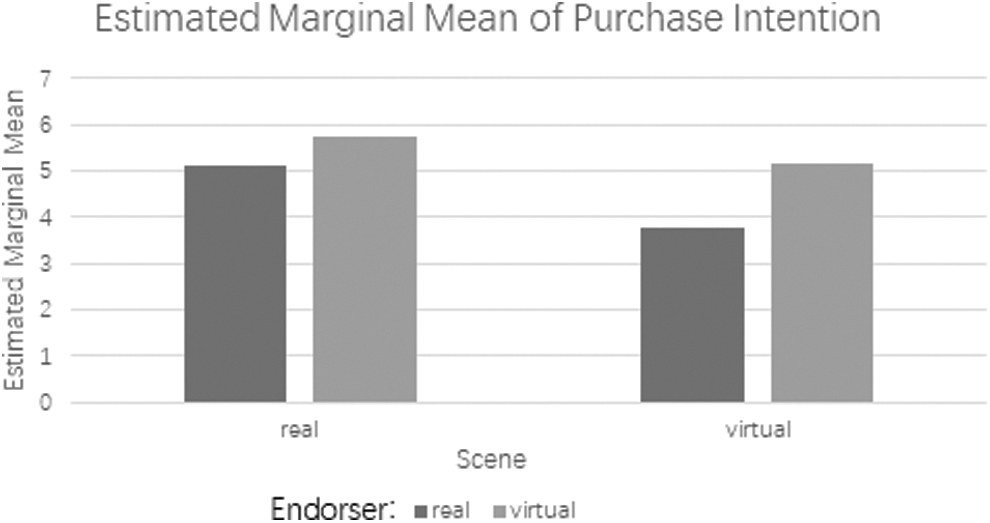
Experiment interaction effect.

Supplementary experiment. Note: the advertisement picture of Experiment 4. Part VR and part VVR are advertisement pictures under the background of virtual environment, VR is the advertisement of the real celebrity spokesperson and part VVR is the advertisement of the virtual image spokesperson; parts RVR and RR are advertisement pictures under the background of real environment, part RVR is a virtual image spokesperson advertisement and part RR is a real celebrity spokesperson advertisement.
In Experiment 4, the results showed that the interaction between celebrity spokesperson type and advertising scenario type had a significant impact on the subjects' purchase intentions (F = 4.13, p < 0.05). Subsequent comparative analysis showed that for real advertising scenarios, virtual character spokespersons led subjects to have higher purchase intentions (

Experiment 4 interaction effect.
Moderating effect test
To verify whether the advertising context has a moderating effect on the relationships between different types of spokespersons and purchase intentions, a two-way ANOVA was conducted in the study (Table 5). The interaction between spokesperson type and endorsement context is significant, so Hypothesis 4 is verified.
Two-Way Analysis of Variance Between Spokesperson Type × Advertising Scenario Groups
To explain the moderating effect of scene type more clearly, this article adopts Model 7 in the SPSS macro compiled by Hayes (2012) to assume that the first half of the mediation model is moderated, which is consistent with the theoretical model of the study. The results (Table 6) show that after including the scene type into the model, the product term of the spokesperson type and the scene type has a significant predictive effect on the purchase intention and psychological need (spokesperson type: B = −0.01, t = −2.03, p < 0.05; and psychological needs: B = 0.91, t = 26.23, p < 0.00), indicating that the scene type can play a moderating role in the indirect prediction of the spokesperson type on the purchase need.
Moderated Mediation Model Testing (n = 290)
Note: **p < 0.01; *p < 0.05.
General Discussion
Conclusion
Celebrity endorsements are a well-established marketing tactic used since the late 19th century. Advertising usually chooses popular celebrities as spokespersons to promote products, but with the development of information technology and online social media, virtual celebrity spokespersons have begun to enter the public eye due to their unique advantages. Then, what is the difference between the spokesperson from a real celebrity and a virtual celebrity, and how should companies choose? Thus, this article attempts to introduce the perspective of psychology need satisfaction, and explore the impact mechanism of different advertising endorsement combinations (spokesperson × endorsement scenarios) on consumers' purchase intentions.
And article finds that, with the development of information technology, compared with emerging virtual celebrity spokesperson, real celebrity spokespersons have less influence on consumers' purchase intentions; at the same time, spokespersons enhance consumers' purchase intentions by improving consumers' psychology need satisfaction. After introducing the endorsement scenarios, the study found that the same type of endorsement combination (real celebrity spokespersons with real scenarios or virtual celebrity spokespersons with virtual scenarios) can better promote consumers' purchase intentions. The above research results show that companies can choose virtual celebrity to promote purchase intention, and the promotion effect is better when matched with virtual advertising scenarios.
Theoretical implications
This study broadens the research in the field of advertising spokespersons and virtual reality marketing and enriches the related research literature.
First, this study makes up for the lack of research on the types of advertising spokespersons. This research on advertising spokespersons focuses on real celebrity endorsement research, most of which focuses on the influence of celebrity endorsement of different types of products,10–13 the influence of celebrity endorsement characteristics and product matching degree on the endorsement effect,14–16 and the influence of the number of celebrity spokespersons on consumer satisfaction, 61 while few studies have classified the types of spokespersons. Starting from the classification of spokespersons, this research explores the differences in the influence of different types of spokespersons on consumers' purchase intentions, thus enriching and broadening the research in the field of advertising endorsements.
Second, this study makes up for the lack of research on the types of advertising endorsement scenarios. Most of the previous research on advertising content has focused on the research of advertising image scenes,41–45 and the continuous evolution of virtual reality technology and the global explosion of the metaverse have given advertising scenarios new research possibilities. Therefore, the study innovatively divides the advertising endorsement scenarios into virtual scenarios and real scenarios, studies the mechanism of different advertising spokespersons on consumers' purchase intentions under different advertising scenarios, and explores the collocation of different scenarios and advertising spokespersons. To a certain extent, this article enriches the research on advertising content and virtual reality marketing.
Finally, based on the theory of self-determination, this article discusses the impact of advertising on consumers from the perspective of meeting basic psychological needs, which enriches the research of consumer psychology. Early psychological need satisfaction is mostly used in research fields such as student psychology and adolescent growth psychology.29–31 This article explores the decision mechanism of psychological satisfaction on consumers' purchase intentions from the perspective of self-determination and clarifies the decision mechanism through empirical evidence.
Furthermore, the article not only explores the mechanism of the matching of spokesperson image and endorsement scenario on consumers' purchase intentions from the perspective of psychological need satisfaction but also explores the specific effects of the three dimensions of psychological need satisfaction from the perspective of self-determination theory. When consumers watch an advertisement, the advertisement will promote their purchase intention by satisfying their psychological needs. However, the three dimensions of psychological need satisfaction do not necessarily have an impact on consumers' purchase intentions at the same time.
Among them, the advertising spokespersons and endorsement scenarios provided by virtual reality technology cannot stimulate purchase intentions by satisfying ability need, but by satisfying autonomous need and relationship need to stimulate purchase intention. Based on these findings, this article not only broadens the research on celebrity advertising endorsement and virtual reality marketing but also enriches the related research literature on psychological need satisfaction.
Practical implications
The research has certain practical relevance.
To the beginning, this article provides a new choice of advertising endorsement image for enterprises. At present, most companies choose real-life high-priced celebrities for product advertisement. 66 However, with the popularity of social media, the private lives of real celebrities are exposed to the public, followed by constant scandals and a decline in the reputation of endorsement products. 12 In this case, the virtual celebrity has no negative advantages and, to a certain extent, has a stronger role in promoting consumers' purchase intentions. Therefore, companies can consider using virtual celebrities as advertising spokespersons for their products.
Then, this article provides new advertising shooting scenarios for enterprises to choose. Different advertising shooting scenarios will affect consumers' purchase intentions by analysis. Most enterprises only consider spokesperson when launching new products, but few enterprises consider that different types of advertising scenarios will affect consumers' expected image. Furthermore, many advertisements are shot in real scenarios. On one hand, the real scene is effective, but it involves considerable human and material resources and security problems. On the other hand, with the ongoing COVID-19 pandemic, the filming of advertisements in real locations faces difficulties in epidemic prevention. However, the advertisement filming of virtual scenes can be achieved solely through virtual reality technology, which greatly reduces the difficulty of epidemic prevention and the loss of labor and material resources. Therefore, enterprises can consider using virtual scenes when shooting advertisements.
Last, but not least, enterprises should consider the satisfaction of consumers' psychological needs when designing advertisements. Of course, product advertising shoots need to highlight the features and benefits of the product. However, in the past, most of the advertising shots only focused on the prominence of product features and ignored the satisfaction of consumers' psychological needs. In the future, advertising shooting can maximize advertising benefits by considering how to meet the autonomous need and relationship need.
Limitations and future research
Above all, the experimental design of this study has a few limitations. On the one hand, the sample size is slightly insufficient. Although this study has collected a sufficient number of questionnaires based on item items, to make the experimental results general, the sample size can be further expanded in future research. On the other hand, the experimental questionnaire adopts the mode of random distribution, but there will still be some deviations. Future research can adopt the research design based on the empirical sampling method, and repeat the measurement of the research variables in a short period of time. Thus deeper analysis of mechanism issues may be obtained.
Then, there is still room for further improvement in the theoretical perspective of this study. This study analyzes the influence mechanism of spokespersons and advertising scenarios on consumers' purchase intentions based on the perspective of psychological need satisfaction. Although this study only examines the influence of real image spokespersons and virtual image spokespersons on outcome variables, Wang pointed out that the gender of spokespersons may also impact consumers. Based on the analytical framework proposed in this study, future research can further divide the types of spokespersons by gender to explore their impact on consumers' purchase intentions.
Footnotes
Author Disclosure Statement
No competing financial interests exist.
Funding Information
National Natural Science Foundation of China (Grant Nos. 71662004, 71872055, 72062003, and 72162002), Key Research Base of Humanities and Social Sciences in Guangxi Universities and the Project of Guangxi Development Strategy Institute in China (Grant Nos. 2022GDSIYB14 and 2021GDSIYB05), Guangxi philosophy and Social Science Planning Research Project (Grant No. 21FMZ050), and Innovation Project of Guangxi Graduate Education (Grant No. JGY2022018).