




Abstract
The growing demand for mental health services and artificial intelligence chatbots to replace human agents have led to increased attention to chatbot anthropomorphizing. This study explored the effect of anthropomorphism on counseling satisfaction and reuse intention for chatbot-led mental health counseling and the mediating role of social rapport in the relationship. This study also examined the interaction effect of anthropomorphism and social anxiety on counseling satisfaction and reuse intention. A total of 374 U.S. adults were recruited from an online crowdsourcing company to simulate user-chatbot interactions in the context of mental health counseling. Two chatbots either with a high anthropomorphic design (i.e., human face) or low anthropomorphic design (i.e., robot face) were developed through Dialogflow—a natural language processing engine—to examine the hypotheses. The results revealed that the high anthropomorphic design produced higher counseling satisfaction and reuse intention than the low anthropomorphic design, while this relationship is mediated by the perceived social rapport between chatbot counselors and users. The results further revealed a significant interaction effect of anthropomorphism and social anxiety on counseling satisfaction and reuse intention. The findings of this study are expected to (a) enhance the understanding of the effect of anthropomorphic chatbots on counseling satisfaction and reuse intention, (b) clarify moderating effects of social rapport and social anxiety, and (c) help mental health practitioners and chatbot designers by providing a psychological mechanism of how anthropomorphism functions in the context of human–chatbot interaction.
Introduction
The demand for timely mental health counseling has become ever more important after the COVID-19 pandemic; the United States has seen about a 30% point increase in the number of adults suffering from symptoms of mental illness, compared with the prepandemic level. 1 Moreover, the hiring crisis in the mental health services industry and burnout and fatigue among practitioners have raised serious public health concerns. 2 Artificial intelligence-based chatbots have been receiving much attention as a replacement for conversational agents 3 not only because they can help reduce the cost but also because they have several strengths such as privacy, anonymity, and ease of access, which can be especially useful in the context of mental health counseling.
Studies have demonstrated several benefits of using chatbots for mental health counseling in that they can alleviate anxiety and depression and help people better manage their mental health.4–6 However, fewer studies have examined the psychological mechanisms of how chatbots affect mental health attitudes and behaviors. 7 To be more specific, human-like chatbot designs and anthropomorphized chatbots have received much attention as the role of chatbots has shifted from a mere information medium into social interaction, yet, not many have assessed the factors affecting the interaction outcomes. Therefore, this study aims to reveal key factors influencing the effect of anthropomorphized mental health chatbots on counseling satisfaction and reuse intention by testing the mediating effect of social rapport and the moderating effect of social anxiety and to provide practical implications to mental health practitioners and chatbot designers.
Literature Review
Anthropomorphic chatbots and interaction outcomes
Anthropomorphism, the perception of humanness in nonhuman agents, 8 has been the standard explanation for users' social responses toward nonhuman agents. 9 The theory of anthropomorphism explains that people interact with nonhumans as they do with humans through a process of anthropomorphism to cater to the need for social connection 10 and better control unfamiliar situations, 8 which are crucial factors in developing bonding between a mental health counselee and a counselor. 11 Studies point out that visual cues trigger anthropomorphic beliefs and humanness heuristics, which affects interaction outcomes.12,13
Human–computer interaction (HCI) studies have emphasized the advantages of the humanlike appearance of nonhuman agents on user attitudes and behaviors.14–16 For example, Gong 14 tested the effect of different degrees of anthropomorphism in computers on user response by developing computer face representations with different degrees of anthropomorphism. Gong 14 found that computer agents with high anthropomorphic facial representations (e.g., human model) received more social responses, positive social judgment, greater homophily, competency, and trustworthiness and yielded greater social influence than agents with low anthropomorphic representations (e.g., robot face). Studies have further extended the application of anthropomorphism to the contexts of chatbot advisors and service robots and revealed the effects of humanlike designs on user satisfaction and other conversational benefits.15–17
However, some studies found contradicting results, indicating that humanness is not always preferred over low anthropomorphic designs.18–20
For example, the uncanny valley effect points out that the positive effect of humanness may drop significantly when it reaches a certain point and cause eeriness and negative interaction outcomes.
21
Moreover, studies argued that the relationship between anthropomorphism and interaction outcomes in chatbots is moderated by conversational contexts in that people preferred humanlike chatbots over machinelike chatbots when a chatbot is providing services while the opposite was true when a chatbot is asking a favor.22,23 This study argues that such conflicting research findings in the anthropomorphism literature call for more evidence to confirm the effect of anthropomorphic chatbots in the context of mental health counseling services. Hence, H1 is proposed as follows:
Mediating role of social rapport
The computers-are-social-actors paradigm and social response theory suggest that computers are regarded as social actors and HCI have subsequent effects on interaction outcomes such as user attitudes and behaviors.24,25 Based on such assumptions, we can predict that the relational variables that apply to counselor-counselee relationships can also be applied to the chatbot counselor-counselee relationship. Social rapport (i.e., counseling rapport)—the therapeutic bond between a counselor and a counselee—is critical to patient-counselor relationships, which are positively associated with patient motivation, confidence in counseling, and counseling satisfaction. 11
Studies showed that anthropomorphism can facilitate social rapport in a HCI because anthropomorphism increases a sense of social connectedness, lifelikeness of the interaction, and emotional attachment to the agent, 26 which can result in counseling satisfaction 11 and reuse intention. 27 Drawing on this line of discussion, this article proposes a mediating role of social rapport in the relationship between anthropomorphism and interaction outcomes (i.e., counseling satisfaction and reuse intention).
Interaction between anthropomorphism and social anxiety
As mentioned previously, anthropomorphism does not always result in positive interaction outcomes.12,20–22 Studies explain such phenomenon with the uncanny valley effect, 21 expectation violations, 12 and contextual variances. 22 Moreover, Sproull et al. 20 compared the effectiveness of counselors (text-only vs. human-faced) and found that humanness does not always elicit positive behaviors. They further state that anthropomorphized computer counselors may lower people's levels of relaxation and confidence and increase social pressure for users to use various social skills, similar to real-life social interactions. 20
Building on the extant studies, this study attempts to add to the literature by considering a psychological factor, social anxiety, as a moderator. Social anxiety is defined as a condition in which people feel anxiety or discomfort when interacting with others due to a high level of shyness. 28 Kang and Gratch 28 found that socially anxious people tend to feel more comfortable when interacting with a virtual human instead of a real human. Pierce 29 also suggests a similar association between social anxiety and the preference for non-face-to-face interactions. 29 This study argues that anthropomorphic chatbots with human faces would create more social pressure that can be uncomfortable for people with a higher level of social anxiety,28,29 especially in the context of mental health counseling where managing social anxiety is a crucial factor in counseling success.30,31 Hence, we propose the following hypotheses (Fig. 1):

Research model.
Methods
Participants
A total of 400 American adults were recruited from a crowdsourcing Web site, Amazon Mechanical Turk, in May 2022, who voluntarily participated after submitting an informed consent form. Data from 26 participants who failed to complete questionnaires or a conversation with a counselor were eliminated from the analysis, yielding a final sample of 374 participants. A total of 185 (49.5%) participants were assigned to the low anthropomorphism condition, and 189 (50.5%) participants were assigned to the high anthropomorphic condition for an even distribution of samples in each condition.
The sample consisted of 225 (60.2%) male and 149 (39.8%) female participants and 329 White (88.0%), 11 Black (2.9%), 25 Asian (6.7%), and 9 participants from other races (2.4%). The average age was 37.7 years (min = 21, max = 69). Twelve participants had completed high school, and 362 held a bachelor's degree or higher. The median household annual income ranged from $50,000 to $59,999.
Procedure
An online experiment was conducted to test the hypotheses. Participants answered pre- and postquestionnaires before and after their conversation with a mental health chatbot counselor. They were asked to sign an informed consent form and answer the social anxiety questions in the prequestionnaire. They were then asked to click an external link to be directed to an online chat room, where they were welcomed by a chatbot counselor with either high or low anthropomorphic face representation. Participants interacted with a chatbot counselor in a two-way conversation using button-type rich responses about mental health issues and recommendations. After the conversation, participants were given a verification code for proof of completion and were redirected to the postquestionnaire page. They then answered questions on demographics and their experience from the conversation and were debriefed.
Stimuli
Based on Gong's 14 design for manipulating the degree of anthropomorphism in computer representations, we developed two types of chatbot counselors—the low and high anthropomorphic conditions (Fig. 2). We created the two types of chatbot face representations based on Gong's 14 design of varying degrees of anthropomorphism. For the low anthropomorphic condition, we created a still image of a robot face representation based on Gong's 14 definition of a low anthropomorphic design and Woebot, the virtual counseling agent's design. 4 For the high anthropomorphic condition, we used an image of a human model.14,20 In both conditions, participants were informed that the agent is an AI-powered computer interface.
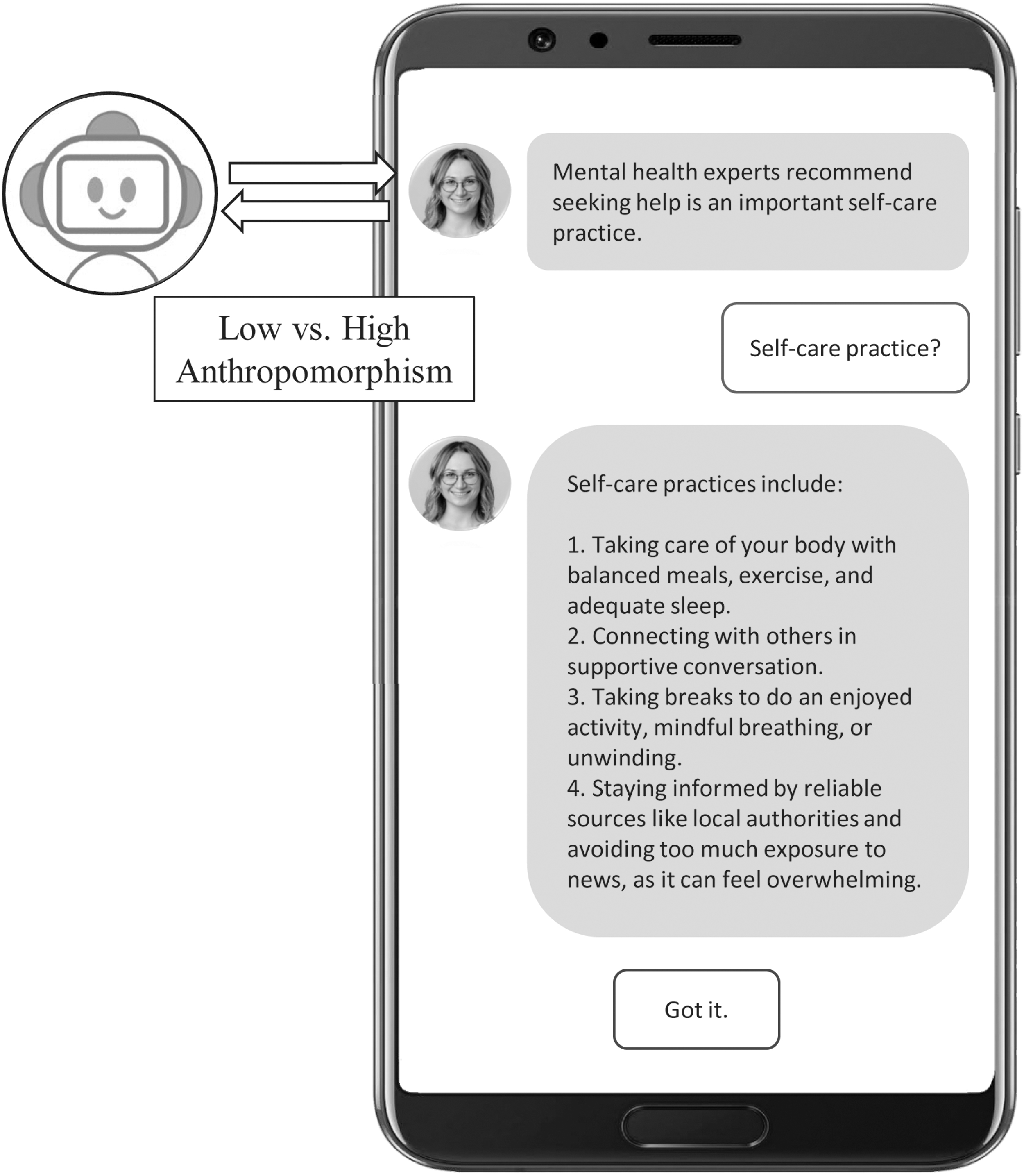
Chat screen with low vs. high anthropomorphic chatbot agents.
User-chatbot interaction was developed through Dialogflow, a natural language processing engine. The rich response function was used so that users can respond to the chatbot using button options to keep the conversation flow as intended (Fig. 3). For example, when a chatbot said, “Mental health experts recommend seeking help is an important self-care practice,” the user was given a clickable bubble (“Self-care practice?”) to learn more about the concept. An online counselor, Woebot, used such a chatbot design. 4 When a participant entered a chat room, a chatbot counselor welcomed the user and started the first part of the user-chatbot interaction by conversing about mental health problems and the user's experience (e.g., “How well could you enjoy your favorite activities over the last few weeks?”).
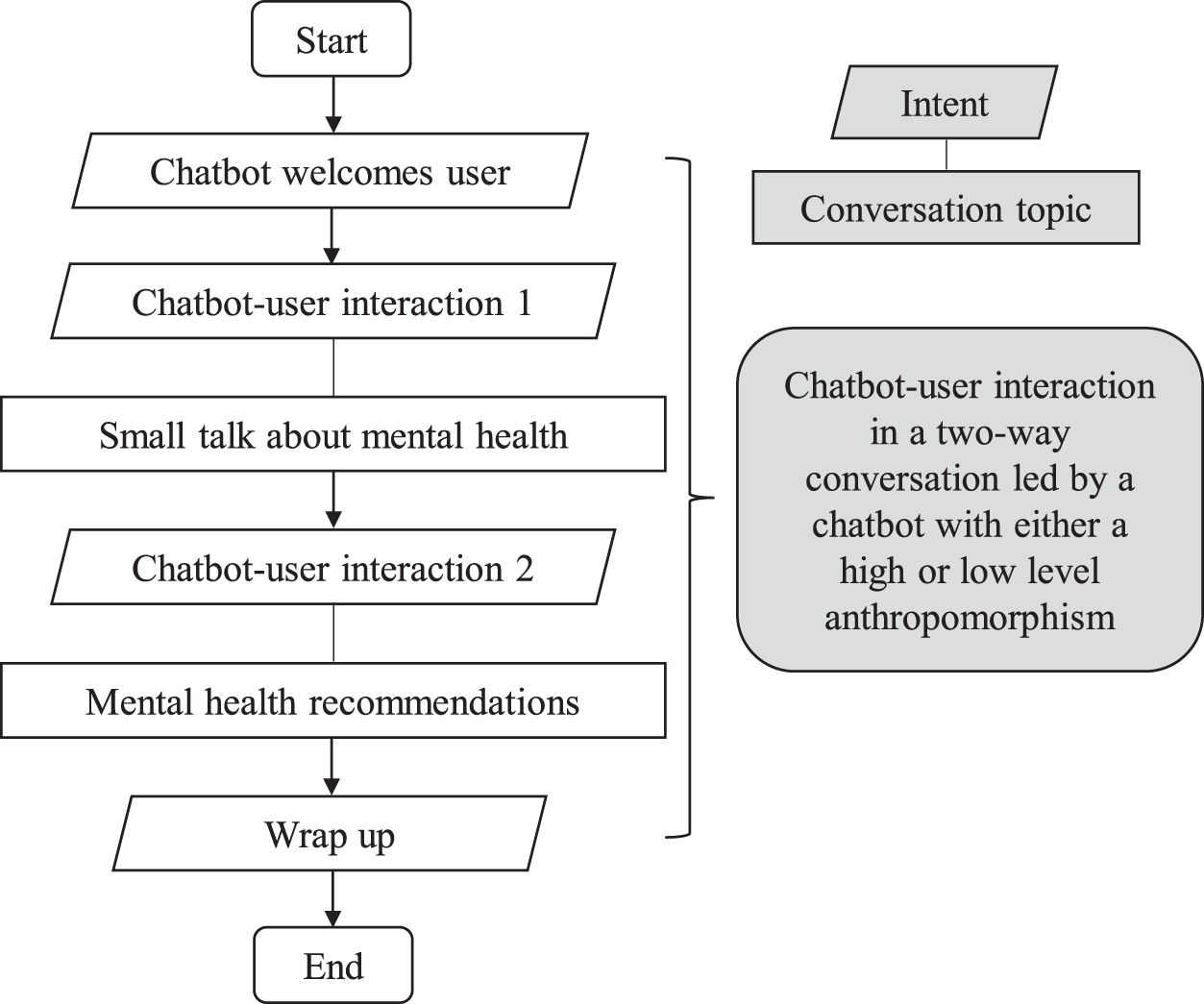
Conversation flow.
In the second part of the interaction, chatbots made mental health recommendations. Mental health-related questions and recommendations were developed based on the Centers for Disease Control and Prevention's mental health guidelines 32 under the close supervision of a certified mental health practitioner. After the two interactions, users were debriefed, given a verification code and redirected to the survey page for the postquestionnaire.
Measurement
Social rapport
Social rapport between participants and chatbot counselors was measured using five items derived from Lubold's 33 study on robot learning companions and learner rapport. Sample items are “The counselor and I understood each other” and “The counselor and I had a connection.” The items were rated on a 7-point Likert scale ranging from 1 = strongly disagree to 7 = strongly agree (M = 5.56, SD = 0.78, Cronbach's α = 0.78).
Counseling satisfaction
Counseling satisfaction was measured using six items from Lee and Choi's 34 study on chatbot and user experience. Items include: “I am satisfied with the counselor's recommendation service” and “Interacting with the counselor was a pleasant and satisfactory experience.” Responses were rated on a 7-point Likert scale ranging from 1 = strongly disagree to 7 = strongly agree (M = 5.49, SD = 0.83, Cronbach's α = 0.85).
Reuse intention
Reuse intention was measured using four questions adapted from Lee and Choi's study. 34 Sample items are: “I am willing to use the counseling service again” and “I intend to speak with the counselor again when I feel depressed.” Respondents were asked to rate each item on a 7-point Likert scale ranging from 1 = strongly disagree to 7 = strongly agree (M = 5.46, SD = 0.98, Cronbach's α = 0.85).
Social anxiety
Social anxiety was measured using six items adapted from Kang and Gratch's 28 study on virtual agents and social anxiety and modified to fit the context of this study. Sample items are: “I feel tense when I'm with people I don't know well” and “I am socially somewhat awkward.” Each item was rated on a 7-point Likert scale ranging from 1 = strongly disagree to 7 = strongly agree (M = 4.90, SD = 1.48, Cronbach's α = 0.93).
Statistical analyses
To test H1, we first performed independent samples t tests with anthropomorphism (robot vs. human) as an independent variable and counseling satisfaction and reuse intention for chatbot counseling as dependent variables; two separate independent samples t tests were conducted on each dependent variable. Next, we conducted PROCESS macro (Model 4) by Hayes 35 to investigate the mediation effect of social rapport on the relationships between anthropomorphism and counseling satisfaction and reuse intention for chatbot counseling (H2); PROCESS macro (Model 4) was conducted twice on each of the two dependent variables.
Finally, again for the two dependent variables, we performed PROCESS macro (Model 8) twice to test the moderating effects of social anxiety on the direct relationship between anthropomorphism and counseling satisfaction and reuse intention (H3) and the indirect relationship between anthropomorphism and counseling satisfaction and reuse intention for chatbot counseling through social rapport (H4). We computed statistics across 5,000 bootstrap samples to assess confidence intervals (CIs).
Results
Preliminary analyses
Table 1 shows the descriptive statistics and zero-order correlations for all the variables included in the research model. The variables were significantly and positively correlated.
Means, Standard Deviations, and Correlations Between Study Variables
p < 0.01.
Hypotheses testing
H1 posited that the chatbot counselor with a human face produces higher counseling satisfaction and reuse intention than the chatbot counselor with a robot face. The results showed that participants who had a conversation with the chatbot counselor with a human face (M = 5.67, SD = 0.66) were more satisfied with the chatbot counseling service than those who conversed with the chatbot counselor with a robot face (M = 5.30, SD = 0.94), t(372) = 4.51, p < 0.001. In addition, participants having a conversation with the chatbot counselor with a human face (M = 5.70, SD = 0.64) revealed a higher reuse intention than those having a conversation with the counselor with a robot face (M = 5.21, SD = 1.18), t(372) = 4.91, p < 0.001. Therefore, the higher the level of anthropomorphism of the chatbot the higher the counseling satisfaction and reuse intention. Thus, H1 was supported.
H2 posited that social rapport mediates the relationship between anthropomorphism (0 = robot face, 1 = human face) and counseling satisfaction and reuse intention. As shown in Table 2, the results indicated that anthropomorphism is positively related to social rapport (B = 0.30, SE = 0.08, p < 0.001), which in turn was positively linked to counseling satisfaction (B = 0.87, SE = 0.03, p < 0.001) and reuse intention (B = 0.89, SE = 0.04, p < 0.001). Thus, the influence of anthropomorphism on counseling satisfaction (B = 0.26, Boot SE = 0.07, 95% Boot CI = 0.12–0.41) and reuse intention (B = 0.26, Boot SE = 0.08, 95% Boot CI = 0.12–0.42) was mediated by social rapport. Specifically, the chatbot counselor with a human face elicited higher social rapport, leading to higher counseling satisfaction and reuse intention. Hence, H2 was supported.
Results of Mediation Analysis (PROCESS MACRO Model 4)
CI, confidence interval.
H3 suggested that social anxiety moderates the direct relationship between anthropomorphism and counseling satisfaction and reuse intention. As shown in Table 3, the results indicated that, consistent with our prediction in H3, social anxiety did not significantly moderate the direct relationship between anthropomorphism and counseling satisfaction (B = −0.03, SE = 0.03, p = 0.36), but moderated the direct relationship between anthropomorphism and reuse intention (B = −0.12, SE = 0.05, p < 0.01). The findings indicated the conditional effects of anthropomorphism on reuse intention at three values of social anxiety (−1SD, mean, +1SD).
Results of Moderated Mediation Analyses (PROCESS MACRO Model 8)
Independent variable (X): anthropomorphism; mediator variable (M): social rapport; moderator variable (W): social anxiety; dependent variables (Y): counseling satisfaction and reuse intention.
Specifically, when social anxiety was low (−1SD: B = 0.41, SE = 0.10, p < 0.001) or moderate (mean: B = 0.23, SE = 0.07, p < 0.001), the direct effect of anthropomorphism on reuse intention was significant. When social anxiety was low or moderate, anthropomorphism increased reuse intention. However, when social anxiety was high (+1SD: B = 0.04, SE = 0.09, p = 0.64), this effect did not emerge. Therefore, H3 was partially supported.
H4 posited that social anxiety moderates the indirect relationship between anthropomorphism and counseling satisfaction and reuse intention. As expected, the results showed the conditional indirect effect of anthropomorphism and counseling satisfaction and reuse intention through social rapport at three values of social anxiety (−1SD, mean, +1SD). Specifically, as shown in Table 3, when social anxiety was low (−1SD; for counseling satisfaction: B = 0.39, Boot SE = 0.14, 95% Boot CI = 0.12–0.67; for reuse intention: B = 0.38, Boot SE = 0.14, 95% Boot CI = 0.12–0.66) or moderate (mean; for counseling satisfaction: B = 0.23, Boot SE = 0.07, 95% Boot CI = 0.11–0.36; for reuse intention: B = 0.23, Boot SE = 0.06, 95% Boot CI = 0.10–0.36), the indirect effects of anthropomorphism on counseling satisfaction and reuse intention through social rapport were significant.
That is, when social anxiety was low or moderate, anthropomorphism increased social rapport, which in turn increased counseling satisfaction and reuse intention. However, when social anxiety was high (+1SD; for counseling satisfaction: B = 0.08, Boot SE = 0.08, 95% Boot CI = −0.09 to 0.24; for reuse intention: B = 0.08, Boot SE = 0.08, 95% Boot CI = −0.09 to 0.24), this effect did not occur. Thus, H4 was supported.
Discussion
Theoretical implications
This study found that the high anthropomorphic design of a chatbot agent can improve counseling satisfaction and reuse intention. This study also found a significant mediating role of social rapport in the relationship between anthropomorphism and counseling satisfaction and reuse intention as well as moderating roles of social anxiety in the relationships. A major contribution of this study is that it tested the effect of anthropomorphism in the context of chatbot mental health counseling. We have seen conflicting results on the effect of anthropomorphic designs on interaction outcomes and learned that human-like designs may not always yield positive outcomes; in fact, studies reported that anthropomorphism might even backfire.12,21
Park et al. 22 highlighted the importance of the role of context in that people are more open to anthropomorphism in the context that a chatbot agent is offering services. This study adds to the results that the context of a conversation can moderate the effect of anthropomorphism. Future studies should conduct a meta-analysis study to test the moderation effect of contextual variance (getting help vs. being asked to help).
Moreover, this study also added to the literature by revealing the psychological mechanism between anthropomorphism and the outcome variables through social rapport. This finding expands the computers-are-social-actors paradigm, 24 social response theory, 25 and the theory of anthropomorphism 10 that humanlike visual cues can activate social responses in the context of chatbot conversation. Another key contribution is that we found the moderation effect of users' social anxiety to add to the explanation of conflicting results on the effect of anthropomorphism. Adding this user characteristic to the discussion of anthropomorphism can add to the literature and help reveal when and why anthropomorphism sometimes works and sometimes fails. We suggest that future studies examine the moderating effect of social anxiety and other psychological variables to further the understanding of the relationship between user characteristics and the effect of anthropomorphism.
Practical implications
This study also has practical implications for the mental health services industry, which has suffered from a labor shortage, especially after COVID-19.1,2 Several anthropomorphic chatbots have been developed to support or replace mental health counselors without accurately understanding what they do and when and why they work. This research has provided evidence that chatbot-human interaction and anthropomorphism can improve counseling satisfaction and reuse intention and help form a therapeutic bond with counselors, which is a critical factor in mental health counseling. Moreover, this study has found a moderating role of social anxiety, which suggest mental health practitioners and chatbot designers consider patient characteristics when applying anthropomorphic designs to mental health chatbots. Furthermore, we also believe that the results can be generalized and help chatbot designers to understand the role of anthropomorphism and social anxiety in forming social rapport and achieving a positive user experience.
Limitations
This article also has some limitations. First, the theory of anthropomorphism states that people can assign human characteristics to a nonhuman agent by processing its physical appearance and emotional and mental states. 8 We only tested the effect of the physical appearance of a chatbot in this study as faces are one of the most effective ways to signal social identity and personality attributes, especially in the short conversation that the participants had with the chatbot agent in this study.20,36 However, according to expectation violation theory, enhanced expectation toward an AI agent (e.g., caused by high anthropomorphic design) yields negative conversational outcomes when it fails to meet the expectation. 37 Shank et al. 37 also argue that language is an important factor in building relationships and social rapport with AIs. Therefore, we suggest that future studies include both physical and emotional (i.e., conversational) anthropomorphic designs to examine the interaction effect.
Moreover, we suggest future studies to test the hypotheses in other contexts, such as customer services or charity marketing, where users are persuaded to cooperate with a chatbot agent. This study only tested the hypotheses in the context where chatbots are designed to benefit users' mental health without asking for any difficult tasks or favors. We believe that the results may vary depending on the conversational setting and topic (e.g., chatbots with persuasive intent).
Ethical Approval
All procedures performed in studies involving human participants were in accordance with the ethical standards of the Institutional and/or National Research Committee and with the Declaration of Helsinki 1964 and its later amendments or comparable ethical standards.
Informed Consent
Informed consent was obtained from all individual participants included in the study.
Data Availability Statement
The data used to support the findings of this study are available from the corresponding author upon request.
Footnotes
Author Disclosure Statement
The authors declare no potential conflict of interest concerning the research, authorship, and/or publication of this article.
Funding Information
This work was supported by the Ministry of Education of the Republic of Korea and the National Research Foundation of Korea (NRF-2021S1A5C2A02088387).