




Abstract
The Cartesian coordinate system is a fundamental concept for mathematics and science and poses a teaching challenge at primary school level. Learning the Cartesian coordinate system has the potential to promote numerical cognition through number–space associations, as well as core geometric concepts, including isometric transformations, symmetry, and shape perception. Immersive virtual reality (VR) facilitates embodied forms of teaching and learning mathematics through whole-body sensorimotor interaction and offers benefits as a platform to learn the Cartesian coordinate system compared with “real world” classroom activities. Our goal was to validate the Cartesian-Garden, a serious game designed to provide an educationally robust but engaging vehicle to teach these concepts in primary-level mathematics in a multisensory VR environment. In the game, the child explores a Cartesian-Garden, that is, a field of flowers in which each flower corresponds to x and y coordinates. Specifically, we tested whether exploring numbers spatially represented improved spatial and numerical skills independently from the use of VR. Children (n = 49; age 7–11 years old) were divided into experimental and age-matched control groups. The experimental group explored the Cartesian-Garden and picked flowers corresponding to target coordinates; the control group played a VR game unrelated to Cartesian coordinates. To quantify potential improvements, children were tested before and after training with perceptual tests investigating number line and spatial thinking. The results point toward differential age-related improvements depending on the tested concept, especially for the number line. This study provides the guidelines for the successful use of the Cartesian-Garden game, beneficial for specific age groups.
Introduction
A
Developmental studies have revealed that there is a progressive refining of multisensory integration throughout childhood8–10 reaching adult-like levels around the ages of 8–10 years.11–14 There is growing evidence that efficient multisensory processing is associated with better cognition in children, including higher IQ scores, 15 better reading performance compared with children with dyslexia 16 and heightened memory encoding 17 and fluid intelligence scores. 18 These studies highlight the pivotal role that early learning multisensory programmes, including serious games, could play in children's cognitive development.
From an educational perspective, 19 education tools that employ synchronous multisensory information can facilitate immediate learning,20–22 numerical abilities,20,21,23,24 and reading 25 in primary school-aged children. Moreover, the addition of haptic information can enhance perception both for visual 26 and auditory27,28 stimuli. Indeed, phenomena such as crossmodal correspondences are known to be present early in life,29–32 suggesting that multisensory associations can be exploited in educational contexts.1,33–35
VR games provide students and educators with the opportunity to interact, in real time, with 3-D environments and importantly with concepts not easily discernible in the real world. 36 Recent studies have shown that immersive VR improves educational outcomes.37,38 Examples of such benefits range from mathematical knowledge about geometric solids in children aged 9–11 years, 39 reasoning abilities in 6- to 10-year-old children 40 to learning of historical concepts in children aged 9–10 years. 41
Given the extensive evidence that multisensory cues and immersive VR facilitate learning and cognition, we developed a serious game for children, the “Cartesian-Garden,” based on the exploration of Cartesian plane coordinates presented through VR, and through which body movement, sonification, and haptic feedback was provided. The game's design was supported by previous evidence that numerical magnitude in children is grounded in sensorimotor functions 42 and that these associations are flexible and represented on multiple spatial axes. 43
The inclusion of multisensory feedback increases the participant's ability to explore the environment by continuously informing them of their performance with ad hoc stimulation that does not overwhelm their cognitive processing. Supporting this view, children aged 10–11 years can integrate visual and self-motion cues when experiencing immersive VR. 44 To examine if playing the Cartesian-Garden improves spatial cognition and spatial abilities related to core concepts in mathematics, we employed an pre-post design where children were divided in two groups depending on the training type and tested before and after the training, with perceptual tests that measured number–space association and geometry-related spatial abilities.
Materials and Methods
Participants
Forty-nine children (14 females) were divided into two age groups: 7–8 years old (n = 26) and 9–11 years old (n = 23) (Supplementary Materials) based on previous findings indicating strong developmental changes in multisensory perception occurring between the ages of 8 and 9 years. 45 Participants were recruited in two countries: Italy (n = 30) and Ireland (n = 19) and assigned to the experimental or the control group to have two age-matched groups for each training type, either the Cartesian-Garden game (experimental) or a control game (control). The study was conducted in accordance with the Declaration of Helsinki. The protocol was approved by the local health service in Italy (Comitato Etico, ASL 3, Genova, Italy), and Trinity College Dublin (Ireland, School of Psychology Ethics committee); written informed consent was obtained from participants' parents.
The Cartesian-Garden game
The Cartesian-Garden game is a VR-based interactive game that exploits multisensory feedback such as the following:
- proprioceptive/vestibular: information about self-motion through the environment; - visual: representation of the environment and targets' position; - auditory: selected line or target; - haptic: crossed line;
All presented through the HTC Vive and controllers (Fig. 1). In a simulated 5 × 5 meters room, Vive controllers were used as inputs to the game through motion tracking of the device and button presses, and for feedback through vibrations.

Image of the Cartesian-Garden environment from the child perspective with the HTC device on. Left panel represents the images as they appear on the goggles; right panel represents the plain view of the environment perceived as 3-D by the participant. To aid performance, the player is presented with a virtual grid of the Cartesian plane that “floats” above the yard and the flowers. The coordinate lines are represented by virtual walls and the coordinate dots are represented by virtual pickets. When the user explores the environment and the Vive controller touches the walls or the pickets, the controller vibrates, giving to the player the impression of touching or crossing a line (wall) or a dot (picket). Regarding the auditory feedback, a thumb button press in the controller triggers a sound sequence that identifies the line or dot “touched” by the player. The x, (horizontal, abscissa) or the y (vertical, ordinate) are indicated by two different musical instruments. In detail, the sound sequence corresponds to a sequence of sounds as long as the number corresponding to each coordinate. For instance, the coordinate [4, 3] will correspond to 4 different sounds of the instrument associated with the x axis and 3 sounds of the instrument that corresponds to the y axis.
In the 3D environment, the experimenter instructed the participant to explore a green fenced garden full of colorful flowers in the middle of a forest (Fig. 1). The general aim of the game is to pick flowers based on the coordinates provided by the experimenter, and accuracy at locating the flowers is recorded. Each flower position corresponds to Cartesian coordinates expressed as x and y values. The game can be performed in two main modes, target coordinates and draw shape (Supplementary Materials).
Experimental procedure
The overall experiment was based on an pre-post design in which all children were tested on their performance before and after playing the game. All participants underwent four sessions. In session 1 and 4 (i.e., pre- and post-training evaluations), we measured spatial associations for positive and negative numbers and spatial abilities related to symmetry, angles, and shapes. In sessions 2 and 3, children performed either a training with the Cartesian-Garden game (experimental group) or a control game not including information related to the Cartesian plane (control group). See Supplementary Materials (Supplementary Fig. S3) for details of procedure.
Results
We performed all analyses on the difference (delta) in accuracy performance before and after training, this was the measurement of improvement. We performed a factorial analysis of variance on the delta with group (experimental vs. control) and age (7–8 years old vs. 9–11 years old) as between-subjects factors. Results are reported in Supplementary Table S3.
Number line
We conducted four separate analyses of the performance data, each associated with specific number lines (horizontal, negative and positive; vertical, negative and positive).
For the horizontal positive number line (Fig. 2), we observed a main effect of age on differential improvements but no evidence of main effect of group nor interaction between these factors. Regardless of the type of training, benefits from training decrease with age as shown by a significantly lower delta for 9- to 11-year-old children in comparison with 7–8 years old (p = 0.02; correlation age vs. delta: rho = −0.52, p < 0.001).
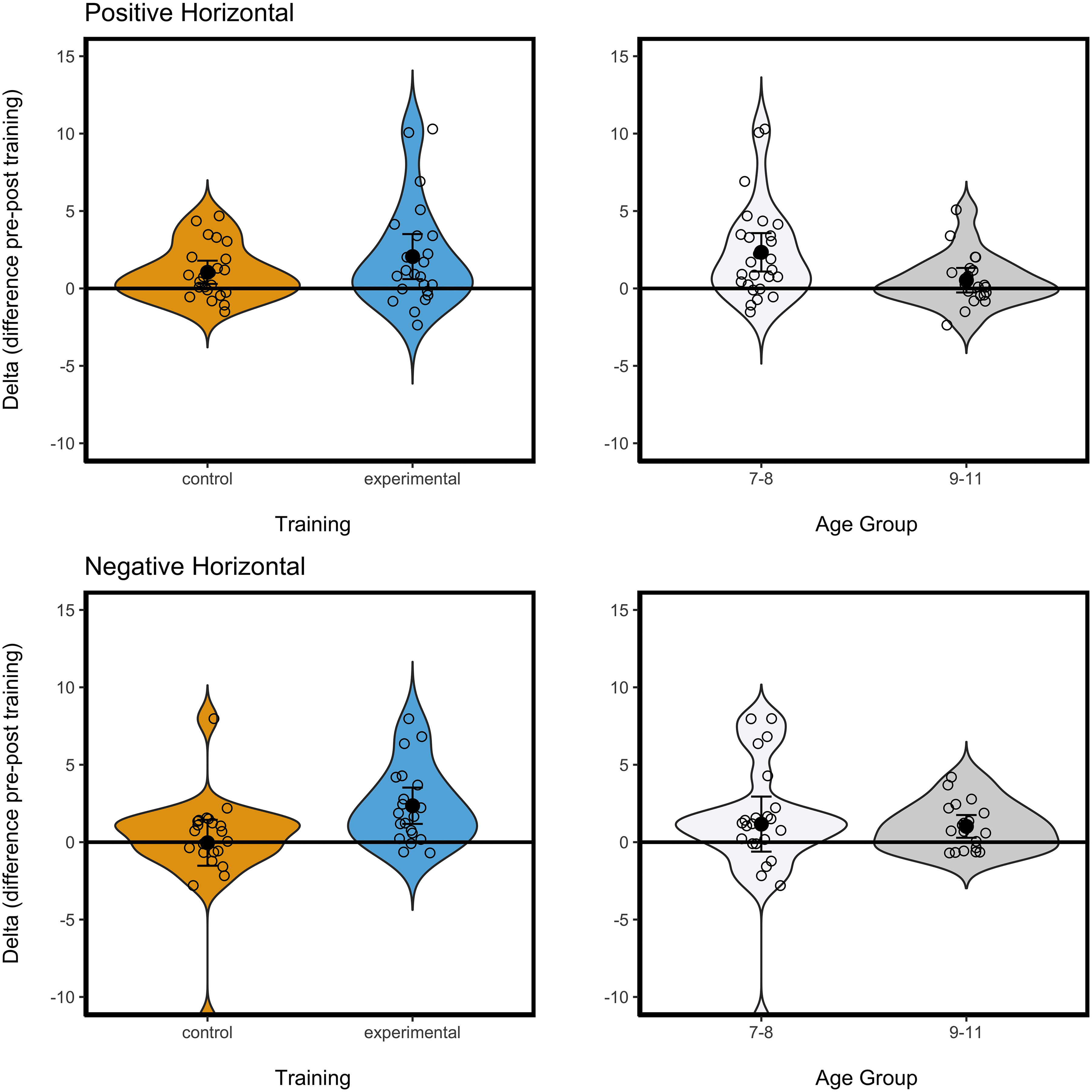
Left panel: Plots showing the difference between pre- and post-training for the positive and negative horizontal number lines for the control versus the experimental group. Individual subject points are plotted with mean delta represented by the black circle with 95 percent confidence intervals. The violin plot element shows the density and distribution of the data. Right panel: Plot showing the difference between pre- and post-training for the positive and negative vertical number line for the control versus the training (experimental) group and for both age groups.
Regarding the horizontal negative number line, although we observed an overall influence of the experienced training, there was no significant effect of age nor a significant interaction between the factors. Performance in the experimental group was significantly better after training compared with the control group (Table 1).
Results for the Between Factor ANOVA (ezANOVA package in R) for Each Condition of the Number Line Test
To test the effect of training, we took the group as a between factor with two levels (experimental vs. control). Considering that age might differentially influence the effect of the training, we took age as an additional between factor, expressed as participants' age groups with two levels (i.e., 7–8 and 9–11 years old).
Indicates p < 0.01; *indicates p < 0.05.
ANOVA, analysis of variance.
In the vertical positive number line (Fig. 3), we observed a significant main effect of group suggesting an influence of the type of training. There was no effect of age, but we did observe a significant interaction between the factors. Performance in the 7- to 8-year-old children assigned to the experimental group, but not 9–11 years old (p = 1), was better compared with the control group (p < 0.01). A significant negative correlation between age and delta in the Cartesian-Garden group-only (experimental: rho = −0.50, p = 0.01; control: rho = 0.21, p = 0.34) suggests greater improvements for the youngest participants belonging to this group.

Left panel: Plots showing the difference between pre- and post-training for the positive vertical and negative vertical number line for the control versus the training (experimental) group. Individual subject points are plotted with mean delta represented by the black circle with 95 percent confidence intervals. The violin plot element shows the distribution of the data. Right panel: Plot showing the difference between pre- and post-training for the positive and negative vertical number line for the control versus the training (experimental) group and for both age groups.
Performance in the vertical negative number line shows a significant effect of training group, no significant influence of the age and a significant interaction between the factors. Post hoc analysis shows an overall stronger improvement in the experimental group (p < 0.01). Seven- to eight-year-old children assigned to the experimental group showed a stronger benefit of training compared with the control group (all p's < 0.03).
Spatial skills
We did not observe a significant effect of the training, nor a significant effect of age on global accuracy (Fig. 4), but we did observe a trend for the interaction between age and the game used during the training (Table 2). Similarly, a correlation analysis did not show a significant correlation between age and overall improvement (rho = 0.14, p = 0.319) or for each of the training groups (experimental: rho = 0.26, p = 0.208; control: rho = 0.03, p = 0.868).
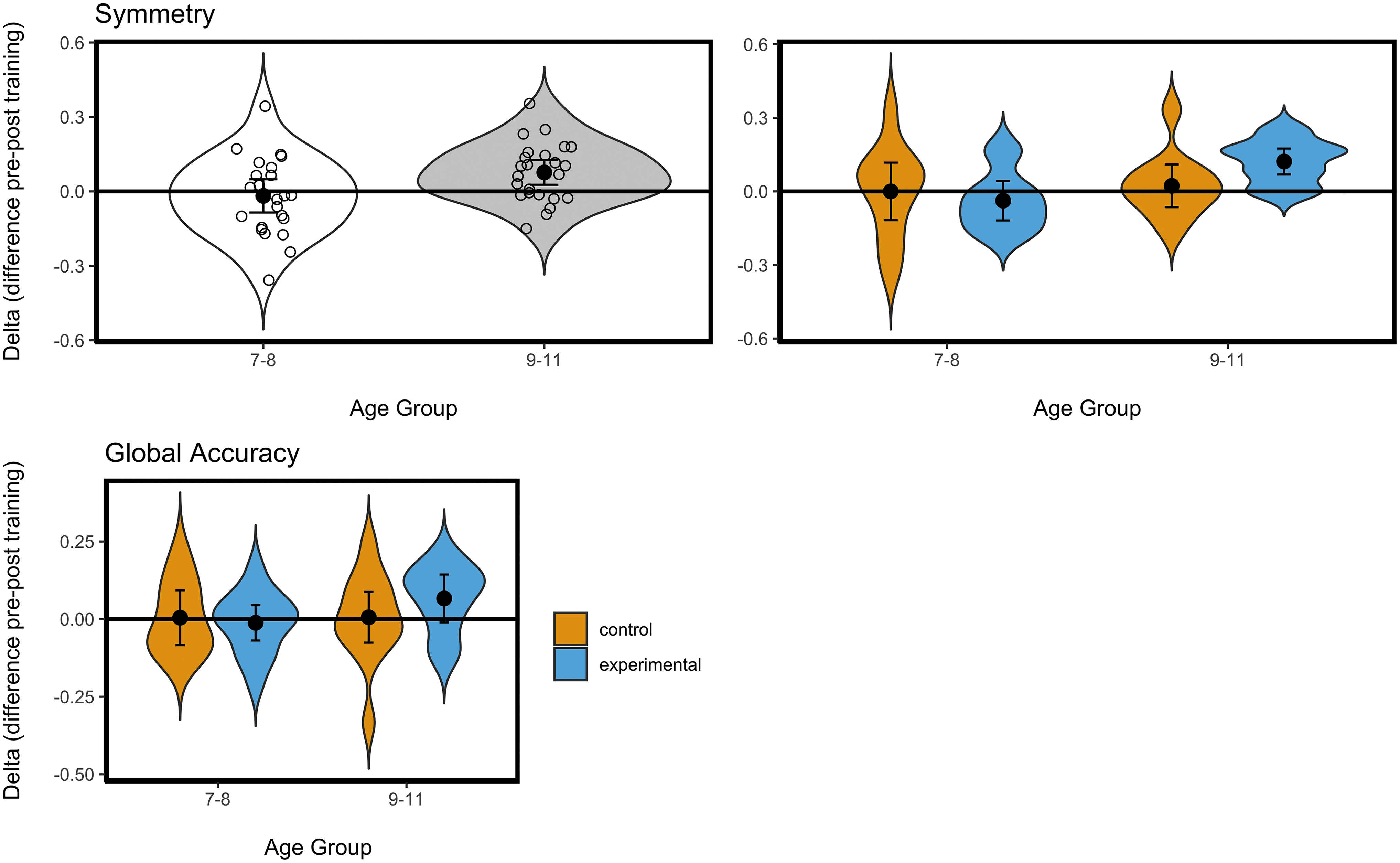
Top panel: Plots showing improvement in symmetry accuracy between pre- and post-training for the younger (7–8) and older age groups (9–11) and for the control versus the experimental group. Bottom panel: Global accuracy improvement scores for control and training group. Mean delta (improvement) is represented by the black circle with 95 percent confidence intervals. The violin plot element shows the distribution of the data.
Results for the Between Factor ANOVA (ezANOVA Package in R) for the Global and Symmetry Accuracy in the i-GEO Test
To test the effect of training, we took the group as a between factor with two levels (experimental vs. control). Considering that age might differentially influence the effect of the training, we took age as an additional between factor, expressed as participants' age groups with two levels (i.e., 7–8 and 9–11 years old).
Indicates p < 0.05; †indicates p≈0.05.
Since data for the geometry accuracy parameter failed the normality test we performed a nonparametric statistical test (ezPerm test with 1,000 permutations) showing no significant influence of training (p = 0.479), nor of age group (p = 0.895) and no evidence of an interaction between the factors (p = 0.364).
There was no significant effect of the experienced training on symmetry accuracy. However, we observed a significant effect of age but no interaction between the factors (Table 2). Post hoc t tests comparing the two age groups revealed a significant difference (p = 0.02), indicating that 9–11 years old improved >7–8 years old in the post-test, regardless of the experienced training. Considering the tendency observed for the interaction between age and training, exploratory analysis with two-sample t tests showed a significant difference between 7- to 8- and 9- to 11-year-old children within the experimental group (p = 0.03, Bonferroni corrected). Thus, the training with the Cartesian-Garden was more effective in 9–11 years old compared with 7–8 years old in understanding the concept of symmetry (Supplementary Materials).
Discussion
This study aimed at testing the efficacy of a VR-based game to improve numerical- and spatial cognition-related competencies in primary-school-aged children. Overall, we observed that only children performing the Cartesian-garden training improved their performance in the number line test and that improvements in spatial skills depend on the child's age. The observed age specificity in training-related improvements might depend on developmental differences in both the ability to take advantage of multisensory information to perform the training and the ability to process number and spatial information.
Developmental changes for multisensory integration take place as age increases, and especially around the age of 8 years. 45 Around this age, children make better use of proprioceptive and vestibular information to move through space14,46,47 as well as in the integration of such unisensory information with environmental landmarks. 12 Along these lines, training-related improvements for mapping numbers onto space in the most common orientation and order such as the positive horizontal number line seem to appear mostly in the youngest group of children. When faced with the most common representation of numbers, children benefitted from general improvements in spatial cognition skills given by the interaction with the VR environment, regardless of the type of training employed.
Similarly, we did not observe training-specific improvement in spatial skills. This result might be based on the properties of the Cartesian-Garden game. Specifically, while performing the game the user's focus is mostly on the association between number and space rather than shapes of symmetry. The latter may come as a second outcome of the performance (e.g., Symmetrical flowers activity, see Supplementary Materials). Considering the importance of a learner-centered education approach in the context of serious games, 38 spatial skills such as symmetry and shape recognition may need to be stressed more in the training phase to lead to actual improvements.
Considering the development of multisensory-based navigational skills, 44 the simple exploration of a VR environment that combines body movement with multisensory landmarks could foster the development of spatial cognition that would anyhow take place as children grow up. Supporting this view, previous studies have shown that the integration of additional sensory information such as a simple acoustic spatial cue for body movement 48 can improve spatial cognition in cases of individuals with blindness49,50 and unusual body-related spatial contexts such as spatial representations at the foot level. 51 In this sense, the use of a VR-based training that combines visual, haptic, auditory, and vestibular/proprioceptive sensory information could have fostered mapping numbers onto space for 7- to 8-year-old children who might be more susceptible to improvements in the context of spatial cognition.
A possible reason can be ascribed to their age being close to the developmental shifts observed in the literature. Nonetheless, the absence of an additional control group that performed a non-VR-based training leads us to handle such a conclusion with caution. Further studies could deepen the understanding of the multisensory mechanisms that underlie potential improvements in spatial cognition by additionally comparing VR-based training with traditional methods that convey the concept of Cartesian coordinates through unisensory rather than multisensory information.
Considering less common spatial mapping of numbers such as the vertical number line both positive and negative, we observe improvements specific for the experimental group, which is in keeping with recent findings that children demonstrate strong vertical number–space associations. 43 During school-based classroom experience, the symbolic representation of numbers are strengthened and refined. However, greater emphasis is given to a horizontal representation of numbers as in learning basic arithmetic such as additions and subtractions. 43 As such, an understanding of the less common and experienced vertical orientation could benefit from the VR-based exploration of spatial coordinates. The associations of spatial navigation and multisensory cues with the exploration of numbers along both horizontal and vertical continuums may improve understanding of less commonly explored spatial representations of numbers.
A similar interpretation can be valid for the selective improvement in the negative vertical number line for 7- to 8-year-old children, compared with older children. In this context, the ability to perform the number line task has been related to children's familiarity with numbers. 52 This aspect can have an even stronger influence in the processing and understanding of negative numbers, such numbers are usually taught to children >9 years old. Thus, the introduction to the negative coordinates in the “Cartesian Garden” training likely made younger children more competent in the ability to spatially represent negative quantities, with which they were previously not familiar.
Considering previous observations on the relationship between performance on the number line task and mathematical abilities 53 and on the effectiveness of immersive VR-based games in facilitating improvements and engagement,37,38 the Cartesian-Garden game or trainings alike may be good candidate activities to introduce such concepts to primary school children. Such an introduction may lead to enhance familiarity, and thus understanding, of concepts not yet faced in the classroom.
Footnotes
Acknowledgments
The digital environment (Cartesian-Garden) discussed in this study was developed by Mereille Pruner, Stéphane Laffargue, Ignition Factory. We thank Corinne Holmes and Stefania Saviotti for the assistance with data collection. We thank Stefano Piana, Paolo Alborno, and Simone Ghisio for the assistance with the setup. We also thank the principals of the CUS and Loretto schools in Dublin, Ireland and the principals of the Istituto Comprensivo Marassi in Genoa, Italy for their assistance and the children from these schools who participated in our research.
Authors' Contributions
Conceptualization, methodology, formal analysis, data curation, investigation, writing—original draft, writing—review and editing, and visualization by L.F.C. and S.C. Conceptualization, methodology, investigation, and writing—review and editing by G.C. Conceptualization, writing—review and editing, and supervision by F.N.N. and M.G.
Author Disclosure Statement
No competing financial interests exist.
Funding Information
This research was part of the weDRAW project, which received funding from the European Union's Horizon 2020 Research and Innovation Programme, Grant Agreement No. 732391.

References
Supplementary Material
Please find the following supplemental material available below.
For Open Access articles published under a Creative Commons License, all supplemental material carries the same license as the article it is associated with.
For non-Open Access articles published, all supplemental material carries a non-exclusive license, and permission requests for re-use of supplemental material or any part of supplemental material shall be sent directly to the copyright owner as specified in the copyright notice associated with the article.
