




Abstract
Despite growing interest in studying the metaverse, a theory-driven investigation into the factors that contribute to an enjoyable metaverse experience remains scarce. The current study examined the impacts of avatar identification, social engagement, and avatar customization on users' enjoyment of the metaverse based on the impression management theory. A total of 301 metaverse users were recruited for the study. The hypothesized models of mediation effect of social engagement and moderation effect of avatar customization were tested between avatar identification and enjoyment. Results indicated that social engagement mediates the relationship between avatar identification and enjoyment in metaverse participation. Furthermore, the significant moderation effect implied that the degree of avatar customization affected the relationship between avatar identification and enjoyment in the metaverse. Empirical evidence from this study contributes to theorizing the transformative role of social engagement and conditional effects based on avatar customization in shaping a positive emotion (i.e., enjoyment) from a metaverse experience. The findings allow researchers and practitioners to gain an initial understanding of the factors contributing to a favorable metaverse experience.
Introduction
The term metaverse generally refers to a three-dimensional virtual world shared by multiple users where various activities are facilitated by virtual reality (VR) technologies. 1 Immersive metaverse experiences have expanded beyond physical environments with limitless possibilities because of the rapid development of VR technologies. 1 Metaverse users can now enjoy a seamless and perpetual multiuser environment where technology allows them to dynamically interact with digital artifacts and other users in real time. 2
The metaverse is experiencing a higher-than-anticipated demand worldwide. One of the most popular online games featured with the metaverse, Roblox, garnered over 10 billion hours of playing time in the first quarter of 2021, and 42 million active users visited this platform on a daily basis. 3 With the immersive implications for transforming various aspects of our life, ranging from education 4 and health care 5 to entertainment, 6 the metaverse is now considered to be an increasingly important context in many fields of scientific research, including psychology and sociology. 7
In metaverse platforms, avatars are essential for users to form virtual identities and interact with other users. 8 As a result, users' identification with avatars is central to their metaverse experiences. The use of avatars in metaverse environments can improve user enjoyment not only because avatars serve as a means of self-presentation but also because psychological associations with avatars can improve user engagement. 9 Most importantly, to create an ideal virtual identity, users frequently customize their avatars to better represent themselves in the metaverse world. 10 In this regard, both identification with avatars and the degree of freedom to customize them are important research topics to understand.
While research related to the metaverse is increasing dramatically, there are still gaps and limitations that warrant inspection. Majority of the studies have been focused on defining the metaverse, 11 exploring its potential applications in various contexts, 12 and examining the technical opportunities and challenges. 13 Although these studies established a solid foundation for our basic understanding of the metaverse, research on metaverse experiences from users' perspectives and how such experiences might affect their psychological status remains unclear.
Research on users' experiences in virtual environments has largely been limited to online gaming environments. Previous studies, for instance, have focused on how users' identification with their avatars in virtual gaming environments can enhance gaming enjoyment 14 and in-game engagement. 15 Given the contextual differences between metaverse (i.e., multidimensional social space) and online gaming (i.e., single-player gaming environment), it is important to elucidate the underlying mechanisms of enjoyable experiences specifically in a metaverse. Whereas most studies considered avatar identification as the antecedent of users' enjoyment, the lingering questions of how and why users' identification relates to enjoyment have not been addressed.
The purpose of this study is, therefore, to examine a chain of effects from avatar identification to enjoyment of metaverse experiences. Based on the impression management theory, 16 we identified social engagement and avatar identification as two important factors influencing users' enjoyment of the metaverse and introduced a conditional factor of avatar customization—as to which extent users perceive their free will to customize or design their avatars 17 —to further specify the relationships between avatar identification, social engagement, and enjoyment.
We contend that our findings based on impression management theory provide a better explanation for metaverse user enjoyment and valuable insights into metaverse applications for scholars and practitioners.
Impression management theory
The impression management theory describes how individuals attempt to control others' perceptions of them. 16 Individuals can influence others to respond to them in desirable ways by creating and reinforcing particular impressions of their appearance, abilities, attitudes, motives, status, emotional reactions, and other attributes. Impression management is useful for eliciting a specific response from others and for more expressive reasons, such as developing a general presentation of oneself that will last beyond single encounters; both facilitate social contact and inspire in others an understanding of their identity consistent with the individual's own claimed or desired self-identity. 18
The impression management theory 16 views self-presentation not only as a means of influencing how one is treated by others but also as an essential aspect of social interaction. Impression management theory posits that the self is not a static entity residing within individuals, but a social process. While this theory originally explains real-life interpersonal relationships, it is efficient in better understanding computer-mediated social interactions such as those in the metaverse. 19
This study draws upon impression management theory to investigate how individuals create, identify with, and customize avatars in the metaverse, which can influence their social engagement, and how this series of processes can affect an individual's mental state.
Avatar identification and enjoyment
Avatar identification describes the level of attachment between a user and their avatar. 20 Numerous studies have applied this concept to understand how individuals perceive virtual environments.21,22 When an individual enters the metaverse, their avatar is the most effective vehicle through which they can convey their identity, including their appearance, abilities, attitudes, motives, status, emotional reactions, and other characteristics. 23 To this end, users often create idealized constructs of themselves in the metaverse, which often lead to a strong bond between users and their avatars. 24
The impression management theory suggests that individuals experience positive emotions such as satisfaction and pleasure if they can control the representation criteria by which others perceive and assess them. 16 This applies to the metaverse as well. For instance, when users represent and express themselves through identified avatars, the process of building that identity affirms the notion of their idealized self and as a result, they experience contentment, pleasure, and a range of other positive emotions. 24 This is because avatar identification can increase intrinsic motivation, fulfill some of an individual's needs, and therefore enhance enjoyment. 24
Trepte and Reinecke
14
asserted that avatar identification induces enjoyment when a user feels that their avatar creation has successfully achieved their personal goals. Other studies have also found a strong correlation between avatar identification and enjoyment in virtual settings.25,26 On this basis, we propose the following hypothesis:
Mediating role of social engagement
According to impression management theory, individuals seek to create a desirable self for social engagement with others and instill a desirable impression in others.16,18 While there are numerous definitions for social engagement, this study focuses on the community- and relationship-building aspects of social engagement through informal interaction within virtual settings. 27
When successful presentation of desirable impressions seems difficult, they become anxious and reluctant to engage in social interactions. 28 This tendency is also manifested in the virtual world. By refusing to disclose information (e.g., photos and videos) on social media, which is inconsistent with the ideals of a group that a user belongs to or wishes to join, the user renounces opportunities to interact with others. 29 It is therefore reasonable to assume that the more a user identifies with the avatar in the metaverse, the more actively they will participate in social interactions in that environment.
Social engagement is considered one of the most important aspects of an optimal experience in a computer-mediated environment. 30 For example, interaction with others within a computer-mediated environment such as expressions of encouragement, excitement, or frustration or the exchange of strategies and advice can be highly socially reinforcing. Previous studies found that such engagement in a virtual environment can exert substantial impacts on enjoyment as sequences of interactions compose a narrative that constructs a compelling virtual experience. 31
Chang
30
found that social interactions with other virtual characters in a virtual setting can greatly develop user enjoyment. We propose that participants who identify strongly with their avatar will become engaged in the social aspect of VR content so that this series of processes will ultimately enhance their enjoyment of the content. On this basis, we developed the following hypothesis:
Moderating role of virtual customization
Although avatar identification may increase enjoyment, not all VR users who have avatar identification homogeneously experience high degrees of enjoyment. Users might optimize their avatars based on their preferences or certain contexts to maximize their experiences and achieve greater enjoyment in virtual settings. 14 In particular, previous studies have suggested that avatar customization—that is, making design decisions about an avatar's characteristics 17 —can affect users' experiences by altering the capacity of users' self-presentation because the customization process affords users a flexible and easy self-presentation in digital environments. 32
While many studies have demonstrated a positive association between avatar identification and enjoyment, 14 researchers have argued that this relationship depends on the fit between a user and their avatar. Wang et al. 33 argued that an avatar used by an individual and its degree of identification can evoke negative emotions (e.g., dissatisfaction) when there is a discrepancy between the avatar and the individual's sense of self.
In this respect, Wang et al. 33 emphasized the importance of avatar customization in matching the avatar with a user's own image and identity in the relationship between avatar identification and enjoyment. From these arguments, we infer that the effect of avatar identification on enjoyment may depend on the ability to perform effective avatar customization. Thus, we posited that avatar customization can serve as a moderator in the relationship between avatar identification and enjoyment. As postulated in the hypotheses, the combined effects as a path model are presented (Fig. 1).
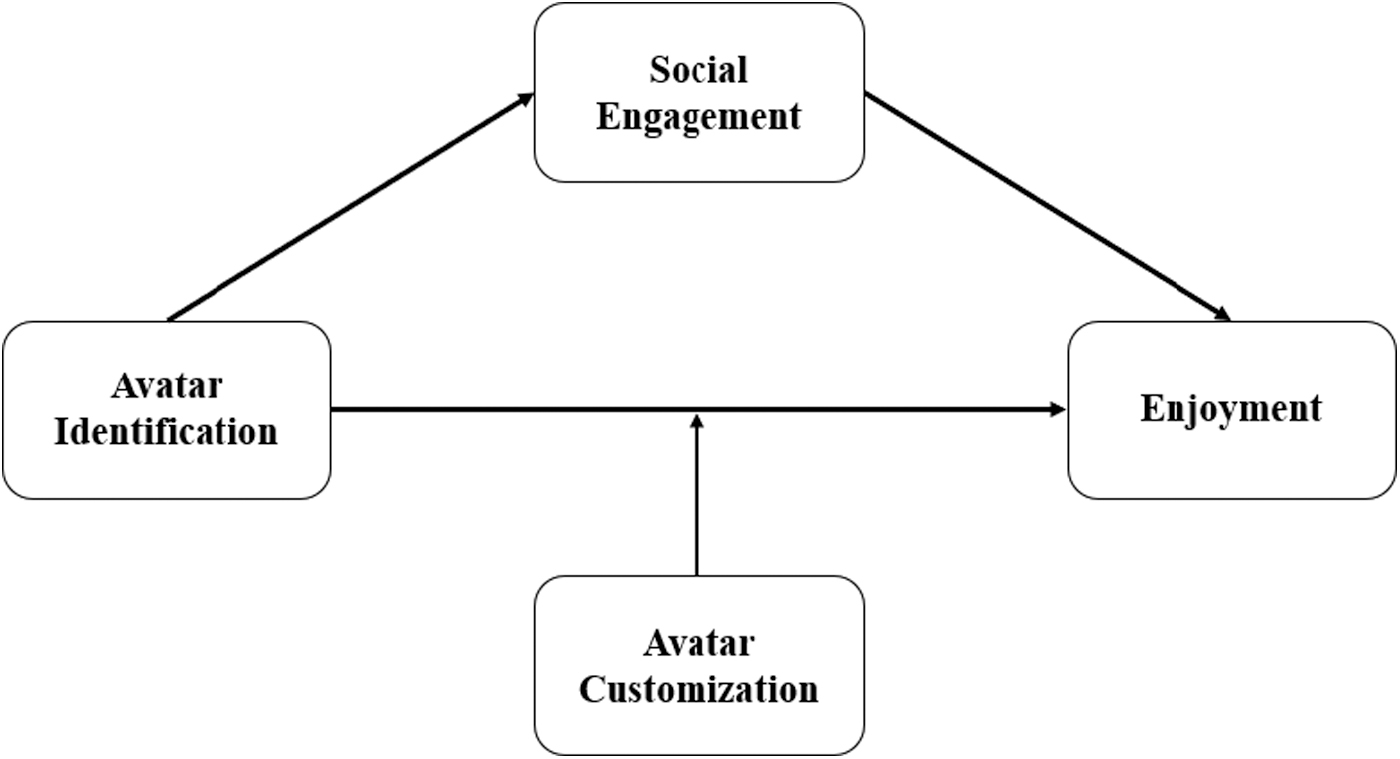
Conceptual Model.
Method
Participants
The survey was conducted using the Qualtrics platform and distributed through Amazon Mechanical Turk. A total of 301 VR users were recruited to participate in the survey after excluding 150 incomplete and nonhuman respondents. We used a series of screening questions to recruit participants who play games or spend leisure time in the metaverse. The screening questions thoroughly reviewed and identified whether participants had used avatars to represent themselves in the metaverse, whether they used a VR device that provided metaverse content, and which metaverse content they used.
VR users over the age of 18 who had already created metaverse avatars were invited to participate in the study. Participants included users of VRChat, Roblox, Meta Horizon Worlds, and Rec Room. Among the respondents, 164 (54.5%) were male and 137 (45.5%) were female. The average age of the participants was 32.04 years, ranging from 20 to 53 years, with a standard deviation (SD) of 8.64. Most respondents were white or Caucasian (n = 257, 85.4%) and had attained a bachelor's degree (n = 200, 66.4%).
The average time spent by the participants in the metaverse per week was 9.84, with an SD of 6.98. Each participant received $0.50 as compensation for their time and effort. The current study obtained approval from the institutional review board of the university with which the authors were affiliated.
Measures
We adopted well-established reliable and valid measures from previous studies, specifically the avatar identification scale used in the study by Van Looy et al., 20 including “My avatar is an extension of myself”; an avatar customization scale used in the study by Kim et al., 34 including “I was able to customize my avatar”; an enjoyment scale used in the study by Lee et al., 35 including “Metaverse makes my leisure time more fun”; and a social engagement scale used in the study by Yoshida et al., 27 including “I often interact with other metaverse users to discuss issues related to metaverse”.
The internal consistency of the scales was satisfactory, with alpha values greater than 0.70. 36 Specifically, Cronbach's alpha value for avatar identification was 0.950, avatar customization was 0.867, enjoyment was 0.771, and social engagement was 0.839. All items were measured on a 7-point Likert-type scale.
Data analysis
We performed a descriptive statistical analysis to obtain the relevant statistics from the collected data. In addition, we performed a correlation analysis to check whether there are multicollinearity issues. To test the hypotheses, we tested the mediated moderation model using conditional PROCESS modeling developed by Hayes. 37 Specifically, we used model 5 using 10,000 bootstrap iterations. The independent variable was avatar identification, the dependent variable was enjoyment, the mediator was social engagement, and the moderator was avatar customization.
Descriptive statistics
Following the recommendations by Hair et al., 38 the data demonstrated a reasonably normal distribution as the skewness and kurtosis values were within the recommended range, from −2 to +2 and from −7 to +7, respectively. To determine whether there are multicollinearity issues in our research model, we conducted a correlation analysis. As the range of the inner variance inflation factor value was from 1.045 to 2.488, below the threshold of 10, 38 we confirmed that there was no multicollinearity issue.
The correlation matrix and descriptive statistics of the items are reported in Table 1.
Descriptive Statistics (N = 301)
Note: **p < 0.01.
Results
All results are reported in Table 2. While the direct path between avatar identification and enjoyment was nonsignificant, rejecting hypothesis 1, both avatar identification and users' social engagement had a significant and positive association with enjoyment. The indirect effect of avatar identification on enjoyment through social engagement was significant, supporting hypothesis 2. The interaction effects of avatar customization on the direct path between avatar identification and enjoyment were also significant, supporting hypothesis 3.
Tests of Direct and Indirect Effects (N = 301)
Note: ***p < 0.001; avatar customization level: low = 2.5 (16th percentile), median = 3.0 (50th percentile), and high = 4.0 (84th percentile).
CI, 95% confidence interval; SE, standard error; LL, lower limit; UL, upper limit.
The conditional interaction effects are visualized in Figure 2. The moderating effect of avatar customization revealed that the effect of avatar identification on enjoyment was stronger when users reported a higher level of avatar customization.

Moderating Effect of Avatar Customization. Dotted line represents a high avatar customization level at the 84th percentile. Plain line represents a median avatar customization level at the 50th percentile. Dash-dotted line represents a low avatar customization level at the 16th percentile.
Discussion
Using impression management theory, the current study shed light on the underlying psychological processes explaining the impact of avatar identification on enjoyment in the metaverse. More specifically, we examined how users' avatar identification, social engagement, and avatar customization influence users' enjoyment in the metaverse. In the following sections, we discuss the results regarding the impression management theory in detail.
According to the results of testing hypothesis 1, the direct effect of avatar identification on enjoyment was nonsignificant, contrary to findings of most previous studies. For example, Decock et al. 26 argued that identification with a game character in a video game setting has a positive effect on perceived enjoyment of gameplay. Hefner et al. 25 argued that identification with an avatar in a virtual environment positively affected pleasure. While impression management theory holds that creating an avatar identity can satisfy individual needs and lead to enjoyment, our findings on the direct and total effects of avatar identification on enjoyment suggest that other factors must be considered. This brings us to our discussion of the mediation (H2) and moderation (H3) effects examined in our model.
The results for hypothesis 2 indicated that social engagement mediated the effect of avatar identification on enjoyment. That is, our findings indicate that an individual must interact with other users to feel enjoyment in a metaverse setting, supporting the impression management theory that social interaction is necessary for individuals to present themselves and make an impression on others.
These findings can help explain the rejection of hypothesis 1 as the direct effect was nonsignificant in spite of the significant total effect, including the mediation. Specifically, unlike the online game setting in which avatar identification and enjoyment had significant association,14,39 the interaction with other users in the metaverse represents a key factor contributing to enjoyment.
Through the lens of impression management theory, the full mediation effect suggests that users in the metaverse are more likely to be open and eager to engage in social interaction when their identification with the avatar is high. This increased social engagement helps to induce an increased level of enjoyment in using the metaverse. Compared with avatar identification, social engagement might be a more critical factor in developing users' enjoyment in the metaverse setting.
In other words, whether users experience social engagement in virtual settings can be critical in developing their positive consumption outcome. Previous studies of online gaming have proposed a similar logic, suggesting a potential causal chain between users' avatars, enhanced engagement, and increased positive emotions (e.g., enjoyment). 40
Interestingly, the results identified a significant moderation effect of avatar customization on the relationship between avatar identification and enjoyment, supporting hypothesis 3. The impact of avatar identification on users' enjoyment increases with the perception that they can freely customize the avatar. From this result, we infer that the more users identify with their avatar, the stronger their attachment and the more they want to decorate and nurture them esthetically. This is because impression management theory suggests that when people's desire to control the image that they show others is satisfied through such a process, they experience a positive emotional state. 24
Consistent with the reason for the rejection of hypothesis 1, our findings suggest that avatar customization in the metaverse is an important factor in understanding the mechanism of the relationship between avatar identification and enjoyment. While prior studies have regarded avatar customization primarily as an antecedent to avatar identification, our results highlight the important role of avatar customization in the effect of avatar identification on enjoyment.
As one of the initial attempts, the current study applied the impression management theory in a metaverse context to illustrate the underlying mechanisms that influence metaverse users' experiences. Different from general VR participation (e.g., video games), in which avatar identification plays an important role in allowing users to experience enjoyment, 31 we found that social interaction is the key factor transporting users' avatar identification to the increased enjoyment in metaverse participation.
This confirmed the applicability of impression management theory in the metaverse context with emphasis on social engagement. Most importantly, the current study identified a boundary condition on the effect of avatar identification on enjoyment by incorporating avatar customization. That is, whether users can freely adjust their avatar to fit their identity is salient in strengthening the association between avatar identification and enjoyment in the metaverse.
This study also offers important practical implications for metaverse practitioners by demonstrating the critical roles of social engagement and avatar customization in developing users' avatar identification and increased enjoyment in the metaverse. Practitioners should provide more contexts and opportunities for social interaction and more diversified options for users to customize their avatar to strengthen their experience of the metaverse.
Despite the meaningful findings, our work is not without its limits. For example, this study mainly considered subjective factors such as avatar identification and social engagement, which may only partially determine users' overall enjoyment in the metaverse. In the metaverse, different avatar identities can elicit different cognitive and emotional responses. Researchers should take into account constructs that may affect avatar identification or customization.
To this end, exploratory qualitative research could be conducted to identify subjective experiences that were not addressed in this study. Furthermore, the interactive environmental settings of a metaverse that form subjective experiences should help to spur increased interest among researchers. Future studies should consider objective factors such as metaverse background design to enhance our holistic understanding of what makes the metaverse enjoyable.
The current study only considered the effect of customization on the path between avatar identification and enjoyment. However, according to Sundar's agency model of avatar customization, avatar customization may also affect user's identification with the avatar, social engagement, and enjoyment of the metaverse experience in a chain of effects. 41 This could serve as an alternative explanation to our model examining avatar customization as a moderator.
Avatar customization was negatively associated with other variables in our data from VRChat, Roblox, Meta Horizon Worlds, and Rec Room users. However, in a game genre such as massively multiplayer online role-playing games (MMORPGs), virtual customization can be a factor leading to avatar identification. 42 In MMORPGs, customization is accomplished through functional items that influence avatar abilities.
On the other hand, there are games where the tier or guild ranking is a more important factor causing users to identify with game characters, and the customization function (e.g., nonfunctional skin) is relatively less important. Therefore, future studies should also consider the serial mediation effect using avatar customization as the focal independent variable or moderated mediation effect of avatar customization on the mediation effect of social engagement between avatar identification and enjoyment.
While we focused on positive aspects of metaverse experiences, previous research has pinpointed major issues related to data security, ethics, safety, regulation, and possible deleterious mental health impacts on vulnerable individuals. 43 For instance, impolite and unsolicited behaviors are being reported more frequently by users in various parts of the metaverse, including the sexualization of avatar encounters, user harassment, unregulated gambling, and data exploitation. 44 Further research on negative aspects of the metaverse will serve to optimize users' experiences.
Conclusions
Driven by impression management theory, this study empirically presented the underlying mechanisms influencing users' enjoyment in the context of the metaverse. We found that the link between avatar identification and social engagement is important in developing users' enjoyment in the metaverse. In contrast to the majority of studies in general VR settings (e.g., online gaming), social interaction is a crucial bridge to transport users' identification with the avatar to the increased enjoyment when participating in the metaverse.
It is also notable that the significant moderation effect of avatar customization further specified the association between avatar identification and enjoyment, where the higher level of avatar customization perceived by users led to a stronger relationship between avatar identification and enjoyment. These findings contribute to our understanding of enjoyable metaverse participation and highlight the salient factors and links between avatar identification, avatar customization, and social engagement in metaverse settings, specifically for metaverse practitioners.
The metaverse is a novel platform potentially critical for deciphering user behavior and consumer culture based on new metrics. 45 To enhance the effectiveness of consumer arguments in the metaverse, researchers should consider using modern technologies such as virtual and augmented reality, particularly in regard to the social aspect of the metaverse. 46 Inclusion of such technologies can provide valuable insights and improve consumer engagement in the metaverse, advancing the understanding and application of metaverse marketing in consumer research and practice. 47
Footnotes
Authors' Contributions
All authors listed have made a substantial, direct, and intellectual contribution to the work and approved it for publication. This study has four authors. The first author was responsible for study conceptualization, data collection, and report writing. The second and third authors were responsible for study conceptualization, data collection, data analysis, and report writing. The fourth author was responsible for study conceptualization and report writing.
Author Disclosure Statement
The authors declare that the research was conducted in the absence of any commercial or financial relationships that could be construed as potential conflicts of interest.
Funding Information
No funding was received to assist with preparation of the article.