




Abstract
Deception in online advertising is not uncommon. An example of deceptive advertising, sometimes used by online retailers to drive traffic to their Web sites, is omission in discount advertising. It is a tactic in which an important condition for a discount on a product or service is (purposefully) excluded when advertised online—only to reveal the initially excluded condition to consumers once they have reached the retailer's Web site. The purpose of this study was to examine how such omission in discount advertising influences purchase intention, and to what extent this effect is mediated by perceived retailer ethics and attitude toward the online retailer. To test our hypotheses, we conducted an experiment (N = 117) with a single-factor (omission in discount advertising: omission vs. control) between-subjects design. Perceived retailer ethics and attitude toward the online retailer were included as serial mediators. The results showed that omission in discount advertising negatively affected purchase intention. Furthermore, this effect was mediated by perceived retailer ethics and attitude toward the retailer, whereby participants who were exposed to the omission advertisement judged the retailer's ethics more negatively and consequently had a more negative attitude toward the retailer. This, indirectly, decreased purchase intention. This study provides evidence for a novel and parsimonious framework explaining the effect of omission in discount advertising on purchase intention, through perceived retailer ethics and attitude toward the online retailer, which is relevant for both theory and practice.
Introduction
Whether it is Singles Day, Black Friday, or just another Monday, online retailers compete with one another year round in the roughly 5 trillion-dollar global e-commerce market.1–3 They aim to attract online consumers to their platforms, often by offering discounts through social media advertising or search engine advertising. And even though most of these advertisements follow regional advertising codes, inaccurate and misleading online advertising is not uncommon. In 2019 for example, ∼60,000 complaints were made by consumers and interest groups across Europe, relating to >35,000 different advertisements— 4 many of which, consumers alleged, were misleading.
In this case, misleading advertising is defined as an advertising claim that “contain[s] any statement, or audio or visual treatment which, directly or by implication, omission, ambiguity or exaggeration, is likely to mislead a member of the general public.” 4
In light of this, scientists have recently called for more research into specific forms of deceptive advertising.5,6 This type of research is crucial because it can impact public policy and legal decisions.5,7 In addition, neuroscience research 8 has shown that different types of deceptive claims elicit different levels of brain activity, further emphasizing the importance of studying various forms of deception in advertising.
One such form of deceptive advertising, often used by online retailers, is omission in discount advertising. This is a tactic in which an important condition for a discount is (purposefully) excluded when advertising the discount online—only to reveal the condition once a consumer has reached the retailer's Web site.
For example, an online retailer might advertise on social media that “all items are 25% off.” However, once a consumer interacts with the ad and ends up on the retailer's Web site, it is revealed to them that there is an additional condition to the discount, and that the discount, for example, only applies “if more than three items are bought,” “on in-store purchases,” or “on select styles.” The goal of such an advertising tactic is to drive online traffic to a retailer's Web site. This type of advertising is considered unethical and unfair toward consumers, because it is deceptive. 7
Although there is much research on deceptive advertising effects in general,7,9–15 little research has been conducted on omission in online discount advertising. This is problematic because even though many people believe online deception is widespread, 16 research has shown that consumers are particularly likely to be oblivious to deceptive advertising practices when confronted with them online.10,17
The aim of this article is, therefore, to examine how omission in online discount advertising affects purchase intention and to what extent this effect can be explained by consumers' perceived retailer ethics and attitude toward the online retailer. By adopting an experimental research design, we propose and test a novel framework for explaining the effect of omission of details in discount advertising on purchase intention.
The findings of this study are also valuable for advertising practitioners, because prior research has shown that deceptive advertising, like omission in discount advertising, can backfire. 13 Consumers might feel as if they are being misguided or tricked by the online retailer, which ultimately could decrease consumers' attitude toward the online retailer and their willingness to continue buying on these platforms.
Theoretical framework
General theories of marketing ethics suggest that (ethical) decision making is initiated when observing an ethical problem.18–20 In the case of omission in discount advertising, consumers are expected to notice, after interacting with the advertisement, that the advertisement excluded crucial information—or, in other words, that the advertisement was deceptive. Feeling deceived, in turn, has been associated with negative consumer responses.13,21
Direct effects of omission in discount advertising
Omission in discount advertising is believed to have a negative direct effect on purchase intention. For example, in line with reactance theory22,23 and the change of meaning principle, 24 omission in advertising is expected to have an overall negative effect on purchase intention. This expectation is supported by empirical research, which shows direct negative relationships between consumers' perceived deception of advertising messages and both purchase intention 13 and consumer satisfaction. 12
Indirect effect of omission in discount advertising
To explain the effect of omission in discount advertising on purchase intention, we propose perceived retailer ethics and attitude toward the online retailer as serial mediators. When consumers realize that they were exposed to incomplete information, they are expected to interpret this as unethical behavior. 25 The overall ethical judgment of the consumer is expected to reflect negatively on the retailer, leading to more negative perceived retailer ethics. 17 Notably, this two-stage correction process—from recognition of deception to correction—is similar to how disclosures can lead to a correction of invalid inferences.21,26,27
Regarding the relationship between perceived retailer ethics and purchase intention, empirical evidence suggests that this is likely mediated by attitude toward the online retailer. For example, in a study among online shoppers, 17 perceived ethics of an online retailer was only found to indirectly (though not directly) affect purchase intention through attitude toward the online retailer. Notably, this is also supported by the dual mediation hypothesis 28 and prior research into the relationship between attitudes and intention.29–31 When consumers perceive a particular retailer as unethical, this is expected to lead to a more negative evaluation of the retailer and ultimately decreases the likelihood they will purchase products from the retailer.
A conceptual model, summarizing our hypotheses, is shown in Figure 1.
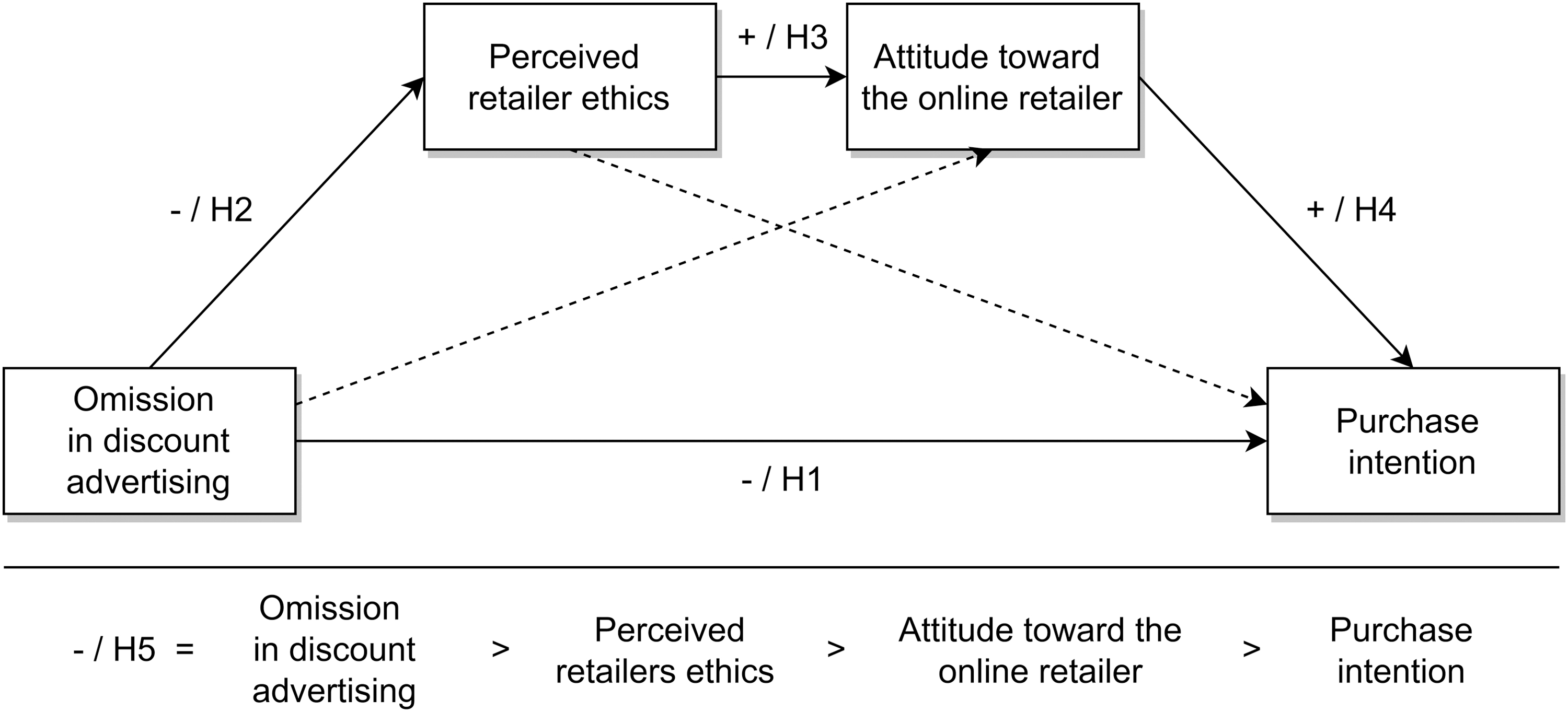
Hypothesized path model for the effect of omission in discount advertising on purchase intention through perceived retailer ethics and attitude toward the online retailer.
Materials and Methods
Participants and procedure
To test the hypotheses, we conducted an online experiment with a single-factor (omission in discount advertising: omission vs. control) between-subjects design. A total of 121 online consumers from western Europe were recruited through a convenience sampling procedure, of which 117 (Mage = 29.56, SDage = 13.53, female = 66.7 percent) completed the study. This study has been conducted in compliance with the ethical regulations of the Department of Communication, University of Amsterdam.
Upon agreeing to participate in the study, participants were exposed to an online advertisement and were asked to imagine that they had come across this advertisement while browsing the Internet. Afterward, participants were randomly assigned to either the omission (n = 59) or control condition (n = 58) and led to one of two respective (mock) retailer Web sites. After exposure to the Web site, participants were asked several questions measuring their perceived retailer ethics, attitude toward the Web site, and purchase intention.
Stimulus material
The stimulus materials of this study consisted of (a) an online advertisement from an online retailer and (b) a mock Web site of the online retailer. The online advertisement was identical for all participants, and indicated that “all items are 25% off.” The Web site differed between the experimental (omission) and control conditions. In the omission condition, extra conditional discount information was included on the Web site (“all items are 25% off, starting from the 4th purchase”).
In the control condition, the discount information on the Web site matched the discount information in the online advertisement (“all items are 25% off”). Besides the extra conditional discount information, both mock Web sites were identical in terms of design and products. The stimulus materials created for this study were inspired by real-world examples of online advertisements (e.g., Zalando, MediaMarkt, and Hollister Co.) using omission tactics and were in line with discount pricing research. 32
Measures
Purchase intention
Purchase intention was measured on a four-item (e.g., “I intend to purchase on this website in the near future”) 7-point Likert scale, ranging from 1 (strongly disagree) to 7 (strongly agree).17,33,34 An index scale was created (M = 2.99, SD = 1.48), which proved both reliable (Cronbach's α = 0.95) and valid (eigenvalue = 3.48, R2 = 0.87).
Perceived retailer ethics
Perceived retailer ethics was measured on a three-item (e.g., “In general, the online retailer is fair”) 5-point Likert scale,12,17,35 ranging from 1 (strongly disagree) to 5 (strongly agree). An index scale was created (M = 2.74, SD = 0.91), which proved both reliable (Cronbach's α = 0.89) and valid (EV = 2.46, R2 = 0.82).
Attitude toward the online retailer
Attitude toward the online retailer was measured on a six-item (e.g., “I am satisfied with the service provided by this website”) 7-point Likert scale, ranging from 1 (strongly disagree) to 7 (strongly agree).17,36,37 An index scale was created (M = 2.97, SD = 1.17), which proved both reliable (Cronbach's α = 0.88) and valid (EV = 3.82, R2 = 0.64).
Results
Hypothesis testing
To test our hypotheses, we used a process macro to estimate a serial mediation model (Model 6) predicting purchase intention.38,39 Omission in discount advertising served as the independent variable, and perceived retailer ethics and attitude toward the online retailer served as (serial) mediators. In line with previous consumer research, 40 the model was specified with 95% confidence intervals (CIs) (10,000 bootstrap samples) and heteroscedasticity-consistent standard errors and covariance matrix estimators (HC3).41,42 An overview of the results is given in Table 1, for the complete path model with standardized coefficients, see Fig. 2.

Serial mediation path model for the effects of omission in discount advertising on purchase intention through perceived retailer ethics and attitude toward the online retailer. Regression coefficients are standardized. Coefficients in bold are significant at α = 0.05.
Regression Analysis for the Serial Mediation Model of Omission in Discount Advertising on Purchase Intention Through Perceived Retailer Ethics and Attitude Toward the Online Retailer
Regression coefficients in bold are significant at α = 0.05.
CI, confidence interval; SE, standard error.
Furthermore, to facilitate the interpretation of the mediation model, means and standard deviations of the dependent and mediator variables (per experimental condition) are given in Table 2.
Descriptive Statistics for Dependent and Mediator Variables Per Experimental Condition
SD, standard deviation.
Direct effects
As given in Table 1, the main effects of omission in discount advertising on purchase intention (p = 0.046) and perceived retailer ethics (p = 0.005) were significant. Both purchase intention and perceived retailer ethics were lower for people who were exposed to the omission condition (compared with the control condition). This supports H1 and H2.
Furthermore, the results given in Table 1 show that both the effect of perceived retailer ethics on consumers' attitudes toward the online retailer and its subsequent effect on purchase intention (p < 0.001) were significant. People with higher (compared with lower) perceived retailer ethics held more positive attitudes toward the online retailer and people with positive attitudes toward the online retailer were more inclined to purchase from the Web site. These findings support H3 and H4.
Indirect effect
Finally, as given in Table 1, we also found a significant indirect effect of omission in discount advertising on purchase intention, explained through perceived retailer ethics and attitude toward the online retailer (b* = −0.16, SE = 0.06, 95% CI [−0.29 to −0.05]). This supports H5.
Discussion
The purpose of this study was to examine how omission in online discount advertising affects purchase intention and to what extent this effect can be explained by consumers' perceived retailer ethics and attitude toward the online retailer. Based on the current findings, two main conclusions can be drawn: (a) omission in discount advertising decreases consumers' purchase intentions and (b) the effect of omission in discount advertising on purchase intention is explained by a decrease in perceived retailer ethics and subsequently in attitude toward the online retailer.
Effects of omission in discount advertising
Overall, the results showed that omission in discount advertising decreases people's intention to purchase a product. These findings corroborate previous study, 13 which showed a negative link between consumers' perceived deception in an advertisement and purchase intention. The findings are in line with the “change of meaning principle,” which suggests that people's perception of (and response to) a message may be modified once they notice that a message was used to persuade them.23,24
In the context of this study, this means that consumers' perception of the deceptive discount is expected to have changed once the conditional information for the discount (i.e., the discount only applied after purchasing four items) was revealed to them. This, ultimately, also altered the consumers' response—their intention to buy from the platform.
The results also showed that the effect of deceptive discount advertising on purchase intention is explained by a decrease in perceived retailer ethics and attitude toward the online retailer. In line with our expectations, the exclusion of critical discount information from the initial advertising message is perceived as being deceptive, and, as a consequence, the retailer considered less ethical. Truthfulness (e.g., giving complete information), as one of the four essential ethical marketing values (in addition to well-being, justice, and freedom), is known to drive consumer's perceived retailer ethics. 25 The relationship between retailer ethics and attitude also corroborates previous research, 17 and is in line with functional attitude theory,43,44 which suggests that attitude formation is shaped by human desires (e.g., honesty and fairness).
Limitations and suggestions for future research
With this study, we made several contributions to the understanding of how deceptive discount advertising works in an online context. However, certain limitations of the design of the study should be taken into account. First, the fact that the sample consisted of western European consumers could be considered a limitation. After all, culture has a big impact on our beliefs, and on what we consider to be ethical. 45 Therefore, applying the findings to, for example, an African, American, or Asian context becomes more difficult and less reliable. Therefore, future research should investigate whether these effects remain stable or, more interestingly, vary throughout different cultural contexts by replicating the study.
Also, in this study we only focused on the omission of a single type of condition (i.e., the discount only applies when at least four items are bought). It is conceivable that the omission of one type of information might be considered more (less) ethical, and thus have stronger (weaker) effects, than the omission of another type of information. In general, any type of omission is expected to harm perceived retailer ethics.4,18 However, the exclusion of a discount condition related to the number of products that should be bought to receive a discount (like the example used in this study) is arguably more invasive than the exclusion of a condition related to the product category (e.g., only applies to select styles).
In particular, because the former condition forces consumers to engage in a particular behavior (e.g., purchasing more products) to receive the discount, whereas the latter merely limits their choice. 22 Future studies should, therefore, explore the potentially moderating role of the type of information that is excluded.
In addition to different types of omission, future research should also focus on comparing the underlying mechanisms of various deceptive online advertising practices, such as dazzling, decoying, and masking, on consumer behavior. 46 With this suggestion, we echo the recent calls for research into various forms of deceptive advertising practices.5,6 Building on previous research, 8 future studies are also invited to consider adopting a neuroscientific approach. 47
Implications for theory and practice
For theory, this study provides evidence for the novel serial mediation model of omission in discount advertising on purchase intention, through perceived retailer ethics and attitude toward the online retailer. Where previous marketing ethics frameworks18,20 have been criticized for being overly complex, 19 the current model offers a parsimonious framework explaining the workings of omission in discount advertising—integrating empirical findings from various studies.13,17,28–30,35 Furthermore, where many of the previous studies offered correlational evidence for the effects of advertising deception,10,17,30 the experimental nature of this study offers insight into the causal pathways of deceptive advertising. 48
For practice, the results of this study demonstrate the negative consequences of engaging in deceptive discount advertising. Deceptive advertising claims do not only lead to negative judgments and evaluations of the online retailer, but also decrease purchase intentions among consumers.
Furthermore, the results emphasize the importance of completeness in online discount advertising. This study shows that omitting (or cutting) words that clarify the conditions of a particular discount from advertising copy could backfire and ultimately lead to negative consumer responses (i.e., judgments, evaluations, and purchase intentions). This is especially relevant in the context of creating ad copy. This could be situations in which practitioners are inclined to leave out words from advertising copy, not to purposely deceive consumers, but because of character constraints in online ad copy (e.g., 30 characters per headline). 49
Another context in which such an (undesired) situation can arise is when artificial intelligence (trained to drive traffic) is used to dynamically create ad copy. Ads with complete discount information are in this situation more likely to be classified as “less effective” than ads with incomplete discount information, because the incomplete discount is a relatively better deal and will thus likely drive more Web site traffic. 50 Taking into account the findings of this study, to avoid any negative consumer responses, practitioners are advised to closely monitor (and if necessary manually overwrite) dynamically created ad copy to assure that discount conditions between the ad and Web site align.
Footnotes
Author Disclosure Statement
No competing financial interests exist.
Funding Information
No funding was received for this article.