




Abstract
Despite the proven safety and clinical efficacy of the Measles vaccine, many countries are seeing new heights of vaccine hesitancy or refusal, and are experiencing a resurgence of measles infections as a consequence. With the use of novel machine learning tools, we investigated the prevailing negative sentiments related to Measles vaccination through an analysis of public Twitter posts over a 5-year period. We extracted original tweets using the search terms related to “measles” and “vaccine,” and posted in English from January 1, 2017, to December 15, 2022. Of these, 155,363 tweets were identified to be negative sentiment tweets from unique individuals, through the use of Bidirectional Encoder Representations from Transformers (BERT) Named Entity Recognition and SieBERT, a pretrained sentiment in English analysis model. This was followed by topic modeling and qualitative thematic analysis performed inductively by the study investigators. A total of 11 topics were generated after applying BERTopic. To facilitate a global discussion of results, the topics were grouped into four different themes through iterative thematic analysis. These include (a) the rejection of “anti-vaxxers” or antivaccine sentiments, (b) misbeliefs and misinformation regarding Measles vaccination, (c) negative transference due to COVID-19 related policies, and (d) public reactions to contemporary Measles outbreaks. Theme 1 highlights that the current public discourse may further alienate those who are vaccine hesitant because of the disparaging language often used, while Themes 2 and 3 highlight the typology of misperceptions and misinformation underlying the negative sentiments related to Measles vaccination and the psychological tendency of disconfirmation bias. Nonetheless, the analysis was based solely on Twitter and only tweets in English were included; hence, the findings may not necessarily generalize to non-Western communities. It is important to further understand the thinking and feeling of those who are vaccine hesitant to address the issues at hand.
Introduction
The individual and public health benefits of routine childhood immunizations, including Measles, cannot be overemphasized. According to the Centres for Disease Control and Prevention (CDC), more than four million deaths worldwide are prevented by childhood vaccination every year. 1 Mandatory childhood vaccination is gradually becoming a policy intervention to address low vaccination rates. Mandates require vaccination for a certain purpose, such as school entry for children. 2
Measles is an infectious disease, caused by a single-stranded ribonucleic acid virus, from the paramyxovirus family. Once contracted, it has an average incubation period of 8–11 days, with prodromal symptoms such as fever, cough, and conjunctivitis. As the disease develops, patients experience a second increase of temperature and rash, and a measles-induced transient immunodeficiency state, which could result in severe and life-threatening complications such as encephalitis and pneumonia. 3
The United States CDC outlined the framework to eradicate measles when the first Measles vaccine was licensed in 1963. Smallpox, polio, and diphtheria had almost achieved eradication through vaccination in the United States by then. Measles was deemed as an easier target to achieve; it had no chronic carriers, caused no inapparent infections, and had no nonhuman reservoirs. 4 The Measles vaccine has made this virulent virus preventable, and is commonly administered with the Rubella and Mumps vaccine, forming the Measles, Mumps, and Rubella (MMR) vaccine that we are familiar with. The vaccine consists of two doses, with the first dose at 12–15 months of age and second dose at 4 through 6 years of age. Although measles was declared eradicated by the World Health Organization (WHO) in 2000, there are still limited outbreaks today due to Measles vaccine refusal.
At present, the situation appears to have worsened, with many countries seeing new heights of vaccine hesitancy or refusal and a resurgence of measles. For example, in September 2019, the United States was at risk of losing measles elimination status due to several large-scale outbreaks resulting in more than 1,200 confirmed cases across 31 states. 5 Despite having a readily available, safe and effective vaccine, measles remains a cause for major morbidity and mortality in the population, especially among unvaccinated young children. In 2021 alone, measles infected an estimated 9 million people worldwide.
Despite extensive research and reassuring public safety data, there appears to be significant hesitancy or refusal among certain groups and communities to receiving the Measles vaccine. 6 “Vaccine hesitancy,” a term defined by WHO's Strategic Advisory Group of Experts (SAGE) on Immunization, refers to a delay in acceptance or refusal of vaccines, despite the availability of vaccination services. 7 Vaccine hesitancy is a major public health issue today, and several studies that examined the public sentiments surrounding Coronavirus Disease 2019 (COVID-19) vaccination have also found increased prevalence of antivaccination sentiments among the general population,8,9 and hints of possible negative spillover effects to influenza and Measles immunizations vis-à-vis the ongoing COVID-19 pandemic.10,11
In a recent joint press release by WHO and the US CDC, urgent concern was raised regarding the declining Measles vaccination rate in the past 2 years, with a record high of ∼40 million children missing a Measles vaccine dose in 2021 alone. 12 Spikes in vaccine hesitancy often coincide with new information, policies, or newly reported vaccine risks, and such information has been made more pertinent due to the rise in social media and other media platforms. 13 At the same time, concern exists pertaining to the spread of misinformation over social media and its impact on behaviors.
Powered by the modernization of the digital world, social media platforms have been increasingly used to pinpoint and circulate health information to promote public health. 13 Even though Twitter has allowed communication of accurate information, the direct communication between producers and consumers of content on social media can also conversely facilitate the spread of unvalidated misinformation across trusted networks and disseminate antivaccination messages. 13
The social support online communication theory suggests that individuals use social media platforms to seek emotional and informational support from their social networks as these online interactions can provide individuals with a sense of connectedness. 14 Social media can be a powerful tool for promoting vaccination and spreading accurate health information. However, in the same way, individuals may seek out information and support related to vaccine hesitancy, which falsely reinforce their hesitancy to vaccinate. A study done by Ashkenazi et al. found that exposure to antivaccine content on social media was associated with lower Measles vaccination intentions, which relate significantly to vaccine hesitancy. 15
In this study, we made use of Twitter, a popular social media platform with more than 250 million active daily users, and where users post tweets or microblogs of up to 280-character limit. Collecting twitter data provides a vast amount of publicly accessible information that can be analyzed to identify trends and patterns in public discourse as many users utilize the platform to freely share their opinions and engage in conversations related to public health issues. 16 This can facilitate spontaneous and flexible replies, discussions, debates, and exchanges of information among users, providing insights into the dynamics of public discourse about Measles. Researchers can analyze these interactions to understand the prevalence of certain viewpoints, the spread of misinformation or myths, and the engagement of different stakeholders, such as individuals who have been affected by Measles.
Furthermore, the COVID-19 pandemic seemed to have intensified the utilization of social media for promoting opinions related to the efficacy and safety of vaccines. An opportunity is presented herein to investigate public sentiments pertaining to Measles vaccine hesitancy or refusal. We specifically aimed to examine the prevailing negative sentiments related to Measles vaccination as the findings may shed light on important misconceptions and highlight avenues for public health intervention. Through a temporal analysis of Twitter posts over a 5-year period, we can also examine changes in public sentiments in relation to the ongoing COVID-19 pandemic to better inform health care and public policies.
We hypothesized that negative sentiments toward the Measles vaccine have increased from the year 2020 onward. The results from Twitter may inform our understanding of public perceptions about Measles and to identify specific concerns or misconceptions that need to be addressed. Furthermore, the analysis of trending topics and hashtags on Twitter may indicate growing public interest on a topic. By tracking these trends, we can identify significant topics and concerns related to Measles vaccine hesitancy and thus develop targeted public health messages to address them.
Methods
The methodology for this study was adapted from previous infodemiology studies published by our research group.17–19 Original tweets posted in English language from January 1, 2017, to December 15, 2022 were extracted. The search terms were “measles” (or “MMR”) and “vaccine” (or similar terms such as “vaccinat*,” “immuniz*,” “immunis*,” “innoculat*,” “anti-vaccin*,” “antivaccin*,” “anti_vaccin*,” “anti-vaxxer,” “anti-vaxxer,” and “anti_vaxxer”). Retweets and duplicate tweets (i.e., tweets with identical sentence and words) were excluded from study. There was no restriction in the country of origin of the tweets, as long as the tweets were posted in English language.
Bidirectional Encoder Representations from Transformers (BERT), a state-of-the-art deep machine learning approach for natural language processing (NLP), uses unsupervised masked language model and the unsupervised next sentence prediction for text deep pretraining and fine-tuning, and is better at understanding the context and meaning of words compared to the traditional bag-of-words model in NLP. 20 An added advantage of the BERT-based model is that it does not require much text preprocessing before analysis as the sentence context is provided by BERT.
Next, the Named Entity Recognition, which recognizes location, organizations, person, and miscellaneous entities, was used to select individual users only. 21 Individual Twitter users were identified by the use of actual human names for the Twitter account of each post. The SieBERT, a pretrained sentiment in English analysis model, was performed and only negative sentiments tweets were selected. 21 Topic modeling, specifically BERTopic, 22 was employed to generate interpretable key concerns on the prevailing negative sentiments related to influenza vaccination. The data processing and machine learning approach are summarized in Figure 1.

Unsupervised machine learning of tweets extracted from Twitter.
R (version 3.6.3) and Python (version 3.7.13) were used for all quantitative analyses. A chi-square test was used to compare the frequency of tweets among the different regions of the world (North America, Europe, and others).
Thematic analysis of the tweets, as guided by the procedure outlined by Braun and Clarke, 23 was performed inductively by the study investigators. Thematic analysis was chosen in favor of content analysis as it has theoretical flexibility, provides a detailed and nuanced analysis, and is useful for studying individual experiences, opinions, and views. 24 Thematic analysis is an adaptable method that can be applied to a wide range of qualitative data and topics of interest, including tweets. It does not rely on predetermined categories or frameworks, allowing an open and iterative process of data analysis. 24
By independently reviewing the tweets, topics, and topic labels, the study investigators familiarized themselves with the data, produced preliminary codes, formulated overarching themes, reviewed and refined themes, defined and specified themes, and produced a write-up. 23 In an iterative process, the study investigators moved back and forth between the different steps during the analysis. Coding disagreements were resolved through discussion and consensus. In doing so, we are able to identify common themes or patterns, and then interpret and analyze these themes to gain insights and understanding into the issues surrounding Measles vaccine hesitancy.
This study did not directly involve human participants. All data used in this study were collected according to Twitter's terms of use. 25 Institutional review board (IRB) approval for the study was granted by the SingHealth Centralised IRB of Singapore (reference number: 2021/2717).
Results
A total of 840,899 initial tweets were identified in the period from January 1, 2017, to December 15, 2022. After removing duplicate tweets, tweets by organizations or news outlets, and tweets without the relevant search terms, 249,316 tweets remained. Of these, 155,363 tweets were identified to be negative sentiment tweets. A flowchart was used to display the tweet selection process (Fig. 2).
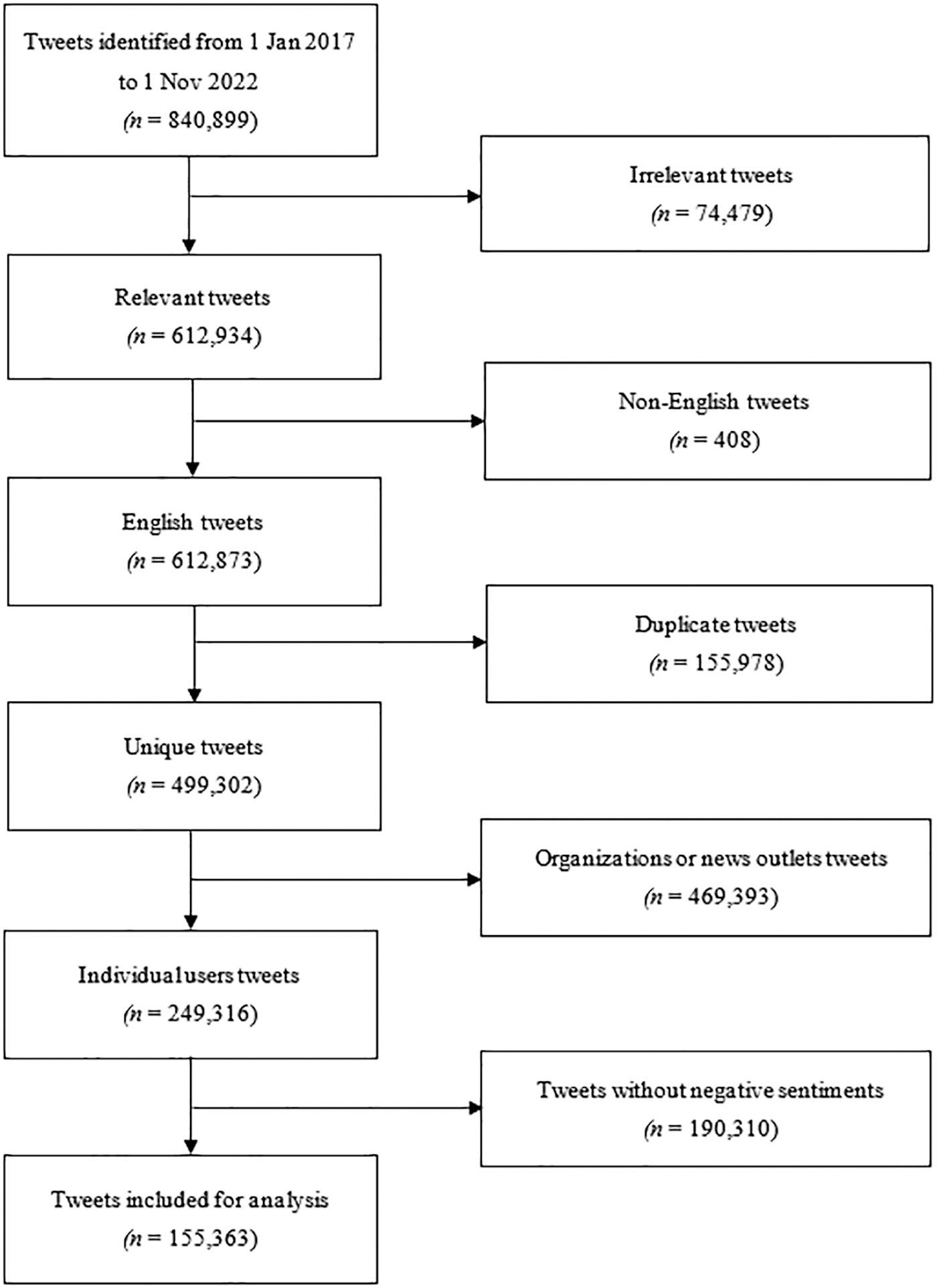
Flowchart illustrating tweet filtering and selection process.
We pulled the geolocation data for tweets and this was represented in Figure 3, with each unique tweet being indicated as a black dot in the map.

Geographical locations of tweets included in this study (each tweet is indicated by a single black dot in the map).
A total of 11 topics were generated after applying BERTopic. The total prevalence of these 11 topics was 80.8 percent; the remaining 19.2 percent was from a topic that was omitted from the current results as the BERT NLP model generates a Miscellaneous topic that groups the remaining, unfit tweets.
A significant majority of tweets were centered around Topic 1 (n = 97,001 tweets, 62.4 percent), which were not negative sentiment tweets directed at Measles vaccination, but negative comments aimed at “anti-vaxxers” and antivaccine sentiments.
Accordingly, the topics were grouped into four main themes by qualitative thematic analysis, namely (a) criticisms directed toward antivaccine attitudes; (b) misbeliefs, misperceptions. and misinformation regarding Measles vaccination; (c) negative transference related to COVID-19 policies; and (d) public reactions to contemporary Measles outbreaks. Table 1 contains the details of topics within each theme.
Themes Related to the Negative Public Sentiments Toward Measles Vaccination, Along with the Respective Topics and Sample Tweets (N = 155,363)
MMR, Measles, Mumps and Rubella.
We also analyzed the temporal trends for these four themes, as a function of the normalized frequency of tweets posted for each topic belonging to these themes over time (Fig. 4).

Temporal trends in the normalized frequency of tweets belonging to Theme 1 (Topics 1, 3, and 7), Theme 2 (Topics 4, 5, 8, and 10), Theme 3 (Topics 2 and 11), and Theme 4 (Topics 6 and 9).
We also compared the frequency of tweets belonging to each theme among different regions of the world (classified as North America, Europe, and Others). The significance test was based on chi-square (p < 0.001), and notable results were found for the following: Theme 2 was more prominent in Europe and Theme 4 was more prominent in North American regions, while Theme 3 was featured more prominent in other continents (Table 2). In contrast, Theme 1 has similar frequency of tweets in North America, Europe, and other regions.
Comparing Frequency of Tweets (Belonging to the Different Themes) Among North America, Europe, and Other Regions
Pearson chi-square (6) = 204.9087; p < 0.001.
Discussion
In this study, we made use of unsupervised deep learning and reflexive thematic analysis to analyze a large amount of free text from social media tweets containing negative sentiments related to Measles vaccination. To facilitate a global and holistic discussion of results, the topics were grouped into different themes through iterative thematic analysis.
Negative attitudes toward anti-vaxxers
The first theme identified was the rejection of “anti-vaxxers” or antivaccine sentiments. The topic labels that fall under this theme are Topics 1, 3, and 7. It was worth nothing that the tweets either had negative attitudes to those who are “anti-vaxx” or were criticizing public figures for supporting antivaccine claims.
This was a surprising finding of the study and it could imply that the current discussion around Measles vaccination in the public sphere may further alienate individuals who are vaccine hesitant and have genuine questions about the vaccine. These, at times, personal attacks and derogatory tweets (e.g., “Will he oppose vaccination for seasonal flu? Or for measles and mumps? How about tetanus? What a nut job”) directed at people who choose not to vaccinate their children or peddle misinformation may be counterproductive. Some studies have found childhood immunization to be an inherently emotionally charged issue, 26 and when we attack other people's values, it may trigger instinctual defensiveness and push them toward extremist views and furthers their “anti-vaxx” attitudes.
Misbeliefs, misperceptions, and misinformation
Themes 2 and 3 highlight the typology of misperceptions and misinformation underlying the negative sentiments related to Measles vaccination and the psychological tendency of disconfirmation bias. This refers to the situation whereby individuals are inclined to believe and accept evidence that is in line with their previously held beliefs, while dismissing evidence that suggests otherwise. 27 This is especially true for beliefs that are considered core to our identity. Therefore, the approach toward overcoming barriers of vaccination should fundamentally target vaccine sceptics who are equivocal; total vaccine objectors are often difficult (if not impossible) to persuade with arguments alone. WHO's Tailored Immunization Programs (TIP) focuses on these ambivalent populations by providing evidence-based information, and seem to have a positive effect on behavioral changes. Furthermore, a systematic review performed by the WHO revealed that dialog-based interventions and multimodal approaches (e.g., flyers and dialogs) are the most effective. 28
Moreover, Theme 2 highlighted various prevailing misbeliefs, misperceptions, and misinformation that could drive Measles vaccine hesitancy or refusal. These include the false belief that the Measles vaccine causes Measles (Topic 4), the false belief that the vaccine is linked to autism onset (Topic 5), the rhetoric on immigrants as a public health threat (Topic 8) and misconceptions regarding herd immunity for Measles (Topic 10). The Measles outbreak in New York City in 2018/19 follows this theme in parallel: primary concerns regarding Measles vaccination and its relation to autism, safety efficacy, and risk of vaccination deepened antivaccination sentiments. This resulted in a large group of undervaccinated and vulnerable young children, which ultimately led to a major outbreak when one unvaccinated child returned home from Israel with measles. 29
Antivaccine sentiments have been well known and growing ever since the discredited study published in the Lancet in 1998, which erroneously linked the MMR vaccine to autism. 30 With the rapid growth of social media, it appeared to have allowed for easier propagation and intensification of misinformation across different geographical communities, potentially undermining public confidence in vaccines. Medical evidence appears to possess little persuasive capabilities.
Despite the retraction of the flawed MMR vaccine study in 2010, misleading claims of causal links between the MMR vaccine and autism in children are still receiving credence and circulating today (as seen in Topic 5 and the analysis of temporal trends shown in Fig. 3). Evidently, misinformation and false beliefs cannot be changed with ease, and studies on the COVID-19 vaccine have found a continued influence effect, whereby individuals can continue to hold these false beliefs and make decisions based on misinformation even after they become aware of the error and accept the correction as true.31,32 In today's digital age, we should be mindful that media and social networks probably help spread and fuel these falsehoods and misinformation.
Negative transference due to COVID-19
Theme 3 further reflected possible negative transference due to COVID-19 and related COVID-19 policies such as mandatory mask wearing, vaccination passports, and differential movement restrictions based on vaccination status. 33 Transference is a phenomenon that happens when people redirect their emotions about a situation to an entirely separate situation. Topics 2 and 11 aptly illustrate the negative transference, whereby the negative sentiments toward COVID-19 public health policies are concurrently exhibited toward Measles vaccination.
A recent report examined nationally representative data from the United States CDC and found low COVID-19 vaccination rates to be associated with low influenza vaccination rates. 11 Our analysis of temporal trends (Fig. 3) also showed an increase in tweets belonging to Theme 3 from the year 2021 onward. This provides some support for our initial hypothesis that negative sentiments toward the Measles vaccine have increased vis-à-vis the COVID-19 pandemic. These are important pointers to be considered for future pandemic planning and in our current public health communications.
Comparison of tweets from different regions
Further analysis was done to identify the predominant themes in each continent across the world. The analysis of data indicated that Theme 2 was more predominant in Europe, while Theme 4 was more prominent in North America. Theme 2 contained misbeliefs, misinformation, and misperceptions regarding the Measles vaccine and appeared to be more prevalent in Europe than other regions. Theme 4 contained tweets pertaining to the recent Measles outbreaks in New York City and Samoa, and hence, it was not surprising that this was more common in North America compared to other regions.
Study limitations
Nonetheless, our study had several limitations. First, the analysis was based on the Twitter platform (with users chiefly from North America) and only tweets in the English language were eligible for inclusion; hence, the findings may not necessarily generalize to non-Western countries and communities. In addition, public opinion may vary significantly, depending on local sociopolitical variables and trust in governments. Second, despite our best efforts to include only tweets by users with actual human names, we cannot entirely exclude non-human Twitter users such as bots, which masquerade as legitimate users in our study sample. These bots may have the deliberate intention to distort public opinion 34 and perpetuate misinformation, thus affecting our interpretations and analyses. Third, despite good face validity of machine learning methods used, misclassification is still possible and may affect our interpretations.
Conclusion
Through the analysis of a corpus of Twitter data over the past 5 years, we found a typology of misbeliefs, misconceptions, and misinformation surrounding Measles vaccination. This appeared to have increased in prevalence from 2021 onward, with particular coincides with negative emotions related to COVID-19 policies and COVID-19 vaccination. The current public discourse surrounding the issue of Measles vaccination may also further alienate those who are vaccine hesitant as a significant proportion of the negative sentiment tweets contained reproachful and disparaging language directed at “anti-vaxxers.” We need to adjust our public messaging, and it is paramount to understand the thinking and feeling of the vaccine-hesitant population and their social processes (such as support from the people around them) to enable motivation and increase uptake of Measles vaccines. This should be the focus of future research.
Footnotes
Authors' Contributions
T.M.L. and Q.X.N. conceived, designed, and carried out the study, and the relevant data analysis and interpretation. Y.Q.J.T., C.Y.K., B.P.-Y.L., and Y.L.L. carried out the study, and the relevant data analysis and interpretation. All authors discussed the results and contributed to the writing and proofreading of the final article.
Compliance with Ethical Standards
The authors certify that they comply with the ethical guidelines for authorship and publishing.
Author Disclosure Statement
No competing financial interests exist.
Funding Information
No funding was received for this article.