




Abstract
Video gaming is a popular pastime for young males, having been shown to have both positive and negative effects on players' mental health. The aim of the current study was to ascertain the rate that male video gamers may seek mental health support for mental ill-health generally. The secondary aims were to (a) identify the most prolific barriers to seeking help; (b) determine how confident this group is to seek help; and (c) whether the variance in help-seeking efficacy be explained, in part, by age, hours gamed, self-esteem, and social capital. The survey included sections on demographic information, standardized measures of self-esteem (The Rosenberg Self-Esteem Scale), social capital (The Social Capital in Gaming Scale), help-seeking efficacy (Self-Efficacy to Seek Mental Health Care Scale), and non-standardized measures of help-seeking behavior and help-seeking barriers. The survey of 2,515 participants had a mean age of 21.37 years. The analysis identified that most participants had not sought mental health support for themselves. The most prolific barriers for this cohort to seek help were cost, confidentiality, and trust. Confidence to seek help was rated the lowest for overcoming embarrassment, understanding information, and coping with others' reactions. Help-seeking efficacy was found to be significantly predicted by age, hours spent gaming, self-esteem, and social capital. Low rates of seeking help, coupled with identifying the significant barriers of this group to seek help, may inform researchers aiming to develop targeted interventions for male youth interested in gaming and who are exhibiting mental ill-health to gain initial access, or engage more often, with mental health services when needed. Further research is recommended for investigating male gamers' insights in determining how to overcome the identified barriers for this cohort to improve mental health seeking behavior rather than avoidant behavior. From this, stigma reduction and ease of access to digital mental health services could be improved.
Introduction
Mental health and help-seeking of males
Asignificant proportion of males experience mental ill-health in their lifetime, 1 representing an established area of importance in health care sectors across the world. Although depression is more commonly diagnosed in women, men have higher suicide rates globally. 2 Mental ill-health among this group culminates in a considerable impact for society, affecting employment, productivity, and quality of life. Men are more likely to develop drug- and alcohol-related abuse problems in their lifetime 3 and be hospitalized as a result. 4 They are also significantly less likely to seek help for a mental health concern than women. 5 Furthermore, research suggests that this delay, decrease, and deficit in male help-seeking behavior may have been exacerbated by the COVID-19 pandemic. 6 This suggests a gendered experience of mental health.
The social norms associated with masculinity is one explanation for this difference; an emphasis on stoicism and self-reliance, traits associated with Western ideals of masculinity, has meant men seek help at lower rates than females. 5 Research on young men has concluded that confidentiality and trust are the largest barriers to them seeking help. 7 This concerns the stigma associated with mental health, where individuals are concerned about being judged.
These significant barriers have presented a problem for clinicians who wish to engage men in the context of mental health. 8 Despite greater understanding of the male experience of mental health and increased service provision, increasing the number of men who access mental health services persists as a challenge for clinicians and policymakers. 9
This challenge is that no single intervention to engage with men on mental-health-related issues has been found to be effective. 10 That is, the heterogeneous nature of the group makes universal interventions unsuccessful in targeting differing subgroups of this population. Evidence suggests that the most effective way of engaging men is by doing so with sensitivity to the interests and needs of the subgroup. 11 One large subgroup of males, with the capacity for interventions to capitalize on shared interests and who tend to congregate on a shared platform, are video gamers.
Video game players: an at-risk group
Gaming is an increasingly popular form of entertainment, with estimates of up to 2.6 billion users worldwide. 12 This has spurred research into the psychological effects of its use. 13 In the fifth edition of the Diagnostic and Statistical Manual of Mental Disorders (DSM), the American Psychiatric Association (APA) noted that compulsive or addictive gaming is a condition warranting further research. 14 While a lack of robust scientific evidence exists regarding the validity of a gaming disorder, 15 there is consensus that further research into the motivations and effects of gaming (i.e., pathological and healthy) is necessary. One reason for this is that video gamers may be more susceptible to having or developing poorer mental health. 16
One common motivation to game is to break mundanity and relieve stress. 17 This is the basis for the theory of escapism, where gaming is used as an avoidance technique from the problems of the individual's life. 18 Research suggests that individuals who engage in this avoidance technique are more likely to report higher personal social anxiety, higher stress levels toward social concerns, academic problems, and relationship problems. 19
While it is theorized that male gamers may be more prone to mental-health-related concerns, through avoidance-based tactics, little is known about the help-seeking behavior and confidence of this group. By understanding this, interventions can be developed with a particular sensitivity to this group, which, if successful, may lead to increased engagement with mental health support services. Research suggests that the optimal approach to engage men in mental health support is to acknowledge the heterogeneous nature of this group 11 and consider interventions in the context of subgroups with shared experiences and views. Video gamers are one such group, with shared interest and who frequently congregate on a shared platform. Their opinions on mental health support, including how they access support and engage with one another, could be of interest to those developing targeted interventions aiming at increasing help-seeking behavior.
The present study
The current research aims to explore the behavior and help-seeking of male video gamers for global mental health concerns. The primary research question asked was at what rate do male gamers seek help for mental health issues? The secondary objectives of the study were to identify (a) the most prolific barriers to seeking help; (b) how confident this group was to seek help; and (c) whether the variance in help-seeking efficacy could be explained, in part, by age, hours gamed, self-esteem, and social capital.
Methods
Procedure
The study received approval from the University of Sydney Human Research Ethics Committee (approval number: 2020/419). Recruitment for the survey was carried out via a Tweet made by an Australian celebrity gamer on October 6, 2021, which advertised the voluntary, anonymous, and unincentivized online survey. The celebrity gamer had a following of more than 20 million on YouTube, which was the primary platform for their gaming content. Upon clicking the link, participants were provided with an information statement and asked to consent to the study.
Participants
The study recruited male participants older than 18 years who self-identified as gamers. The project focused specifically on male gamers, as research suggests that they seek help for mental health at a significantly lower rate than females. 7 In this study, video game players were defined as individuals who self-identified with the term and who reported playing any type of video game for at least 1 hour/week. Data collection was undertaken in October 2020, where 3,443 responses were collected. Of this sample, 928 incomplete responses were removed. A total of 2,515 complete responses were then analyzed. The demographic characteristics of the participants are presented in Table 1.
The Demographic Information Collected from the Participants
Measures
The survey composed of six parts, which included demographic information and five psychological scales. The demographic information obtained were age, gender, country of residence, average time spent playing video games per week, and highest level of education attained. “Is there anything that you think would better support you to access mental health services?” was also asked of the participants, but the results in this article will only report the quantitative results.
Self-esteem
The Rosenberg Self-Esteem Scale was used to assess the individual's level of self-esteem, which has produced a Cronbach's alpha level of 0.81, indicating strong validity. 20 The measure included 10 items, with participants' responses reported on a 5-point Likert scale ranging from “strongly disagree” to “strongly agree.”
Social capital
The Social Capital in Gaming Scale 21 was used to measure participant social engagement. This measure included 12 items, and responses were also collected using a 5-point Likert scale (as above). The scale has reported a Cronbach's alpha level of 0.89. 21
Help-seeking efficacy
To determine the confidence of the participants to seek help for mental health issues, the Self-Efficacy to Seek Mental Health Care (SE-SMHC) was administered. 22 This scale recorded a Cronbach's alpha level of 0.87. 22 The measure included eight items and asked participants to indicate their level of confidence regarding help-seeking behaviors using a 5-point Likert scale ranging from “no confidence” to “complete confidence.”
Help-seeking behavior
Help-seeking behavior was investigated by asking the participants whether they had sought help for themselves or a friend for mental-health-related concerns. The options for these two questions were no, yes—through a mental health professional or, yes—by accessing online resources.
Help-seeking barriers
The final section was a six-item measure that investigated the barriers to help-seeking, as viewed by this group. The items that were rated in terms of how big a barrier they are to getting help were reported on a 5-point Likert scale from “not at all” through to “greatly.” The six items were synthesized based on research on young men, which identified these six items as the barriers they faced to accessing mental health support. 7
Data analysis
Responses were analyzed using the Statistical Package for the Social Sciences (SPSS). Frequency data were computed to identify the percentage of participants who had sought help for themselves or their friends. This addressed the main research question of the study, by ascertaining the rate that video gamers are seeking mental health support through formal (mental health services) and informal (online resources) channels.
Subsequently, the items on the help-seeking efficacy and barriers to seeking help measures are reported as percentages. This identified the most prolific barriers to seeking help for this group.
As the study used a descriptive research design, a multiple regression was used. The independent variables of age, hours spent gaming, self-esteem, and social capital were entered simultaneously into the equation to determine whether a significant proportion of the variance in help-seeking efficacy could be predicted.
Results
The scores of the three scales were determined by calculating the averages of the items within each of them. The overall mean for the self-esteem scale was 2.746 (standard deviation [SD] = 0.628), the social capital scale reported a mean of 3.487 (SD = 0.641), and the help-seeking efficacy scale's overall mean was 3.431 (SD = 0.966). Cronbach's alpha was found to be 0.894, 0.789 and 0.908, respectively, for each scale.
Help-seeking behavior
As shown in Table 2, 58.3 percent of participants reported that they had not sought help for a mental-health-related concern, whereas 56.0 percent reported that they had not sought help for a friend.
The Reported Help-Seeking Behavior of Respondents
Help-seeking barriers
As shown in Figure 1, the largest barrier reported was the cost of accessing services, with 39.9 percent of individuals reporting that this affected them “quite a lot” or “greatly.” Confidentiality and trusting the health care practitioner and difficulty identifying symptoms were also major barriers, with 27.9 percent and 25.4 percent of individuals, respectively, being affected by these issues “quite a lot” or “greatly.” The smallest barrier, as reported by the participants, was the location of mental health services, with 58.6 percent reporting that this did not affect them a lot or at all.
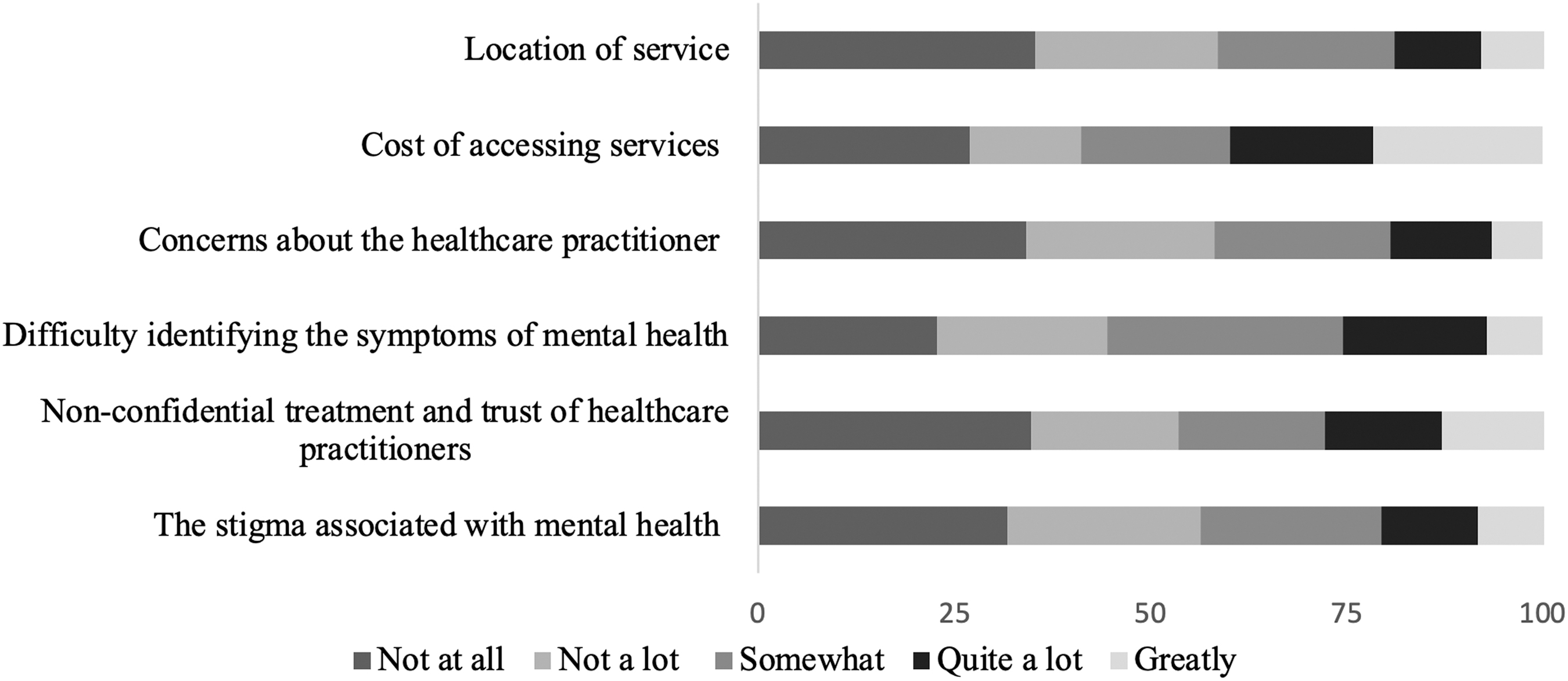
The degree to which individuals reported being affected by several barriers to seeking help, reported as a percentage.
Help-seeking efficacy
Figure 2 shows the distribution of responses on the SE-SMHC. This refers to how confident the participants were to access mental health support. The lowest level of confidence reported was for overcoming embarrassment, with 31.6 percent of participants reporting either no or low confidence. This was followed closely by understanding information given to the individual from mental health services and coping with family and friends' reactions (both with 30.8 percent of participants reporting no or low confidence). Respondents reported the highest confidence levels for getting transportation and coping with the attitudes of the mental health staff or service workers (59.4 percent and 57.0 percent, respectively, reported that they were either pretty or completely confident).
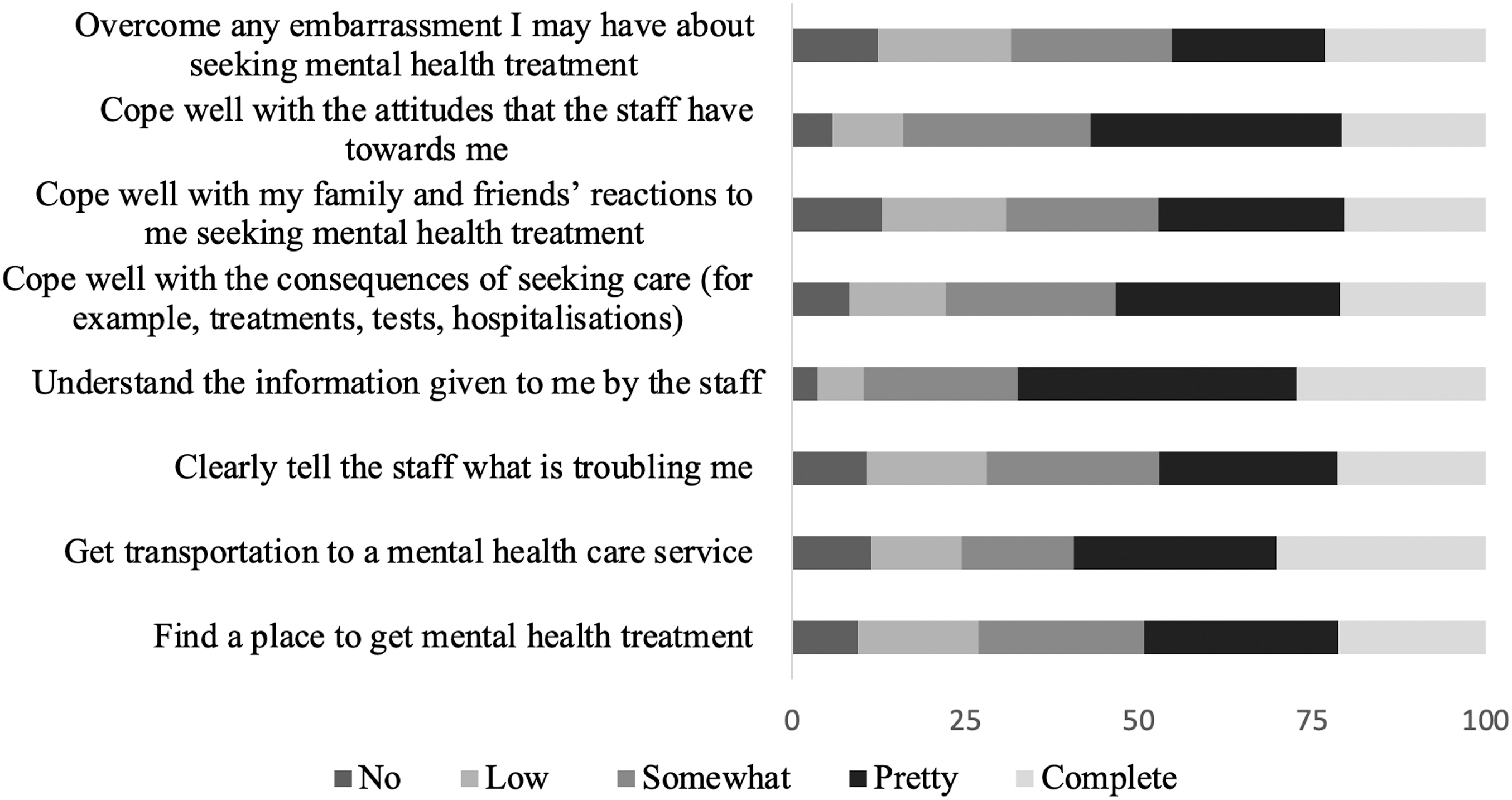
The level of confidence reported for each item of the SE-SMHC measure of help-seeking efficacy, reported as a percentage. SE-SMHC, Self-Efficacy to Seek Mental Health Care.
Predicting help-seeking efficacy
A multiple regression was conducted to observe if age, hours gamed, self-esteem, and social capital predicted help-seeking efficacy. By employing a regression analysis, the unique contribution of each variable, by holding the other variables constant, in predicting help-seeking efficacy was determined. It was found that these variables explain a significant amount of variance in help-seeking efficacy [F(4, 2511) = 227.868, p < 0.01, R2 = 0.266, R2Adjusted = 0.265]. The analysis shows that age [Beta = 0.065, t(2,515) = 3.770, p < 0.001], hours gamed [Beta = −0.058, t(2,515) = −3.342, p = 0.001], self-esteem [Beta = 0.463, t(2,515) = 26.502, p < 0.001], and social capital [Beta = 0.140, t(2,515) = 8.002, p < 0.001] were all significant predictors of help-seeking efficacy. All the variables positively correlated except hours spent gaming, which was negative.
Discussion
The current study aimed to explore the help-seeking behavior, barriers to seeking help, and help-seeking efficacy of male video game players. Drawing on a large sample, the results indicated that approximately one-in-five individuals sought help for their own mental health through a mental health professional. Further studies should endeavor to identify the facilitators of help-seeking behavior among male gamers and consider the base rate of mental illness in this group. Considering the estimated base rate of the population is somewhere around 45 percent of individuals experiencing a mental illness at one point in their life, 7 there may still be a considerable gap between individuals who sought help for their mental health and those who have experienced symptoms of mental illness.
It was also found that more individuals had tried to seek mental health support for a friend rather than themselves. This may be reflective of research findings, which have suggested that games can provide a platform for individuals to interact and develop meaningful relationships, 23 which has been shown to increase prosocial behavior online and offline. 24 The results of this study found that the participants were committed to supporting their peers to access psychological support at a greater rate compared with individuals seeking self-support. Researchers may be able to leverage this “referral” behavior in developing future interventions aiming to increase help-seeking behavior among this group.
Cost of accessing services rated as the biggest barrier to accessing mental health services. The United States, where a large proportion of the participants live, have significant costs associated with accessing health care and, in particular, psychological services. 25 This is evident in other developed and developing countries, where there may be a cost associated with psychological services, which serves as a barrier to accessing care for those who may not be able to afford them.
The participants identified trusting practitioners and overcoming embarrassment as key barriers in seeking help. It has been found that trusting health professionals and feelings of embarrassment are consistently reported barriers to accessing services. 26 Research has categorized the concern of trust as relating to stigma, where the fear of breached confidentiality stems from the fear of others finding out that they are in the position to need help. 27 In the context of gendered expectations, a disconnect exists between the stoicism and self-reliance associated with prominent forms of masculinity in Western societies, and the inherent vulnerability associated with seeking help. The stigma around accessing support that exists because of this disconnect should be considered when developing interventions targeted at this group.
Over half of the responses indicated that they were not confident, had low confidence, or were only somewhat confident in seeking help for the items in the SE-SMHC measure of help-seeking efficacy. Young men have historically reported significant barriers to accessing help, which research has shown negatively impacts their perceived capacity to access help. 7 While participants reported the lowest confidence in overcoming embarrassment, this was followed closely by not being confident in understanding information. This indicates a need for programs to increase mental health literacy among this group, which would subsequently increase the confidence of individuals to be able to synthesize mental-health-related information.
Self-esteem and social capital were significant predictors of help-seeking efficacy for our participants. This was consistent with existing evidence that individuals with low self-esteem tend to “self-limit” and overestimate barriers, decreasing their confidence in their ability to complete tasks. 28 Likewise, the importance of social capital for our participants corroborates research that has found social support to be a significant predictor for young adults' intentions to seek help. 29 This is a novel finding for the video gaming cohort. The medium-sized effect and significance within the model affirm the validity of this variable in predicting help-seeking efficacy for our study cohort.
Age and hours spent gaming were also significant predictors of help-seeking efficacy. As anticipated, higher self-efficacy scores were associated with older participants. This is consistent with the general trend of confidence that is associated with gains in knowledge, skills, and expertise that comes with age. 30 More hours spent gaming was negatively associated with confidence to seek help. This may reflect a risk factor for problematic gaming.31,32 It should be noted that the causal relationship is unclear; whether more time spent gaming causes low help-seeking efficacy or if low self-efficacy causes an individual to game for longer periods of time. Escapism theory suggests that the latter may be more consistent; in that the individual uses gaming to escape negative emotions and to be diverted from the problems in their lives. 18
The nature of the study warrants interpretative caution, given the cross-sectional design. While associations are reported, causation cannot be concluded. Further studies are necessary to determine whether the variables reflect the causes or consequences of video gaming. Longitudinal research is needed to clarify the causal mechanisms behind the associations reported. Another limitation of the present study is the nature of self-report. One study identified that gamers may systemically underreport their playing, with findings suggesting that gamers underreport, on average, 1.26 hours/week, with certain groups such as older gamers are more likely to underreport than others. 33 It would be advantageous for future article to affirm the findings of this study with data from mental health professionals, peers, and friends of gamers, and objective measures of how many hours the individuals gamed.
By understanding the help-seeking efficacy and the barriers to seeking help in video gamers, interventions can develop strategies to increase the help-seeking behavior. The results of this study indicate a need within this population, to be able to access nonjudgmental affordable services. The next step is uncovering how this group would prefer to access services: referrals from the games themselves, in forums and discussions online, developing mental-health-specific games or by other means. Participatory action research on how to actively direct this group toward mental health services and improve the accessibility of online information and health literature skills would produce a user-led strategy. Once sufficient evidence is gathered, a pilot program can be developed and tested to evaluate its validity in increasing help-seeking behavior and increasing help-seeking efficacy among individuals of this group.
Conclusions
The current study identified the behavior, barriers, and efficacy associated with seeking help in a group of male video game players. Results indicate that many participants had not sought any help. A notable proportion of participants indicated that they had sought help for a friend. The barriers that were reported to affect the participants the greatest were: cost, confidentiality and trust, and difficulty identifying the symptoms. Participants reported that they had the lowest confidence in overcoming embarrassment, understanding information, and coping with family and friends' reactions. These findings underscore the significance of addressing these specific areas of concern in promoting effective help-seeking behavior.
Strategies aimed at increasing confidence in overcoming embarrassment may involve creating safe and nonjudgmental environments, normalizing help-seeking behaviors, and promoting a culture of support and understanding. Help-seeking efficacy among participants was found to be significantly predicted by age, hours spent gaming, self-esteem, and social capital. These findings may contribute to developing targeted interventions aimed at increasing the uptake of mental health services through specific programs that address unique needs of this group. Further research considering the causal relationships between these variables and research using alternate methods to self-report would be advantageous.
Footnotes
Authors' Contributions
E.L.S.: Conceptualization, methodology, formal analysis, investigation, and writing—original draft. K.L.A.: Supervision, and writing—review and editing. B.R.: Formal analysis, supervision, and writing—review and editing. R.F.: Supervision, and writing—review and editing. A.J.C.: Conceptualization, methodology, supervision, and writing—review and editing.
Author Disclosure Statement
No competing financial interests exist.
Funding Information
No financial support was ascertained for this study.