




Abstract
Drawing on the social compensation hypothesis, this study investigates whether Facebook use facilitates social connectedness for individuals with traumatic brain injury (TBI), a common and debilitating medical condition that often results in social isolation. In a survey (N = 104 participants; n = 53 with TBI, n = 51 without TBI), individuals with TBI reported greater preference for self-disclosure on Facebook (vs. face-to-face) compared to noninjured individuals. For noninjured participants, a preference for Facebook self-disclosure was associated with the enactment of relational maintenance behaviors on Facebook, which was then associated with greater closeness with Facebook friends. However, no such benefits emerged for individuals with TBI, whose preference for Facebook self-disclosure was not associated with relationship maintenance behaviors on Facebook, and did not lead to greater closeness with Facebook friends. These findings show that the social compensation hypothesis has partial utility in the novel context of TBI, and suggest the need for developing technological supports to assist this vulnerable population on social media platforms.
Introduction
Traumatic brain injury (TBI) affects ∼1.7 million Americans annually and is a leading cause of long-term disability. 1 TBI can disrupt survivors' sensorimotor, psychological, and cognitive functions 2 and cause lifelong social disability. 3 Indeed, individuals with TBI commonly report loss of friends 4 and loneliness. 5
Social media has gained prominence as a tool for connecting the world 6 and could reduce social isolation after TBI. Individuals with TBI report both interest in social media and barriers in access,7,8 and potential benefits to this population are unknown. Thus, we ask: Does social media offer social benefits to people with TBI, fostering closeness with online friends?
Drawing on the social compensation hypothesis,9–11 we examine the extent to which individuals with moderate-to-severe TBI prefer to self-disclose on social media versus in face-to-face (FtF) interactions, enact relationship maintenance behaviors12,13 on social media, and report closeness with social media friends as a result. To understand the unique role of social media in these processes, we include a sample of noninjured adults for comparison. Our analyses focus on Facebook, the social media platform most consistently used by U.S. adults with14–16 and without 6 TBI.
Moderate-to-Severe TBI and Social Challenges
TBI severity is classified according to acute injury characteristics (e.g., loss of consciousness, neuroimaging findings). 17 Individuals with moderate-to-severe TBI typically experience problems recognizing and expressing emotions, understanding humor and sarcasm, remembering information, and following along on conversations as topics and speakers change.18,19 A particular issue is inappropriate self-disclosure, as this group typically overshare personal information 20 and feel self-conscious in social interactions. 4 These impairments can lead to loss of relationships and social support after injury,4,21 reduced participation in social and leisure activities, 5 and difficulty making friends. 22 While these negative social consequences can occur for anyone with a brain injury, they are more common for those with moderate-to-severe TBI. It is unsurprising then that the latter report more loneliness and poorer quality of life than those without TBI, 23 prompting recommendations to consider friendship maintenance as a key element in supporting individuals well-being post-TBI.4,24
Social Compensation Hypothesis
The social compensation hypothesis proposes that individuals who struggle with initiating and maintaining relationships FtF could benefit from interacting online. 9 The hypothesis delineates two categories of factors that cause relationship difficulties in FtF environments: stable individual differences (e.g., low social competence,25,26 introversion, 27 low self-esteem28,29) and internalizing disorders (e.g., social anxiety,30,31 loneliness, 32 depression23,33). Collectively, these factors are referred to as psychosocial vulnerabilities. 34
The social compensation hypothesis makes two predictions. First, individuals with psychosocial vulnerabilities will prefer computer-mediated communication (CMC) over FtF because the former is more comfortable, controllable, and easily accessible.26,35–38 Second, the preference for CMC will lead these individuals to engage in more social interaction online and to derive more benefits from it, such as making new friends and feeling closer to online friends, than their counterparts without psychosocial vulnerabilities.
Supporting these predictions, a strong preference for CMC over FtF has been documented among socially anxious adolescents 11 and adults,31,39,40 lonely adolescents, 41 and online daters with anxiety and depression. 34 Individuals with psychosocial vulnerabilities engage in more online communication, especially self-disclosure,10,32,40 and derive benefits from it such as higher friendship quality with online friends, 30 more online friends, 10 greater social capital, 12 and more social support. 31
Hypotheses
Since TBI interferes with relationship initiation4,21 and is frequently accompanied by internalizing symptoms,
22
the social compensation hypothesis should help explain the preferences and behaviors of individuals with TBI. Thus, we predict that individuals with TBI will prefer Facebook over FtF communication. We focus on preferences for Facebook self-disclosure because self-disclosure is the building block of close relationships
42
and is difficult for those with TBI due to cognitive limitations. Hence,
Second, we predict that preferences for Facebook self-disclosure among adults with TBI will be associated with the enactment of relationship maintenance behaviors, which, in turn, will produce relational benefits, specifically greater perceived closeness with Facebook friends. On Facebook, relationship maintenance behaviors take the form of offering one-click indicators of support (i.e., “likes” or other reactions), writing comments on others' posts, sending public and private messages, and responding to “friends’” public questions.12,43 These behaviors require little investment of time and effort and have been shown to promote closeness with Facebook friends.43,44
Self-disclosure and relationship maintenance are key, intertwined predictors of relationship closeness.
45
Due to reciprocity norms, an individual's increased self-disclosure (a self-focused activity) tends to prompt that individual to also enact more relationship maintenance behaviors (an other-focused activity), resulting in greater relational closeness.
46
These associations have been observed in the general population,
47
and we expect them to also emerge among individuals with TBI interacting on Facebook, given the ease of enacting relationship maintenance behaviors on social media relative to FtF:
The social compensation hypothesis predicts that these associations should be stronger for adults with TBI than for those without, because the former should be more comfortable with and invested in managing their social lives online:
Methods
Participants and procedure
Participants were adults with moderate-to-severe TBI and a demographically matched comparison group of noninjured adults (Table 1). All participants were recruited from the Vanderbilt Brain Injury Patient Registry. 48 Participants completed an online questionnaire regarding their social media preferences and practices. 15 Procedures were Institutional Review Board-approved.
Demographic Characteristics
N/A, not applicable; SD, standard deviation; TBI, traumatic brain injury.
Measures
To accommodate cognitive challenges among participants with TBI, all scales contained simplified three-point response options (1 = disagree; 2 = neither agree nor disagree; 3 = agree), following best practices for this population.49–51 For each scale, responses were averaged into an index.
Preference for Facebook self-disclosure (compared to FtF) was measured using Ledbetter's 52 well-validated scale for attitudes toward online self-disclosure (seven items; e.g., “When on Facebook, I feel more comfortable disclosing personal information than FtF”; Cronbach's α = 0.87–0.90).
Relational maintenance behaviors on Facebook were measured using the validated relationship maintenance scale by McEwan et al. 53 (14 items; e.g., “I post on friends' Facebook newsfeeds”; Cronbach's α = 0.87–0.91).
Relational closeness with Facebook friends was measured using Dibble et al.'s 54 relational closeness scale (12 items; e.g., “My relationships with my Facebook friends are close”; Cronbach’ α = 0.85–0.93).
Results
An independent sample t test showed that individuals with TBI displayed a greater preference for Facebook self-disclosure than individuals without TBI, t(83) = −2.856, p < 0.05, Cohen's d = 0.51, supporting H1.
To test H2 and H3, separate mediation models were constructed for individuals with and without TBI. In each model, preference for Facebook self-disclosure was entered as the independent variable, relational closeness with Facebook friends as the dependent variable, and relational maintenance behaviors as the mediator (Figs. 1 and 2).
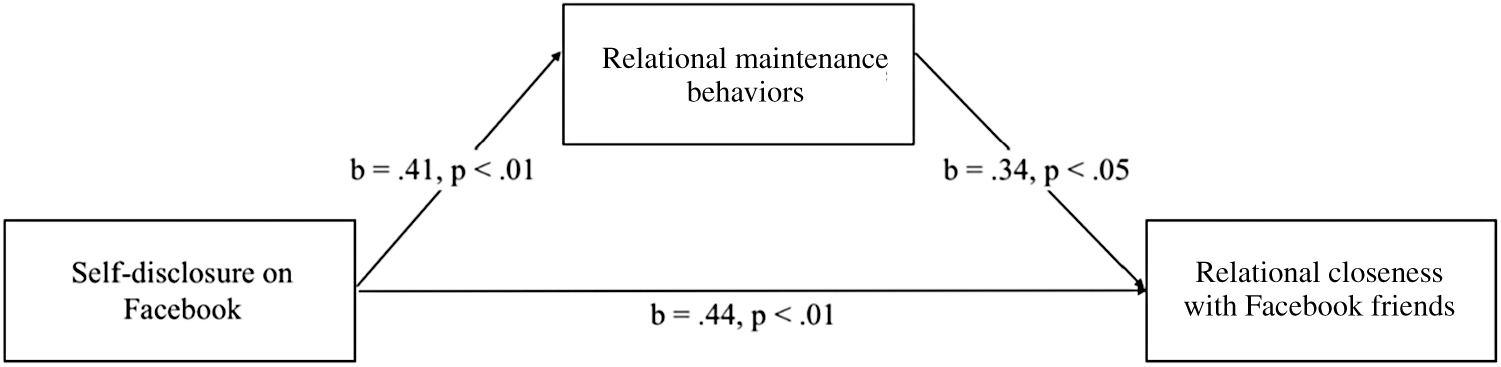
Mediation model for noninjured individuals. Note. Solid lines show significant relationships.
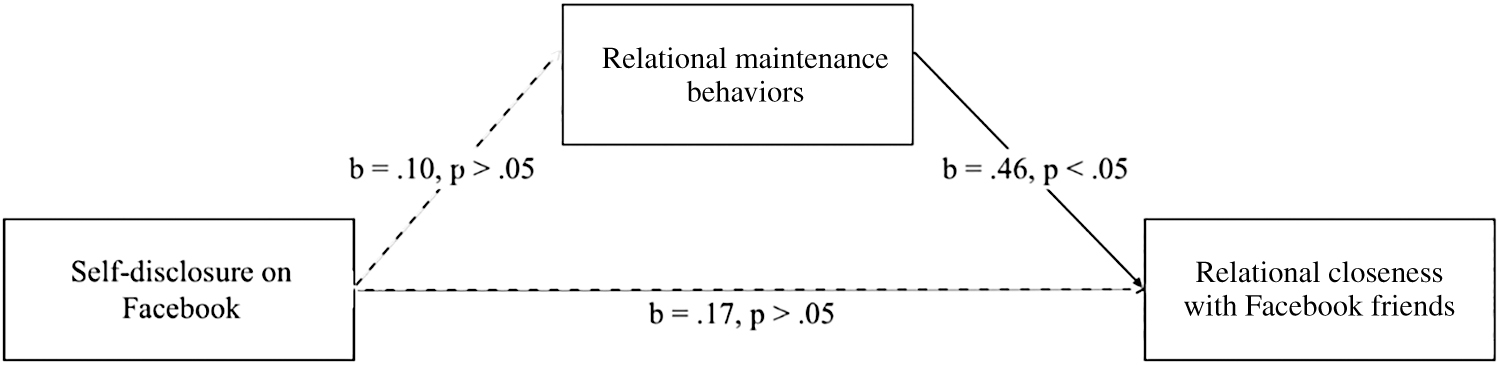
Mediation model for individuals with TBI. Note. Dashed lines show non-significant relationships; solid line shows significant relationship. TBI, traumatic brain injury.
For noninjured individuals, preference for Facebook self-disclosure was significantly associated with the enactment of relational maintenance behaviors (b = 0.41, p < 0.01), which was then significantly associated with relational closeness with Facebook friends (b = 0.34, p < 0.05). There was a direct relationship between preference for Facebook self-disclosure and relational closeness with Facebook friends (b = 0.58, p < 0.001), but it was weakened when the mediator (i.e., relational maintenance behaviors) was entered (b = 0.44, p < 0.01).
For H2, the TBI group's preference for Facebook self-disclosure was not significantly associated with the enactment of relational maintenance behaviors on Facebook (b = 0.10, p > 0.05). However, Facebook relational maintenance behaviors were significantly associated with relational closeness with Facebook friends (b = 0.46, p < 0.05). The direct relationship between preference for Facebook self-disclosure and relational closeness with Facebook friends did not reach significance (b = 0.22, p > 0.05), nor was it significant when the mediator (i.e., relational maintenance behaviors) was included (b = 0.17, p > 0.05) (Fig. 2), providing partial support for H2.
Associations between the study variables only emerged for noninjured individuals; thus, H3 was not supported. However, it is worth noting that there were no significant mean differences between those with and without TBI for Facebook relational maintenance behaviors or closeness with Facebook friends (Table 2).
Descriptive Statistics for Key Variables
NC, noninjured control.
Discussion
Social network sites are described as “social supernets” 55 because they allow users to connect with others with low effort.28,56 We examined whether such benefits emerged for individuals with moderate-to-severe TBI, who are at high risk for loneliness.
Results paint a complex picture. On the one hand, adults with TBI reported greater preferences for self-disclosing on Facebook versus FtF. They also reported engaging in as many relationship maintenance behaviors and experiencing as much closeness with Facebook friends as those without TBI. These findings suggest that Facebook might help individuals with TBI combat social isolation.
On the other hand, the results reveal limitations in the way Facebook supports individuals with TBI. Among those with TBI, preferences for Facebook self-disclosure did not materialize into perceived closeness with Facebook friends because preferences were not linked with the enactment of relationship maintenance behaviors, as was the case for noninjured individuals. Participants with TBI showed a breakdown in this relationship-enhancing chain, as their preference for disclosing on Facebook was not associated with other-oriented communication, such as expressing support, showing interest, and responding to others' messages. These relational maintenance behaviors may be difficult to orchestrate because they involve high-level, theory-of-mind calculations, such as understanding the needs and preferences of relational partners.57,58 It is also possible that due to the tendency of adults with TBI to overshare, 20 they might disclose indiscriminately rather than in a directed way that will maintain friendships. The controllability and ease of access of social media may be insufficient for redressing these cognitive difficulties.
While the social compensation hypothesis was useful in explaining preferences for Facebook interaction in adults with TBI, it did not adequately describe their behaviors on this platform, perhaps because participants' cognitive impairments prevented them from using Facebook in ways that would yield relational benefits.
Practical implications
There is evidence that individuals with TBI enjoy using social media platforms,7,8,14–16,59 so social media could be a tool to help this group combat social isolation. However, social media sites may currently lack accessibility and usability features to support users with cognitive impairments. Such features could include conversation prompts, reminders to respond to others' messages or to contact others, or a menu of suggestions from which to pick the best message. 60 Streamlining and simplifying interfaces, especially by highlighting information from closer friends, might also be beneficial.
Limitations and Future Direction
Studying TBI has unique challenges. It is difficult to recruit individuals with TBI for lab studies, which restricts sample size. Since participants' cognitive impairments limited questionnaire length and complexity, we focused only on a small set of key variables and simplified response options. Our study was a cross-sectional survey. Future longitudinal studies may inform how social media engagement affects adults with TBI's friendships and provide evidence of causality. The self-reported measures, while appropriate for capturing participants' preferences and perceived closeness with online friends, may be less accurate in capturing their actual relationship maintenance behaviors. For instance, individuals with TBI may overreport the extent to which they engage in relationship maintenance. Future research should employ content analyses of posts and private messages to capture these behaviors more objectively.
Conclusion
Social media platforms like Facebook have been connecting the world, keeping relationships alive, and fostering new ones. This study shows that many of these social benefits extend to individuals with TBI, a vulnerable population. However, access is not enough; we must also support adults with TBI in using these platforms to their full social potential.
Footnotes
Acknowledgments
The authors sincerely thank all the participants in this study. We thank Nirav Patel for his role in participant recruitment.
Authors' Contributions
C.L.T.: Conceptualization (equal), writing—original draft (lead), methodology (lead), formal analysis (supporting), writing—review and editing (equal). J.H.: Writing—original draft (supporting), methodology (supporting), formal analysis (lead), writing—review and editing (equal). L.K.: Writing—original draft (supporting), writing—review and editing (equal). E.L.M.: Data curation (lead). L.S.T., M.C.D., and B.M.: Conceptualization (equal), writing and editing (supporting).
Ethics
The study was approved by the Research Ethics Committee of Vanderbilt University, and the research was completed in accordance with the Declaration of Helsinki as revised in 2013.
Data Access Statement
All relevant data are within the article and its Supporting Information files.
Author Disclosure Statement
The authors declare that they have NO affiliations with or involvement in any organization or entity with any financial interest in the subject matter or materials discussed in this manuscript.
Funding Information
This work was supported by grant NIH/NCMRR RO1-HD071089-06A1 from the National Institute of Health. The funders had no role in study design, data collection and analysis, decision to publish, or preparation of the manuscript.
Note
a. The Vanderbilt Brain Injury Patient Registry invites individuals with and without brain injury to be part of a standing pool of research participants for large-scale basic and translational research on acquired brain injury. In addition to experimental data collection, the Registry also collects demographic information and neuropsychological and neuroanatomical data to better inform tracking and prediction of long-term outcomes.