




Abstract
Using online survey methods (n = 153), this study investigates whether exposure to different levels of customization in games will increase the experiences of enjoyment, both directly and indirectly, through the experience of avatar embodiment, as well as whether these relationships are influenced by gender identity. Results indicate a positive relationship between level of exposure to customization and enjoyment for women-identified participants. These outcomes may provide insight into gendered preference in gaming, potentially providing an avenue by which to make games more inclusive to women gamers.
Introduction
Avatars are digital representations of players,1,2 which vary in how much they can be customized. For instance, in some games, the playable character is limited to a single uncustomizable character, while others offer the ability to customize every feature of the avatar. The wide range of customization is understudied; research suggests that customizing an avatar increases a player's emotional attachment to their character, fosters a sense of control and autonomy, and ultimately leads to more enjoyment of the game. 3 However, yet to be studied are individual differences, such as demographic variables, which make customization more or less important to a player's game experience. This study examines the relationship between exposure to avatar customization and game enjoyment through avatar embodiment, with gender as a moderator.
Avatar embodiment and game enjoyment
When players experience the psychological feeling of their body and their avatar's body being integrated, it is called embodiment.
4
Self-presence is a term used to indicate that a certain aspect of a person's self is inside the digital world, such as the presence of a person's body schema or their identity.
5
Embodiment resembles self-presence as experiencing embodiment makes the body of the player relevant in the digital world.5,6 If embodiment means that a player feels their own self is represented in the avatar's movements, and customization can make them feel more connected to their avatar, we hypothesize that increased customization will be associated with greater reported embodiment:
Enjoyment is defined as the pleasure people experience when responding to a stimulus.
7
Customization is indirectly and positively related to enjoyment when compared to no customization at all.
8
In addition, embodiment experiences have been demonstrated to be associated with enjoyment.
9
Thus, we predict the following:
Gender in games
There are some gender differences in gaming preferences.10,11 Some scholars suggest that women feel the need to express their gender identity more explicitly than men in games, as women prefer to select an avatar that has the same gender as them, while men are less particular.
10
In 2014, women voiced the need for more gender inclusivity in games, resulting in both online and offline harassment surrounding the gamergate movement.
12
Due to this threat and exclusion, being represented appears to be more important for women gamers, it's possible that not only is customization more important to women but it is also necessary for them to truly engage in a fun gaming experience. To determine how gender may affect the relationship between exposure to customization and player's experience with gameplay, we ask the following:
The hypotheses and research question lend themselves to a moderated mediation model as can be seen in Figure 1 below.
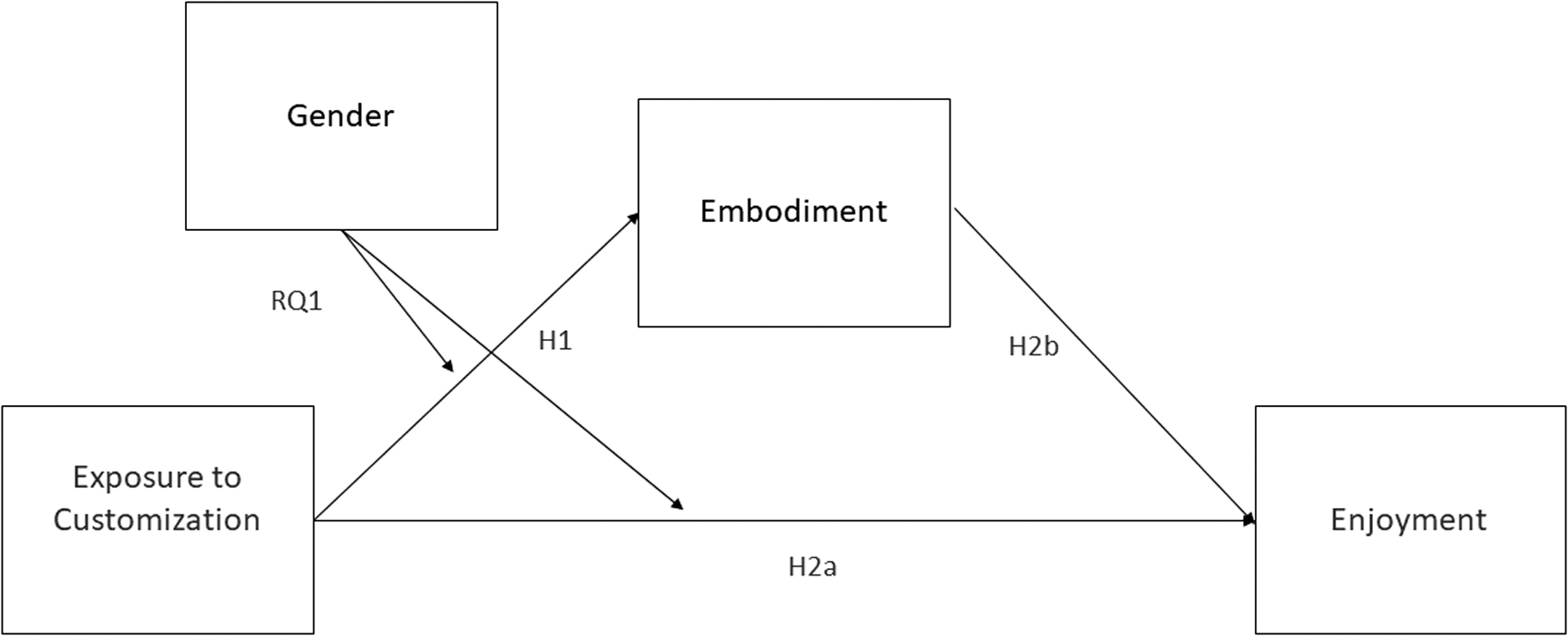
Conceptual model.
Method
This study received ethical approval from the University of Delaware's Institutional Review Board.
Data collection was conducted using an online survey, with avatar customization for each video game asked about in the survey determined by a prior content analysis.
Content analysis
The top eight best-selling games between 2017 and 2022 were selected based on a list of top-selling games according to npd.com.13–19 YouTube videos for each game were used to code for the game's level of customizability.
Coding procedures
Two graduate student coders were used to determine the level of customization allowed for each game. The codebook operationalized five different levels of customization depending on the alterations one can make to a game character at the start of each game:
No customizability (0)
No or very little customization of the game's main avatar. The avatar's traits and looks are based on default settings within the game.
Minimal customizability (1)
Players can choose certain features of their avatar at the start of the game such as changing name, gender, outfits, or equipment; and can include the choice of multiple preset characters.
Moderate customizability (2)
Players can change their avatar's name, clothes, hair, face, or gender, but appearance can only change minimally. Players are unable to change individual features of appearance (such as selecting eyes or noses). Players also have options to choose character attributes such as skills, abilities, or classes.
High customizability (3)
Players can customize many features of their avatar's appearance, including choosing individual facial features, hair, gender, clothes, and equipment. Players have options to choose a few character attributes such as personality attributes, skills, abilities, classes, and more.
Total customizability (4)
Players can completely customize their avatar's appearance, including adjusting different facial features (eyes, nose, cheekbones, and lips), hair (style/color), skin color, body type (not necessary), clothes, and equipment. Includes highly customizable character attributes, with many options for personality, background, skills, abilities, class, and race.
Coder training and reliability
Coders trained on 10 games that came from years previous to the sample years of 2017–2022. Krippendorf's alpha was used to determine reliability on the 5-level customization item, and reliability was achieved as α = 1.00. In addition, 20 percent of the full sample was double coded to recheck reliability, which was acceptably high at α = 0.947.
Online survey
Participants
Survey respondents were 153 undergraduates who received course credit for their participation. Participants were only eligible for the study if they reported playing a video game in the past year. Gender identities included 94 (61.44 percent) women, 54 (35.29 percent) men, 3 (1.96 percent) nonbinary, and 2 (1.31 percent) preferred not to say.
Survey measures
Embodiment
Participants rated avatar embodiment based on a 5-item 11-point Likert scale 4, which asked them to respond to statements that indicated to what extent they felt embodiment. The scale responses ranged from (0) did not feel it at all to (10) felt it very much (mean [M] = 3.12, standard deviation [SD] = 2.83, and Cronbach's α = 0.95).
Enjoyment
The scale for enjoyment was adapted to fit the context of the study. 8 This scale is an 11-point Likert scale with items concerning overall video game enjoyment, which has responses that range from (0) strongly disagree to (10) strongly agree (M = 5.90, SD = 2.26, and Cronbach's α = 0.94).
Gender
Participants were asked to indicate their gender from the options: “Man,” “Woman,” “Nonbinary,” “Prefer not to answer,” or “Other.” Five cases who responded something other than woman or man were not included in the analysis, leaving a binary (men = 0 and women = 1) version. This choice was made not to assume a gender binary, but due to the small number of respondents, statistically their inclusion would potentially lead to incorrect conclusions. Rather than risk error in the analysis of this group's experiences, the choice was made to remove them.
Gaming frequency
Participants were asked, “On average, how much time do you spend playing on a computer and/or video games per day?” with response options of “never,” “less than one hour,” “one to two hours,” and “three hours or more” (M = 2.12, SD = 0.84).
Exposure to customization
Participants were presented with all 48 games in the coded sample and asked to indicate if they have ever played each game within the past 5 years (yes or no). For each they indicated yes, they were then asked how often they played it on an 11-point Likert scale from (0) never to (10) very often (M = 4.96 and SD = 2.73). Each game was given a score based on its level of customizability using the content analysis; no customizability = 0 (n = 24 games coded), minimal customizability = 1 (n = 3), moderate customizability = 2 (n = 2), high customizability = 3 (n = 7), and total customizability = 4 (n = 12).
This score for each game was then multiplied by the frequency that a participant indicated playing the game, to create a per-game customization exposure score for each participant across the 48 games. Participants' scores on all 48 games were then averaged (with never playing a game treated as 0) to give an overall score for exposure to customization. Exposure scores (M = 2.99, SD = 3.6) were positively skewed (2.16) and kurtotic (8.23). The ladder function in Stata suggested a square root transformation for this measure. This transformed version (M = 1.45, SD = .94) is used in the analysis of the hypothesized model, and is no longer non-normal (skew = 0.74, kurtosis = 3.42). 20
Analysis and Results
The Hayes PROCESS macro in SPSS 21 was used with 5000 percentile-based bootstrapped samples. Mediation analysis (Model 4) was used to test the hypotheses and conditional process analysis (Model 8) was used to answer RQ1. Gaming frequency was a covariate in both models and gender identity was a covariate in the mediation-only model. Table 1 includes full statistical results for the mediation analyses. H1 and H2 were unsupported as customization was not significantly associated with embodiment nor indirectly related to enjoyment with embodiment as a mediator. H2a was supported, in that there was a significant direct effect of customization exposure on enjoyment, but it was not significantly mediated by embodiment.
Mediation Analysis
Exposure to customization was square root transformed, coefficients reported are unstandardized; CIs are 95% confidence. Significant coefficients at p < 0.05 are bolded for ease of interpretation.
CI, confidence interval.
Table 2 includes full statistical results for the moderated mediation analysis with gender added as a first-stage moderator of both the indirect and direct effects, in relation to RQ1. Gender did not significantly moderate the relationship between customization exposure and embodiment. It did, however, significantly moderate the direct effect between customization exposure and enjoyment, such that the relationship between customization and enjoyment was significant and positive only for women. It was not significant for men.
Conditional Process Analysis
Exposure to customization was square root transformed, coefficients reported are unstandardized; CIs are 95% confidence. Significant coefficients at p < 0.05 are bolded for ease of interpretation.
CI, confidence interval.
Discussion
Previous research suggests that the ability to customize a character in a digital game increases that game's value in several ways.22–24 This study adds to this literature by finding evidence for a linear effect that as players are increasingly exposed to more customization options, they will also increase in video game enjoyment. Previous literature often evaluates customization as either a game having absolutely no customization option or some miscellaneous amount of customizable options22,23; however, the quantity and quality of customization in a game can vary. The other major finding in this study is that the relationship between exposure to customization and enjoyment differs depending on the participant's identified gender, indicating that there may be additional gender preferences in video games, where one gender enjoys one of many features (i.e., customization) of gaming more than the other.
Limitations and future directions
This study was limited by its methodology, as it was taken online, requiring participants to recall their experience with whatever games they indicated playing from the survey's list of games. It is expected that participants played games outside of what was selected for the survey, especially in considering the skewness of the distribution.
The content analysis only examined the level of customization available in each game; we did not evaluate other possible differences between games that could threaten the validity of the study, such as including the general quality of the game's design or if the games included a strong narrative aspect. Forty-eight games were represented in the content analysis, which include a wide variety of genres, playing styles, consoles, and narratives. We see this as adding what is hopefully random variance to our analysis, and not necessarily systematic variance. Despite these limitations, this study provides an exploration of relationships between customization, gender, and enjoyment that can act as a jumping-off point for further inquiry.
Footnotes
Author Disclosure Statement
No competing financial interests exist.
Funding Information
There is no funding associated with the work featured in this article.