




Abstract
Previous studies have examined the relationship between social media and extroversion, often relying on correlational designs. This study introduced a social media induction procedure to examine the relationship between social media and extroversion with an experimental design. In a procedure adapted from the personality research literature, participants used a written prompt to imagine themselves as a social media influencer and were then asked to use social media with this mindset. Participants' extroversion was measured before and after this activity using the Big Five Inventory. The results show that this social media induction procedure resulted in increased reports of extroversion after the task, and this post-task change was not predicted by other related social media factors (such as hours of social media use per day). These results complicate the assertion that differences in social media use between extroverts and introverts are due to its stronger appeal to extroverts.
Introduction
As social media becomes more ubiquitous, considerable research has been dedicated to understanding how these platforms affect human behavior. Many studies have explored the relationship between social media and individual differences, such as how personality factors might affect engagement with social networking sites (SNSs). One common finding has emerged in the literature: extroversion is correlated with increased SNS use.2–4 As defined by the Big Five Personality model, 5 extroversion describes an individual's sociability, assertiveness, and energy level, with extroverts ranking high in these characteristics.
In a review by Bowden-Green et al., 6 extroverts were more likely than introverts to use social media, spend longer lengths of time on social media, and interact with others on social media platforms. A separate meta-analysis found that more than any other personality indicator, SNS use predicted extroversion scores, with individuals spending more time on SNSs also showing higher rates of extroversion.
One explanation for the relationship between SNS use and extroversion is that extroverts may use social media due to their desire for more social attention, engaging in conversations that provoke meaningful discussion, and a need to be surrounded by people who share commonalities. 6 For example, many of the behaviors that are encouraged by SNSs (e.g., communicating with others, meeting new people) are analogous to offline behaviors that are sought by extroverts. 7
The correlational nature of much of the literature has limited the conclusions that can be drawn about how social media affects personality. Discerning the causal effects of extroversion is particularly difficult given that personality connotes a longstanding pattern of behavior (i.e., traits) rather than moment-to-moment states. However, extroversion has been shown to constitute both state and trait characteristics.1,8,9 In other words, an individual who is an introvert can report high levels of extroverted behavior and self-perception and vice versa. 10 Margolis and Lyubomirsky 1 found that an extroversion-induction task created temporary changes in state extroversion.
Participants were instructed to imagine themselves as extroverts (or introverts, based on random assignment) and engage in extroverted behaviors (e.g., be “talkative, assertive, and spontaneous”) for 1 week. Participants reported higher levels of extroversion when asked to retake a personality inventory afterward. Similar induction tasks have been used for other psychological constructs, such as mood 11 and stress. 12 If the relationship between extroversion and social media use is causal (i.e., extroversion leads to increased SNS use, or SNS use leads to increased reports of extroversion), then a social media induction task may show higher levels of state extroversion after imagining themselves in a situation where they are a frequent social media user.
The purpose of this study is to explore the relationship between extroversion and social media use by adapting Margolis and Lyubormirsky's extroversion-induction task 1 such that participants were asked to imagine themselves as a popular and active social media user (i.e., an “influencer”), with participants' extroversion measured before and after the task. This social media-induction task would require participants to engage in behaviors common among extroverts on social media, such as creating content, engaging with social trends, and achieving social goals, such as an increased number of followers on their social media profiles. 6
This direct experimental manipulation would provide some insight into the relationship between extroversion and social media use, but without the correlational designs that limit causal inferences. We hypothesized individuals would report higher levels of extroversion after engaging with this adapted “influencer prompt.”
Methods
Participants
Participants were 82 college students from Westfield State University, receiving extra credit in a psychology course for their participation in a study approved by the University's Institutional Review Board. A total of 15 participants were excluded from the final analysis for not following directions or for a majority of incomplete responses submitted after a unanimous independent review from the coauthors. The final analysis included 67 participants (60 percent women; M age = 21.06 years, standard deviation [SD] age = 3.65).
Procedure
Participants were asked a series of demographic questions that included age, gender, and current major. Participants were then given a series of exploratory questions related to their SNS usage followed by an extroversion personality inventory. After this, participants were presented with a guided imaginative prompt that asked them to imagine themselves as a social media influencer.
After this prompt, participants used a social media app of their choice to engage with an SNS, imagining themselves as a social media influencer through social media with the SNS being chosen at their discretion. Participants were then asked to list between three and five specific ways that they could imagine incorporating this influencer mindset into their own social media use. Afterward, participants were presented again with an extroversion personality inventory.
Measures
To measure participants' extroversion, participants were instructed to complete a subscale of the Big Five Inventory (BFI) targeting only extroversion items. 13 The BFI was originally developed to measure the broad personality traits of extroversion, openness, conscientiousness, agreeableness, and neuroticism. From the larger 44-item inventory, participants were given the 8 items measuring extroversion characteristics. Participants responded to each item on a scale of 1 to 5, with 1 representing “disagree strongly” and 5 representing “agree strongly.” 13 Participants were asked to consider how much they saw themselves as someone who “is reserved,” “is full of energy,” or “tends to be quiet.” 13
In addition to personality factors, information about SNS use was also collected. Participants were asked what SNS they used most, how much time per day they spent on their most-used SNS, how many followers they had on their most-used SNS, and how many people they followed. Finally, they were asked how much time they spent creating content for social media on all of their applications combined each day. Participants completed these questionnaires through an online survey taken on their phones, using their own social media accounts, to better simulate the experience of engaging in social media in the real world.
Influencer Prompt
Participants were instructed to follow a written prompt created for the specific purpose of this experiment. The purpose of this prompt was to induce an influencer social media mindset in participants based upon imaginative prompts used in previous literature. 1 Participants were asked to imagine themselves as a social media influencer while scrolling through various social media applications for 10 minutes, to specifically imagine themselves posting on social media, interacting with large number of people, and creating content for their platform, and to think of three to five ideas of how and when they would incorporate these behaviors into their content creations. Some ideas could include, “I will interact with my comment section for 5 minutes,” or “I will spend the next 20 minutes taking pictures to post on my Instagram story.”
Results
Participants reported TikTok as their most-used social media platform (48.5 percent) followed by Instagram (27.9 percent), Snapchat (13.2 percent), Facebook (4.4 percent), Twitter (2.9 percent), Youtube (1.5 percent), and Reddit (1.5 percent). Participants' amount of time spent on these applications averaged 2.4 hours (SD = 1.4 hours). When asked whether participants felt this was an accurate portrayal of their use of social media, 45.6 percent of the sample answered “yes.” Responses were grouped based on those who answered “yes” or “no” to the previous question. An independent t-test found no difference in the change-in-extroversion score (post-test subtracted from pretest) and their response of “yes” or “no,” t(65) = −1.68, p = 0.1.
Comparing the pretest and post-test scores of extroversion, participants reported higher levels of extroversion after the social media induction, as shown by a paired-samples t-test, t(51) = 2.45, p < 0.05, d = 0.34. These data are shown in Figure 1. No other personality traits were scored during this research and only the extroversion-related questions were used to determine these results.
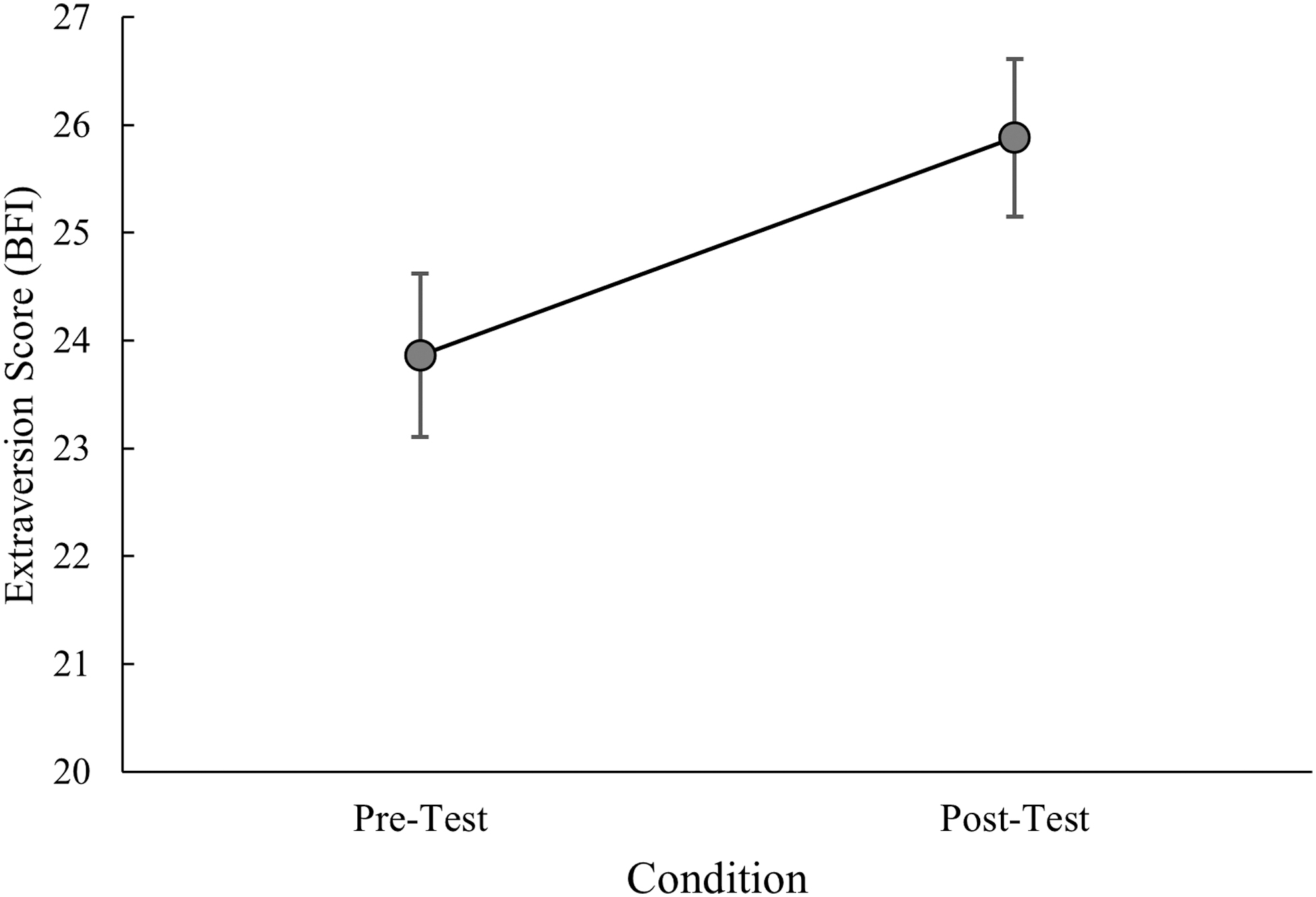
The before and after effects of social media intervention on extroversion. The error bars represent the 95 percent confidence intervals.
An exploratory regression analysis was conducted to examine any potential factors that may have contributed to these data. This linear regression included the predictors of age, gender, time spent on social media, and social media followers, and used change in score (postinduction scores subtracted by preinduction scores) as the dependent variable. The regression failed to predict change in score, F(4,62) = 0.25, p = 0.91, and none of the individual factors significantly predicted change in extroversion scores, p's > 0.52.
Discussion
This study found that participants self-reported more extroverted attitudes after imagining themselves using social media as an influencer. Even though this study required participants to imagine themselves as an influencer for only 10 minutes, BFI scores for extroversion consistently rose after this intervention, although further study is warranted to determine how long-lasting these effects are. Although we do not suggest that a brief 10-minute intervention resulted in permanent changes to trait extroversion, these findings mirror similar research that found an extroversion induction resulted in participants reporting higher levels of state and trait extroversion. 1
Like in that study, we found modest effect sizes from self-reported BFI scores, suggesting that these short-term changes are not likely to result in dramatic changes in behavior. An exploratory linear regression model found none of the other variables collected (e.g., age, gender, and average daily social media use) predicted the degree to which extroversion scores increased after the intervention. This offers insight into the directional relationship between SNS use and extroversion; SNS use with a highly engaged mindset (i.e., an influencer) leads to more extroverted behavior. This study's data suggest that introverts may benefit from short-term increases to state extroversion, which is correlated with positive affect 14 and autonomy. 1
These findings are in agreement with previous research establishing a relationship between extroversion and increased SNS use.6,15,16 Lee et al. 17 recently found that increased rates of trait extroversion predicted activity and engagement in virtual-reality chat meetings (i.e., Zepeto). These converging lines of evidence suggest that SNS use is appealing to extroverts because they are able to engage with others directly, simulating their otherwise offline behaviors. An alternative explanation of the current data could be that increased technology use, rather than specifically SNS use, resulted in higher state extroversion scores, but this seems unlikely, as highly online individuals (such as e-sports athletes) are not necessarily more extroverted compared with their more offline counterparts. 18
However, there are limitations that should be considered when interpreting this study's results. First, the exploratory nature of the study used a limited sample size; it is difficult to draw generalizations to the hundreds of millions of individuals worldwide who incorporate social media into their daily lives from this sample. Second, this study used exploratory questions about social media use (e.g., “How much time do you spend on your most-used social media application?”); whereas these questions were not the primary interest of this study, a standardized psychometrically balanced inventory for asking questions about social media use would have been desired.
Another limitation to consider is the homogeneity of the current sample; this study recruited from an American New England public university, which does not represent the vast diverse audiences that use SNSs.
Future research might seek to further explore the role of individual differences in SNS use. The present social media induction task could be further adapted to examine how SNS affects other individual differences beyond personality traits, such as depression or anxiety. This study did not directly measure other cyberpsychology-relevant constructs such as fear of missing out or SNS addiction, both of which might shed further insight into this relationship.
It is still unknown how platform-specific these results may be; even though the most popular SNS platform for participants in this study was TikTok, there may be individual differences specific to those applications and user bases. Future research might further explore the degree to which these effects depend on their unique platforms, and how much of these effects are more broad and platform agnostic in nature.
Footnotes
Acknowledgments
The authors thank Jaden Smith and Tatum Morey for assistance in data collection.
Author Disclosure Statement
No competing financial interests exist.
Funding Information
No funding was received for this article.