




Abstract
This study investigated the association between parental phubbing and adolescents' smartphone addiction, the mediating role of depression, and the moderating role of perceived school climate in the association. Seven hundred forty-two Chinese adolescents (Mage = 12.97, SD = 0.64, 45.55 percent female) were recruited and self-reported questionnaires were administered. Results indicated that parental phubbing was positively associated with adolescents' smartphone addiction. Depression partially mediated the above relation. Further, perceived school climate moderated the relation between parental phubbing and depression, such that the positive association between parental phubbing and depression was stronger among adolescents who perceived their school climate as more negative (vs. positive). The findings deepened our understanding of the relation between parenting behaviors and adolescents' smartphone addiction and implications for interventions and practices were discussed.
Introduction
Phone addiction—the obsessive use of smartphone1,2—is often accompanied by the emergence of psychological and behavioral problems, such as reduced sleep quality, impaired cognitive function, and increased anxiety and depression.3–7 Adolescents are at higher risk of smartphone addiction given their high sensation seeking and low impulse control at this age stage.8,9 The trend of smartphone penetration has become more prevalent among young population. As of November 2022, the proportion of underage Internet users with their own Internet access devices (primarily smartphones) reached 86.7 percent. 10 Extant research has investigated smartphone addiction among college students. Nonetheless, relevant studies that understand the potential factors that are related to adolescents’, especially middle school students' smartphone addiction have been limited. Therefore, this study aimed to explore the potential mechanisms among parental phubbing, perceived school climate, depression, and smartphone addiction in adolescents.
Parental phubbing and smartphone addiction
Parental phubbing refers to parental behavior that spending too much time and attention on their smartphones thus ignoring their children. 11 Parental phubbing may elicit children's smartphone addiction for a few reasons. First, children acquire behaviors through observational learning. 12 Hence, adolescents who have experienced parental phubbing may internalize such behavioral norms and show a greater intention to use smartphones.13–15 Additionally, according to social control theory, family plays a crucial role in regulating adolescent deviant behavior. Parents who are distracted by their mobile phones may fail to timely supervise and correct children's deviant behaviors, 16 which may result in higher levels of smartphone addiction. Empirical studies have identified parental phubbing as a risky factor for adolescents' problematic smartphone use.11,17–19 Thus, we hypothesized that parental phubbing would be positively associated with adolescent smartphone addiction (Hypothesis 1).
The mediating role of depression
Depression refers to the state of loss, frustration, or sadness in adverse situations and events. The context-process-outcomes model suggests contextual factors (e.g., parental behaviors) may impact adolescent development outcomes through individuals' psychological processes. 20 Specifically, parents who spend too much attention on their smartphones may neglect their children's needs, 21 resulting in insecure parent–child relationship and poor parent–child interactions,22,23 which may lead to adolescents' undesirable outcomes such as anxiety and depression. 24 In turn, depression may hinder individuals' self-regulation and increase adolescent's susceptibility to smartphone addictive behaviors.25–30 Based on the evidence above, we anticipated that parental phubbing would be positively related to adolescent depression, which, in turn, would be positively related to adolescent smartphone addiction (Hypothesis 2).
The moderating effect of perceived school climate
According to the ecological systems theory, individual development is the product of the interaction between the individual and different layers of environmental systems, among which family and school settings represent two key microsystems of adolescents' social interaction contexts. 31 A positive school climate may protect adolescents from excessive smartphone use. For example, adolescents whose peers and teachers provide sufficient emotional support may have less likelihood of developing smartphone addiction given positive school climate could compensate for parental ignorance and rejection.32,33
Nonetheless, adolescents who experience parental neglect due to parental phubbing and hostile school climate may face a higher possibility of smartphone addiction, as both contextual factors may hinder adolescents' adaptive development in a cumulative way. 34 Therefore, we hypothesized students' perceived positive school climate would buffer the positive relation between parental phubbing and depression, and the positive relation between parental phubbing and smartphone addiction. However, these positive relations would be stronger among adolescents who perceive their school climate as less supportive. (Hypothesis 3; see Fig. 1 for a conceptual model).
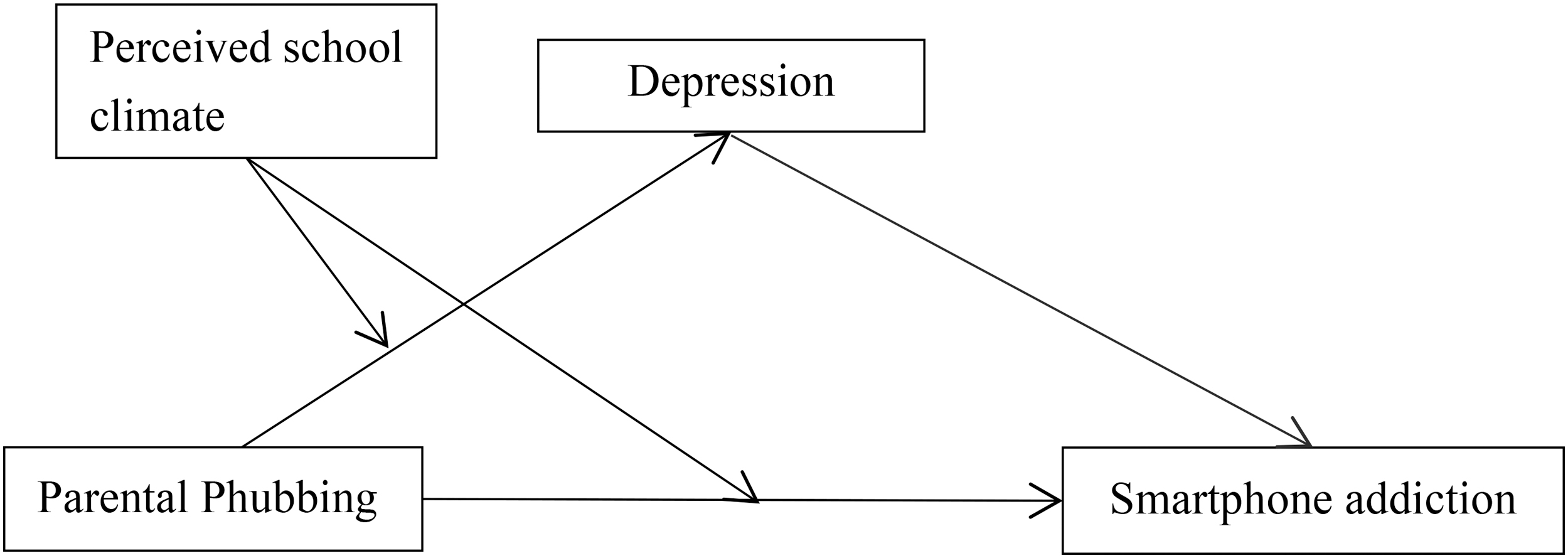
The conceptual model.
Methods
Participants and procedures
Participants were 742 Chinese middle school students (Mage = 12.97, SD = 0.64, 45.55 percent female) that were recruited from one secondary school in Southeast China through convenience sampling. Informed consents were obtained from students before data collection, and online questionnaires were completed by participating students at a computer classroom under the guidance of school teachers.
Measures
Key variables
Parental phubbing was measured by the revised Phubbing Scale (e.g., “When I am with my parents, they keep their phones where they can see them.”) which was rated on a 5-point Likert scale (1 = never, 5 = always). 14
Depression was assessed using the 9-item Patient Health Questionnaire-9 (e.g., “Feeling down, depressed, or hopeless.”) on a 4-point Likert scale ranging from 0 (not at all) to 3 (nearly every day). 35
Smartphone addiction was measured using the 16-item Mobile Phone Addiction Tendency Scale for College Students (e.g., “I feel uncomfortable when I don't use cellphone for a long time”) that was rated on a 5-point Likert scale ranging from 1 (very nonconforming) to 5 (very conforming). 36 This measure has been used to assess smartphone addiction among middle school students and has shown acceptable reliability and validity.37,38
Perceived School Climate was assessed by the 38-item Perceived School Climate Inventory (e.g., “School teachers truly care about students”) that was rated on a 4-point scale ranging from 1 (not at all) to 4 (completely). 39
For each key concept, item scores were summed to create a composite score, with higher scores representing high levels of the measured concept.
Covariates
Covariates included gender (0 = male, 1 = female), age (in years), and subjective socioeconomic status (SES), as those variables were found to be related to smartphone addiction. 40 SES was measured using a 10-step ladder, where a score of 1 represents participants perceiving themselves as belonging to the most economically disadvantaged group, and a score of 10 represents the group with the highest income. 41
Results
The Harman single-factor test was performed to detect common method bias, results that showed 11 factors with a characteristic root of more than 1, and the variance explained by the most significant factor was 25.27 percent, indicating a nonsignificant standard method bias among our participants. 42
Table 1 presents descriptive statistics and correlations among variables. Parental phubbing was positively correlated with depression and smartphone addiction, and negatively with perceived school climate. Depression was positively correlated with smartphone addiction and negatively with perceived school climate.
Descriptive Statistics and Correlations Between Variables
Note: α = Cronbach's alpha; Gender was coded that 1 = Female and 0 = Male.
p < 0.01; ***p < 0.001.
DPN, depression; PP, parental phubbing; PSC, perceived school climate; SA, Smartphone addiction; SES, subjective socioeconomic status.
SPSS Hayes' PROCESS Model 4 and Model 8 were used to examine the hypothesized mediation and moderated mediation associations, respectively.
Parental phubbing was positively associated with smartphone addiction (β = 0.40, p < 0.001) and depression (β = 0.37, p < 0.001). Additionally, depression was positively associated with smartphone addiction (β = 0.46, p < 0.001). After including the mediation path, the association between parental phubbing and smartphone addiction remained significant (β = 0.23, p < 0.001), indicating depression partially mediated the relation between parental phubbing and smartphone addiction (indirect effect = 0.17, SE = 0.02, 95% CI = [0.13–0.22]). The mediation model accounted for 42.50 percent of the total effect of parental phubbing on smartphone addiction (Table 2).
Testing for Mediation
p < 0.05; **p < 0.01; ***p < 0.001.
Results of the moderated mediation showed that perceived school climate moderated the relation between parental phubbing and depression (β = −0.07, p = 0.02), but did not moderate the relation between parental phubbing and smartphone addiction (β = 0.04, p = 0.15; Table 3). Simple slope analyses showed that the relation between parental phubbing and depression was significant among adolescents with a low (β−1SD = 0.40, p < 0.001) and high (β+1SD = 0.26, p < 0.001; Fig. 2) perceived school climate, but the relation was weaker among adolescents who perceived a positive perceived school climate.

The associations between parental phubbing and depression at different levels of PSC. PSC, perceived school climate.
Testing for Moderated Mediation
p < 0.05; ***p < 0.001.
CI, confidence interval; M, mediator; W, moderator; X, predictor; XW, interaction between predictor and moderator.
Discussion
To better understand the individual and contextual factors of adolescents' smartphone addiction, we examined the relations between parental phubbing, adolescent depression, perceived school climate, and smartphone addiction. Partially consistent with our hypotheses, depression partially mediated the positive relation between parental phubbing and smartphone addiction. Furthermore, the positive association between parental phubbing and depression was stronger among adolescents with a negative (vs. positive) school climate.
Consistent with existing theories and empirical evidence, adolescents with more “phubbing” parents are more likely to experience smartphone addiction.11,14,17,18 More importantly, the relation between parental phubbing and adolescent smartphone addiction is partially mediated by adolescent depression. As a form of social exclusion, parental phubbing may threaten adolescents' needs of connection and interpersonal communication, 22 which would induce higher levels of depression.43,44 Consequently, adolescents may turn to smartphones as a maladaptive coping strategy for depression, which may exacerbate smartphone addiction.27,45
More importantly, we found positive school climate may buffer, whereas negative school climate may exaggerate, adolescent depression in the context of parental phubbing. This finding emphasizes the importance of social contexts beyond the family settings in adolescent development 46 and demonstrates the interactive nature of multiple social contexts that are related to adolescent development. 31 Nonetheless, we failed to find a similar moderating role of school climate in the relation between parental phubbing and smartphone addiction. Noteworthy, we examined perceived school climate as a unified rather than multidimensional concept. To have a more profound understanding regarding the association between parental practices and students' smartphone addiction, future studies may benefit from looking into the more nuanced aspects of school climate as separate moderators in this association.
The study findings need to be interpreted with cautious. First, this study used a cross-sectional design and causal conclusions cannot be made. Replications with longitudinal designs are needed. In addition, the data were exclusively collected from adolescents' self-reports, future studies may consider collecting data from multiple reporters (e.g., parents, peers, and schoolteachers) and through strategies (e.g., utilizing mobile applications and systems to collect smartphone use data 47 ) to capture the examined concepts comprehensively.
Although these limitations, this study was the first to investigate the association between parental phubbing, depression, school climate, and adolescent smartphone addiction among Chinese adolescents. Our findings have several practical implications. Parents need to be cautious with their smartphone usage and reduce the frequency of phubbing when interacting with their children. 48 In addition, parents, teachers, and schools should pay attention to promoting adolescents' positive emotionality and adaptive coping strategies, as negative emotions such as depression may render adolescents more susceptible to smartphone addiction. Last but not least, teachers and schools should pay attention to constructing a nurturing and supportive environment and improving teacher–student and student–student relationships, 33 as such climate may benefit students' optimal development, especially for adolescents with unsupportive parents.
Overall, the current study provides the first attempt to identify the significant roles of parental phubbing, depression, and perceived school climate in adolescent smartphone addiction by investigating a mediated moderated mechanism. Our finding indicated that depression mediated the association between parental phubbing and smartphone addiction, and perceived school climate moderated the indirect effect of parental phubbing on smartphone addiction through depression and regulated the first half of the path of the mediating model. The findings contribute to a deeper understanding of the development of smartphone addiction and can inform related prevention and intervention efforts.
Notes
1. A prior power analysis was conducted using G*Power 3.1.9 to determine the appropriate sample size. With 7 predictors, a sample size of 103 is sufficient to achieve 0.80 power with a medium effect size (ƒ 2 = 0.15).
Footnotes
Acknowledgments
The authors wish to thank the study participants, as well as the many research assistants who contributed to this project.
Authors' Contributions
Y.T.: Writing-original draft, writing—reviewing and editing, formal analysis. H.Z.: Conceptualization, methodology, investigation, supervision writing—reviewing and editing, funding acquisition. J.X., Y.Z., and T.D.: Writing—reviewing and editing.
Submission Declaration and Verification
The work described has not been published previously, and it is not under consideration for publication elsewhere. Its publication is approved by all authors and tacitly or explicitly by the responsible authorities where the work was carried out. If accepted, it will not be published elsewhere in the same form, in English, or in any other language, including electronically without the written.
Human Participants
All procedures performed in studies involving human participants were in accordance with the ethical standards of the institutional and/or national research committee and with the 1964 Helsinki declaration and its later amendments or comparable ethical standards.
Ethics Approval Statement
This study was approved by Institutional Review Board at Nanjing Normal University.
Informed Consent
Informed consent was obtained from all individual participants included in the study.
Data Availability Statement
Data that support the findings of this study are available from the corresponding author upon reasonable request.
Author Disclosure Statement
The authors declare that they have no conflict of interest.
Funding Information
This study was supported by the National Natural Science Foundation of China (32100868), the Social Science Foundation of Jiangsu Province in China (23SHC015), the project of higher adult education reform in Nanjing Normal University (2022NSDJG032), and the outstanding teaching team of the “Qing Lan Project” of universities of Jiangsu Province—Students Psychological Development and Education.