




Abstract
Social media and health research have covered the benefits for the public and patients as users. Specifically, this has focused on searching for health information, connecting with others experiencing similar health issues, and communicating with their health professionals. Recently, there has been a shift in research to focus on health care professionals as users as they participate in professional development, improve communication with patients, and contribute to health research and service. However, such research has predominantly focused on text-based platforms, namely Facebook and Twitter. The scope of this article is a systematic review of publications on health care professionals' use of the image-based platform Instagram, according to the preferred reporting items for systematic reviews and meta-analyses guidelines. This study, drawing from 51 articles, shows how health care professionals use Instagram, and reveals that these professionals utilize the platform to address health concerns that may not necessarily align with their specific expertise. Images were the common format of posts created by health care professionals, with six content types identified: (a) educational, (b) promotional, (c) patient experience, (d) personal, (e) emotion based, and (f) other. Three measures of post engagement were used by researchers, including (a) likes and comments, (b) use of hashtags, and (c) number of followers. This study also identified the dangers of misleading users, including (a) lack of credentials reported, (b) edited images, (c) quality of content, and (d) patient and client confidentiality issues. In conclusion, insights into the advantages of health care professionals' use of Instagram and ways in which they can maximize its use to reach and engage with their target audience are provided.
Introduction
Health research over the last decade has reported on the use of social networking sites (SNSs) to search for health information, 1 communicate with health care professionals, 2 and connect with others experiencing similar health issues.3,4 Recently, there has been a shift in research focus from patients as users, to health care professionals as users. SNSs have been found to be beneficial for hospitals and practices to engage with service users,5,6 and for health care professionals to participate in professional development, improve communication with patients, and contribute to public health research and service.7–9 However, its use also comes with challenges of inefficiency, privacy concerns, poor information quality, and blurred professional boundaries. A common concern is the ethical and legal implications of inappropriate use9–12 due to limited ethical guidelines and social media training for health care professionals.8,13
Most research on SNS use in health care covers principally text-based platforms, namely Facebook and Twitter. While SNSs such as Facebook, Instagram, LinkedIn, and Twitter often share common elements, they also differ in the content shared, its delivery, and terminology used.14,15 The image-based SNS, Instagram, has shown to be increasingly popular and gaining traction with health organizations and professionals.16–18 Instagram users create a profile where they can share visual updates about almost anything. Images have been found to be useful on SNSs to help educate and tell a story, without requiring a lot of space or being limited by character restrictions found with Twitter. 19
It is essential that Instagram be included in research on SNS use for health, given its distinctiveness from other frequently studied platforms. Importantly, the age group of Instagram users is lower than that of other popular SNS platforms, with 71 percent of 18- to 29-year-olds predominantly using Instagram compared with Facebook, where 77 percent of users are aged 30–49 years. 20 This younger cohort of users may be more susceptible to fake news, and may not have any guidance on how to identify and navigate misinformation. 21
Although there are some reviews evaluating the use of SNSs for health,22,23 no systematic reviews have focused on Instagram use by health care professionals. Therefore, the aim of this review was to bridge a critical gap in the existing literature by uncovering the ways in which health care practitioners use Instagram while identifying any challenges with its use. It was expected that the findings would recognize opportunities for further research, ensuring the responsible and accurate dissemination of health-related information to users within online communities.
In addition, this study aims to uncover the professional benefits and safety considerations associated with health care professionals' use of Instagram in their practice. By offering evidence-based insights and informed recommendations, an anticipated outcome is to equip health care professionals with the essential knowledge to facilitate the effective use of Instagram in their profession.
Methods
A systematic search according to the preferred reporting items for systematic reviews and meta-analyses (PRISMA) guidelines 24 was conducted in June 2022 to identify studies that described the use of Instagram by health care professionals. Selected as the major health and medical field repositories for peer-reviewed scholarly research, the following online databases were searched: Cinahl, Medline, ProQuest, ScienceDirect, and Scopus. The search was limited to the years spanning from 2004, when Instagram was founded, to June 1, 2022, and focused on finding health- and medical-related publications using the keyword “Instagram.” The keywords “social media” and “social networking sites” were not used as we limited the parameters of the search to Instagram only. Reference lists of selected articles were also manually searched for additional records. Titles containing “Instagram,” “social media,” “social networking,” and “health professional” were assessed for eligibility.
Inclusion criteria were if findings (a) reported on the use of Instagram, and (b) identified users of at least one health care profession (in any health care field). Our search only included peer-reviewed publications written in English and excluded publications that were not original research (e.g., book, review, or conference abstract).
Articles from the database and reference list searches were exported into web-based software Covidence. 25 One reviewer (K.L.A.) scanned all entries to apply the exclusion criteria. To establish the relevance for inclusion in the study, the remaining records were independently screened by K.L.A. and M.B. Discrepancies were resolved through discussion and mutual agreement. To assess the eligibility of the articles, K.L.A. completed the extraction table, which was then supplemented and confirmed by M.B. (Supplementary Table S1). Data extraction was completed in early December, with an additional search conducted on December 14, 2022, to ensure the review was inclusive of the latest research. The same search strategy described above was used, searching the dates between June and December 2022. Figure 1 presents a PRISMA flow diagram of the screening process.

PRISMA flow diagram. PRISMA, preferred reporting items for systematic reviews and meta-analyses.
After data extraction, K.L.A. and M.B. finalized the list of articles to be included in the review through discussion and mutual agreement. Given the heterogeneity of the findings in the included articles, no formal assessment of study quality or statistical analyses was performed. The extracted data, content, features, and concepts across the included articles were discussed by K.L.A. and M.B., and results descriptively synthesized.
Results
The initial search in June resulted in 7,392 articles exported into Covidence. A total of 1,530 duplicates and 5,769 articles that did not meet our criteria were removed. A total of 93 full-text articles were obtained for analysis, with 36 articles meeting the inclusion criteria for data extraction (Supplementary Table S1). The secondary search in December resulted in 1,982 articles exported into Covidence, with 147 duplicates and 1,787 ineligible articles removed. An additional 15 articles were included in the extraction table (n = 51).
User demographics
Location
Several studies were inclusive of international user profiles,26–37 and only few specified the location of profiles, namely Turkey17,38 and the United States.39–44
Health care professionals as Instagram users
The health issues identified from the articles were broadly grouped into categories. Figure 2 illustrates the number of different health care professionals posting content for these health categories. For example, different health care professionals made posts related to infertility, including embryologists, reproductive and nonreproductive endocrinologists, nurses, midwives, 16 psychologists, and physicians. 45 The health categories and specific health care professions identified in the articles are detailed in Table 1.
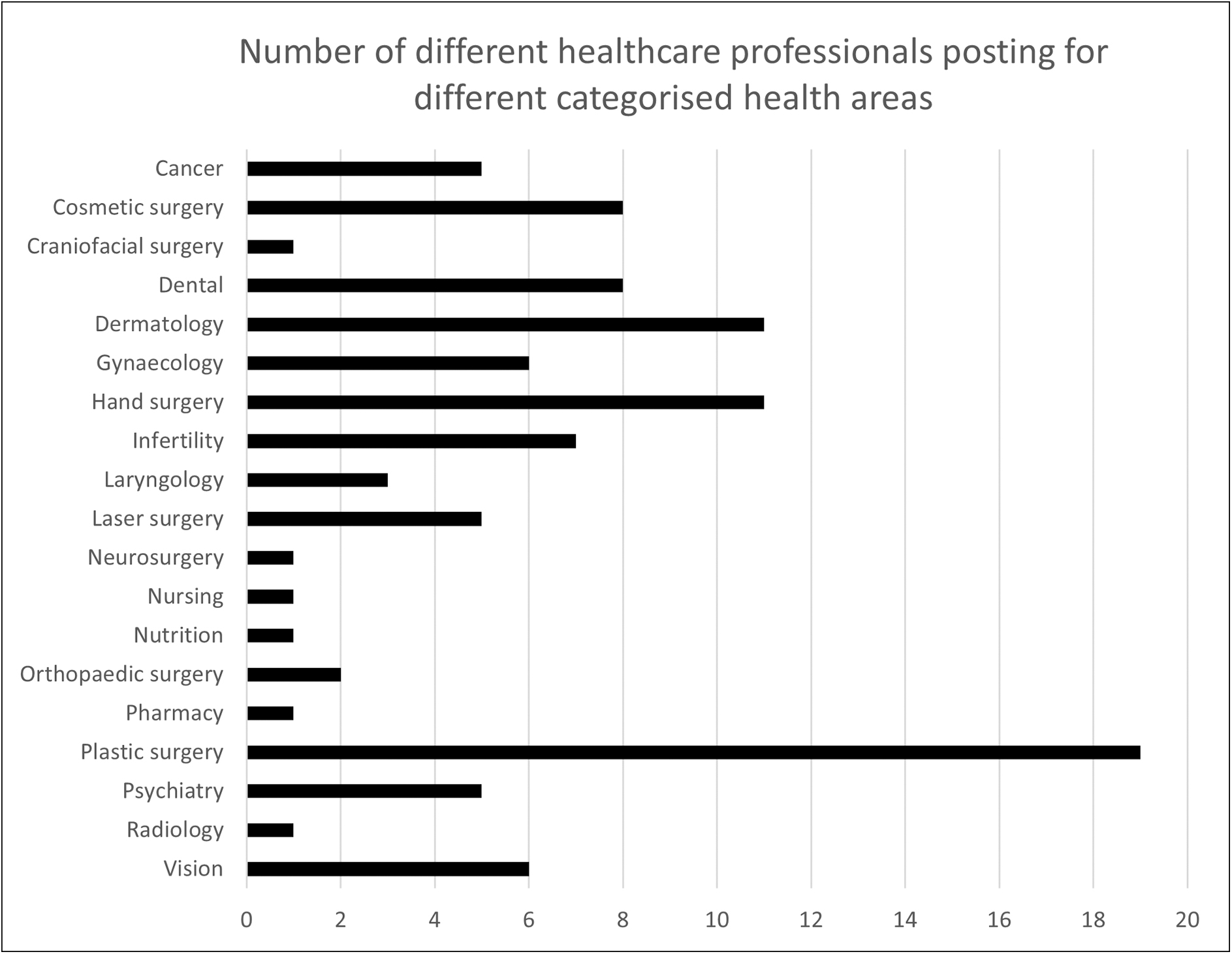
The number of different health care professionals posting for different health categories.
Health Care Professionals Posting About Different Health Topics
ENT, ear, nose, and throat.
Format of Instagram posts
The formats of posts were identified in 15 articles, and 6 of these identified either photo or video formats of the posts.30,37,42,46–48 Only one study specified excluding videos from their analysis. 45 The other nine articles included additional categories of the post formats, including, graphics, photo-images, text-images, video, text-video.26,28,29,34,38,49–52 Of the articles reporting on the format of the posts, 12 specified the proportion of posts that were images or photographs and those that were videos.28–30,34,37,38,46–50,52
In all of them, photographs or images were the format most frequently posted compared with video format. Alkadhimi et al 46 reported that of the 300 posts they analyzed, 244 (81.3 percent) were photograph posts and 56 (18.7 percent) were video posts. Other articles reported similar percentages of photograph posts and video posts.37,47,48 Additional categories of post formats included text-based images or graphics, and live videos.50,52 Only two articles38,52 reported the use of Stories, and one reported the use of Instagram TV (IGTV) and Story Highlights. 42
Instagram content posted by health care professionals
All but four articles27,53–55 reported the types of content posted by health care professionals. These were categorized as follows: (a) educational, (b) promotional, (c) patient experience, (d) personal, (e) emotion based, and (f) other. All content reported in the articles are detailed in the extraction table (Supplementary Table S1).
Educational
Over half (n = 33) of the articles described Instagram posts made by health care professionals as educational in nature. Some articles reported on a broad “educational” category.16,28,30,33,34,37,38,40,42,45,50,52,56–59 However, several articles provided specific examples including demonstrations, case studies, clinical cases, research articles, diagnoses, and medical information about conditions, including definitions, drug information, and posts that raised awareness about health issues.17,26,29,32,46,47,48,60–67 According to Huang et al.'s 50 study, while educational content comprised the majority of ophthalmology-related posts (56 percent), it was reported to be the least engaging. In contrast, Wang et al 59 found that posts by physicians and posts with educational content relating to orthopedic surgery generated the most engagement (highest mean number of likes).
The audience was also considered when making educational posts. Alsoudi et al 49 reported that ophthalmologists (81 percent) were more likely to post for colleague education compared with optometrists (35 percent), whereas optometrists (52 percent) were more likely to post for patient education compared with ophthalmologists (8 percent). Similarly, Rahimy et al 68 reported that 30 percent of radiation oncology-related posts aimed to educate colleagues, and 31 percent aimed to educate patients.
Promotional
Posts classified as promotional were reported in 35 articles. These posts were identified as “promotional” or an “advertisement,” and included posts where users marketed themselves as a health professional, described attendance at conferences and work-related events, advertised their clinic and the services provided, made paid and/or nonpaid product endorsements, and provided advocacy.16,17,26,28,29,31–35,37–50,52,57–60,64–69 Also included in this category were posts that promoted the engagement of their followers, such as using polls or quizzes to ask questions, or requesting users to act (e.g., “Tag a friend” or “Sign up”).26,41
Plastic surgery posts that included prices or discounts, or invited consultations received more likes and comments. 31 Of the clinical and professional posts (including photographs of clinicians in a professional and academic setting, and posts that promoted goods and services) identified in Basa and Spiegel's 39 study for facial plastic surgery, these garnered the most engagement through likes. Similarly, plastic surgery posts that invited consultations and the inclusion of prices or discounts in the post received more likes and comments. 31 In contrast, however, promotional content made by orthopedic surgeons in Abbas et al.'s 26 study was less well received, with 43.7 percent fewer comments received compared with nonpromotional posts.
Patient experience
Descriptions of patient experience were identified in 20 articles. Posts in this category included patient/client testimonials, before-and-after pictures, and personal stories.16,28,29,31,35,36,39,42–45,48,57,60,63,64,66,69–71 In addition to posting pictures with their clients, dietitians were reported sharing images of client self-portraits, clients chronicling the changes to their body size or weight during weight loss, and conversations with their client. 17 Ayribas and Ayhan 38 reported that of the 124 users included in their analysis, 10.5 percent of them shared patient information, including pictures, letters, or messages from patients.
Similarly, in Joa and Park's 31 study looking at plastic surgery-related posts, 71 percent of images analyzed featured female patients. Additionally, 81 percent were pictures of body parts as a focus, 56 percent were before-and-after pictures of patients, and 19 percent were pictures of a patient's face as the focus of the post.
Personal
Post of a personal nature made by health care professionals was identified in 14 articles. These included selfies, pictures, or videos taken outside of the office, including being on vacation and celebrations, posts showing the user's lifestyle and hobbies away from work, including opinions and political thoughts, and posts of pictures with friends and family.16,26,38–40,42–45,49,50,52,64,68
Emotion based
The use of emotions was reported in 16 articles. These included posts that were humorous, motivating, or inspiring through the use of memes or quotes.16,17,26,31,32,34,38,41–43,52,58,62,64,66,68 The tone of posts was also reported, which included serious (informative, thoughtful), positive (excited, joyful), optimistic (humorous, assumption of how things will work out), or negative (sad, pessimistic) posts. Posts that elicited more negative emotions compared with positive or neutral emotions received 50.6 percent and 70.7 percent more likes; however, there was no statistically significant impact on the number of comments received based on the tone of the post. 26
Other
A total of 11 articles identified posts made were not related to the health issue or profession, and were categorized as “Other (not specified),” “Not applicable,” “Unrelated,” “Miscellaneous,” or “Uncodable.”16,26,34,35,44,46,49,57,60,64,68
Post engagement
Over half of the articles included in this review (56.8 percent) reported on the use of different Instagram functions to measure engagement with the posts. Functions included were as follows: (a) likes and comments, (b) hashtags, and (c) followers.
Likes and comments
Twenty-one articles reported on the number of likes or comments received as part of their analysis.26,27,29–32,34–39,42,43,49,50,54,56,57,59,67 For example, of the 2,112,393 posts analyzed in Braun et al.'s 27 study, a total of 15 million comments, 369 likes, and 6 billion views were reported. No additional information was provided as to which type of post generated greater likes or comments to further explore engagement. To measure engagement, other studies reported on the number of likes or comments received by the type of user.32,35,56 For example, posts made by hand surgeons received 7.3 percent of likes, nonhand surgeons received 92.7 percent of likes, and patients received 13.5 percent of likes. 56
According to Kilcoyne et al.'s 32 study, posts made by mothers received statistically more likes and comments compared with posts made by surgeons. In Sinha et al.'s 35 study, education-related content posts on gynecological surgery had the greatest average number of likes. However, none of these posts were made by a health care professional, with these posts all made by other users, including patients, support and community groups, and profit and nonprofit organizations. 35
Measuring engagement through likes and comments was calculated differently across the articles reviewed. These included calculating the highest number of likes or comments received, 31 calculating the engagement ratio of each post (ERpost), 43 measuring the number of post-likes to account-followers (Engagement Level Ratios), 50 calculating the average number of likes as a percentage of total followers, 39 and measuring post-likes and comments correlated with their True Reach value. 42
When compared with other social networking platforms, Instagram was found to be the most effective for engaging users with the highest proportion of likes (94.3 percent) compared with Facebook and Twitter. 54 Other studies also found that Instagram posts had significantly more likes compared with Twitter posts.57,59 In Mullens et al 57 Instagram posts received an average of 917 likes compared with an average of 1 like per Twitter post, and Instagram posts were commented on ∼18 times more.
Hashtags
Most articles (80.4 percent) in this review searched hashtags to identify posts to analyze (Supplementary Table S1), and it was also another way to measure engagement. The use of hashtags in the comments section had higher engagement compared with when it was directly in the caption of the post. Hashtags created specifically by the user was also reported to be useful. 43
Some studies identified the top used and most engaged hashtags in a health field.35,56,72 For example, the hashtags with the most engagement based on total number of likes and comments relating to cervical cancer were #hpv (151.3 likes per post) and #papillomavirus (78.0 likes per post). The use of #hpv had the highest number of comments per post (64.6) with the use of #hpv on videos having the most views per video (8.8). 72 A difference was found between users who posted with hashtags using layperson language and those using medical terminology.28–30,43,44 For example, medical professionals posted 100 percent of #rhinoplasty posts, but only 88 percent of #NoseJob posts. This was compared with the higher rate of patient posts using #TummyTuck (98 percent) compared with using #abdominoplasty (74 percent). 44
Followers
The number of Instagram followers was reported in 15 articles,16,26,34,36,38,39,42,43,47,52,53,55,60,67,73 which is useful when considering the potential reach for information shared through posts. The follower count across the health categories identified in this review is presented in Table 2. The range of followers was as low as 5 for neurosurgery 47 and as high as 2,900,000 for cosmetic surgery. 36
Number of Followers Identified for Various Health Areas and Health Care Professionals
The social network analysis (SNA) method was used by Chartier et al 53 to identify the most important people and groups within the plastic surgery community on Instagram. A total of 64,737 different users and 116,439 follower-followed relationships were examined, and revealed that the top 40 accounts were affiliated with plastic surgery residency programs (67.5 percent), board-certified plastic surgeons (17.5 percent), professional societies (10 percent), and peer-reviewed journals (5 percent). Beyond the 50th percentile, there was a significant increase in nonphysician or nonplastic surgeon accounts. This data-driven approach was an effective method for identifying a core group of reliable sources of information within a plastic surgery community.
Ethics and safety
The articles reviewed also reported on ethical issues when using Instagram. These included the following: (a) the reporting of credentials, (b) edited images, (c) quality of content, and (d) confidentiality issues.
Reporting credentials
While some health care professionals presented their credentials and board certifications on their profiles 42 or in post captions, 32 there were concerns where these were lacking or incorrect.30,31,36,74 For example, all obstetrician-gynecologists, dermatologists, general surgeons, family practice, and emergency medicine physicians in Dorfman et al.'s 30 study marketed themselves as “cosmetic surgeons” despite not being board certified. In addition, Richey et al 74 identified three users in their study who used “Dr.” as part of their Instagram title, and another three who described themselves as doctors or physicians when they were not.
In Vaca et al.'s 36 study, only 28 percent of the facial esthetic surgery posts were by plastic surgeons, with other posts by practitioners who advertised invasive procedures outside the scope of their practice. According to Wells et al., 37 there was a significant difference in the number of total likes but not in the number of comments for the content posted by board-certified versus nondermatologists.
Edited images
Two articles reported issues regarding edited Instagram images.36,71 The differences between the before-and-after images were reported on metrics, including patient position, magnification, luminosity, color profile, image clarity or sharpness, 71 and manipulation of photography conditions. 36 Vaca et al 36 analyzed lighting, facial expression, makeup, head position, and framing (including hairstyle, jewelry, or clothing) to calculate a bias score to identify variations between the before-and-after images, which may affect how people perceive the aesthetic qualities of a clinical photograph.
A higher positive score indicated a greater bias favoring the appearance of the “after” image. A significant positive correlation between a higher photography bias score and a greater number of Instagram account followers was found. A trend was also identified between the number of likes per post and a higher photography bias score; however, this was not significant. 36
Quality of content
Three articles covered the issue of quality Instagram content.46,48,60 For example, posts with information on orthodontic products were found to have little factual basis and were misleading. Of the 472 claims, only 1.7 percent were objectively true and 60 percent of the claims were false. 46 The quality of Instagram posts was evaluated differently across the articles reviewed. These included using validated criteria such as the DISCERN instrument and PEMAT tool for understandability and actionability, 60 and the Global Quality Scale. 48
Several studies related to plastic surgery have identified issues related to problematic discussion of beauty standards and body dissatisfaction.31,64,69 The substantial number of posts making light of plastic surgery through humor or criticizing the patients was found troubling in the study by Joa and Park, 31 as this could lower the perceived risk associated with the medical procedures and condone callous attitudes toward plastic surgery patients.
Similarly, humor was also found to be a recurring theme with posts found using #pharmacist, which Hindman et al 64 stated may be insensitive to patients or families, particularly on disease-related posts, and risks the spread of misinformation. Qualitative data from Kerr et al 41 demonstrated that humor in nursing-related posts was used in a manner that might have only been understood by other health care professionals with contextual knowledge, with memes often used to represent potentially stressful situations.
Patient and client confidentiality issues
An issue found to be more prevalent on Instagram (compared with Twitter) 57 was the violation of client confidentiality by posting identifiable images.17,34,38,57 Public Instagram accounts of some psychiatrists were found to share patient information, including pictures, letters, or patient messages. 38 Similarly, posts from some dietitian profiles included images of clients chronicling changes in their body size or weight (before and/or during weight loss), self-portraits of clients or with clients, and conversations with clients. 17 Including identifiable images and/or videos of patients or their health information, a small number (2 percent) of posts was found to have violated the Health Insurance Portability and Accountability Act (HIPAA) privacy rule. 34 However, these accounts originated outside the United States where the law was unenforceable.
Discussion
In contrast to previously published systematic reviews on social media use for health,22,23 our systematic review identified various healthcare professionals' Instagram use and the specific methods they employ on the platform. Establishing a professional Instagram profile for patient education and health promotion can be advantageous for health care professionals, as an increasing number of patients are sourcing health information from social media.75,76 With the continued growth of social media users, 77 this trend is unlikely to change.
While several types of health care professions were identified, more posts and engagement from health care professionals are still required to provide accurate information about health issues, share research, and improve practitioner–patient relationships.35,37,45,49,56,61,62,65,66,68 In research that investigated Instagram posts on fertility education, 45 only 15 percent of posts were made by health care professionals.
None of these were research related, and only 8 percent contained educational content. Similarly, in a study of 1,000 radiation therapy posts, only 18 percent were made by health professionals (compared with 53 percent of them posting on Twitter). Instead, radiation therapy posts on Instagram were primarily made by patients or their caregivers, 68 emphasizing the need for a greater health care professional presence.
Social media influencers can be defined as users who create and share content to introduce new information and ideas with large online circles. They have the ability to shape conversations and influence people's opinions. 78 Their impact can be measured through connectedness, represented by the number of their followers, and their posts' engagement as measured by the number of likes, comments, and shares of those posts. 79 The large followings of health care professionals on Instagram (Table 2) demonstrated an opportunity for health care professionals to reach wide audiences as medical influencers.18,80–82 Influencers in this review were identified by having a minimum of 10,000 followers 16 to >100,000 followers. 52
Every influencer is prone to possessing personal interests and biases that inevitably affect their scope of engagement. The concern lies in engagements that are monetarily quantified. While some health care professionals may be transparent about disclosing sponsorship, not all are. 83 In addition, fake accounts, bots (software programs running automated tasks to appear like real accounts), and purchasing followers to appear popular are problematic practices. These can easily mislead users who turn to SNSs for health information to meet their medical needs. 84
Instagram can be used as a platform to educate and inform. 85 Therefore, health care professionals who use it need to be aware of the influence they have, intentional or not, over other individual's health care decision-making. This includes the quality and reliability of their content. In a recent retrospective analysis, 86 health claims were extracted from Instagram accounts of naturopathic influencers.
Over half (51 percent) provided evidence supporting the claim made, yet only 6.9 percent provided users with a link to the evidence to support the claim. Health care professionals on Instagram need to share more evidence-based, reliable health information and aid in the correction of misinformation. With only 5 percent of the articles in this review reporting on the quality or reliability of the information being shared, further research is warranted to critically consider the accuracy of information on Instagram.
Considerations for health care professionals who use Instagram
A combination of limited SNS regulation policies for health care professionals and the public's lack of awareness regarding practitioner certification pose a threat to the integrity of health care professionals and the safety of their patients and prospective clients. For example, posting edited images on SNSs may influence a patient's choice of practitioner without considering the practitioner's credentials or qualifications.36,44,69
Instagram offers users an opportunity to be “verified” (represented by a blue tick next to the user's name in their profile). The blue tick indicates that Instagram has confirmed that the profile is the authentic presence for that user. Users must meet account and eligibility requirements when applying for verification. Once approved, it is not a symbol of endorsement, authority, or expertise in a subject matter, merely confirmation of who the user claims to be. 87 Few articles in this review reported on verified health care users.16,39,52 However, Instagram verification may be a consideration for health care professionals to assure other users of their identity and expertise. It is important that Instagram users are educated about misinformation and take caution when trusting sources, with blue tick verification being one-way users can evaluate the authenticity of messaging.
The predominant format of posts made by health care professionals was static image.26,28,29,34,37,46–52 Another format used on Instagram is Reels. Reels of up to 90 seconds using multiclip videos with audio and effects can be posted.88–90 It takes up greater screen space compared with other post types and attracts 22 percent more engagement compared with videos posted on Instagram. 90 Reels were not identified in any study in this review yet should be considered if health care professionals aim to reach and engage with a wide audience.
In addition, Instagram has an inherent issue with resharing external content limiting the ability to share health-related information effectively compared with other platforms. This may contribute to limiting further reach. 54 As such, health care professionals need to consider how to best link external content to Instagram posts including Web sites for additional information or research articles to support their claims.
Greater participation by health care professionals on Instagram may increase the quantity of educational posts, and offers a low-cost platform for networking and connecting with patients and other providers. 66 Adding hashtags to posts has the potential to reach users and receive high engagement. For example, posts about #OrthognaticSurgery shared by orthodontists and surgeons had significantly more mean likes than those shared by patients. 29 However, it is important that appropriate hashtags are used for their intended audience as use of medically related hashtags by professions other than specialists in the field may be confusing or misleading to patients. 44
Findings from this review suggest that the use of specific hashtags and lay language terms as hashtags would reach more general users compared with using medical terminology.30,43,44 Table 3 provides a reference overview of the advantages of health care professionals using Instagram, and suggestions to maximize its use to engage with their target audiences.
Ways in Which Health Care Professionals Can Maximize Their Instagram Engagement
The need for clear guidelines to assist with ethical issues
Given the findings of potential patient/client confidentiality breaches reported in this review,17,34,38,57 there is a strong case for clear guidelines to assist health care professionals use Instagram safely to protect their patients and clients, and well-defined policies and regulations that protect themselves. 46 Suggestions include obtaining informed written consent from patients before posting on their page to protect patient privacy, and photographs and videos should include legal surveillance (where at a minimum, images should be deidentified). 31
The Australian Health Practitioner Regulation Agency (AHPRA) provides some guidance to help Australian registered health practitioners understand and meet their legal and ethical obligations when using social media. 91 Providing examples, these guidelines cover issues of patient confidentiality, cultural awareness and safety, professionalism, public health messaging, and advertising, so that practitioners can actively consider how to use SNSs professionally. However, guidance is primarily targeted toward raising awareness of breaches in ethical practice, rather than providing specific guidance on ways to engage on SNSs ethically and professionally. Additional issues arise because Instagram is used internationally, where policies and regulations differ across countries. 34
Limitations and future research
The study specifically centered on the use of Instagram by individual health care professionals. It excluded examinations of Instagram use among medical and other health care students, as well as health care entities such as hospitals or organizations. In addition, articles published in languages other than English were excluded due to language restrictions of the researchers. Including these studies in future research may identify further engagement strategies and the different ways in which international health care professionals use Instagram.
Conclusions
Health care professionals as Instagram users are reported worldwide. They make posts that are educational, promotional, showcase patient experience, share their personal life, and are emotion based. To determine audience engagement with Instagram posts, researchers measured the number of likes and comments, use of hashtags, and the number of followers. While these activities represent the advantages of using Instagram, the dangers of its use include lack of professional credentials reported, edited images, quality of content, and confidentiality issues. Taking into consideration these inherent risks, health care professionals need better guidance with clear policies to navigate the use of social media platforms responsibly to ensure the dissemination of accurate information and protect the well-being of the public.
Footnotes

References
Supplementary Material
Please find the following supplemental material available below.
For Open Access articles published under a Creative Commons License, all supplemental material carries the same license as the article it is associated with.
For non-Open Access articles published, all supplemental material carries a non-exclusive license, and permission requests for re-use of supplemental material or any part of supplemental material shall be sent directly to the copyright owner as specified in the copyright notice associated with the article.
