




Abstract
Policing is a highly demanding and stressful profession. Virtual reality (VR) has emerged as a promising tool for enhancing stress management programs, including for police officers. The use of VR in combination with biosensors enables measurement of psychophysiological responses such as peripheral temperature (PT) and skin conductance level (SCL). This study investigated the psychophysiological responses of police officers exposed to a VR scenario simulating a car accident. The study included a total of 63 police officers from the Public Security Police. Participants were divided into three groups based on their police divisions: the Investigation Brigade of Traffic Accidents, the Traffic Surveillance Squad (TSS), and a control group from the Lisbon Metropolitan Command. The results indicated that the VR environment effectively induced psychophysiological arousal, particularly in less experienced officers (TSS), that is, there were significant group differences in mean SCL and PT, showing this group with higher SCL and lower PT during the VR exposure. These results support the potential of VR as a stress inoculation strategy for training police officers and highlight the complex nature of stress responses that are influenced by individual factors and psychopathology.
Introduction
Policing is a professional occupation conducted in environments characterized by social and criminal risks, making it widely acknowledged as one of the most demanding and stressful vocations.1,2 Extensive evidence exists in the literature regarding the high levels of stress experienced by police officers, with prevalence rates ranging from 33 to 46 percent.3–5 A recent study conducted with a large sample of Portuguese police officers revealed moderate levels of operational stress, distress, and burnout, with 28 percent of the participants reporting high distress and 55 percent at risk of developing a psychological disorder. 6
One of the cognitive psychological approaches utilized in stress intervention is stress inoculation training (SIT), originally developed by Donald Meichenbaum in 1979. The training process typically involves exposure to simulated real-life scenarios, wherein individuals are trained to proactively cope with stressors. The primary focus of the training is to develop effective coping strategies for dealing with challenging situations, while also assisting individuals in identifying less effective strategies (e.g., negative self-talk) and replacing them with more effective ones (e.g., relaxation, self-instructions, self-reinforcement). 7
The advent of digital environments has opened up new avenues for supporting psychological interventions, particularly in the realm of stress management programs. Virtual reality (VR) has recently emerged as an innovative and promising method for enhancing traditional stress management techniques. VR-assisted stress inoculation training (VR-SIT) has been implemented in various contexts, including individuals with high-stress occupations, such as military personnel and police officers. 8
Serino et al. 9 highlighted that VR-SIT enables controlled exposure to meaningful and interactive stressful environments, thereby offering the potential to train coping skills within a realistic setting. The notable advantages of utilizing VR-SIT in the specific domain of police and military training include the ability to expose individuals to scenarios without jeopardizing their safety 10 and the opportunity for repeated exposure of a given environment or situation. 11
Complementary to VR devices, existing biosensors enable measurement of psychophysiological responses such as the breathing rate, heart rate (HR), heart rate variability (HRV), electrodermal activity (EDA), and skin temperature. Some studies have incorporated psychophysiological measures in VR-SIT. For instance, Kosinska et al. 12 investigated the effectiveness of an SIT program that involved VR exposure with a sample of four soldiers. Analysis of HRV indexes indicated that VR-SIT assisted participants in reducing arousal and achieving relaxation following the exposure.
A pilot study by Hourani et al. 13 demonstrated the impact of VR-SIT on military personnel's arousal (based on HRV) and performance effectiveness (based on reaction time), with the experimental group showing better relaxation and performance outcomes compared with the control group using traditional methods. Similarly, a large, randomized controlled trial 14 conducted with the military population found that subjects enrolled in VR-based SIT exhibited increased HRV compared with the control condition.
Higher HRV scores, according to Krypotos et al.'s study, 15 are associated with faster adjustment responses to negative stimuli. A study 16 with emergency health care personnel demonstrated that exposure to emotionally charged virtual environments could induce physiological stress, as evidenced by increased levels of HR and EDA, which is essential for the implementation of SIT.
Despite the promising potential, before the development and validation of structured VR-SIT programs, it is crucial to investigate whether a specific VR environment can induce sufficiently high stress levels to ensure an “inoculation” effect. Serino et al. 9 highlighted the significance of psychophysiological assessment of stress indicators (such as HR, HRV, and EDA) for evaluating the efficacy of VR-SIT.
In line with this, the present study utilized a VR environment to induce psychophysiological arousal responses in police officers, contributing to validation of the scenario for SIT in this population. Specifically, our objective is to compare the psychophysiological responses (HR, EDA, respiratory rate, and peripheral temperature [PT]) of police officers from different divisions of the police force when exposed to a VR setting simulating a car accident involving victims.
Methods
Participants
The total sample comprised 63 police officers from the Public Security Police (PSP) of Portugal, consisting of 61 (97 percent) men and 2 (3 percent) women, with a mean age of 39 years (SD = 9.55), ranging from 23 to 62 years. These participants belonged to different police divisions within the PSP, specifically 28 (45 percent) officers from the Investigation Brigade of Traffic Accidents (IBTA), 16 (25 percent) officers from the Traffic Surveillance Squad (TSS), and a control group of 19 (30 percent) officers from the Lisbon Metropolitan Command (LMC).
TSS officers are part of the first responder team and are the first to arrive at the scene of a traffic accident, while IBTA officers are responsible for postaccident investigative procedures. Typically, IBTA officers are older and have more years of experience on the job.
In our study, the mean age of IBTA officers was higher than TSS officers (IBTA: M = 45.75, SD = 8.56, years; TSS: M = 39.18, SD = 6.44, years). LMC officers are not involved in traffic accident interventions. The majority of participants had a secondary schooling level (n = 45; 72 percent) and reported moderate levels of experience with computers (n = 37; 58 percent) and videogames (n = 46; 73 percent).
The inclusion criteria for this study were being of Portuguese nationality and employed in the PSP of Portugal. Data of one participant were excluded from data analysis for scoring above the cutoff on the Beck Depression Inventory-II (BDI-II), 17 indicating moderate depression.
Measures
The measures employed in this study included a brief sociodemographic form, self-report instruments for emotional adjustment, and psychophysiological assessments. Depression screening was conducted using the BDI-II, 17 specifically employing the Portuguese version by Ponciano et al., 18 as well as the Depression, Anxiety, and Stress Scales (DASS) (Portuguese version). 19
The psychophysiological assessments focused on four peripheral measures: HR in beats per minute (BPM), EDA assessed according to the skin conductance level (SCL) in microSiemens (uS), respiratory rate (RR) in breaths per minute, and PT in degrees Celsius. These measures were recorded at a sampling rate of 1,000 Hz. The experimenter placed the electrodes in standardized body regions for each measure.
For HR, three electrodes were placed on the participant's chest, while for SCL, electrodes were positioned on the index and middle fingers of the nondominant hand. The respiratory rate was measured using a belt placed around the abdomen, and PT was assessed using a sensor on the ventral wrist.
VR scenario
The study involved the development of a VR scenario aimed at inducing stress in police officers from a traffic division. The VR scenario, created using Unity for VR with the Oculus Rift S device, depicted a city with a single block of buildings. In the task, the participant assumed a standing position and was instructed to walk around the buildings as part of a police surveillance tour. Approximately 5 minutes into the tour, a radio message from the police command alerted the participant to a nearby traffic accident.
The participant was tasked with responding to the accident as they would in a real situation, checking for victims in need of medical attention and reporting the accident details afterward. The accident involved two vehicles, a police car and a civilian vehicle, and included three victims—a police officer, a civilian driver, and a baby whose cries could be heard as the participant approached the scene. The entire exposure lasted for ∼10 minutes.
Fig. 1 depicts the three moments of the VR exposure, namely (from left to right panel) the (a) baseline acquisition period, (b) trajectory from the start point to the car accident, and (c) car accident visualization. Previously, all participants underwent a training session comprising a maze where they had to find their way out following colored cues on the maze walls to familiarize with the controls and movement in the virtual scenario.

Virtual reality scenario.
Hardware and software
The VR exposure was administered using an MSI laptop gaming series connected to an Oculus Rift S headset. The psychophysiological assessment was performed using the Biosignalsplux Explorer software from PLUX® (Lisbon, Portugal). The Biosignalsplux Explorer enabled the simultaneous recording of four different channels. The data recording and analysis were conducted using the OpenSignals software from PLUX.
Procedure
The study received ethical approval from the Ethical and Deontological Committee for Scientific Research at the School of Psychology and Life Sciences (CEDIC) of Lusófona University in Lisbon, Portugal. Ethical approval for this study was documented in Minute No. 5 by this commission on May 28, 2019. Participants who agreed and signed the informed consent form provided sociodemographic information such as gender, police division, age, education level, and experience with computers and videogames in a brief sociodemographic form.
Self-report questionnaires were then completed by the participants. Afterward, electrodes were placed on specific body regions to record psychophysiological data, while the experimenter provided instructions on movement and interaction within the VR scenario. Participants adjusted the VR headset to ensure a clear image.
The task began with participants walking in the virtual environment along a predetermined path around the block of buildings. Participants had control over their movement, but if they deviated significantly, the experimenter instructed them to stay on the sidewalk. At the end of the exposure, the experimenter encouraged participants to share their experiences with the VR to reduce any lingering psychophysiological activation. Participants removed the electrodes and respiratory belt.
The entire procedure lasted ∼25 minutes per participant.
Statistical analysis
The statistical analysis was carried out utilizing the Statistical Package for the Social Sciences, v.25 (IBM). The normality of dependent variables was assessed through the Kolmogorov–Smirnov test. Parametric comparisons among the three groups (IBTA vs. TSS vs. LMC) were performed using analysis of variance (ANOVA), while nonparametric comparisons were conducted using the Kruskal–Wallis test.
The chi-square statistic was employed to compare categorical variables across the groups. Given that psychophysiological data were collected continuously during the VR exposure, within-subject comparisons (baseline vs. radio vs. accident) were analyzed using repeated-measures ANOVAs. To explore significant effects in further detail, multiple comparisons with Bonferroni adjustment were performed.
Results
Differences in sociodemographic variables according to the PSP group
The chi-square test indicated that the distributions of gender, schooling, and computer and videogame experience did not differ significantly across the three groups (all p values >0.05). However, the Kruskal–Wallis nonparametric test comparing age between groups revealed statistically significant differences [H(2) = 36.724; p < 0.001].
Subsequent independent tests using the Mann–Whitney statistic with Bonferroni-corrected alpha/3 showed that the mean ranks for age were significantly higher in the IBTA group compared with the TSS group (U = 125.000; p = 0.016) and LMC group (U = 22.000; p < 0.001). For clarity, the reported central tendency measure for age includes mean values for the IBTA group (M = 45.75; SD = 8.56), TSS group (M = 39.18; SD = 6.44), and LMC group (M = 29.80; SD = 3.12).
Therefore, age was controlled in further statistical comparisons between PSP groups.
Differences in self-reports for anxiety, depression, and stress according to group
The Kruskal–Wallis nonparametric test did not reveal statistically significant differences in self-reports of anxiety, stress, and depression across PSP groups (all p values >0.05).
Psychophysiological activity during VR exposure
Psychophysiological assessments were analyzed using an analysis of covariance (ANCOVA) to control for the effect of age in within-subject comparisons. The ANCOVA included one within-subject factor (VR exposure: baseline vs. radio vs. accident) and one between-subject factor (PSP group: IBTA vs. TSS vs. LMC). SCL was assessed based on the mean, maximum, and minimum conductance levels at each assessment point.
The analysis revealed a statistically significant interaction effect for the mean SCL [F(2.155, 58.188) = 8.914; MSE = 27.756; p < 0.001], indicating an influence of group on the variation of mean SCL during VR exposure. Bonferroni-adjusted simple-effects analysis showed that the TSS group exhibited significant increases in mean SCL (all p values <0.01). Visual inspection of Figure 2 suggests a large increase in mean SCL from the baseline to the radio message, while a moderate increase is observed during the accident visualization.
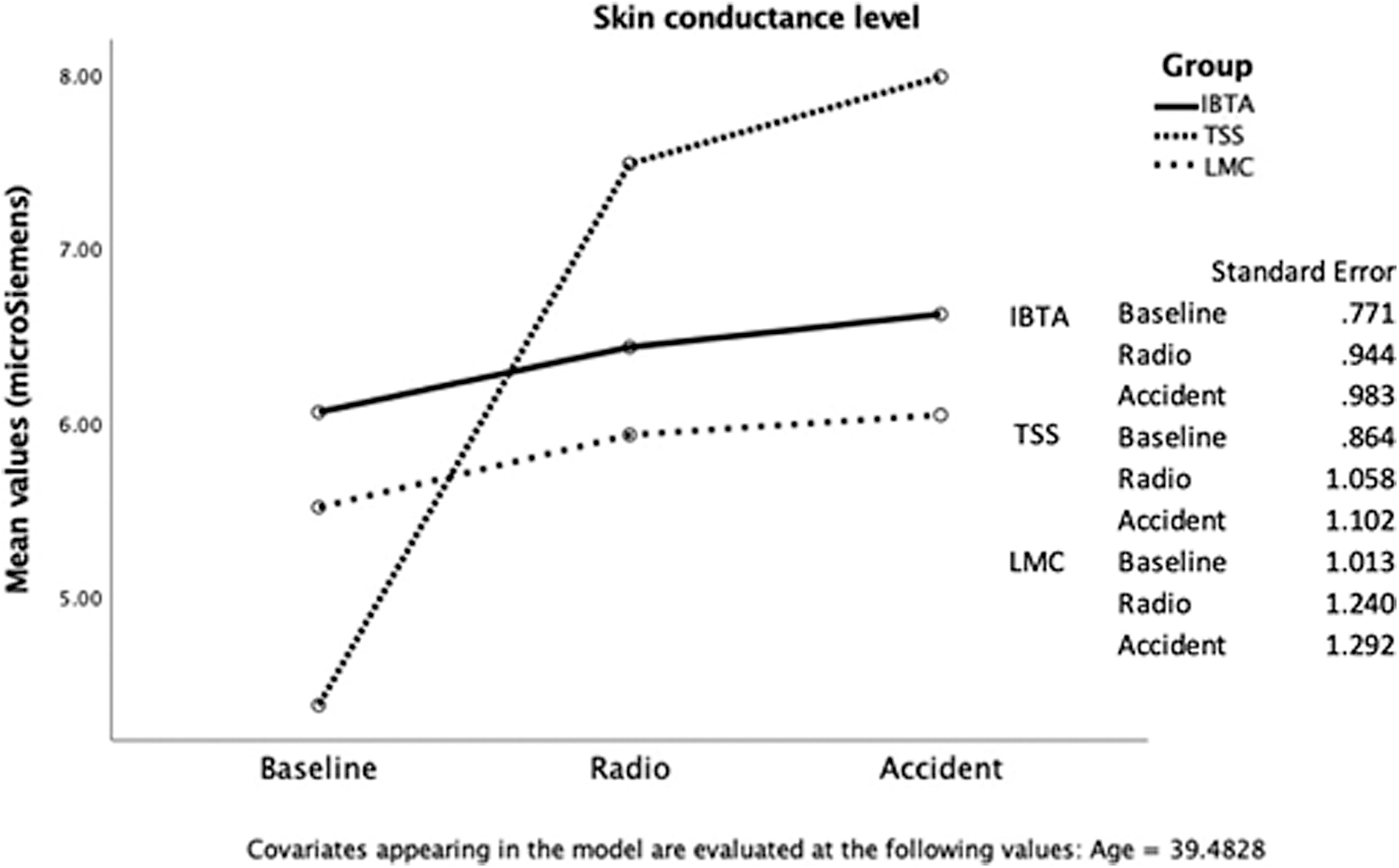
Skin conductance by group. IBTA, Investigation Brigade of Traffic Accidents; LMC, Lisbon Metropolitan Command; TSS, Traffic Surveillance Squad.
The results for the maximum and minimum SCL measures agree with the above result for the mean SCL, indicating a more pronounced increase from the baseline to the radio message only in the TSS group (Table 1).
Skin Conductance Level (Maximum and Minimum) for Each Group During the Virtual Reality Exposure
Covariates appearing in the model are evaluated at the following value: age = 39.4828 years.
IBTA, Investigation Brigade of Traffic Accidents; LMC, Lisbon Metropolitan Command; SCL, skin conductance level; SE, standard error; TSS, Traffic Surveillance Squad.
The same ANCOVA on mean, maximum, and minimum HR values revealed a significant main effect for maximum HR [F(1.796, 79.009) = 9.207; MSE = 2996.769; p < 0.001], as shown in Table 2. The multiple comparisons suggested a decrease in maximum HR from the baseline to accident visualization, which may suggest a decrease in variability of HR measurement during the VR exposure. The ANCOVA on mean HR (Fig. 3) and minimum HR (Table 2) did not reveal any significant effect (all p values >0.05).
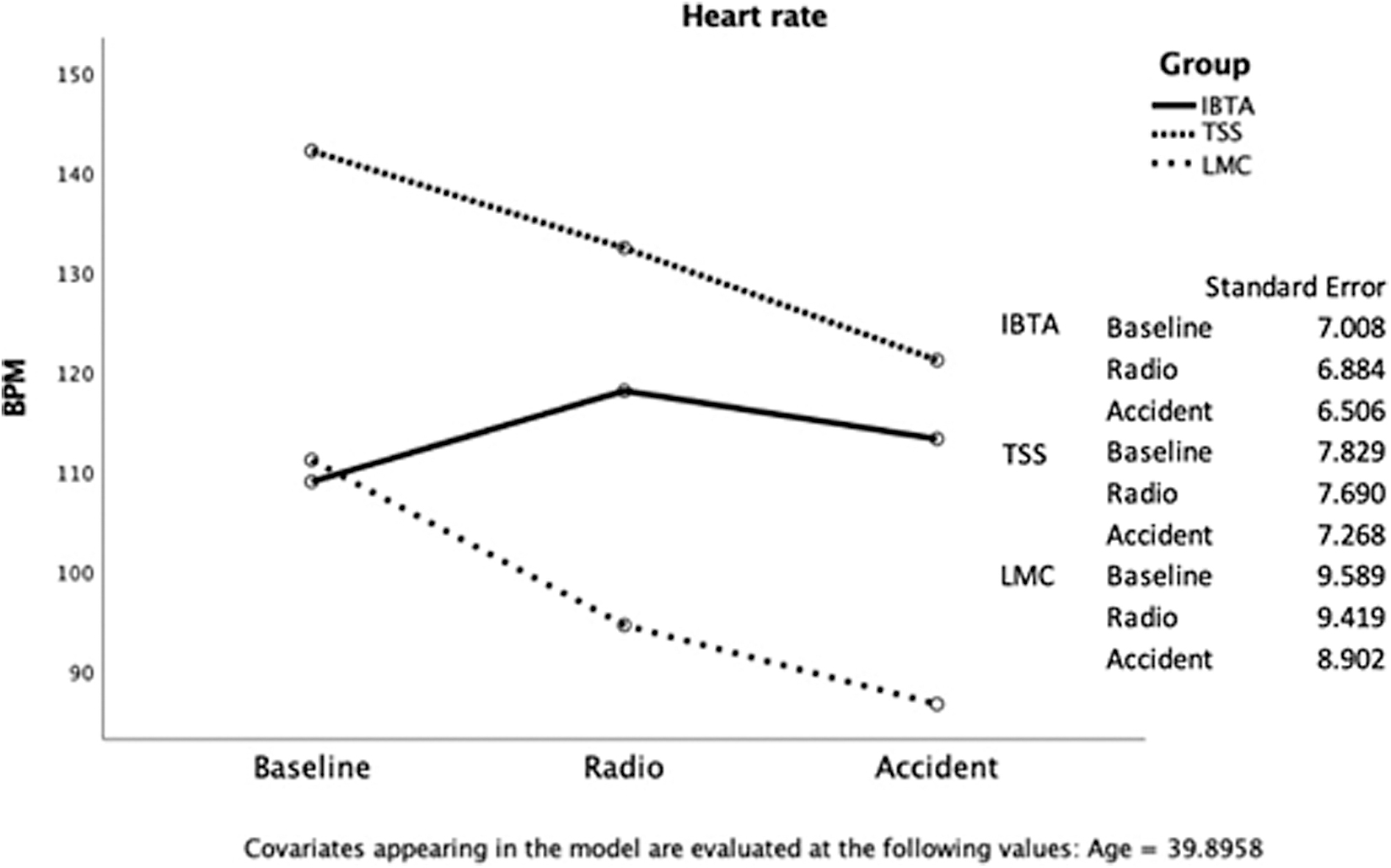
Heart rate by group.
Heart Rate (Maximum and Minimum) for Each Group During the Virtual Reality Exposure
Covariates appearing in the model are evaluated at the following value: age = 39.8958 years.
HR, heart rate.
The analysis of the RR through mean breath cycles per minute also did not reveal main or interaction effects of the mean RR (p > 0.05) (Fig. 4).

Respiratory rate by group.
With regard to PT, the ANCOVA showed a main effect on the mean PT values [F(1.297, 68.738) = 8.847; MSE = 2.664; p = 0.002], indicating a decrease from the radio message to the accident visualization, according to Bonferroni-adjusted multiple comparisons (p = 0.031). Figure 5 depicts the results for mean PT.

Peripheral temperature by group.
The analysis of the maximum PT revealed a significant interaction effect [F(2.533, 65.870) = 5.808; MSE = 1.238; p = 0.002]. This effect was decomposed with simple-effects analysis (Bonferroni adjusted), indicating a decrease in maximum PT at all the assessment points only for the TSS group (all p values <0.01). The same analysis of minimum PT revealed a main effect [F(1.546, 80.392) = 5.642; MSE = 3.257; p = 0.009], but multiple comparisons (Bonferroni adjusted) failed to detect any significant difference (all p values >0.05).
Table 3 describes the results for maximum and minimum PT.
Peripheral Temperature (Maximum and Minimum) for Each Group During the Virtual Reality Exposure
Covariates appearing in the model are evaluated at the following value: age = 39.5893 years.
PT, peripheral temperature.
Discussion
This study aimed to evaluate the potential application of a VR scenario designed to induce stress inoculation in police officers with different profiles (IBTA, TSS, and LMC) by analyzing psychophysiological data, including HR, RR, SCL, and PT. Our results demonstrate the ability of the VR environment to induce psychophysiological and emotional arousal, which is a crucial step within SIT approaches.20–23
These findings may contribute to the assessment and training of individuals within an SIT context.24,25 The use of noninvasive devices for physiological measurements provided valuable insights into acute stress responses during VR exposure, surpassing the limitations of self-report measures and resource-intensive biochemical assessments. 26
Previous studies have examined the physiological indicators of acute stress responses in police officers, revealing that repeated exposure to stress in this profession may lead to increased physiological reactivity and altered physical and cognitive performance.27,28 Our findings align with these police context-specific studies as we observed significant psychophysiological arousal, particularly in the TSS group, which consists of younger and less experienced officers, compared with the IBTA and control (LMC) groups.
However, the specific effects observed may be influenced not only by professional experience but also by individual characteristics of police professionals, such as coping skills and level of training, which need further investigation due to inconsistent results in the literature. 29
Regarding specific physiological measures, sympathetic nervous system (SNS) activation during stress typically leads to physiological changes associated with the “fight or flight” response, such as increased HR, RR, pupil dilation, and blood pressure. 30 Our results align with this outlook as we observed a significant increase in SCL, indicating stress-induced emotional arousal during VR exposure in the TSS group.
Furthermore, the TSS group exhibited a significant decrease in PT, which could be attributed to variations in body temperature regulation between different regions of the body (core and distal skin regions) and vasoconstriction caused by SNS activation and cortisol release. 31
In contrast, RR did not show significant variation during VR exposure, despite its recognized potential as a reliable indicator of acute stress response due to observable breathing patterns. 32 The complex interplay of compensatory mechanisms, balance between sympathetic and parasympathetic influences, individual variability in stress response, and psychological factors may contribute to the lack of significant changes in RR under stressful conditions. 33 Further research is necessary to understand the underlying mechanisms and individual differences in stress-related respiratory rate variations.
Similarly, HR measures did not exhibit significant differences in our study, despite existing research demonstrating significant HR increase during stress response in police officers, and in a VR exposure study involving military service members with PTSD symptoms.29,34 However, caution should be taken while addressing these measures as isolated indicators of stress-induced emotional arousal due to their high variability influenced by individual factors, smaller sample sizes as in our study, and potential inaccuracies in measurement using wearable monitoring devices compared with medical diagnostic tools.
In this sense, HRV may be a more appropriate measure to capture the dynamics between sympathetic and parasympathetic activation, provided that the task design allows for at least 5 minutes of HRV recording. 35 Psychopathology and individual stress reactivity, whether heightened or blunted, may indicate allostatic load and maladaptive coping mechanisms, highlighting the importance of considering these factors in relation to physiological activation. 30
The present findings align with previous evidence that supports the effectiveness of VR in eliciting psychophysiological arousal through immersion in stress-inducing simulations. Our study stresses the prospect of using VR as a stress inoculation strategy for less experienced professionals who are exposed to stressful events, providing an opportunity to opt for controllable ecologically valid scenarios simulating realistic stressful situations in the police context for training coping skills.
While our study approaches physiological responses in a controlled setting, potential broader implications contribute valuable insight on the influence of SIT in managing stress responses of police enforcement in real-world policing. Notably, future research could explore the diversity of policing stressors and responses in VR, possibly yielding varied results, as previously demonstrated for cognitive performance in different stress induction and simulation types of lethal force encounters—a highly relevant sociopolitical matter in law enforcement. 28
This knowledge may be important to integrate in SIT to accurately address specific consequences of stress in police officers in VR simulations.
Footnotes
Acknowledgments
The authors would like to formally acknowledge the valuable contributions and support from various organizations within the Public Security Police (PSP) of Portugal, namely the Lisbon Metropolitan Command of PSP, the Lisbon Traffic Division of PSP, the 3rd ESID of DSI of the Lisbon Metropolitan Command of PSP, and the Psychology Division of PSP, without whom completion of this scientific article would not have been possible.
Authors' Contributions
P.G. was involved in conceptualization, methodology, supervision, and writing; J.O. was involved in conceptualization, methodology, and data curation; J.S. and M.L.R.M. were involved in resources; J.R., J.C., and H.A. were involved in investigation; R.D. was involved in conceptualization and investigation; F.D. was involved in software and investigation; S.A.M. was involved in investigation and writing; and A.S. was involved in writing.
Author Disclosure Statement
No competing financial interests exist.
Funding Information
This study was funded by the Foundation for Science and Technology—FCT (Portuguese Ministry of Science, Technology and Higher Education), under grant no. UIDB/05380/2020.