




Abstract
Pursuing health equity necessitates recognizing health disparities that disproportionately impact disadvantaged groups and eliminating their barriers to essential health resources. Interactive digital technologies—specifically, popular social media platforms such as blogs and social networks—can be leveraged to engage underserved minority populations in collective social action aimed at addressing key determinants of health disparities and promoting equitable health outcomes. The present research focuses on the plight of African Americans—a minority group facing significant health disparities. Particularly in the domain of bone marrow donation, African Americans remain the group least likely to find a matching donor. Guided by the social comparison framing literature, we conducted an online experiment to investigate how group comparison information (GCI) emphasizing group-based disparities and supportive user comments on social media platforms influence African Americans’ intentions to join a bone marrow registry. In doing so, we considered hope as a mediator and group identification as a moderator. Results based on a conditional process analysis showed that GCI led to greater bone marrow donor intentions in the presence of supportive comments through elicitation of hope, particularly among those low in group identification. The current findings demonstrate that it is important to consider the role of supportive message environments and group identification when addressing health disparities with GCI. Theoretical and practical implications are discussed.
Introduction
Advancing health equity requires awareness of health disparities—differences in health outcomes that disproportionately affect disadvantaged social groups—and efforts to remove obstacles for these groups in accessing essential health resources. 1 One promising avenue that can leverage interactive digital technologies—in particular, social media platforms such as blogs and social network sites—is engaging underserved populations in collective social action aimed at addressing key determinants of health disparities. 2
The realm of bone marrow donation for African Americans is a prime example where digital health interventions can be instrumental. Particularly in the United States, African Americans have the smallest chance of finding matching donors among all racial/ethnic groups. Notably, with African Americans having less than a 20 percent chance of finding a matching donor compared with White Americans having a 75 percent chance, the stark contrast indicates a severe disparity in bone marrow donation.3,4
Group comparison information (GCI), which highlights disparities between different groups, 5 holds potential as a message strategy to motivate disadvantaged groups to improve their situation. However, this strategy may pose a dilemma, as information emphasizing unfavorable situations faced by one’s own group relative to better-off others may inadvertently demoralize the members of the disadvantaged group. 6 Given these ideas, it is crucial to understand how delivering GCI-based messages, particularly via social media platforms widely used in bone marrow donation campaigns,7,8 can effectively target African Americans. To this end, the present research considered a key user engagement feature of social media platforms that plays a vital role in shaping message environments: user comments. 9 Specifically, we investigated how GCI and supportive comments jointly influence African Americans’ intentions to join a bone marrow registry in the context of blog-based communication, exploring the mediating role of hope and the moderating role of group identification.
Social comparison framing of health disparities
African Americans face greater challenges compared with other racial/ethnic groups in the United States on nearly every health metric, 10 including bone marrow donation. Specifically, African American blood disease patients have more difficulty finding matching donors compared with other racial/ethnic groups due to greater human leukocyte antigen (HLA) diversity and a smaller donor pool3,4. This disparity highlights the urgent need for effective strategies to increase donor registrations within the African American community.
Research on group-based health disparities and risk perceptions has demonstrated a contrast effect. 6 For example, people perceived a group as more vulnerable to a disease when compared with a reference group with a lower, rather than higher, disease prevalence rate. 11 In another study, the same risk statistic was perceived differently, with GCI widening the gap in perceived risk ratings between the less at-risk and more at-risk groups. 5 These findings suggest that GCI highlighting disparities might have “a persuasive element” 5 (p276) by influencing people’s perceptions of health risks.
A question worth asking is whether and how GCI as a message strategy for bone marrow donation promotion affects African Americans’ awareness of their group’s unfavorable situation and motivation to expand the donor pool. In addressing this question, social comparison framing research of health disparities5,6,12 offers important insight. Social comparison framing research has extended social comparison theory 13 —which, in its original form as conceived by Festinger, focuses on how individuals compare themselves against other individuals—to intergroup contexts. 14 According to this perspective, GCI for disadvantaged group members is a double-edged sword, as it inherently entails upward social comparison (i.e., comparison with better-off others). Namely, while GCI could motivate disadvantaged group members to overcome disparities, it could also demoralize them, especially if they perceive the goal as unachievable or overwhelming. 6 Given this aspect, it is crucial to consider a message environment factor that may interact with GCI, potentially enhancing or mitigating its effect.
Supportive comments and the role of hope
Social media platforms are recognized for their impact in promoting health-related causes, 15 and supportive comments play a crucial role in shaping how audiences perceive and respond to health-related messages.16–19 Supportive comments may help create a message environment that counteracts the potentially negative effects of GCI. According to the supportive communication literature, perceived social support can evoke feelings of connectedness as well as psychological empowerment.10,20,21 In the current context, supportive comments from ingroup members, combined with GCI intended to heighten the awareness of disparities, can increase perceived social support and reassure individual message recipients that improving their group’s situation is an achievable goal. In this line of reasoning, we note the role of hope.
Hope, as a discrete emotion, arises in unfavorable situations where a desired outcome is cognitively appraised “as possible, but not certain” and “as creating a better future”. 22 (p600) When confronted with GCI accentuating the plight of their group, African Americans might feel they lack the necessary resources to improve the situation. Without additional information highlighting the feasibility of expanding the donor pool, feelings of hopelessness may overshadow hope.23,24 Supportive comments, in such contexts, could deter target group members from surrendering to hopelessness; instead, they could foster beliefs in the attainability of desired outcomes amidst uncertainty. Therefore, we hypothesized:
GCI will elicit hope to a greater extent when supportive reader comments are present than when they are absent.
Furthermore, given the tendency for hope to correlate with an approach (as opposed to avoidance) response, 25 the elicitation of hope may encourage people to address their group’s unfavorable situation and aim for positive change. 26 Thus, we hypothesized:
Message-induced hope will lead to greater bone marrow donor intentions.
The Role of Group Identification in Hope and Behavioral Intentions
Group identification—a sense of affiliation with and commitment to one’s group27,28—plays a crucial role in mobilizing group members’ efforts to improve unfavorable conditions of the group. 29 High identifiers are more likely to show a strong commitment to the goals of the group and are therefore more likely to make efforts to benefit the group. 30 Given this, we anticipate that group identification may shape how GCI and supportive comments affect bone marrow donor intentions through hope.
Generally, hope motivates people to take action to overcome challenges by fostering perceptions that goals are attainable.31,32 Yet, in the current context, the hypothesized joint effect of GCI and supportive comments on hope—and potentially the resulting persuasive outcome—may depend on one’s group identification level. While high identifiers tend to be resilient against negative information about their group, low identifiers are more vulnerable to such information. 33 When exposed to messages highlighting their group’s disadvantage compared with others, low identifiers might lean toward feeling hopeless rather than hopeful, without additional cues suggesting the attainability of the goal promoted in the message, which could subsequently influence the persuasive outcome. Given the limited empirical evidence regarding the interplay among GCI, supportive comments, and group identification on hope and persuasive effects, we posited the following research questions in lieu of directional hypotheses:
Will group identification moderate the effects of group comparison and supportive reader comments on hope? If so, how? Will group identification moderate the effects of group comparison and supportive reader comments on bone marrow donor intentions through hope? If so, how?
Figure 1 presents a conceptual illustration of the proposed hypotheses and research questions.
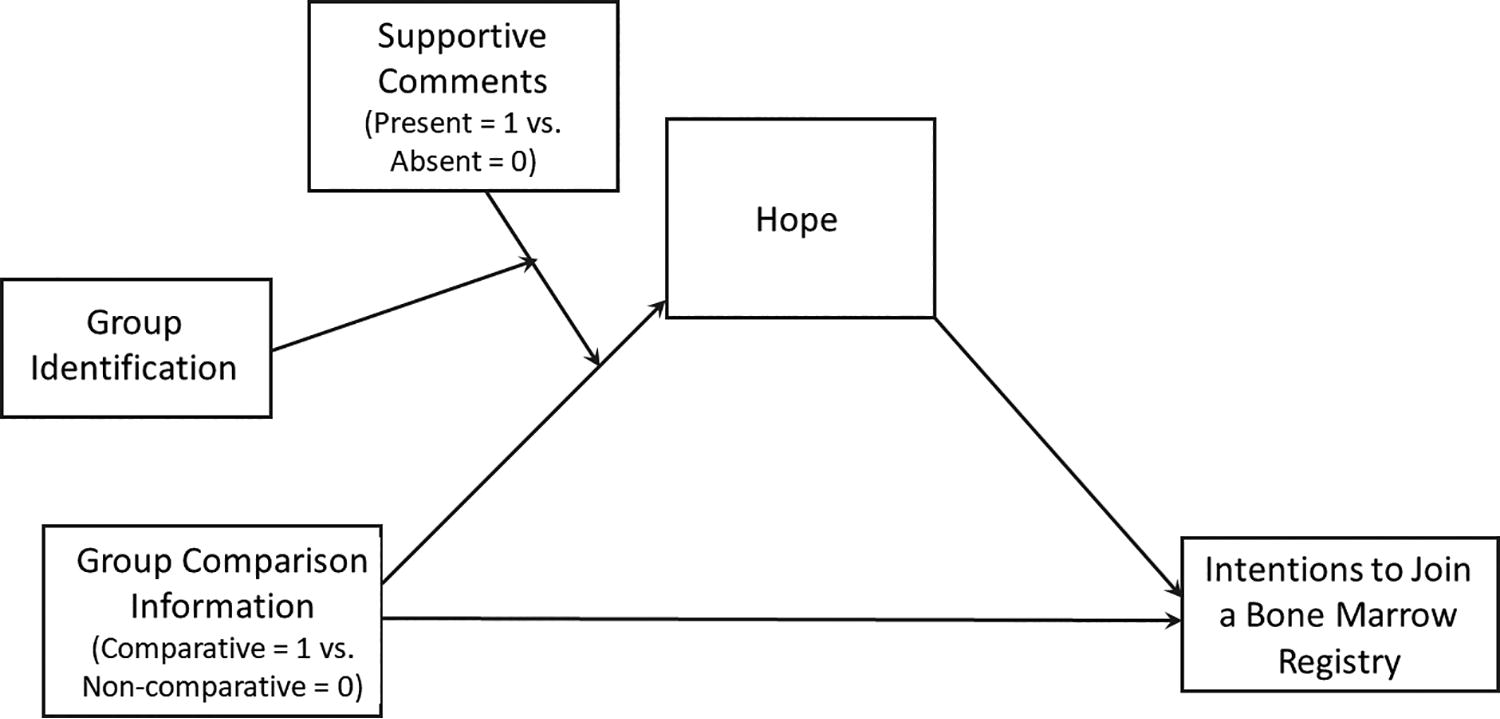
Conceptual illustration of the proposed model (PROCESS Model 11).
Method
Participants
We collected data from African Americans recruited through the Qualtrics online panel service. Following the National Marrow Donor Program’s eligibility criteria, we recruited individuals between 18 and 44 years old. A total of 207 participants (Mage = 31.87, SDage = 7.33; 49.3 percent female) completed the study.
Procedure
Data collection was conducted in two waves. The Wave 1 (W1) online survey measured group identification (proposed moderator) and covariates (age, gender, education, income, and trait empathy). Approximately 7–10 days following the W1 survey, those who completed the survey were invited back for Wave 2 (W2). The W2 online experiment was based on a 2 (GCI: comparative vs. non-comparative) × 2 (supportive comments: present vs. absent) between-participants design. Participants were randomly assigned to view one of four conditions and viewed a mock blog page encouraging African Americans to join a bone marrow registry. After this, participants answered a questionnaire containing measurement items as well as attention and manipulation checks (see the Supplementary Data S1 for more information).
Stimuli
Group comparison manipulation
The GCI manipulation was based on the actual data published on various U.S. racial/ethnic groups’ likelihood of finding a matching donor. 3 The non-comparative blog post read: “According to a recent research article published in the New England Journal of Medicine, there is only a 19% chance that an African American will have a perfectly matching donor already on the United States registry who is available to donate.” To this information, the comparative blog post added: “For other racial and ethnic groups, the chance is much higher. It’s about 40% for Hispanic Americans, 52% for Native Americans, and 75% for Caucasian/White Americans.”
Supportive comment manipulation
Using comments collected from the National Marrow Donor Program’s social media pages, we constructed five supportive comments for the manipulation. In the comments-present condition, the blog post was immediately followed by a “Join the Conversation” section that presented five supportive comments (see Figure 2). The comments-absent condition displayed the blog post only.
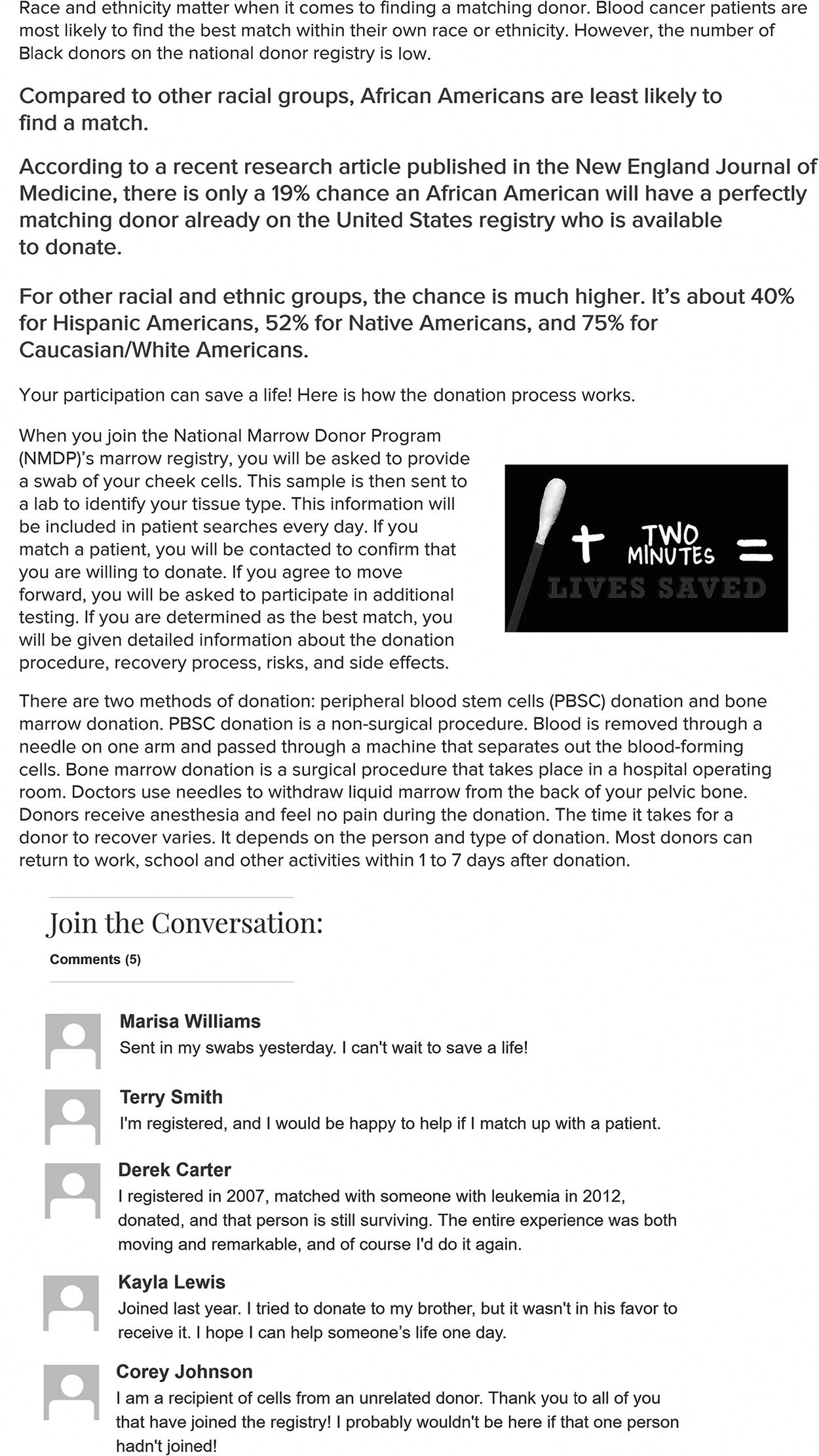
A sample experimental stimulus: the mock blog page presenting group comparison information and supportive comments.
Attention and manipulation checks
The W2 questionnaire presented attention and manipulation checks at the end. First, we checked attention to the supportive comment manipulation by asking whether participants recalled seeing supportive comments posted to the blog message (“no” vs. “yes”). Data from 17 participants who failed the check were excluded, leaving a valid sample of N = 190 (Mage = 31.80, SDage = 7.32; 48.9 percent female).
Next, we checked the GCI manipulation by asking participants to rate the following statement on a 5-point scale (1 = not at all accurate, 5 = very accurate): “The blog message noted that African Americans’ chance of finding a matching bone marrow donor is lower than that of other racial/ethnic groups such as Hispanic Americans, Native Americans, and Caucasian/White Americans.” The comparative condition participants (n = 93; M = 4.54, SD = 0.74) gave higher accuracy ratings than the non-comparative condition participants (n = 97; M = 3.24, SD = 1.33), t(150.71) = 8.32, p < 0.001 (equal variances not assumed from the Levene’s test, F = 30.06, p < 0.001). These results indicated that the manipulation was properly implemented.
Measures
Group identification (W1)
Participants rated six statements (e.g., “I have a strong sense of belonging to my own racial/ethnic group”) from the Revised Multigroup Ethnic Identity Measure (MEIM) scale 27 on a 5-point scale (1 = strongly disagree, 5 = strongly agree; α = 0.89), which were averaged.
Covariates (W1)
Demographic variables (age, gender, education, and income) were included as covariates. Additionally, we controlled for trait empathy, given its positive association with willingness to engage in altruistic health behaviors such as becoming an organ donor. 34 Trait empathy was measured with 14 items (e.g., “I often have tender, concerned feelings for people less fortunate than me”) from the Interpersonal Reactivity Index (IRI) 24 rated on a 7-point scale (1 = does not describe me very well, 7 = describes me very well; α = 0.81) and averaged.
Hope (W2)
Participants rated four items (“Hopeful,” “Optimistic,” “Encouraged,” and “Positive”)35,36 on a 7-point scale (1 = not at all, 7 = very much). The items (Cronbach’s α = 0.90) were averaged.
Bone marrow donor intentions (W2)
Four items (e.g., “I have it in my mind to join a bone marrow registry in the near future”), adapted from Park and Smith, 37 were rated on a 7-point scale (1 = strongly disagree, 7 = strongly agree; α = 0.96) and averaged.
Results
Table 1 presents the correlation matrix of the variables, along with means and standard deviations. H1 was tested with a two-way (GCI × supportive comments) analysis of covariance (ANCOVA) controlling for covariates. H2, RQ1, and RQ2 were addressed with ordinary least squares (OLS) regression based on PROCESS macro (Model 11) with 10,000 bootstrap samples. The full ANCOVA and OLS regression results are presented in the Supplementary Data S1.
Zero-Order Correlations, Means, and Standard Deviations of Measured Variables (N = 190)
Age was asked in an open-ended question format and participants provided their age in years. Education was measured by asking participants, “What is the highest level of education you have completed?”; participants were given four response options: “less than high school (1),” “high school (2),” “some college (3),” and “bachelor’s degree or higher (4).” Income was measured by asking participants, “What was your total household income before taxes during the past 12 months?”; participants were given eight response options ranging from “lower than $15,000 (1)” to “$150,000 and over (8).”
p < 0.05, **p < 0.01, ***p < 0.001.
M, mean; SD, standard deviation.
H1 predicted that GCI would elicit greater hope with supportive comments present than absent. The two-way interaction was significant for hope, and simple effects test revealed that GCI led to significantly higher levels of hope with supportive comments present than absent, consistent with H1 (see the Supplementary Data S1 for more information).
H2 predicted that message-elicited hope would lead to greater bone marrow donor intentions. In the regression predicting bone marrow donor intentions, hope was a significant and positive predictor, b = 0.35, standard error (SE) = 0.07, p < 0.001, supporting H2. RQ1 asked if and how group identification would moderate the joint effects of GCI and supportive comments on hope. The three-way interaction for hope was significant. When group identification was set at three levels, mean − 1SD (2.65) as low, mean (3.63) as moderate, and mean + 1SD (4.61) as high, group identification moderated the effect of GCI and supportive comments on hope (Figure 3). Without supportive comments, GCI significantly reduced hope for both low (b = −1.21, SE = 0.53, p = 0.023) and moderate identifiers (b = −0.99, SE = 0.33, p = 0.003) but not for high identifiers (b = −0.77, SE = 0.45, p = 0.090). However, with supportive comments, GCI significantly increased hope among low identifiers (b = 0.97, SE = 0.40, p = 0.018) but not for moderate (b = 0.22, SE = 0.32, p = 0.491) and high identifiers (b = −0.53, SE = 0.46, p = 0.243).
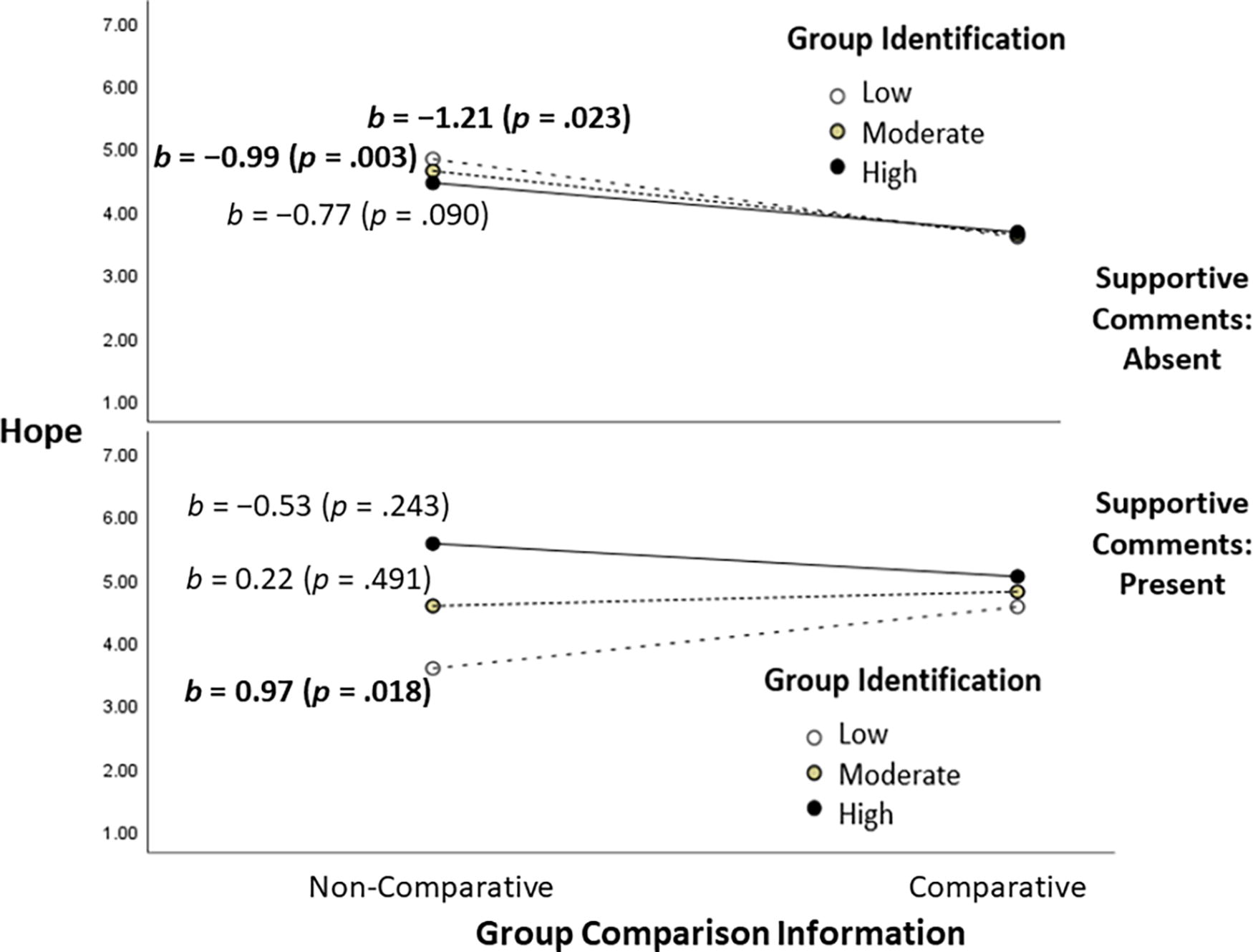
Three-way interaction of group comparison information, supportive comments, and group identification for hope.
RQ2 asked if and how group identification would moderate the joint effects of GCI and supportive comments on donor intentions through hope (see Figure 4 for the statistical model of the results). The PROCESS macro (Model 11) produced the index of moderated mediation involving three-way interaction (i.e., index of moderated moderated mediation 38 ), which tested if one moderator’s relationship with an indirect effect shifts based on another moderator’s levels.
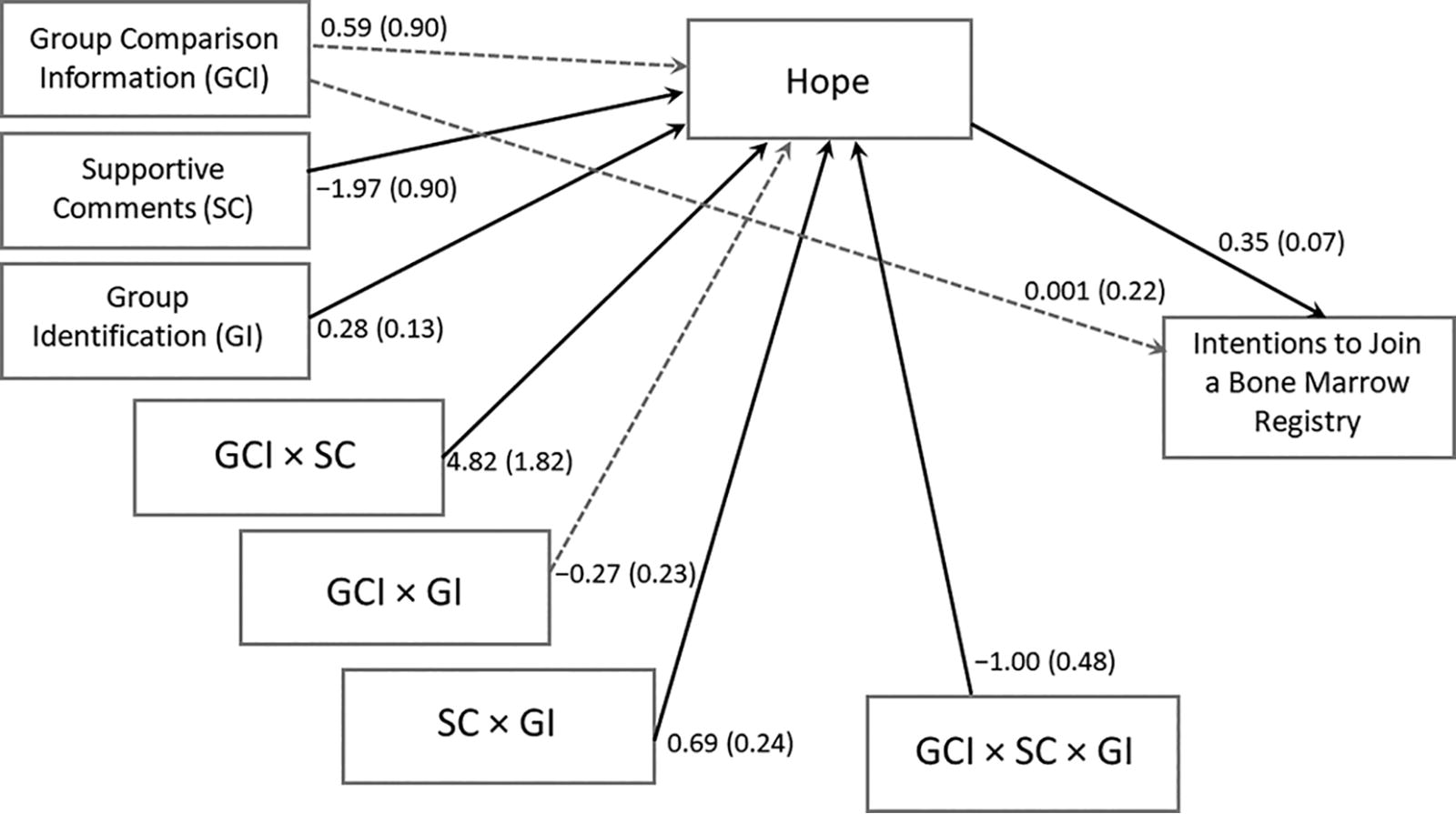
Statistical model of the conditional process analysis results. Solid lines indicate significant paths, and dotted lines indicate non-significant paths. Age, gender, education, income, and trait empathy were controlled for.
The index was significant for hope (index = −0.35; bootstrap SE = 0.19), with the 95% bootstrap CI not including zero (−0.7596 to −0.0050). When supportive comments were absent, GCI indirectly influenced donor intentions through hope, showing a significant and negative effect for both low and moderate identifiers but not for high identifiers. Intriguingly, this pattern reversed when supportive comments were present. The conditional indirect effect was significant and positive for low identifiers but not for moderate and high identifiers (see Table 2). The direct effect did not reach significance, b = 0.001, SE = 0.22, p = 0.995.
Conditional Indirect Effects of Group Comparison Information on Intentions to Join a Bone Marrow Registry (N = 190)
SE, standard error; CI, confidence interval.
Discussion
Our study showed that GCI increased hope and bone marrow donor intentions for African Americans when accompanied by supportive comments, with these effects further moderated by group identification. Specifically, supportive comments were crucial for enhancing hope, and, in turn, bone marrow donor intentions, among low identifiers. These findings demonstrate that it is important to consider the role of supportive message environments and group identification when addressing health disparities with GCI.
Theoretical implications
The present findings extend the literature on social comparison framing of health disparities in important ways. Previous social comparison framing studies concerning racial/ethnic minorities have primarily focused on perceptions of disease risks such as cancer, cardiovascular disease, and diabetes.6,12 Our study uniquely addresses disparities concerning bone marrow donation—a prosocial health behavior aimed at benefiting others, 39 which can contribute to reducing mortalities for one’s ingroup. 40 This shift from individual disease risks to collective prosocial action broadens the scope of social comparison framing, suggesting that social comparison extended to groups and identity processes can significantly influence communal health initiatives and engagement among racial/ethnic minorities.
Additionally, this research highlights the role of supportive online communication environments as a determinant of the effectiveness of GCI. Our findings not only demonstrate that supportive communication is empowering 20 but also speak to how user-generated message environments on social media platforms can contribute to digital health equity by effectively engaging low identifiers, who are generally more difficult to reach and persuade when compared with high identifiers. 30
Practical implications
For health campaign practitioners, the present findings present strategic insights. Engaging both strong and weak ingroup identifiers is essential to promoting prosocial health behaviors that require collective ingroup efforts. However, particularly in consideration of those less intrinsically tied to their group, creating an atmosphere where supportive comments thrive is vital, beyond crafting compelling comparative messages.
Furthermore, our findings could potentially guide global health organizations such as World Health Organization (WHO) and United Nations International Children’s Emergency Fund (UNICEF) in addressing critical public health problems such as water scarcity. 41 Particularly in developing nations, water conditions vary widely across different communities, which makes group-based comparisons viable. As communities can play a vital role in responsible water consumption and management, 42 campaign strategies that leverage both GCI and supportive user engagement on social media platforms may motivate and empower communities to effectively mobilize collective ingroup initiatives to improve health outcomes.
Limitations and future directions
Our study has limitations that should be addressed. Notably, the presence of supportive comments was counterproductive in the non-comparative conditions, which warrants interpretation. GCI, highlighting the plight of the group and the urgency of mobilizing action, might have made supportive comments more relevant and effective. Without GCI, supportive comments might be perceived as irrelevant or even insincere, leading to a reduced motivational impact. Assessing perceived relevance and sincerity of supportive comments could provide data to validate these speculations.
Additionally, the binary lens of presence/absence of supportive comments may not encapsulate the full spectrum of communication behaviors on social media platforms. Future endeavors should examine varied tonalities in the realm of online comments. Relatedly, given the nuanced influence of group identification, it will be important to study how group identification influences information processing when confronted with defiant, skeptical, or non-supportive comments. Exploring these nuances across diverse health communication areas will provide a richer understanding of digital health equity.
Conclusion
The present research sheds light on how social media campaigns can contribute to addressing health disparities. Our findings speak to the significance of understanding the interplay among message strategies, message environments, and group identification in increasing awareness and mobilizing support among the members of disadvantaged groups. Understanding these intricate dynamics associated with digital health communication will be paramount in the drive toward health equity.
Footnotes
Acknowledgments
We thank the anonymous reviewers for their constructive and insightful feedback. The first author also acknowledges support from the Ministry of Education of the Republic of Korea, the National Research Foundation of Korea (NRF-2021S1A3A2A02090597), and the Institute of Communication Research (ICR) at Seoul National University.
Authors’ Contributions
The first author conceived and designed the study, and also performed the data collection. Both authors analyzed the data, wrote the article, and approved this submission.
Authors Disclosure Statement
No competing financial interests exist.
Funding Information
The data collection for this study was funded by The Ohio State University’s Time-Sharing Experiments for the School of Communication (TESoC) program.

References
Supplementary Material
Please find the following supplemental material available below.
For Open Access articles published under a Creative Commons License, all supplemental material carries the same license as the article it is associated with.
For non-Open Access articles published, all supplemental material carries a non-exclusive license, and permission requests for re-use of supplemental material or any part of supplemental material shall be sent directly to the copyright owner as specified in the copyright notice associated with the article.
