




Abstract
The global shift to remote work during the COVID-19 pandemic has intensified scholarly attention to remote workers’ well-being. Although existing studies explore the varied impacts of remote work, there is a gap in understanding remote workers’ well-being through the lenses of social disparity and the digital divide. Extending digital divide scholarship to the remote work context, this study disentangles why some remote workers experience better well-being than others. We conducted a two-wave longitudinal panel study in South Korea during the COVID-19 pandemic (Wave 1: February 2021, Wave 2: October 2021). Among the 501 participants who participated in both waves, we found that individuals with lower education levels were less likely to have remote work opportunities. We focused our further analyses on a subset of 144 employees who had remote work opportunities within organizations with typical hierarchical structures. We found that socioeconomic status (SES) did not directly influence remote workers’ well-being but indirectly influenced it by contributing to the diversity in using information and communication technologies (ICTs). Workers with higher SES or more diversity in using ICTs demonstrated lower vulnerability and more effectiveness in maintaining their well-being in virtual organizational communication situations. This study highlights social disparities in remote workers’ well-being, which arise from the complex interplay of SES either indirectly influencing the diversity in ICT usage or interacting with virtual organizational communication satisfaction and duration. This study advances remote work scholarship by restructuring theoretical discussions on social stratification and the digital divide reproduced within the evolving work environment.
Whom Does Remote Work Make Happy?
The digital divide in remote workers’ well-being
The mandatory transition to remote work during the COVID-19 pandemic accentuated the attention to remote workers’ well-being. South Korea also implemented strict social distancing measures to curb COVID-19 during the study period (February–October, 2021), including a mandatory 30% remote work policy. Studies have focused on the binary question of whether remote work increases or decreases workers’ well-being, such as improved autonomy at work, 1 specifically through using information and communication technologies (ICTs), or increased isolation2–4 owing to a lack of social support. 5
However, a gap exists in research investigating the nuances of remote workers’ well-being as a manifestation of social disparity and the digital divide. For instance, studies have treated sociodemographic variables such as gender, age, and education as mere determinants of remote workers’ well-being6,7 without considering different levels of well-being as an extension of social inequality. Although research has acknowledged the importance of efficient ICT usage8,9 and virtual organizational communication10–12 for remote workers’ well-being, it has not grasped them from the broader theoretical frameworks of the digital divide.
By integrating digital divide scholarship and employing a two-wave longitudinal panel design, we aim to address this gap. We ask how socioeconomic status (SES) shapes remote work opportunities and ICT usage, as well as how these interact with virtual communication, ultimately generating well-being inequalities. How do SES, ICT use, and their interaction with virtual organizational communication generate digital divides in remote workers’ well-being?
Digital divides in remote workers’ well-being
Digital divide scholarship has illuminated three levels of challenges encountered by individuals with lower SES: (1) limited access to computers or the Internet; 13 (2) inadept usage of ICTs,13–15 such as less diverse ways of using ICTs; 16 and (3) diminished productivity outcomes resulting from ICT use. 17 Indeed, individuals with higher SES are more likely to use ICTs for activities that are information-seeking (e.g., political or health information) and capital-enhancing (e.g., financial transactions, research, and consulting services), yielding tangible outcomes for their academic or professional pursuits, rather than engaging in casual browsing, gambling, or gaming for temporary entertainment.15,17–19
Applying the insights from digital divide scholarship to the remote work context, individuals with higher SES are postulated to be more adept at generating practical outcomes by utilizing ICTs for remote work during the pandemic.1,20 Remote work scholarship underscores that not all workers but predominantly knowledge workers, who create and apply knowledge in their roles, have the opportunity to leverage ICTs for remote work.
21
This disparity emerges as a significant determinant of job security and health, thereby influencing overall well-being, especially during the pandemic. Regardless of frontline professionals such as healthcare workers, individuals with higher education were more likely to hold jobs that could be performed remotely, rendering them less vulnerable to job loss during lockdowns.1,20 Further, those occupying higher work ranks, such as a director in a production company, had the authority to choose remote work options across companies compared with lower-ranked staff confined to working within a factory.1,20 Therefore, we hypothesize: Individuals’ SES at Wave 1 positively predicts the opportunity for remote work at Wave 1 during the pandemic.
After workers gain the opportunity for remote work, remote work scholarship indicates that leveraging ICTs enhances their task accomplishment, 22 fosters feelings of flexibility and control at work, 23 and boosts overall workplace effectiveness, 24 ultimately contributing to remote workers’ well-being. 4 Further, during the lockdown, remote workers’ diverse usage of ICTs positively influenced aspects beyond their professional tasks, including their satisfaction with the organization and their relationships within it, fostering feelings of connection with others, 25 and shaping their overall well-being.
Digital divide scholarship proposes that it is the disparate SES of remote workers that influences the diversity in their use of ICTs, which, in turn, enhances their well-being. Individuals with high SES employ ICTs in diverse ways to improve their well-being, increasing work productivity through acquiring relevant information or skills17,18,26 and enhancing a sense of purpose and meaning through work.
27
In addition to work-related productivity, these remote workers utilize ICTs diversely, contributing to their well-being by seeking health information, maintaining a balanced work–life dynamic, efficiently managing household tasks, enjoying hobbies, or engaging in online classes with positive outcomes.
26
Thus, we posit: Remote workers’ SES at Wave 1 positively predicts diversity in using ICTs at Wave 1 and, in turn, influences their well-being at Wave 2 during the pandemic.
Virtual organizational communication for remote workers’ well-being
The advent of the COVID-19 pandemic introduced additional complexities to remote work, including shifts in organizational dynamics and uncertainties about the future, which amplified psychological strain among remote workers. 2 Organizational communication, defined as communication within a work organization among coworkers or between supervisors and subordinates, 28 emerged as a crucial source of emotional and informative support for workers’ well-being in such times of organizational crises and transformation.29,30
Research conducted before underscores the significance of both the quality and quantity of organizational communication for workers’ well-being. The quality of organizational communication, such as satisfaction with organizational communication,
31
enhances the general well-being of remote workers by increasing job satisfaction and reducing stress or insecurity,10–12
even amid the pandemic.
32
Concerning the quantity of organizational communication, a high volume of communication during remote work was correlated with increased information flow29,30 and the establishment of a stable community among organizational members,
33
given the cumulative nature of information and emotional support provided by virtual organizational communication. It also alleviated remote workers’ psychological distress and fostered connectivity during the pandemic.4,25,34 Prolonged virtual communication during the pandemic may also have aided workers in adjusting to and feeling comfortable with their new communication practices and work–life balance, improving their well-being.
35
Thus, we hypothesize: (a) Virtual organizational communication satisfaction and (b) duration at Wave 1 positively predict remote workers’ well-being at Wave 2 during the pandemic.
Interaction with SES and ICT use
Remote workers’ virtual organizational communication can have both positive and negative interactions with factors related to ICT use, jointly shaping their well-being. First, individuals with high education, high work rank, and diverse ICT use excel in generating productive outcomes from using ICTs, so they may better leverage virtual organizational communication to enhance well-being by improving work performance, managing work–life balance, and sharing health-related information.18,26,36
Conversely, remote workers with lower education, lower work rank, and less diverse ICT use may be less effective in using ICTs independently for well-being management,18,26,36 making supportive virtual communication more impactful. Considering these two plausible patterns, we offer nondirectional hypotheses on the interaction effect of virtual organizational communication on remote workers’ well-being: (a) Virtual organizational communication satisfaction and (b) duration will interact with remote workers’ education and work rank at Wave 1 and influence remote workers’ well-being at Wave 2 during the pandemic. (a) Virtual organizational communication satisfaction and (b) duration will interact with remote workers’ diversity in using ICTs at Wave 1 and influence remote workers’ well-being at Wave 2 during the pandemic.
Methods
Participants
This study used a two-wave longitudinal panel dataset available from Embrain, an online survey company in South Korea (www.embrain.com, see Table 1 for details). This study operationalized remote workers as employees with the experience of working from locations outside the organizational site within organizations following a typical hierarchical structure. Of the 501 participants who participated in both waves, 420 were employed and 71 identified their work ranks as “(6) other” with titles such as freelancer or self-employed individual, who were not working in the typical hierarchical structure (Wave 1). Thus, to examine H1 regarding whether the remote-working opportunity differed among participants by their SES (Wave 1), we excluded 71 of the 420 employees, which left 349 employees for analysis.
Survey Participants by Data Collection Period
Note: Survey anonymity was ensured through the allocation of ID numbers by the survey company, which were used to link participants across Wave 1 and Wave 2. All procedures received approval from the host university’s Institutional Review Board. Participants provided online consent forms before engaging in the surveys.
Missing data or data with completion times outside three standard deviations from the mean were deemed invalid and thus excluded from analysis. 52
Compensation fee was given upon completing both Wave 1 and Wave 2, which is a comparable compensation fee for samples from survey companies. 53
To examine other hypotheses about remote workers, we eliminated the 205 workers who did not report that they had remote-working experiences and only analyzed responses from remote workers (n = 144). All procedures received approval from the host university’s Institutional Review Board. Participants provided online consent forms before engaging in the surveys.
Measures
We assessed if the participants had the opportunity for remote work during the COVID-19 pandemic (see Table 2 for full measures and Supplementary Appendix A S1 for correlations among main variables). For remote workers’ affective and cognitive well-being, we used identical, validated measures from a previous study. 37
Full Items and Descriptions of the Study Variables
Note. Among three components of SES (income, education, and work rank in a hierarchical structure of the organization 38 ), we focus throughout this article on education and work rank. This decision was based on four reasons. First, previous research has regarded education as the most influential determinant of individual activities using ICTs. 39 Second, many studies have found that education rather than income becomes more important in explaining ICT uses and their consequences after ICT access becomes available.39,40 Third, in this study's context of South Korea, income data suffer from the validity issue because of the face-saving culture in Korea, which induces Koreans to conceal or exaggerate their income even in anonymous surveys.41,42 Finally, work rank reflects the extent of a worker’s power to decide how to use ICTs and what work to generate from them. 43 ICT, information and communication technology; SES, socioeconomic status.
Among the three components of SES (income, education, and work rank), 38 in this study, we operationalized and measured SES as a composite of participants’ highest educational attainment and their work rank within a hierarchical organizational structure. We focused on only these two components for four reasons. First, previous research has regarded education as the most influential determinant of individual activities using ICTs. 39 Second, many studies have found that education rather than income becomes more important in explaining ICT uses and their consequences after ICT access becomes available.39,40 Third, income data in Korea suffer from the validity issue because of the face-saving culture, which often induces Koreans to conceal or exaggerate their income even in anonymous surveys.41,42 Finally, work rank reflects a worker’s power to decide how to use ICTs and what work to generate from them. 43
For diversity in using ICTs, we employed a previous measure. 44 We asked participants’ degree of engagement in six online activities during the pandemic and summed the number of activities in which participants engaged either (4) frequently or (5) always. A higher sum indicated a greater diversity in participants’ use of ICTs.
For participants who reported working remotely since the onset of the COVID-19 pandemic (n = 144), we assessed virtual organizational communication satisfaction using the Communication Satisfaction Questionnaire 31 and the total virtual communication duration by the number of months they had been communicating virtually owing to remote work.
Analysis
To test H1, multiple logistic regression was used to examine whether the remote-working opportunity differed among participants in terms of education and work rank. Education, work rank, and control variables were added to a logistic regression model predicting the probability of participating in remote work.
We also conducted a mediation analysis on 144 remote workers (H2). 45 Control variables used in the regression analysis were also included as covariates. A bootstrapping method was used with 5,000 possible samples, which provides a sample-based estimate of the indirect effect and biased corrected confidence intervals (CIs).
To analyze the consequences of remote work and draw causal inferences (H3–H5), we utilized hierarchical ordinary least squares lagged dependent variable regression models on remote workers. 46 Well-being at Wave 2 was regressed on well-being at Wave 1, education, work rank, diversity in using ICTs, virtual organizational communication, interaction terms, and control variables. The inclusion of well-being at Wave 1 formed lagged dependent variable models, capturing the effects of independent variables (Wave 1) on the changes in the dependent variable between Wave 1 and Wave 2. All variables except well-being at Wave 2 were measured at Wave 1. In every analysis, we controlled for age, gender, and marital status, which are known predictors of individuals’ well-being, 47 as well as workers’ length of service within their organization. Given the COVID-19 context and its potential impact on participants’ physical health, a key determinant of well-being, 48 we also accounted for their present health status.
Model 1 included education, work rank, diversity in using ICTs, and control variables at Wave 1. Model 2 added communication satisfaction and duration at Wave 1. Model 3 added interaction terms between virtual organizational communication with (1) education, (2) work rank, and (3) diversity in using ICTs. All variables were mean-centered for the interaction terms. To further investigate the interaction, we implemented the Johnson–Neyman technique to estimate the magnitude and significance for the conditional effect of independent variables on dependent variables across regions in the range of moderating variables. 49
Results
Individuals’ education positively influenced the initial chance for remote work (see Table 3, odds ratio = 1.29, 95% CI [1.14, 1.47]). Work rank did not have a significant influence on the opportunity for remote work. Thus, H1 was partially supported.
Odds Ratio for Participating in Remote Work
Note: Cell entries are odds ratio and confidence interval from multiple logistic regression. Bold ORs indicate p < 0.05. CI, confidence interval; OR, odds ratio.
The indirect paths between (1) education and remote workers’ affective well-being and (2) work rank and remote workers’ affective well-being through diversity in using ICTs were significant, whereas the direct paths from SES to well-being were not significant (H2, see Table 4). This implies that diversity in using ICTs significantly mediated the relationship between (1) education and remote workers’ affective well-being (β = 0.01, 95% CI = 0.00 to 0.01) as well as (2) work rank and remote workers’ affective well-being (β = 0.01, 95% CI = 0.00 to 0.02). The indirect paths between (3) education and remote workers’ cognitive well-being and (4) work rank and remote workers’ cognitive well-being through ICT use were not significant. Therefore, H2 was partially supported.
Mediation Tests for H2
Note: n = 144. Number of bootstrap samples = 5,000.
Bootstrapped standard error.
Bias-corrected bootstrapped 95% confidence intervals. If the 95% confidence interval for an indirect path does not include 0, there is evidence of significant mediation.
p < 0.05. ICT use: Diversity in using ICTs. ICT, information and communication technology.
Each type of virtual organizational communication exhibited distinct relationships with remote workers’ well-being (H3, see Model 2 in Tables 5 and 6). Communication satisfaction emerged as a positive predictor of remote workers’ affective well-being (β = 0.23, p < 0.01) but not of cognitive well-being. Communication duration was a negative predictor of affective well-being (β
Effects of Wave 1 SES, ICT Use, Organizational Communication on Wave 2 Affective Well-Being
Note: Comm.: Communication ICT use: Diversity in using ICTs. ICT, information and communication technology; SES, socioeconomic status.
***p < 0.001, **p < 0.01, *p ≤ 0.05, + p < 0.10.
Effects of Wave 1 SES, ICT Use, Organizational Communication on Wave 2 Cognitive Well-Being
Note: Comm.: Communication. ICT use: Diversity in using ICTs. ICT, information and communication technology; SES, socioeconomic status.
***p < 0.001, **p < 0.01, *p ≤ 0.05, +p < 0.10.
Education interacted with communication satisfaction, jointly influencing affective well-being (H4a, β = −0.21, p < 0.05). Among those with low education (below 2.11 points in Figure 1), affective well-being decreased dramatically as their communication satisfaction decreased. Among those with higher education, however, the relationship between communication satisfaction and affective well-being did not change significantly. The interaction effect between education and communication satisfaction on cognitive well-being was not significant. Work rank had no combined effect with communication satisfaction on remote workers’ well-being.

The upper graph represents the Johnson–Neyman graph of the conditional effect of communication satisfaction on affective well-being (y-axis) by level of education (x-axis). Although those with low levels of education experienced a significant decline in affective well-being as communication satisfaction decreased, those with high levels of education experienced no such change. The middle graph represents the Johnson–Neyman graph of the conditional effect of communication duration on cognitive well-being (y-axis) by level of education (x-axis). Although those with low levels of education experienced a significant decline in cognitive well-being as communication duration decreased, those with high levels of education experienced no such change. The lower graph represents Johnson–Neyman graph of the conditional effect of communication duration on cognitive well-being (y-axis) by work rank (x-axis). Although those with higher work rank experienced a significant rise in cognitive well-being as communication duration was extended, those with lower work rank experienced no such change. The level of education and work rank were mean-centered, setting 0 as the mean.
Education interacted with communication duration, jointly influencing cognitive well-being (H4b,
Work rank interacted with communication duration, jointly affecting cognitive well-being (β = 0.16, p < 0.05). Cognitive well-being increased with communication duration for those with higher work rank (above 1.43 points in Figure 1), whereas no such change was observed for those with lower work rank. Thus, H4 was partially supported.
Diverse ICT use interacted with communication satisfaction, jointly influencing affective well-being (H5a, β = −0.17, p = 0.05). Those with less diversity in using ICTs (below −0.16 points in Figure 2) experienced declining affective well-being with decreasing communication satisfaction, whereas those with more diverse ICT use maintained consistent levels of affective well-being despite changes in communication satisfaction. The interaction term between diversity in using ICTs and communication satisfaction was not significantly associated with cognitive well-being.
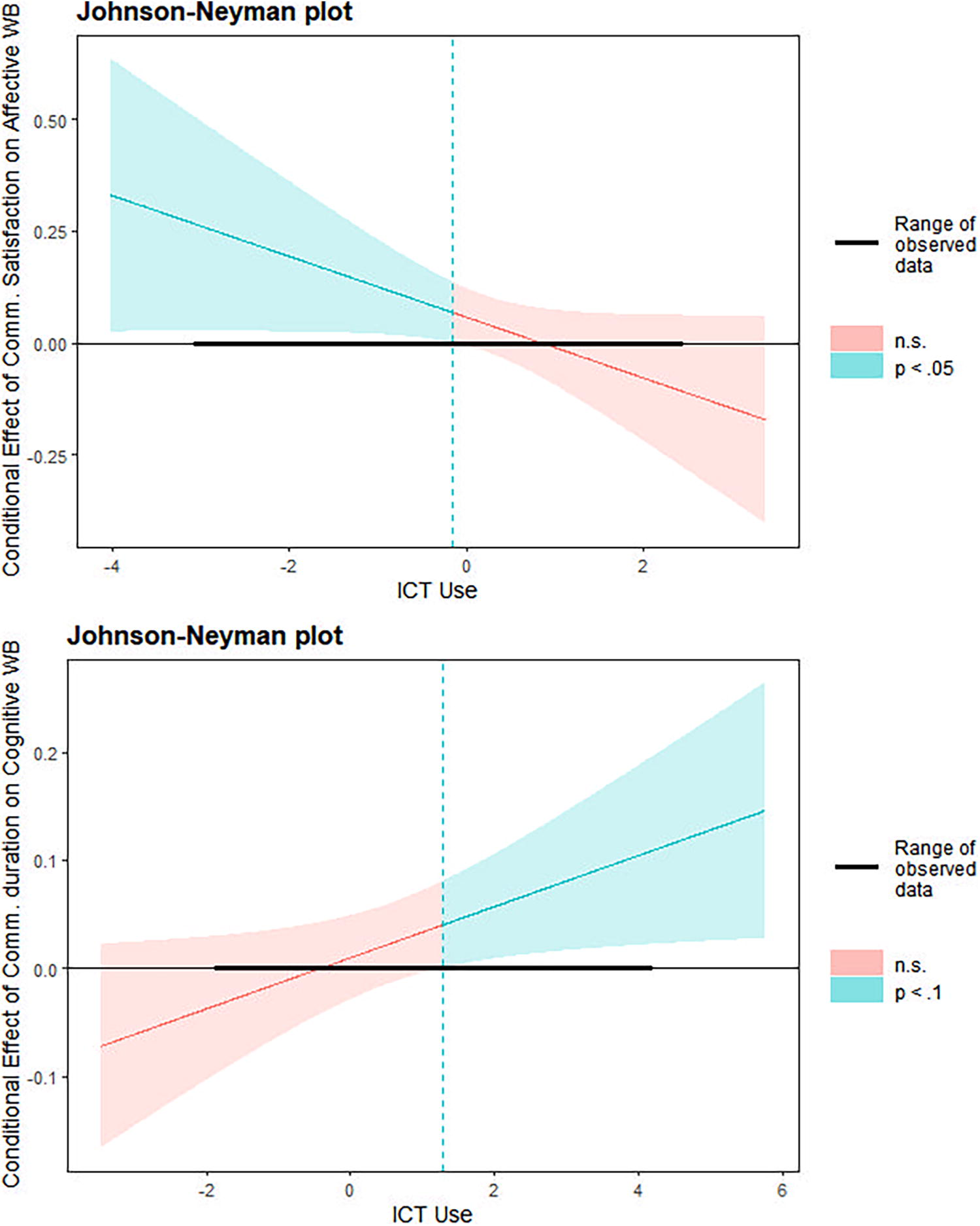
The upper graph represents Johnson–Neyman graph of the conditional effect of communication satisfaction on affective well-being (y-axis) by diversity in using ICTs (x-axis). Although those with less diversity in using ICTs experienced a significant decline in affective well-being as communication satisfaction decreased, those with more diversity in using ICTs experienced no such change. Lower graph represents Johnson-Neyman graph of the conditional effect of communication duration on cognitive well-being (y-axis) by diversity in using ICTs (x-axis). Although those with more diverse ways in using ICTs experienced a significant rise in cognitive well-being as communication duration was extended, those with less diverse ways in using ICTs experienced no such change. The diversity in using ICTs was mean-centered, setting 0 as the mean. ICTs, information and communication technologies.
Diversity in using ICTs also interacted with communication duration, jointly affecting remote workers’ cognitive well-being (H5b, β = 0.13, p < 0.10). Cognitive well-being of workers with more diversity in using ICTs (above 1.28 points in Figure 2) increased with longer communication duration, whereas cognitive well-being of those with less diversity didn’t change significantly under the same conditions. The interaction term between diversity in using ICTs and communication duration was not significantly related to affective well-being. Thus, H5 was partially supported.
Discussion
This study suggests that SES and ICT use, together with virtual organizational communication, do generate disparities in remote workers’ well-being, but the divide is more complicated than just the privileged becoming more privileged. Initially, higher levels of education opened up more remote work opportunities during the pandemic regardless of health professionals working offline. However, SES influenced remote workers’ well-being not simply but through (1) the mediation of diversity in using ICTs or (2) interaction with virtual organizational communication. Those with higher SES utilized ICTs in diverse ways, making them less vulnerable or more productive in virtual organizational communication situations, thereby maintaining their well-being.
Although previous research has extensively explored pros1,21 and cons3–5,50 of remote work on well-being, this study suggests that these discussions may not apply uniformly across education levels. Access to ICTs does not guarantee related opportunities, such as remote work. By integrating digital divide scholarship, this study enriches remote work literature, urging a reconstruction of theoretical discussions and a reconsideration of the social inequalities reproduced in the evolving work environment.
Further, research has underscored the positive role of organizational communication in facilitating remote work.4,25,32,34,51 However, our results indicate that even when communication decreases, high levels of education and diverse ICT use contribute to sustaining workers’ well-being. Conversely, when communication increases, high work rank and diverse ICT use help leverage the positive role of communication for workers’ well-being (H4 and H5). These findings draw attention to the complex role of communication in generating inequality in remote workers’ overall well-being. This study contributes to remote work literature by identifying the nuanced roles of virtual communication and its intricate interactions with workers’ SES and ICT use to influence social disparities.
Future research and conclusion
This study has several limitations that pave the way for future research. This study did not use a nationally representative sample, so the results may not be generalizable to every remote worker in the country or in other cultural contexts. Moreover, organizations and remote workers may have become more adept to remote work conditions after Wave 2. Future studies should gather data continuously and investigate changed roles of ICT-related factors and organizational communication in remote workers’ well-being. Integrating actual data, such as log data of communication duration, alongside self-reported measures, may also complete the picture of the role of organizational communication in remote workers’ well-being.
The compulsory shift to remote work amid the COVID-19 pandemic prompted heightened awareness of remote workers’ well-being. Moreover, remote work is anticipated to persist as a prevalent working arrangement beyond the pandemic era. Integrating health and organizational communication scholarship into digital divide research, this study suggests future research directions to incorporate health inequalities of remote workers as essential divides in individual lives. It further underscores that remote workers’ well-being may be a manifestation of deeper societal inequalities and that a broader theoretical framework encompassing social and digital disparities is imperative for a nuanced comprehension of the evolving work landscape.
Footnotes
Author Disclosure Statement
There were no conflicts of interest in the conduct and presentation of this study.
Funding Information
This study was supported by the Ministry of Education of the Republic of Korea and the National Research Foundation of Korea (NRF-2021S1A5B8096358) and the Institute of Communication Research at Seoul National University. This study was supported by a research grant from Kwangwoon University in 2023.

References
Supplementary Material
Please find the following supplemental material available below.
For Open Access articles published under a Creative Commons License, all supplemental material carries the same license as the article it is associated with.
For non-Open Access articles published, all supplemental material carries a non-exclusive license, and permission requests for re-use of supplemental material or any part of supplemental material shall be sent directly to the copyright owner as specified in the copyright notice associated with the article.
