




Abstract
The ability and self-efficacy to utilize the internet and technological devices has become critical during the COVID-19 pandemic. By examining the role of on- and offline social capital as a moderator in the relationship between technological self-efficacy (TSE) and subjective well-being, this study aims to contribute to the understanding of whether the social compensation or social enhancement hypotheses explain the well-being of immigrants in South Korea during the COVID-19 pandemic. We analyzed data from the 2020 Digital Divide Survey of immigrants (n = 700) and native-born Koreans (n = 6,910) aged ≥18 years. In the ordinary least squares regression model, subjective well-being (SWB) was the dependent variable and TSE was the independent variable. Online social capital, including bonding and bridging, was the moderating variable. Moreover, we tested the moderated moderation of nativity and on- and offline social capital. The results showed that bonding and bridging on- and offline social capital played a positive role in the SWB of both immigrants and native-born Koreans; bridging played a greater role among immigrants than among native-born Koreans. Furthermore, the interaction between TSE and online bonding social capital has a stronger association with the SWB of immigrants, as supported by the moderated moderation model. In line with the social enhancement hypothesis, immigrants with more online bonding social capital showed a stronger positive association between TSE and subjective well-being. Our results suggest that culturally adapted technological education for immigrants can be tailored to meet their unique needs and experiences.
Introduction
During the COVID-19 pandemic, social capital acts as a buffer against loneliness for better mental health and subjective well-being (SWB), especially immigrants who have fewer resources and networks in their destination countries.1,2 The role of “online” social capital, which positively impacted psychological well-being in the prepandemic era,3,4 is further emphasized. 5 The pandemic has led to the further integration of offline social spaces into online environments, with most connections being maintained through digital platforms.6,7 Nonetheless, its role, particularly among various immigrant groups, remains unexplored. 8
Digital technology use positively influences SWB,9,10 as it helps people access COVID-19 information10,11 and maintain social relationships, especially during social distancing.12,13 Although digital technology can help immigrants and refugees adapt to their destination countries,14–16 it remains unclear how their self-efficacy regarding digital technology use compares to native-born individuals, how it impacts their SWB, and how online social capital influences this relationship, particularly during the pandemic.
In South Korea (hereinafter Korea), where the immigrant population is growing, 17 few studies have addressed their mental health or well-being during the COVID-19.18,19 To our knowledge, no research has explored immigrants’ SWB in relation to their internet use and social capital during the pandemic in Korea. This study aims to fill that gap with empirical data.
Theoretical Framework and Literature Review
Immigrants’ online social capital
Studies show that immigrants often lose social capital when leaving their home countries capital20,21 and must build new networks in their host country.22,23 Digital technology, especially online social capital, can help compensate for this loss, 24 serving as an alternative resource for immigrants. 25 Putnam 26 distinguished two types of social capital: bonding, which provides emotional support through strong ties, and bridging, which involves weak ties that help acquire information and new perspectives. Williams 27 extended these concepts to online communities, creating the internet Social Capital Scale (ISCS) to measure social capital’s functional distinctions.
The patterns of immigrants’ use of digital technology and their implications for social capital can also be examined from these two aspects. Williams 28 argued that internet use correlated positively and negatively with bridging and bonding social capital, respectively, and immigrants use digital technology to maintain their close networks, such as family or coethnic friends, 29 across geographic borders. First, online bonding social capital “intensifies close relationships rooted in strong ties.” 30 It is associated with strong ties with family/friends in home countries using technology. On the other hand, online bridging social capital “opens towards new perspectives from connections based on weak ties.” 30 The internet plays a significant role in assisting immigrants’ acculturation, because it provides them information that is often hard to obtain through other media. 31
The line between offline and online social spaces has increasingly blurred as digital technologies become integral to daily life.32,33 Recent literature suggests a high correlation between online and offline social capital,34,35 and Williams 27 did not report divergent validity between online and offline social capital measures in his scale development. During the pandemic, social distancing led to a heavy reliance on online platforms to maintain social connections, further blending online and offline social capital.6,7 The surge in online activities during this period 36 highlighted the increasing importance of online spaces in maintaining and developing offline social connections. 37
Technological self-efficacy and SWB
Self-efficacy, defined as belief in one’s ability to perform a specific task at a specified level, 38 in digital utilization is necessary in the internet era. Technological self-efficacy (TSE) is “the belief that one can make effective use of new technologies, or the anxiety associated with new technologies.” 39 TSE can predict SWB in digital technology use. 40 During the pandemic, when technology became central to daily life, online social capital via the internet and social media benefited psychological well-being.41,42 TSE is essential for effectively leveraging this capital.43,44
Social enhancement and social compensation hypotheses
How digital technology utilization affects an individual’s SWB varies according to moderators,45–47 mediators,48–50 and demographic backgrounds.45–50 Two opposing hypotheses explain this relationship: social enhancement and social compensation. 51 The social enhancement hypothesis asserts that people with more social networks can enhance themselves through online activities to improve their SWB. 52 Further, online bonding and bridging social capital could enhance SWB by improving or expanding people’s social networks.53,54
Conversely, the social compensation hypothesis posits that online activities benefit those lacking social capital and networks.55,56 It allows individuals with low self-esteem or social anxiety to form relationships more easily than in-person interactions.57–60 That is, the internet can compensate for lack of social capital and social networks for sexual minorities who are unable or unwilling to disclose their identities61,62 or immigrants with language or cultural barriers.63,64
Testing the social enhancement and social compensation hypotheses requires a holistic approach that considers psychological (TSE) and social factors (online social capital). The relationship between digital technology use and SWB is complex, and examining the interaction between psychological and social factors can help untangle it. Additionally, considering the impact of nativity can provide valuable insights into maximizing digital technology’s benefits for immigrants with less social capital or social support in the host country.65–67
The Current Study
This study revisits the social compensation and social enhancement hypotheses with the following aims. First, this study investigated the differences between on- and offline social capital and TSE based on nativity. Second, we tested whether the two on- and offline social capital types and TSE are associated with SWB among immigrants and native-born Koreans. Third, we examined whether bonding and bridging social capital moderate the TSE–SWB relationship (see Figure 1) to test the above hypotheses.

Proposed model.
Methods
Data and samples
We analyzed data from the 2020 Digital Divide Survey by the Ministry of Science and ICT and the National Information Society Agency of South Korea. This annual cross-sectional statistical survey is approved by the government (approval no. 12017). This study utilized data collected during the pandemic (September–December 2020) via face-to-face interviews. We included married immigrants (n = 700) and native-born Koreans (n = 6,910) aged ≥18 years.
Measures
Dependent variable: SWB
To measure SWB, we used the Satisfaction with Life Scale 68 and translated it into Korean. This scale includes five items (e.g., “In most ways, my life is close to my ideal” and “So far, I have gotten the important things I want in life”) rated on a 4-point Likert scale: not satisfied at all, somewhat dissatisfied, somewhat satisfied, and very satisfied. We used the five responses’ average score; the Cronbach’s alpha was 0.8067 for native-born Koreans and 0.8058 for immigrants.
Independent variable
TSE. TSE was assessed based on three statements: “I tend to adapt well to new technologies and products”; “When using new technologies and products, I am confident that I will learn how to use them by myself”; “When using new technologies and products, I am better than the others.” These statements are a short version of the validated self-efficacy subscale of mobile application acceptability among the Korean population.69,70 Responses were rated on a four-point Likert scale: 0 = “not at all; 3 = “very much.” We used the three statements’ average score (0–3 points), with higher scores suggesting higher TSE. Cronbach’s alpha was 0.8566 among native-born Koreans and 0.8177 among immigrants.
Control variables. Age, gender, education, and household income were control variables for both immigrants and native-born Koreans. Education was a categorical variable: less than high school, high school, and college or higher. Household income was a dichotomous variable if it was greater than $3,000. For immigrants, we included whether they had lived in South Korea for at least 10 years and/or obtained citizenship.
Moderator: On- and offline social capital
Online social capital was assessed using 10 statements adapted from the ISCS. 27 The original scale included 20 statements: 10 each for bonding and bridging social capital. This study utilized five statements each for bonding and bridging social capital. Acknowledging the inseparable relationship between online and offline contexts, especially in light of the COVID-19 pandemic,6,7 we use the term on- and offline social capital to align with existing literature while emphasizing our focus on the digital dimension of social capital.
Bonding Social Capital. The five statements were “There are several people online/offline I trust to help solve my problems”; “There is someone online/offline I can turn to for advice about making very important decisions”; “There is someone online/offline that I feel comfortable talking to about intimate personal problems”; “I know people online/offline well enough to get them to do anything important”; and “The people I interact with online/offline would help me fight an injustice.”
Bridging Social Capital. The five statements were “Interacting with people online/offline makes me feel like part of a larger community”; “Interacting with people online/offline reminds me that everyone in the world is connected”; “I am willing to spend time to support general online/offline community activities”; “Interacting with people online/offline gives me new people to talk to”; and “Online/offline, I come in contact with new people all the time.”
Responses were rated on a four-point Likert scale: 1 = “not at all”; 4 = “very much.” For bonding/bridging social capital, we used the five statements’ average score (1–4 points); a higher score suggested higher bonding/bridging social capital. For bonding (bridging) social capital, Cronbach’s alpha was 0.8292 (0.8309) among native-born Koreans and 0.7484 (0.8058) among immigrants.
Analytic approach
We compared the immigrant sample with native-born Koreans using descriptive statistics, chi-square tests, and t-tests. Hierarchical regressions assessed the roles of TSE and on- and offline social capital in SWB, controlling for sociodemographic factors. Moderation analysis examined the interaction effect of on- and offline social capital on TSE and SWB, whereas moderated moderation tested if this effect varied by nativity. The variance inflation factors (VIF) were calculated, and an exclusion threshold of VIF >5 was used to assess the multicollinearity of the model. 71 None of our variables exceeded this threshold (the maximum was 2.02) and the mean VIF was 1.49. All analyses used STATA 17.0, and the significance level was p < 0.05.
Results
Table 1 shows the characteristics of the study participants. There was no significant difference in SWB between immigrants and native-born Koreans, with the mean scores being 2.65 and 2.67, respectively. Immigrants reported lower TSE, with a mean score of 1.59 compared to 1.75 for native-born Koreans, and overall social capital, with mean scores of 2.79 and 2.87, respectively, including both bonding and bridging social capital. On average, immigrants were younger, with a mean age of 40.39 years (standard deviation [SD] = 9.52), compared to a mean age of 45.33 years (SD = 18.62) for native-born Koreans. Immigrants included more women (77.86%) than men (22.14%); their percentages were the same among native-born Koreans. The national median household income exceeded $3,000 for only 35.71% immigrants but for 83.70% of native-born Koreans. Only 18.14% immigrants graduated from college; almost half of native-born Koreans (48.28%) graduated from high school, and more than a third (35.67%) graduated from college. Most immigrants received Korean citizenship (83.00%), and more than half had lived here for ≥10 years.
Characteristics of Study Participants, n (%)
$1 was calculated as ₩1.
M, mean; SD, standard deviation; SWB, subjective well-being; TSE, technological self-efficacy.
Table 2 shows the correlation matrix of the study variables. SWB was positively correlated with TSE (r = 0.363, p < 0.001), bonding social capital (r = 0.338, p < 0.001), and bridging social capital (r = 0.306, p < 0.001). TSE was positively correlated with bonding social capital (r = 0.375, p < 0.001) and bridging social capital (r = 0.405, p < 0.001). Bonding social capital and bridging social capital were strongly moderately correlated (r = 0.584, p < 0.001). Nativity was negatively correlated with TSE (r = −0.059, p < 0.001), bonding social capital (r = −0.041, p < 0.001), and bridging social capital (r = −0.033, p = 0.005).
Correlation of Study Variables
p < 0.01.
p < 0.001.
SWB, subjective well-being; TSE, technological self-efficacy.
Factors associated with SWB
Table 3 presents factors associated with SWB by nativity. Model 1 shows that TSE related positively to SWB among immigrants; it remained significant when both types of on- and offline social capital, which also had a positive role in SWB, were added to Model 2. Model 3 shows that TSE and on- and offline social capital were significantly associated with SWB when sociodemographic characteristics were controlled. Being younger, having lived ≥10 years in Korea, and having household income more than the median were positively related to SWB among immigrants. Among native-born Koreans, TSE correlated positively with SWB in Model 1. Both bonding and bridging on- and offline social capital related positively to SWB, and TSE remained significant after controlling for both social capital in Model 2. With sociodemographic characteristics controlled, TSE and both on- and offline social capital were significantly associated with SWB (Model 3).
Ordinary Least Squares Regression on Subjective Well-Being by Nativity
p < 0.05. Confidence intervals are in square brackets.
p < 0.01.
p < 0.001.
TSE, technological self-efficacy.
Table 4 and Figure 2 show the interaction effect of on- and offline social capital on the TSE–SWB relationship. For both groups, higher bonding social capital strengthens the positive relationship between TSE and SWB. The interaction effect was stronger among immigrants (β = 0.146, p < 0.01) than among native-born Koreans (β = 0.032, p < 0.01). Bridging social capital had no moderating effect on either group.
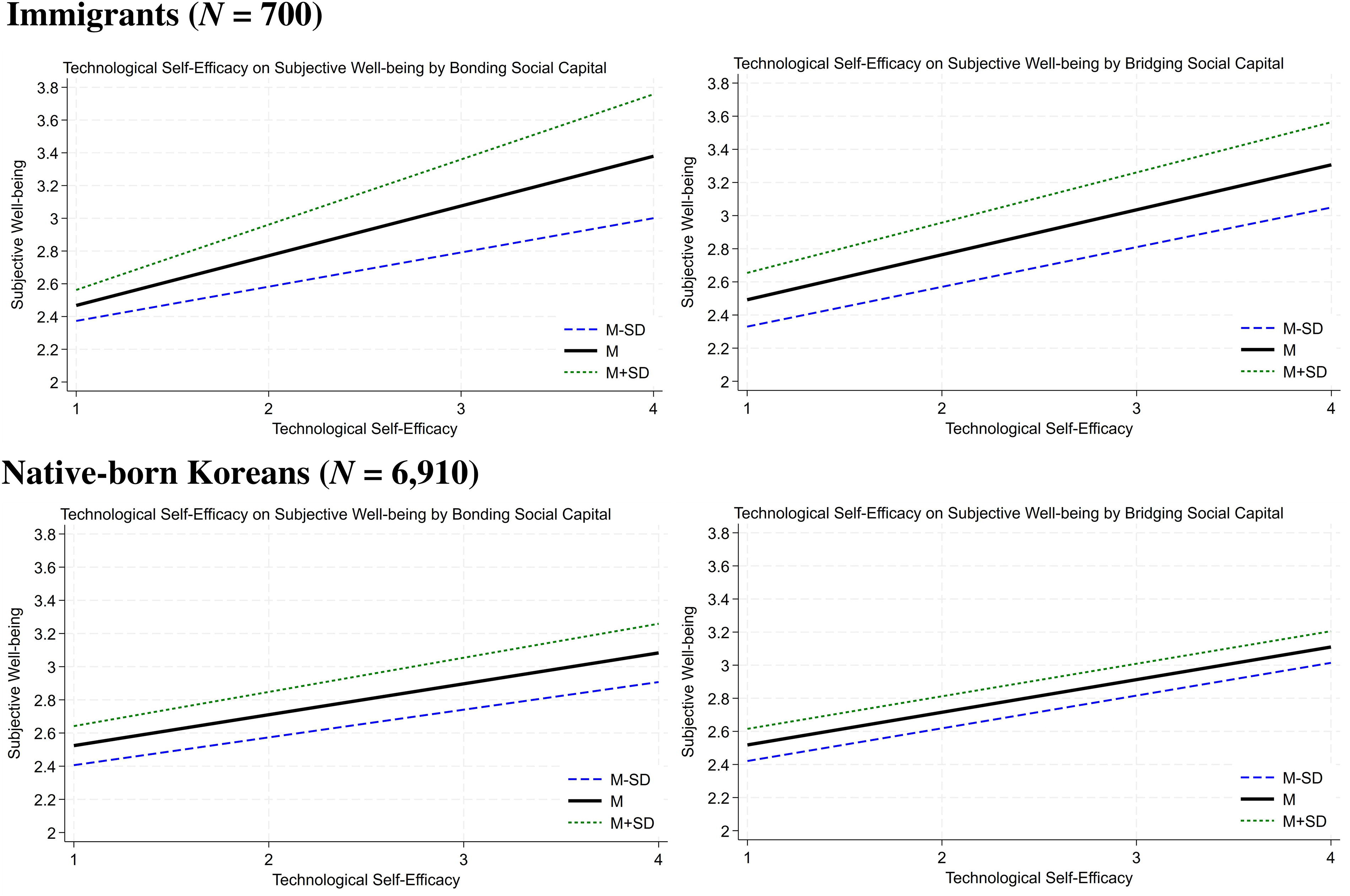
Moderation Effect of On- and Offline Social Capital between Technological Self-efficacy and Subjective Well-being Immigrants (n = 700) Native-born Koreans (n = 6,910) Note: The lines indicate the levels of each social capital. M, mean; SD, standard deviation.
Moderation Effect of On- and Offline Social Capital on the TSE–SWB Relationship
p < 0.05.
p < 0.01.
p < 0.001.
Confidence intervals are in square brackets. Socioeconomic variables (age, gender, education, and household income) were controlled for. For immigrants (n = 700), citizenship status, and years of living in Korea were additionally controlled.
SWB, subjective well-being; TSE, technological self-efficacy.
For robustness, we tested the moderated moderation of nativity, online bonding, and bridging social capital (Table 5). We found that the significant three-way interaction between immigrants, TSE, and online bonding social capital predicted SWB (β = 0.177, p < 0.05). The interaction between immigrants, TSE, and online bridging social capital did not significantly predict SWB.
Moderated Moderation Model of Online Social Capital and Nativity between Technological Self-Efficacy and Subjective Well-Being
p < 0.05.
p < 0.01.
p < 0.001.
Confidence intervals are in square brackets. Socioeconomic variables (age, gender, education, and household income) were controlled for.
TSE, technological self-efficacy.
Discussion
We found a positive relationship between TSE and SWB for both immigrants and native-born Koreans, with this effect being more pronounced among immigrants. The COVID-19 pandemic period was characterized by heightened reliance on technology for a wide range of activities.36,72,73 Consequently, TSE could be considered a proxy for technology utilization, suggesting that its positive impact on SWB likely works for both immigrants and nonimmigrants.
Although both bonding and bridging social capital were positively related to SWB among immigrants and native-born Koreans, bridging social capital had a greater impact on immigrants, whereas bonding social capital had a stronger effect on native-born Koreans. This difference may be attributed to the context of Korean society, which is relatively homogeneous and where native-born Koreans, who are generally tech-savvy, 74 might derive more emotional support from bonding social capital with others similar to themselves. In contrast, immigrants, who are often navigating a new environment, may benefit more from bridging social capital by connecting with diverse individuals beyond their strong ties, which helps them access new resources and support systems in the host society. 75
The interaction between TSE and online bonding social capital significantly predicted higher SWB for both groups, reinforcing the social enhancement hypothesis. Our study challenges the social compensation hypothesis by demonstrating that even vulnerable groups, such as immigrants, benefit more from online interactions when they have higher TSE, and social capital. The moderating effect of online bonding social capital was stronger among immigrants than native-born Koreans, whereas bridging social capital did not influence the TSE–SWB relationship for either group. For native-born Koreans, bonding social capital enhances SWB through interactions within their social networks. In contrast, immigrants’ bonding social capital often involves maintaining ties with their home country, 76 and online ethnic communities provide vital support in native languages.77,78 High TSE facilitates effective communication with these ties, boosting SWB. However, immigrants with high bonding social capital but low TSE may struggle to leverage these connections, limiting their positive impact on SWB.
We propose the following policy implications based on our findings. First, we showed that immigrants report lower TSE than native-born Koreans. Since TSE is positively related to SWB and is becoming critical during the COVID-19 pandemic,79,80 more TSE education that focuses on immigrants as well as culturally and linguistically appropriate intervention materials are needed. Additionally, there is a need to promote social capital online since both bonding and bridging are positively associated with SWB. We showed that bridging on- and offline social capital plays a greater role for immigrants than bonding on- and offline social capital; thus, meeting new people (supposedly native-born Koreans) online would be more beneficial for immigrants than communicating with other immigrants to obtain emotional support through bonding social capital. As a similar pattern was found among native-born Koreans, more active participation and online interaction between native-born people and immigrants may benefit both groups. There are many ways to encourage immigrants from various backgrounds to build on- and offline social capital, such as by providing translation services for non-Korean-speaking users and website members and regulating hate speech online based on race/ethnicity, religion, and nativity status.
Our study had some limitations to be addressed in future research. First, it relied on self-reported data, which may introduce subjectivity bias. Additionally, our analysis of secondary data did not allow for a complete separation of online and offline social capital, despite following established measurements of on- and offline social capital from previous research. 27 Considering that recent studies emphasize the need to distinguish between on- and offline interactions and their role on subjective well-being,7,81,82 future studies should aim to more distinctly measure on- and offline social capital to explore potential autocorrelations between these two types and to investigate how their roles in TSE and SWB differ between immigrant and native-born populations. Third, we analyzed cross-sectional data, making it difficult to determine the causal relationship between TSE and SWB. Moreover, as this study relied on data collected during the COVID-19 pandemic—a period marked by unprecedented reliance on technology—caution should be exercised when interpreting our results in the context of broader trends. Future studies could analyze longitudinal data to better understand this causal relationship over time, as immigrants in host countries become increasingly socially integrated over time. 83 Additionally, we only included marriage immigrants, so it is not representative of diverse immigrant populations in Korea. There are other immigrant groups, including foreign workers, international students, and refugees. Future studies could expand the scope to include these diverse groups to better understand the role of on- and offline social capital and TSE in the well-being of immigrants in Korea. Specifically, we suggest future studies compare North Korean refugees, who we did not include in the current study owing to their distinct characteristics (such as similar language and culture with native-born Koreans), with general marriage migrants and refugees from other countries. This comparison would provide a more comprehensive understanding of how varying backgrounds and experiences impact the relationship between social capital, TSE, and well-being among different immigrant populations.
Footnotes
Authors’ Contributions
All authors contributed to the conception and design of this study. N.Y. and S.H.J.: Performed the data analysis. N.Y. and S.H.J.: Wrote the first draft of this article. The authors contributed equally to this work.
Ethics Approval
This study utilized secondary data without personally identifiable information, and additional IRB approval was not required.
Data Availability Statement
We analyzed the data obtained from the 2020 Digital Divide Survey conducted by the Ministry of Science and ICT and the National Information Society Agency of South Korea. This annual statistical survey is approved by the government (approval no. 12017). These data are publicly available at https://www.data.go.kr/data/15038422/fileData.do
Author Disclosure Statement
The authors have no relevant financial or non-financial interests to disclose.
Funding Information
The authors declare that no funds, grants, or other support was received during the preparation of this article.