




Abstract
The field of problematic Internet use (PIU) has seen significant academic interest in recent years. In the absence of a universally accepted definition of PIU, a multitude of scales have been developed to evaluate it. Notably, the Generalized Problematic Internet Use Scale 2 (GPIUS-2), formulated on the cognitive-behavioral model by Caplan, emerges as a significant instrument in this domain. This research conducts a systematic review and meta-analysis of the GPIUS-2. The central aim is to assess its internal structure and reliability. This is achieved by a meta-analysis of the Cronbach’s alpha and the factorial structure, which is carried out in the framework of the Meta-Analytic Structural Equation Modeling. The results reveal high internal consistency of the GPIUS-2, support the multidimensional nature of the scale, and provide evidence about the presence of a generalized factor supporting the use of a total scale value as indicator of GPIUS. In addition, the study delineates potential areas for future research aimed at further refining the validity of the GPIUS-2.
Introduction
Problematic Internet use (PIU), identified by an excessive and uncontrolled usage of the Internet that leads to individual difficulties and a lack of control, has emerged as a significant concern in recent decades. 1 Despite not being classified within recognized diagnostic systems like the Diagnostic and Statistical Manual of Mental Disorders, 5th Edition (DSM-5) or the International Classification of Diseases, 11th Revision (ICD-11), PIU has been extensively studied and discussed in research and clinical circles.2,3
In fact, PIU has become a significant issue, because it has remarkable negative consequences, particularly among adolescents. For example, PIU has been related to psychological and social impairments, such as disrupted sleep patterns, low self-esteem, diminished academic performance, and difficulties in personal relationships.4,5 In addition, it has been linked to specific problematic Internet phenomena such as fear of missing out, nomophobia, and cyberbullying, all of which contribute to emotional distress and further dependence on Internet use. 5 The strong connection between PIU and mental health issues like depression and anxiety is especially worrisome, 6 with some studies even associating PIU with an increased risk of suicide, particularly among adolescents. 7 Some personality traits (e.g., impulsivity, neuroticism) and socioenvironmental factors, such as peer pressure, increase the chance of PIU. Vulnerable groups, such as youngsters with attention-deficit/hyperactivity disorder or autism spectrum disorder, may be more prone to PIU, using the Internet as a coping mechanism that increases their risk of Internet overuse and exacerbates underlying psychological issues.4,5,7
The exact categorization of PIU, whether as a disorder, addiction, or another type of clinical condition, remains unclear, but given the important consequences of this problem and its prevalence, PIU has attracted considerable attention from the academic, health care, and policy sectors. Notably, European studies have reported a prevalence of PIU among adolescents at about 4.4 percent.8,9 Two meta-analyses, each encompassing 31 countries, revealed elevated prevalence rates as follows: one reported a 6 percent prevalence, 10 and another based on 113 epidemiological studies concluded a 7% prevalence. 11 Further systematic reviews indicate significant variations in PIU prevalence across different countries, with figures ranging from 1 percent to 21 percent. 12 The COVID-19 pandemic has intensified PIU with a recent meta-analysis 6 revealing that approximately 20 percent to 30 percent of adolescents experienced PIU during the pandemic. In some regions, such as China, the prevalence was even higher. These findings emphasize the need for more research and targeted interventions to address the increasing rates of PIU. To effectively tackle this growing issue, it is crucial to count on a sound conceptualization of the problem and adequate measurement instruments.
Even if some variation in prevalence rates across studies can be attributed to cultural differences and the irruption of the COVID-19 pandemic, the variation also reflects the diverse ways PIU has been conceptualized and measured, and the lack of consensus in the field. The specialized literature on PIU uses a variety of terminologies to reference it, such as compulsive use, 13 Internet use disorder, 14 pathological use, 15 Internet addiction, 16 generalized Internet addiction, 11 or maladaptive Internet use. 17 Each term brings its own perspective, highlighting the multifaceted nature of PIU. This diversity is mirrored in the array of measurement scales developed for assessing PIU, with Laconi et al. 18 documenting as many as 41 different scales designed to evaluate PIU and related constructs. Such variation in terminology and measurement approaches underscores the complexity of PIU as a construct and points to the need for greater standardization and clarity in its assessment.
Despite the diversity, there is unanimity in recognizing Caplan’s contributions both in the definition of PIU and in proposing a relevant explanatory theoretical model.1,19 The proposal, known as a cognitive-behavioral model of generalized problematic Internet use (GPIU), was a derivative from the model initially proposed by Davis 20 and proposes that PIU results from a combination of problematic cognitions and behaviors that either intensify or maintain a maladaptive response to Internet use. Central to this model is the placement of maladaptive cognitions at the core of pathological Internet use, emphasizing how these cognitions, along with behaviors, contribute to the development and maintenance of PIU pattern. Caplan’s work introduced new dimensions to this conceptualization, emphasizing the role of online social interactions and Internet use in mood regulation as key factors in PIU. He hypothesizes that a preference for online social interaction and online mood regulation increases the likelihood of developing GPIU. This model has found empirical support in various empirical studies15,18,21–26 and can be considered as one of the most influential theoretical models in the study of PIU.
The Generalized Problematic Internet Use Scale 2 (GPIUS-2), developed by Caplan in 2010, was designed to evaluate cognitive and behavioral symptoms associated to PIU through a comprehensive and multidimensional approach. The GPIUS-2 consists of 15 items, rated on a Likert scale from 1 (strongly disagree) to 8 (strongly agree). The scale examines the following five key facets of PIU: preference for online social interactions (POSI), mood regulation (MR), negative outcomes (NO), cognitive preoccupation (CP), and compulsive Internet use (CIU). These dimensions are initially represented by three primary factors—POSI, CP, and CIU—along with a higher-order factor termed deficient self-regulation (DSR), which encompasses both CP and CIU. The GPIUS-2 explores how POSI, the tendency to favor online over in-person social interactions, and mood regulation, the use of the Internet to positively alter emotions, contribute to a lack of self-regulation. This deficit in self-regulation, characterized by uncontrolled Internet use and persistent online preoccupations, often results in negative personal and professional consequences. Furthermore, the model suggests a causal pathway where POSI can indirectly lead to negative outcomes by promoting Internet use for mood regulation, which then exacerbates DSR. According to the author, the GPIUS-2 can be utilized in two distinct manners as follows: either as a collection of separate subscales or as a comprehensive composite index of GPIUS, although this last use has not been empirically justified.
Purpose of the study
This study aims to analyze the GPIUS-2 through a systematic review and meta-analysis, with two main objectives as follows:
Conduct a systematic review of the GPIUS-2’s internal structure to support its validity. Perform meta-analyses on internal consistency and structure to highlight the scale’s multidimensionality and demonstrate the utility of a general indicator within the GPIUS framework.
Methods
Search strategy and screening
The literature review was completed in June 2023 (from 2010, when the GPIUS-2 was published). Our research utilized a comprehensive set of databases accessed via the EBSCOhost platform, including Academic Search Premier, APA PsycArticles, APA PsycINFO, ERIC, MEDLINE, and Psychology and Behavioral Sciences Collection. In addition, searches were extended to PubMed, ScienceDirect, Web of Science, Scopus, and Google Scholar. Keywords were pertaining to the GPIUS-2. We applied both the full name of the scale and its various abbreviations (GPIUS 2, GPIUS-2, GPIUS2) as search terms in the Title and Abstract sections. For instance, in Web of Science (WoS), the Boolean phrase was (“gpius 2” OR gpius-2 OR gpius2 OR “Generalized Problematic Internet use scale 2” OR “Generalized Problematic Internet Use Scale-2”) (Title) or (“gpius 2” OR gpius-2 OR gpius2 OR “Generalized Problematic Internet use scale 2” OR “Generalized Problematic Internet Use Scale-2”) (Abstract).
Our final tally identified 201 records, narrowing down to 64 unique studies after eliminating duplicates based on DOI or title. Because 1 of the studies was not accessible, we focused on 63 studies. The article selection criteria were defined by the following three key requirements: (a) publication had to be in English or Spanish, (b) use empirical data (excluding reviews and case studies), and (c) use the GPIUS-2 regardless of whether the validation of the questionnaire was the primary goal or not. In addition, dissertations (n = 1), conference proceedings (n = 5), and e-posters (n = 1) were excluded to focus on sound peer-reviewed research. Initial screening was based on titles and abstracts. This approach was in line with the Preferred Reporting Items for Systematic Reviews and Meta-Analyses (PRISMA) guidelines. 27 Figure 1 shows the study selection process according to these guidelines. After applying the abovementioned exclusion criteria and removing duplicates, 48 publications were selected. A thorough evaluation of the methods and results sections led us to exclude 21 additional articles as follows: 13 did not report on reliability (Cronbach’s α) and/or factor structure of the GPIUS-2, 2 had substantially changed the scale (e.g., the number of items), 5 had changed the item content to focus on social networks such as Facebook (n = 5), and 1 did not perform the Confirmatory Factor Analysis (CFA) at the item level. Thus, a total of 27 articles were included in the meta-analyses. The task of coding each article was independently carried out by all three authors, with any differences in coding being resolved through a mutual agreement. The extracted data included participant numbers, demographics (age, gender, origin), language of GPIUS-2 administration, and psychometric details (reliability coefficients, item analysis, and internal structure). Factor analysis results highlighted the best-fitting model structures. A summary of these data is given in Table 1 (see Supplementary Data S1).
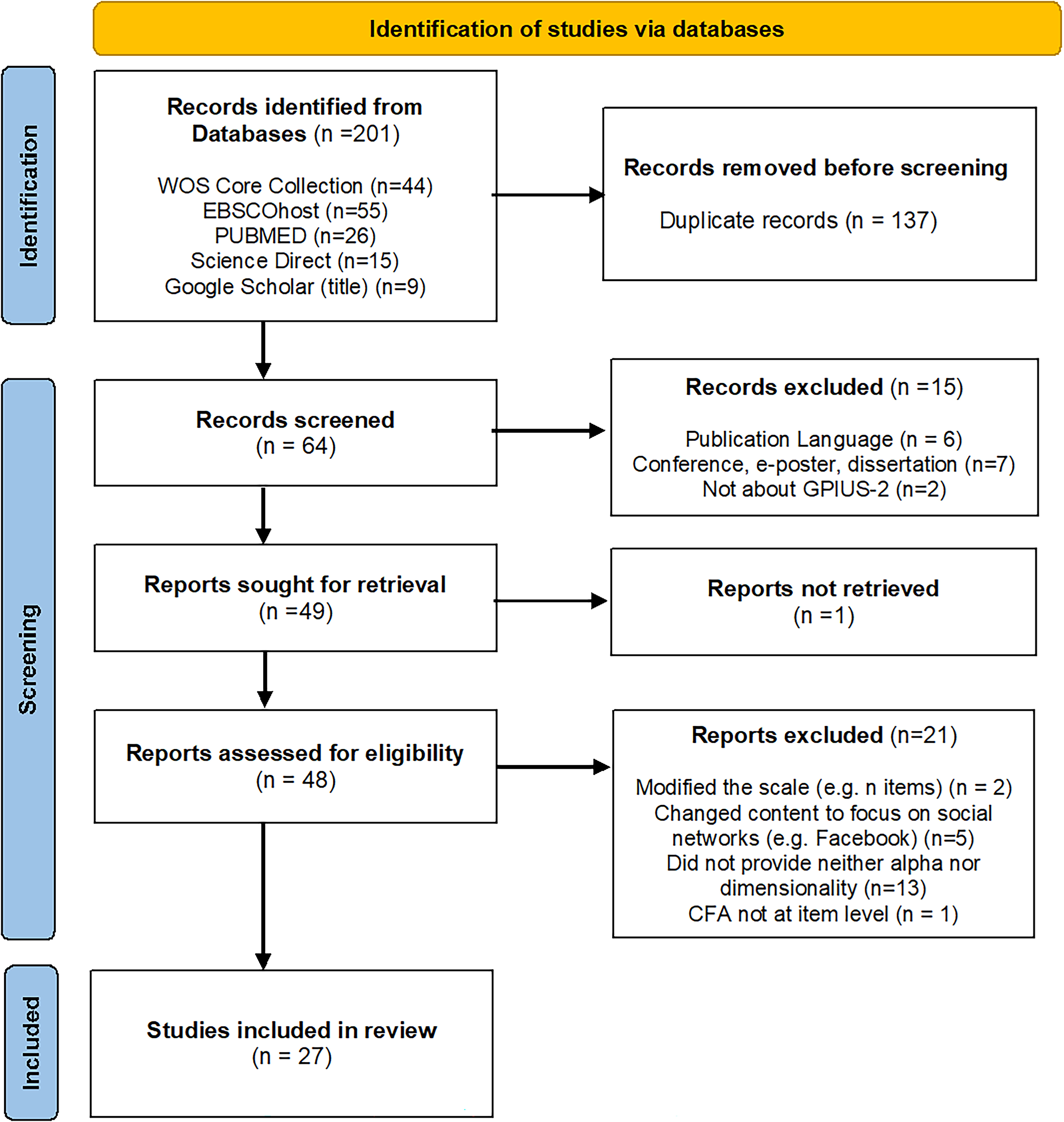
PRISMA flow diagram of the screening process and selection of studies.
GPIUS2—Principal Characteristics and Internal Consistency Results of the Meta-Analyzed Articles
PP, paper and pencil administration. OL, online administration.
Age mean and SD are not separately reported for each sample.
Only POSI and DSR.
Data analysis
Two meta-analyses were conducted as follows: one for Cronbach’s alpha and another for the internal structure of GPIUS-2. Study quality was assessed using the COSMIN risk of bias checklist for internal consistency and structural validity, rated on a four-point scale (very good, adequate, doubtful, inadequate). 30 The “worst score counts” principle was applied, and any disagreements among the authors were resolved by consensus.
Risk of bias
For internal consistency, 30 studies were included. Of these, 23 received a “very good” rating, meeting COSMIN criteria for each GPIUS-2 subscale. The remaining studies, reporting Cronbach’s alpha for the full scale, were deemed inadequate (Table 1).
For structural validity, 14 articles (17 studies) were evaluated. All used structural equation modeling framework, with all studies rated ‘very good’ on the COSMIN checklist (Table 5).
Cronbach’s alpha meta-analyses
The original indexes were transformed to normalize their distribution. 31 To obtain summary statistics, the random effects model was applied, weighting the coefficients by the inverse of their variance. The between-study variance, τ2, was estimated by restricted maximum likelihood. The 95% confidence intervals (CIs) were calculated using the method proposed by Knapp and Hartung. 32 Heterogeneity was evaluated using the Q test for Heterogeneity and the I2 index, 33 with a significance level set at 0.05, and I2 values of approximately 25%, 50%, and 75% were considered as indicative of low, moderate, and high heterogeneity, respectively. An analysis of moderator variables was conducted using meta-regression analysis for continuous variables and analysis of variance (ANOVA) for categorical variables. Mixed-effects models were assumed. The proportion of variance explained by the moderating variables was estimated with R2. Model specification errors for meta-regression and ANOVA were assessed using the test for residual heterogeneity (QE) and the omnibus test for moderators (QW) statistics, respectively. As continuous moderator variables, we consider sample size, gender distribution (% female), mean and standard deviation of the participants’ ages (in years), and mean and standard deviation of GPIUS-2 total scores. As a moderator categorical variable, we consider the aim of the study, distinguishing between studies where the primary focus was the examination of the psychometric properties of the GPIUS-2 scale, and applied studies where GPIUS-2 played a secondary role.
Factorial structure meta-analysis
The study utilizes the meta-analytic structural equation modeling (MASEM) framework, 34 integrating meta-analysis with structural equation modeling (SEM). This innovative methodological approach encompasses the synthesis of correlation matrices from various research works and fitting a hypothesized model in a SEM framework. MASEM enables researchers to investigate the latent factor structure through evidence compiled from an array of studies, an analysis that transcends the capabilities of a singular primary study. The method involves a two-stage process (TSSEM). 35 Following the procedure proposed by Cheung, 35 a multigroup structural equation modeling technique is applied to estimate the population correlation matrix, treating each individual study as a distinct group. A fixed-effect model was used to generate the pooled matrix, assuming consistent population correlations across studies. Homogeneity was tested using a χ2 statistic and fit indices. In the second stage, four factorial models were estimated using the weighted least squares method for comparative analysis (see Figure 2).

Factorial models.
As most articles lacked interitem correlation matrices, we emailed corresponding authors to request them, with follow-up reminders sent after 3–4 weeks. Six researchers provided matrices, yielding nine independent matrices in total. One matrix was excluded for containing only 14 items 28 (see Table 2).
Reliability Meta-Analysis
Note: GPIUS, Generalized Problematic Internet Use Scale; POSI, preference for online social interactions; MR, mood regulation; NO, negative outcomes; DSR, deficient self-regulation; CP, cognitive preoccupation; CIU, compulsive Internet use. K, number of independent samples where the alpha coefficient was available; N, total sample size; ES+, pooled reliability estimate; CI, confidence interval; Q, Cochran’s heterogeneity Q statistic with k-1 degrees of freedom and p significance level associated; I2 = heterogeneity index.
All statistical analyses were carried out using R (version 4.2.2) with the metafor package (version 4.0.0) 36 and metaSEM package. 37
Results
Reliability: Internal consistency
Table 2 displays the results of the meta-analysis on reliability. The meta-analysis reveals that the overall scale scores yielded a Cronbach’s alpha coefficient of 0.89 (95% CI [0.89–0.90]). For the subscales, the alpha coefficients varied, ranging from 0.79 (NO) to 0.87 (DSR). Indications of heterogeneity within these coefficients were observed, evidenced by a significant Q value and a high I2 index (greater than 90%).
Moderation analyses were carried out to explain the large variability observed in the total test alpha coefficients (with a prediction interval, considering heterogeneity, that ranged from 0.85 to 0.93). Table 3 shows the results of the simple meta-regressions applied to the alpha coefficients, revealing no moderators with a significant effect. As for the qualitative moderators, Table 4 details the results of the ANOVAs. Similarly, the categorical moderator variable did not exhibit any significant effect.
Moderator Variables—Simple Meta-Regressions (Continuous Variables) Applied on Total GPIUS Alpha Coefficients
K, number of independent samples; N, total sample size; b, regression coefficient; p significance level; QE, test for residual heterogeneity.
p < 0.001; R2: Determination coefficient.
Moderator Variables—Simple ANOVAs (Categorical Variables) Applied on Total GPIUS Alpha Coefficients, Taking the Goal of the Study as Independent Variable
K, number of independent samples; N, total sample size; QW, omnibus test for moderators; R2, determination coefficient; ANOVA, analysis of variance.
Internal structure and narrative synthesis
The studies (Table 5) reported a range of factorial structures, varying from three correlated factors to a complex third-order factor structure. Building on Caplan’s foundational work, apart from the original research, four articles have adopted a six-factor model (Figure 2c). The Japanese adaptation of GPIUS-2 slightly modifies this model, with a shift in one item from Compulsive Use (CU) to CP. Some studies reframe DSR as a primary rather than a secondary factor and propose a simpler four correlated factor structure. This model, consisting of POSI, MR, DSR, and NO, has been found to be optimal in four independent articles (Figure 2b). Moreover, one Polish study 29 concludes a five first-order structure, whereas the Spanish version 23 supports a highly complex seven-factor structure (Figure 2d). This structure is based on the original Caplan’s model, but defining a tertiary factor encompassing GPIU. Finally, the Turkish version 28 presents the simplest structure, comprising only 14 items and 3 correlated factors (DSR, MR, and POSI).
GPIUS-2—Internal Structure Outlined in the Analyzed Articles
MetaSEM of factor structures
Eight interitem correlation matrices, involving 7,617 participants and 6 countries (France, Italy, Mexico, Poland, Spain, and United States), were analyzed (Table 5) using a fixed-effect model. Fit indices showed slight heterogeneity among the observed correlation matrices as follows: χ2 (840) = 3777.14, p < 0.001, Goodness-of-Fit Index (GFI) = 0.943, Standardized Root Mean Square Residual (SRMR) = 0.063, and Root Mean Square Error of Approximation (RMSEA) = 0.068 (95% CI: 0.066–0.070). In accordance with established SEM practices, 38 the results revealed a slight degree of heterogeneity; however, considering the amount of observed data and the number of parameters estimated within the applied model, this degree of heterogeneity was considered practically acceptable.
Among the discussed structures, we focused our analysis on the most significant ones, considering both the number of studies supporting the proposals and their theoretical relevance. Based on those criteria, four distinct structures for the GPIUS-2 were fitted to the pooled correlation matrix as follows:
By comparing these models, the study aims to clarify whether GPIU can be understood as a single, overarching construct or if it requires a more complex multidimensional approach. The greater acceptance of the second and third models highlights the importance of considering both cognitive and behavioral dimensions in understanding PIU. Visual representations of these models can be found in Figure 2 with detailed results outlined in Table 6.
GPIUS2—Fit Indexes for Assessed Factorial Structures
The unidimensional model showed the poorest fit (CFI = 0.885; RMSEA = 0.100; SRMR = 0.279). The four-correlated factor model improved slightly, but remained suboptimal (CFI = 0.957; RMSEA = 0.063; SRMR = 0.104). Caplan’s model provided the best fit (CFI = 0.969; RMSEA = 0.054; SRMR = 0.075). The third-order model did not improve upon Caplan’s, with a slightly lower CFI (CFI = 0.964) and higher RMSEA and SRMR values (RMSEA = 0.057; SRMR = 0.089).
Discussion
The primary objective of this study was to carry out a comprehensive systematic review and meta-analysis focusing on the internal structure and consistency of the GPIUS-2. This endeavor was undertaken with the intention of providing insightful data that could contribute to enhancing the comprehension of PIU, a topic of growing interest in the field of digital behavior studies. The selection of the GPIUS-2 over other potential scales has been primarily influenced by its foundation in a prominent theoretical model. This model offers a comprehensive framework for understanding and assessing GPIU.
In the meta-analysis focused on consistency, the GPIUS-2 demonstrates a high level of internal consistency, evidenced by a Cronbach’s alpha coefficient of 0.89 for the overall scale score. Regarding the subscale scores, there is some variability in internal consistency. Specifically, the scales for NO and CP presented slightly lower Cronbach’s alpha values below 0.8. Conversely, the scales for POSI, MR, and CIU recorded higher Cronbach’s alpha values of 0.82, 0.82, and 0.84, respectively, indicating good internal consistency for these components. Study categorization based on the COSMIN checklist did not affect the meta-analysis of Cronbach’s alpha for the overall scale or subscales.
In analyzing the internal structure of the GPIUS-2, the first step of MASEM (TSSEM) uncovered minor heterogeneity among the interitem correlation matrices. However, for all practical purposes, this heterogeneity was deemed negligible, allowing the matrices to be treated as sufficiently homogeneous. In the second step of the TSSEM, four distinct internal structures were evaluated as follows: two focused on identifying an index for GPIUS, whereas the remaining two examined the most pertinent competing models—Caplan’s original model and the four-factor correlated structure. Noticeably, the analysis confirmed the validity of the original model proposed by Caplan, with fit values aligning well with established academic standards in the field of SEM (CFI = 0.969; RMSEA = 0.054; SRMR = 0.075). This finding underscores the robustness of Caplan’s model in capturing the nuances of PIU as conceptualized in the GPIUS-2. The model that most closely resembled the original was the third-order model. Despite its marginally lower fit, it remains the sole model endorsing the use of a general index for GPIUS, which holds both theoretical and practical significance. The analysis indicated that both the unidimensional model and the correlated four-factor model failed to achieve satisfactory fit indices, suggesting that these models may not adequately represent the underlying structure of the data in question.
Although the three-order factor model of the GPIUS-2, which proposes an overall score for GPIU while preserving the first-order (POSI, MR, CP, CIU, and NO) and second-order (DSR) factors, did not demonstrate a better fit than Caplan’s original model, the slight reduction in parsimony may be beneficial for both researchers and practitioners. On the one hand, this structure provides justification for the obtention of a global index of GPIU, which simplifies the diagnostic process by providing a comprehensive measure with strong internal consistency (Cronbach’s α = 0.89). In addition, it would be advisable to analyze the index’s adaptability across different cultural contexts through measurement invariance studies, as this would further enhance its value for cross-cultural research and support global public health efforts to address the growing concern of PIU. On the other hand, the dimensional scores can offer more detailed insights, enabling the identification of specific vulnerabilities and guiding interventions tailored to distinct aspects of PIU, such as DSR. For example, increasing social support and improving parent–adolescent relationship, as well as fostering self-efficacy, may contribute to build emotional regulation abilities and reduce POSI, which would decrease the risk of developing PIU.7,39 In addition, resilience-building programs can contribute to improving emotional regulation and impulse control. 40 This is expected to decrease reliance on online platforms for managing negative emotions, further preventing the escalation of PIU. 4 These preventing factors may also serve as moderators of the negative consequences of the GPIU. Further research is needed on other protective factors and boundary conditions (moderators) and underlying mechanisms (mediators) that can mitigate the negative consequences of PIU.
Despite the support for Caplan’s theoretical model and the possibility of using an overall index that summarizes the information provided by the different factors in the model, it is important to recognize that cultural differences may affect the structure and interpretation of the GPIUS-2. While the meta-analytical study included six countries, with studies from Germany and Turkey supporting Caplan’s original five-factor model, adaptations in other countries suggest that cultural context influences how PIU is conceptualized and measured. For example, the Japanese adaptation moves an item from CP to CIU, whereas the Turkish version simplifies the structure to three factors with only 14 items. These changes highlight the need for culturally sensitive adaptations while emphasizing the importance of adhering to international standards for test translation and adaptation. Cultural norms related to Internet usage, social interactions, and self-regulation likely shape how PIU manifests and is measured in different populations.
These findings underscore the broader significance of scale adaptation in advancing scientific knowledge. Beyond Caplan’s original study, most subsequent GPIUS-2 research has been conducted in languages other than English, requiring careful adaptation to ensure cultural and linguistic appropriateness. A significant issue identified in this review is the frequent lack of adherence to international standards for test adaptation. To maintain the validity and reliability of the GPIUS-2 across diverse cultural settings, rigorous adaptation protocols must be followed.41,42 Without such measures, cross-cultural research on PIU risks producing inconsistent results due to poorly adapted instruments.
The focus on young undergraduate students in the samples warrants attention. While PIU is often studied in adolescents, expanding the population of interest is advisable due to the construct’s broader relevance. Some recent studies have begun addressing this gap, but more analysis is needed. In addition, the limited language scope (articles published in English or Spanish) may have restricted cultural diversity, affecting the generalizability of results. Since Internet use patterns vary by age, education, and culture, including more diverse samples would improve the validity and applicability of the GPIUS-2 across different populations.
Finally, it is important to note that the GPIUS-2 was not developed based on DSM-5 or ICD-11 criteria, limiting its ability to assess specific Internet-related disorders, such as gaming disorder in the ICD-11. While it captures GPIU, it lacks alignment with diagnostic frameworks. This limitation led to tools such as the Assessment of Criteria for Specific Internet-use Disorders-11, which follows the DSM-5 or ICD-11 criteria to assess specific disorders like gaming or social media addiction, offering new assessments and interventions.43–47 Relatedly, the Internet Gaming Disorder Scale–Short-Form (IGDS9-SF), a short-form scale based on the DSM-5 criteria for Internet gaming disorder, is widely recognized for its psychometric properties, including cross-cultural validity and internal consistency. 48
In summary, progressing the knowledge in the field of GPIU necessitates robust theoretical models and validated instruments. These elements are essential for enhancing our comprehension of its origins, risk factors, and prevention strategies for PIU. Systematic reviews and meta-analyses focused on specific instruments or constructs related to GPIU provide invaluable sources of information, aiding in the development of more effective approaches to address this growing concern. This research has shown, among others, three important evidences related to the internal validity of the GPIUS as follows: (a) among various proposed models, Caplan’s multidimensional theoretical model emerges as the most statistically robust, (b) the meta-analytical evaluation of its internal structure validates the existence of an overarching factor of problematic Internet, supporting the use of global measures of PIU, and (c) the scale shows a high level of internal consistency. Those findings solidify the GPIUS-2 as an instrument with excellent internal evidence of validity.
Footnotes
Acknowledgements
Author Disclosure Statement
The authors declare that they have no known competing financial interests or personal relationship that could have appeared to influence the work reported in this article.
Funding Information
This study was partially supported by the Spanish Ministry of Science, Innovation and Universities under grant PID2019-103859RB-IOO.

References
Supplementary Material
Please find the following supplemental material available below.
For Open Access articles published under a Creative Commons License, all supplemental material carries the same license as the article it is associated with.
For non-Open Access articles published, all supplemental material carries a non-exclusive license, and permission requests for re-use of supplemental material or any part of supplemental material shall be sent directly to the copyright owner as specified in the copyright notice associated with the article.
