




Abstract
Alternative health (AH) has an important role in public health across cultures, as the World Health Organization acknowledges. Using structural topic modeling, we analyzed 25,561 posts from public Facebook groups that contained AH-related content during the COVID-19 pandemic over 3 years. Thirty-one topics emerged, and they were categorized into six major themes, including (1) sharing information regarding AH treatment for COVID-19, (2) spiritual and mental healing in the pandemic, (3) news and information about COVID-19, (4) commercial content related to AH treatment, (5) COVID-19 precautions suggestions, and (6) caution against treating AH as a cure-all. We found that these Facebook groups served as digital spaces for AH content by playing a dual role: (1) disseminating information on COVID-19 and AH for both laypeople and experts and (2) providing spiritual connections and commercial content to alleviate anxiety during the pandemic. While accurate information and social support were shared, a notable part of commercial messages and AH treatments offered for COVID-19 included misleading and unverified claims. Findings shed light on the nature and extent of misleading AH content and why engagement with AH media may contribute to increased belief in health misinformation. We further discuss the complexity and diversity of content on AH media.
Introduction
The popularity of alternative health (AH) has surged, especially during the COVID-19 pandemic. AH refers to healthcare approaches that deviate from biomedical processes and often lack support from traditional medical establishments and scientific trials. It includes practices such as acupuncture, herbal medicine, traditional Chinese medicine, massage, Tai Chi, yoga, meditation, and homeopathy. 1 Largely overlooked in the literature until recently, AH media is shown to have the potential to spread health misinformation. 2 AH media, encompassing social media, websites, and blogs, presents unconventional health perspectives not sanctioned by most global or local health authorities such as health ministries or international organizations such as the World Health Organization (WHO). 3
Previous studies indicate that more reliance on AH media is associated with a stronger belief in COVID-19 misinformation, which suggests AH media could be an important channel for disseminating health misinformation.3,4 However, no study has investigated the specific details and nature of information on these media platforms. Addressing this question is vital to understanding why engagement with AH media may contribute to a stronger belief in COVID-19 misinformation or health misinformation in general. In contrast, AH has important cultural acceptance across the world. 5 Due to the wide use of AH and the prevalence of AH clinics, some countries have public regulatory agencies for AH, for example, the Health Sciences Authority in Singapore. WHO also recognizes the value of AH. 6 Hence, it is crucial to understand the nature of content in AH media spaces, such as those in social media. The results of this content analysis ultimately aim to inform the emerging field of AH media and communication toward building a theoretical framework.
Present Study
Against this background, we conducted a large-scale automated content analysis using structural topic modeling (STM) on a specific example of AH media—AH-related Facebook groups. We aim to examine the content of these AH groups by answering the following research questions: (1) What topics and themes emerged within AH groups on Facebook amid the COVID-19 pandemic? (2) How prevalent were these topics and themes? (3) Did the topics and themes change over the COVID-19 pandemic? (4) What are AH Facebook groups’ broader roles and implications in disseminating health information during the global public health crisis?
Methods
Data collection
Based on a series of AH-related keywords (Supplementary Appendix SA1), we first identified Facebook public groups related to AH using CrowdTangle, a data source provided by Meta to analyze public Facebook content. 1 In our data collection, we included groups with over 100 members to focus on those already garnering significant interest on Facebook and having substantial content. 7 In total, 640 publicly accessible groups from anywhere around the world were identified. After that, we searched for COVID-19-related posts (Supplementary Appendix SA1). Posts published from January 1, 2020, until the data collection date (21 April 2023) were incorporated into the final dataset to ensure sufficient data points for a total coverage of 1207 days. In total, 37,615 individual posts were collected from these 640 groups, along with pertinent metadata such as dates, reaction metrics, usernames, and group names. Note that CrowdTangle data provide only original posts and do not provide comments from public groups. While this is a limitation, the data checking revealed that few posts received extensive comments. 2
Structural topic model
Topic modeling has been applied as an exploratory tool to analyze texts from digital media. 9 We utilized the STM method from various topic modeling approaches (Supplementary Appendix SA2). STM can incorporate document-level covariates into the model to investigate how much the document’s metadata is associated with the topics’ proportion. 10 Our study treated the postdate as a covariate in the model due to the evolving nature of online discussions at various pandemic stages. This helps us understand how the time of posting affected the proportion of topics. We followed Roberts et al.’s STM workflow by preprocessing the documents (Figure 1). 10 Next, we estimated and evaluated a range of STM candidate models, each with varying numbers of topics. Then, we selected the model with the optimal number of topics and interpreted and visualized its results. The final corpus contains 25,561 posts, and we eventually chose the model with 35 topics as the most optimal model (Supplementary Appendix SA3).

STM workflow.
Model interpretation and validation
The output of the STM model based on 35 topics was reviewed. Although the STM assumed each document comprised a mixture of topics and generated a probability distribution for each, we only focused on the dominant topic, which is the topic with the highest probability in that document. We named the topics by looking into PROB and FREX words 3 , followed by a detailed review of 20 highly associated Facebook posts for each topic, which is to examine the face validity of topic interpretation. 9 However, during the labeling process, it was noticed that four of the topics (topics 3, 16, 18, and 21) were not directly related to the COVID-19 pandemic. For example, although some posts referenced the pandemic, they pertained to the “opioid pandemic,” unrelated to COVID-19. Therefore, we omitted topics 3, 16, 18, and 21. Eventually, 31 of the 35 topics were selected. After this labeling process, we classified the topics into six more distinct themes. The themes, topic labels, and associated words for each topic are presented in Table 1.
Themes and Topics from structural topic modeling
Results
We analyzed 25,561 Facebook posts in this study using STM. Figure 2 displays the total monthly post count through the time under analysis. Table 1 presents the results of themes and topics gained from STM. Thirty-one topics were categorized into six themes, each given a number (the leftmost column): (1) sharing information regarding AH treatment for COVID-19, (2) spiritual and mental healing in the pandemic, (3) news and information about COVID-19, (4) commercial content related to AH treatment, (5) COVID-19 precautions suggestions, and (6) caution against treating AH as a cure-all.
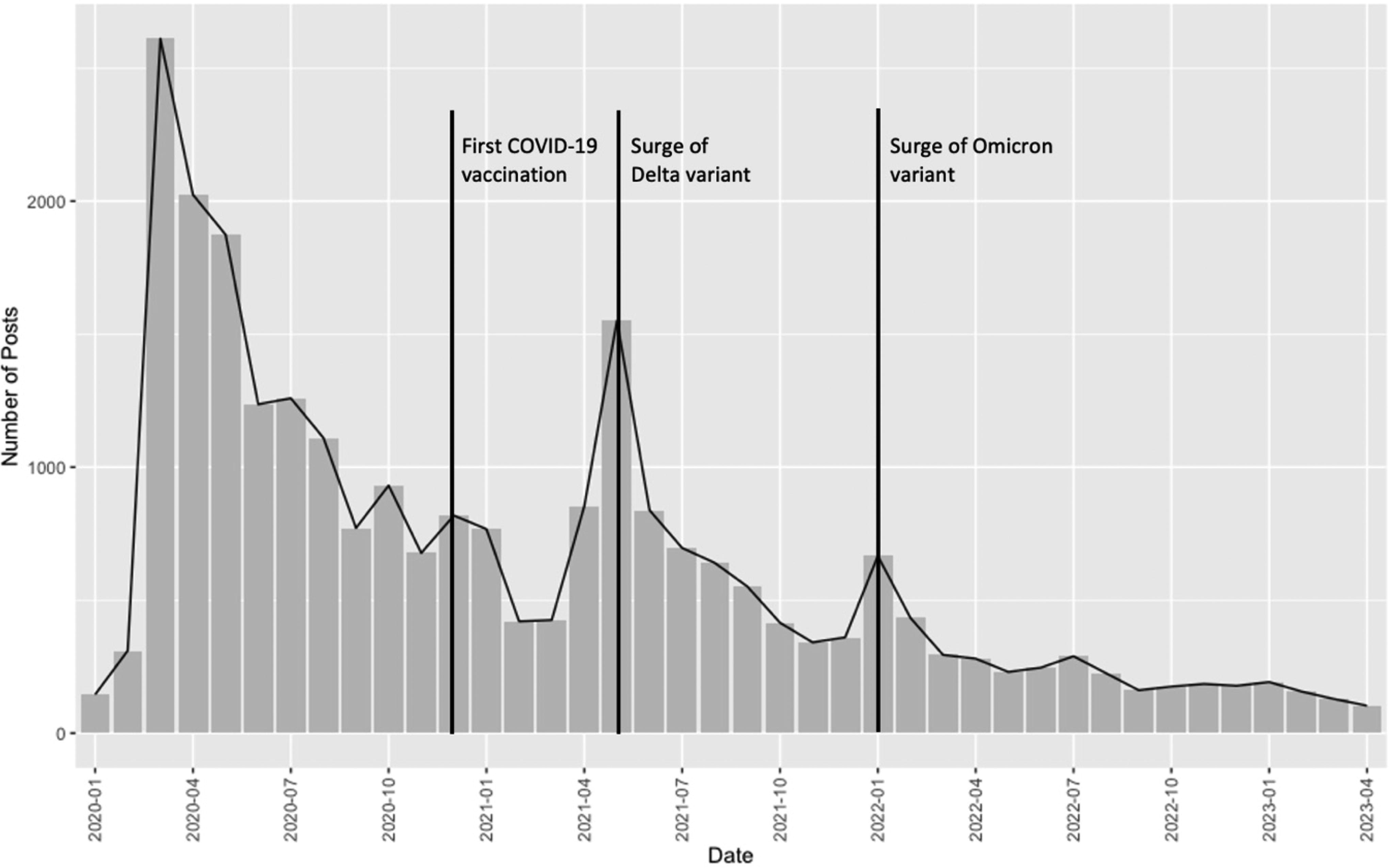
Number of Facebook posts by date.
First, we found that AH Facebook groups provided a space to alleviate pressure and find hope during the pandemic, evident in themes such as (1) spiritual and mental healing in the pandemic and (2) commercial content related to AH treatment.
Over 22% of posts, including nine topics, were categorized under spiritual and mental healing. These posts pointed out the anxiety and fear people face during the pandemic (e.g., “With the pandemic of the coronavirus, there is another pandemic we must resolve … FEAR”). They emphasized people’s mental well-being and adaptation to the health crisis. In addition, various activities, such as yoga, meditation, and energy therapy—some commercial—were promoted through the AH Facebook groups. Unusual AH-related treatments such as hypnotherapy were also found in some posts.
The theme of commercial content related to AH treatment had five topics. These posts emphasized advertising AH products. Natural remedies and various herbs such as turmeric, elderberry, and ginger were frequently mentioned in these posts. Additionally, vitamin supplements and melatonin were also highly advertised. These products highlighted the concepts of naturalness and immune system enhancement as unique selling points, offering hope to individuals searching for a solution during the pandemic. Certain products were manufactured by industries, whereas some were made by individuals, which raises questions about the quality and safety of these products.
Second, AH Facebook groups emerged as hubs for information exchange for both ordinary people and AH practitioners, as indicated by themes such as (1) sharing information regarding AH treatment for COVID-19, (2) news and information about COVID-19, and (3) COVID-19 precautions suggestions.
Eight topics were grouped under the theme (sharing information regarding AH treatment for COVID-19), mainly sharing information on applying AH for COVID-19 prevention, treatment, and management. Commonly used AH included traditional Chinese medicine, acupuncture, homeopathy, and natural remedies. Targeted audiences sometimes were beyond laypeople. For example, some posts provided detailed acupuncture protocols for COVID-19 treatment for AH practitioners. These posts primarily focused on sharing up-to-date information and knowledge rather than being commercially driven, although determining their veracity can be challenging. Another post type was sharing webinar or symposium information regarding the use of AH in COVID-19, encouraging people to register and attend, and illustrating the organizational and mobilizational dimensions.
Under the theme of news and information about COVID-19, a total of five topics were categorized. Approximately 5% of posts provided information about the virus and the disease, including details about COVID-19 symptoms after infection and characteristics of individuals more susceptible to contracting it. COVID-19-related news, including confirmed cases and the impact on people’s lives, was also shared within AH Facebook groups, reflecting the changes brought by the pandemic. Another important thread is COVID-19 vaccine information, including details about its development status and various vaccine types. However, it is worth noting that misinformation and conspiracy theories were also contained in some posts. For example, vaccines were claimed to be a strategic philanthropy that feeds many vaccine-related businesses for Bill Gates. Another post shared news titled “New Orleans Archdiocese Asks Catholics to Avoid Johnson & Johnson COVID Vaccine,” demonstrating a cautious attitude toward the COVID-19 vaccine reflecting religious concerns.
There were two topics under the theme of COVID-19 precautions suggestions: “How to keep safe in COVID-19 from the view of AH practitioners” and “Wearing masks for self-protection.” In the first topic, AH practitioners provided tips for maintaining health. The second topic provides more well-recognized protective measures, such as wearing masks. Myths about facemasks were also debunked (e.g., “… People wrongly believe that wearing a mask can help to skip social distancing. But the fact is, you have to maintain 6ft distance between you and other people while wearing a mask. So you can protect yourself and persons you come into contact with”).
Third, the least prevalent theme reflected a counterpublic narrative cautioning against viewing AH as a cure-all. This theme consisted of one topic: be cautious against using AH in COVID-19. It argued that double-blinded randomized trials were needed to test the efficacy of AH when treating COVID-19 patients (e.g., “If we want to be serious about this matter, we should ask to do epidemiological research in one of the hospitals in Europe”), suggesting seeking serious evaluation and scientific approval of AH. These posts also criticized unqualified AH practitioners for potentially damaging AH’s reputation (e.g., “At this moment with this situation, homeopathy could have its best chance to prove its efficacy, but due to such nonsensical ideas, circulating from irresponsible persons, have damaged deeply the real Classical Homeopathy”). It should be noted that although these posts present a contrasting viewpoint from the generally positive attitude toward AH in other topics, their aim in most cases was not to oppose AH but rather to enhance its validity.
Last, we analyzed how topic prevalence varied from January 1, 2020, to April 21, 2023 (Figure 3). Themes 1 and 2 were the most common, focusing on specific AH treatments for COVID and spiritual/mental healing during the pandemic. Theme 1 remained stable, while theme 2 grew steadily. Theme 3, news about COVID-19, peaked early and decreased to 15%. Theme 4, commercial AH content, rose steadily to nearly 20%. Theme 5, COVID precautions, peaked at 15% in March 2020 and declined. Theme 6, cautioning against viewing AH as a cure-all, remained below 5% and decreased over time.

Proportion of themes by date.
Discussion and Conclusions
Our research shows that AH Facebook groups could act as hubs for information exchange among and across both ordinary people and practitioners, offering spiritual connections and commercial content to ease uncertainty and anxiety, particularly earlier during the pandemic. This contrasts some other characterizations of AH content as being fully unscientific, unhelpful, and misleading.11,12
First, AH Facebook groups as knowledge hubs for AH practitioners facilitated the exchange of the latest information on AH treatments, and most of the content showed support toward these treatments. This resonates with Huynh et al.’s research, showing that 91.1% of Vietnamese health professionals relied on social media for COVID-19 updates, surpassing official channels such as the Ministry of Health websites. 13 Early pandemic uncertainties made it challenging for individuals, including health professionals, to access valid prevention, diagnosis, and treatment methods. AH Facebook groups emerged as rapid knowledge dissemination catalysts. AH practitioners further encountered challenges accessing the latest information from authoritative channels such as WHO or local health ministries, which primarily focused on conventional and biomedical treatments. 14 Thus, online communities such as AH Facebook groups play crucial roles in information sharing, though information quality may be dubious. A study on cancer-related social media exchange revealed all alternative therapy information to be unproven. 15 While the level of unproven remedies for severe diseases such as cancer might make sense, for diseases or health problems of lesser severity, the extent of misleading information might be very different and debatable, especially when we consider psychological health.
Second, the topic modeling results suggest that AH Facebook groups may provide a spiritual refuge amid the pandemic, meeting the need for comfort, easing stress, and instilling hope amid health crises. Confronting serious illnesses often triggers spiritual needs such as fear of death, searching for meaning, and a desire for the divine presence.16,17 AH, linked to spirituality and religion, aligns with holistic care principles, contrasting with biomedicine’s focus solely on the physical aspects of disease diagnosis. AH acknowledges the significance of spirituality, vitality, and energy in achieving overall well-being. 18 Therefore, the favorability toward AH stems from its characteristics tied to spirituality and religion, elucidating the emphasis on emotional and spiritual support in AH Facebook groups.
In addition to offering relief through spiritual-related information, AH Facebook groups might also alleviate stress through commercial content. Our findings revealed a prevalent presence of peer-to-peer marketing and soft-sell advertising in these groups. Commercial posts in AH groups tended to be from ordinary people or micro-influencers with experience using AH, relying on trust to endorse products and services. 19 Unlike explicit hard-sell advertising that highlights product advantages, soft-sell advertising incorporates promotional messages into content that engages consumers on a personal level. 20 Within AH Facebook groups, commercial posts offered informative insights, illustrating the effectiveness of specific AH medicines and treatments against COVID-19 while subtly recommending associated services and products. These advertisements strategically tap into the audience’s desire for a potential solution to safeguard against or combat COVID-19. In the case of severe diseases such as cancer, this aligns with Zenone et al.’s study, which underscored the exploitation of hope in AH cancer treatment advertisements on Meta social media platforms targeting patients with terminal and poor prognoses. 21
In AH Facebook groups, a minority advocates cautious skepticism toward AH as a cure-all, even among AH practitioners. They suggest conducting scientific experiments, such as double-blinded trials, to assess AH therapies’ effectiveness against COVID-19, mirroring biomedical approaches. This aims to validate AH treatments, potentially integrating them into mainstream medicine and reaching broader audiences. The intention had a dual purpose: first, to validate the efficacy of AH treatments against COVID-19, to enhance the likelihood of AH gaining recognition within the mainstream medical health system, reaching a broader audience, including those primarily reliant on conventional medicine. These messages resembled a call within the AH community, urging more AH practitioners to engage in similar efforts to enhance the status of AH in broader society. Additionally, they served as a reminder to ordinary individuals to exercise caution regarding random AH treatments claiming effectiveness against COVID-19. However, this theme consistently represented only a small fraction of the information shared within these AH groups, indicating a lack of widespread agreement and resonance within the AH community.
In summary, our findings indicated that AH Facebook groups could serve as a public sphere where individuals can access the latest information regarding diseases, in our case, the COVID-19 pandemic, and information about AH treatments for the disease. Meanwhile, these groups may offer emotional support and a means of releasing pressure during uncertain periods, such as a global health crisis. This contradicts the concerns raised by researchers and journalists about the harmful nature of AH information and its promotion of misinformation and conspiracy theories.12,22
Our study showed that it would be too simplistic to characterize all content on AH Facebook groups as misinformation. For example, posts urging caution in using AH as a cure-all offer a more nuanced view of its use during the pandemic. Additionally, it is challenging to determine what qualifies as misleading, especially for posts claiming the psychological benefits of AH. Nevertheless, we identified two themes warranting customized attention, potentially carrying misleading information, which are (1) AH treatments for COVID-19 and (2) the commercial content of AH. In these two themes, health-related misinformation mostly tended to take the form of unsubstantiated claims lacking sufficient scientific support rather than outright false claims contradicting scientific evidence or disregarding expert consensus. The commercial content of AH frequently included exaggerated claims regarding its effectiveness in combating COVID-19. However, as of now, no singular AH treatment has proven effective against the coronavirus. These health claims, therefore, have the potential to heighten people’s expectations and perceptions of AH as a cure for serious diseases, fostering a belief in COVID-19-related misinformation, such as the assertion that “ivermectin can prevent and treat COVID-19”. 23
This study is subject to several limitations. First, our thorough search for AH-related Facebook groups and pandemic-related posts within these public groups might not account for instances of outright misinformation removed from the platform due to content moderation policies. This could result from the closure of specific AH groups or the deletion of posts containing misinformation by the platforms. Since 2020, Facebook has steadily removed groups that broke the platform’s rules and taken down posts that violate specific policies, actively working to reduce harmful content and misinformation. 24 Public AH Facebook groups may also transit to private status in response to platform regulations.
Furthermore, our research did not encompass a vital facet of AH media—private AH groups on social media and messaging applications. This research does not address country or cultural differences in posts from AH Facebook groups due to the lack of geographic data and the publicly accessible nature of the groups from anywhere around the world. Future research could explore these variations by comparing AH content across different countries and cultures from specific posts of followers of these groups. Nevertheless, our study provides a valuable overview of AH media, offering insights into its public content ecology. By elucidating content, patterns, and trends, our findings will aid in constructing a theoretical framework in the AH media and communication field.
Footnotes
Acknowledgment
The authors thank Associate Professor Taberez Ahmed Neyazi from the National University of Singapore for granting us access to CrowdTangle.
Ethics Approval
The study was approved by the National University of Singapore, Department of Communications and New Media (No. 20230321_01).
Authors’ Contributions
Y.W.: Conceptualization, Methodology, Formal analysis, Data Curation, Writing—Original Draft, Visualization. O.K.: Writing—Review & Editing, Supervision.
Author Disclosure Statement
The authors declare no competing interests.
Funding Information
No funding has been received to conduct this research.

References
Supplementary Material
Please find the following supplemental material available below.
For Open Access articles published under a Creative Commons License, all supplemental material carries the same license as the article it is associated with.
For non-Open Access articles published, all supplemental material carries a non-exclusive license, and permission requests for re-use of supplemental material or any part of supplemental material shall be sent directly to the copyright owner as specified in the copyright notice associated with the article.
