




Abstract
In today’s sociocultural milieu, characterized by pervasive social media and evolving conceptions of masculinity, this study examines the interplay among loneliness, social media addiction, self-reliance, and life satisfaction across Generations (Gen) X, Y, and Z. Employing a comprehensive model, the study explores social media addiction as a mediator between loneliness and life satisfaction, with a focus on the moderating role of the pivotal masculine trait of self-reliance in the loneliness–social media addiction relationship. Based on an online survey of 775 Israeli men aged 18–58, the findings reveal unique generational patterns. For Gen X, social media addiction negatively correlates with life satisfaction, without mediation or moderation effects. In Gen Y, loneliness is directly associated with life satisfaction, and a positive correlation exists between loneliness and social media addiction. Notably, self-reliance moderates the link between loneliness and social media addiction, amplifying this association at lower self-reliance levels. Gen Z replicates the Gen Y findings albeit without the moderation effect. This study contributes nuanced insights into the literature on masculinity, revealing the evolving nature of self-reliance—a crucial masculine trait—across generations. Such evolution, in turn, is associated with responses to loneliness and patterns of engagement with social media.
Introduction
Social media has become an integral part of human lives, shaping lifestyle and communication patterns. However, excessive online engagement may lead to isolation from real life, 1 fostering compulsive behavior and a sense of lost control. 2 Social media addiction (SMA) is characterized by excessive and compulsive use of social media platforms, resulting in interference with daily functioning, personal well-being, and relationships. 3 Studies have identified key features of SMA, which include preoccupation with social media, difficulty regulating usage, mood changes associated with online activity, and withdrawal symptoms when access is impeded. 4 Concern about the addictive use of social networking sites has prompted extensive research into its causes, mechanisms, and consequences.5,6
The focus of this research is the relationship between SMA, loneliness, and satisfaction with life. Studies indicate that various psychological factors, such as happiness, social anxiety, and depressive symptoms, play a significant role in explaining SMA, often exhibiting stronger associations than loneliness. 7 However, loneliness remains an important variable, as research suggests it can drive individuals to seek social connections through social media, potentially leading to excessive or addictive behaviors intended to compensate for perceived social deficits. 8 Furthermore, SMA has been shown to predict lower life satisfaction (e.g., Arampatzi et al. 9 and Satici 10 ). Based on these studies, we suggest that SMA might play a mediating role in the relationship between loneliness and life satisfaction.
In Western culture, traditional gender norms and expectations for men often reflect qualities such as independence, stoicism, and self-reliance. 11 Men may feel societal pressure to be less expressive about their emotions, including feelings of loneliness. In response to societal expectations, they may develop self-reliance as part of their socialization into masculine gender roles. 11 Examining the relationship between loneliness and SMA in the context of self-reliance can provide insights into how men cope with emotional challenges, as they may be less likely to seek professional or informal support. 12
Coping with loneliness appears to be sensitive to cultural influences 13 and evolves with developmental maturation 14 ; thus, it should be addressed in the generational context. Gender cultural norms, attitudes, and societal expectations change over time. Men from different generations may experience and express loneliness and self-reliance in distinct ways, where specific masculine norms play a more critical role than generalized gender norms in shaping their coping mechanisms. 15 Generation (Gen) X (1965–1980) tends to conform to traditionally masculine traits such as self-reliance, while Gen Y (1981–1996) and Gen Z (1997–2005) challenge these norms, reflecting a shift toward specific traits and away from general gender roles.15,16 This underscores the importance of understanding traditional masculine norms not as a uniform construct but as a collection of specific, distinct norms. 15 Accordingly, the purpose of the current study was to examine the interrelationships between loneliness, SMA, self-reliance, and life satisfaction among men from a generational perspective. This study uniquely combines a generational perspective with evolving concepts of masculinity, offering a nuanced analysis of how self-reliance—a pivotal masculine trait—intersects with loneliness, SMA, and life satisfaction across three distinct cohorts. By highlighting the generational shifts from hegemonic to inclusive and soft masculinity, the research provides critical insights into how prevailing masculine norms of self-reliance have shaped digital and emotional coping mechanisms in the social context of each period.
Literature Review and Research Hypotheses
Generational cohort theory
The dynamic interplay between loneliness, SMA, and life satisfaction may be connected not only to individual norms and behaviors but also to the unique characteristics and tendencies of generational cohorts. Generational cohort theory was introduced by Inglehart, 17 as a way to segment a population by generation. In this theory, a cohort encompasses those born in a span of 20–25 years, or longer, who share common experiences and events—economic, social, and political—during their formative early adulthood years (ages 17–24). 18 These experiences and events influence the cohorts’ values, preferences, attitudes, and behavior, which generally remain constant throughout a generation’s lifetime and create a generational identity.19,20
Gen X
The early 1980s and 1990s, the formative years of Gen X members, were a period of considerable economic and social uncertainty, as reflected in economic recessions, higher divorce rates, and the spread of AIDS. From an early age, boys were immersed in hegemonic masculinity norms, reflected in messages such as “boys don’t cry,” and they were expected to suppress fear, weakness, and any signs of inadequacy or anxiety.
21
Since boys and men of that period learned that others do not respond positively to their distress messages, they are less likely to reveal mental health symptoms to others. As a result, behaviors associated with vulnerability and weakness, such as help seeking, are often viewed in a negative light and avoided.
22
The traits and characteristics generally associated with them are individualism, self-reliance, skepticism, a lack of social skills, and strong technical ability.
23
In terms of technology adoption, Gen Xers are seen in the literature as “digital immigrants.”
24
Their initial exposure to social media occurred later in life compared with younger generations, often as professionals or parents.
25
Thus, they may be less likely to use social media as a primary coping mechanism for loneliness, consistent with their formative experiences emphasizing self-reliance and offline interactions.
26
Accordingly, we hypothesize that: In Gen X, loneliness and SMA will be negatively correlated with life satisfaction. There will be no mediation effect of SMA and no moderation effect of self-reliance in the relationship between loneliness and SMA.
Gen Y
Unlike Gen X, Gen Y grew up during a period of economic growth and witnessed a growing emphasis on emotional intelligence, redefined strength, and a rejection of rigid gender norms. Gen Y challenged the hegemonic masculinity of older generations by embracing inclusive masculinity and was more likely to prioritize emotional openness, form deep friendships, engage in traditionally feminine roles, and seek support27,28 while rejecting traditional ideals of toughness and detachment.
29
Gen Y is the first generation to grow up with the internet and social media,30,31 and its members are likely to spend a significant amount of their life in “virtual” social media environments. Studies indicate that the social media behavior of Gen Y is associated with upward social comparisons and exposure to idealized portrayals on platforms such as Instagram,
32
fear of missing out (FOMO),
33
and compulsive consumption behaviors.
34
Detachment from real-world experiences, responsibilities, and relationships can contribute to a sense of emptiness and dissatisfaction. Gen Y men with high levels of self-reliance may be more inclined to adopt independent coping strategies when facing loneliness. In contrast, Gen Y men with lower self-reliance may be more inclined to seek external validation and support when experiencing loneliness. Moreover, rather than developing independent coping strategies for loneliness, such individuals may turn to the media as a primary source of comfort and distraction. Accordingly, we may hypothesize that: In Gen Y, SMA will mediate the association between loneliness and satisfaction with life, such that besides the negative direct effect of loneliness on life satisfaction, loneliness will be positively correlated with SMA. This, in turn, will be negatively correlated with life satisfaction. Self-reliance will moderate the positive association between loneliness and SMA, such that this association will be more pronounced at lower levels of self-reliance.
Gen Z
Gen Z was molded by a series of recessions and financial crises, war and threats of terrorism, political unrest, and the constant presence of social media. 35 The behaviors and emotions manifested by Gen Z men are diverse 36 and include reduced self-reliance, 15 compared with older generations, as well as playful or youthful traits sometimes misinterpreted as childishness. They also embrace soft masculinity, characterized by emotional openness, gentleness, sensitivity, and traits traditionally associated with nurturing, vulnerability, and aesthetic interests, 37 which undermines hegemonic masculinity stereotypes. 38
Gen Z is a digital generation in all respects, heavily reliant on social media, streaming services, and user-generated content platforms such as YouTube and TikTok. 39 Gen Z men with lower self-reliance may turn to the online world to escape feelings of isolation. SMA, in the context of loneliness, can serve as a form of escapism and coping. However, by following the embellished life of influencers or more successful peers, Gen Z men may engage in social comparison, which, when combined with loneliness, can lead to a cycle of seeking interactions, positive feedback, likes, comments, or acknowledgment. This constant comparison may impact life satisfaction negatively. 40
Gen Z men with high self-reliance may be more likely to seek support from diverse sources. They may cultivate relationships offline and use social media as a supplementary tool for staying connected. In contrast, Gen Z individuals with low self-reliance may be more prone to seeking social approval on social media. The constant need for likes, comments, and online interactions becomes a primary source of emotional support, contributing to a higher risk of developing addictive behaviors as a response to loneliness. Accordingly, we may hypothesize that: In Gen Z, SMA will mediate the association between loneliness and life satisfaction, such that aside from the negative direct effect of loneliness on life satisfaction, loneliness will be positively correlated with SMA, which in turn will be negatively correlated with life satisfaction. Self-reliance will moderate the positive association between loneliness and SMA, such that this association will be more pronounced at lower levels of self-reliance.
Materials and Methods
Research population and sample
The current study consisted of a sample of 775 Israeli men aged 18–58 (Meanage = 30.04, standard deviation [SD] = 9.69). The sample was categorized into three generational cohorts: 112 men from Gen X, 279 men from Gen Y, and 384 men from Gen Z. For samples of demographic characteristics, see Table 1.
Demographic Characteristics of the Samples (Gen X, Y, Z)
GEN, generation; SD, standard deviation.
Sampling methods and procedure
The study was granted approval by the institutional committee for Nonclinical Research on Human Subjects at Ariel University. A structured questionnaire was distributed through a link using various online platforms, including Facebook and WhatsApp groups. Participation in the survey required the completion of an informed consent form at the survey’s https://doi.org/10.1177/0020872817712562 outset. Respondents’ anonymity was rigorously preserved by refraining from requesting any information that could potentially reveal their identities.
Measures
Self-reported loneliness was assessed by a three-item scale, 41 measuring how often respondents felt that they lacked companionship, how often they felt left out, and how often they felt isolated from others. The final loneliness index was computed by totaling the participants’ responses to these three questions, resulting in scores that ranged from 3 to 9, with higher scores indicating a greater degree of loneliness.
Social media addiction was assessed using the Bergen Social Media Addiction Scale (BSMAS). 42 To calculate a total BSMAS index, the responses to all items were totaled, resulting in scores that ranged from 6 to 30, with higher scores indicating greater levels of SMA.
Self-reliance was assessed using the three-item subscale of the 30-item New Short Form of the Conformity to Masculine Norms Inventory (CMNI-30). 43 The mean score for the three items was computed to create a total self-reliance index, resulting in scores that ranged from 0 to 6, where a higher score indicated a greater degree of self-reliance.
Satisfaction with life was assessed by the five-item Life Satisfaction Scale (SWLS). 44 To calculate a total SWLS index, the responses to all items were totaled, resulting in scores that ranged from 5 to 35, where a higher score indicated a greater degree of satisfaction with life.
Data analysis
Descriptive statistics (means and SD) and bivariate correlations were calculated for all variables in this study (see Table 2). A moderated mediation model was tested using model 7 PROCESS v4.2 macro for SPSS, 45 with loneliness as the independent variable, SMA as the mediator, satisfaction with life as the dependent variable, and self-reliance as a moderator in the association between loneliness and SMA (see Figures 1–3). In this study, we employed 10,000 bootstrap samples to assess the mediating effect and established a 95% confidence interval for this purpose. To explore moderation, we estimated the conditional direct and indirect effects at three points: one SD above the mean, at the mean, and one SD below the mean.
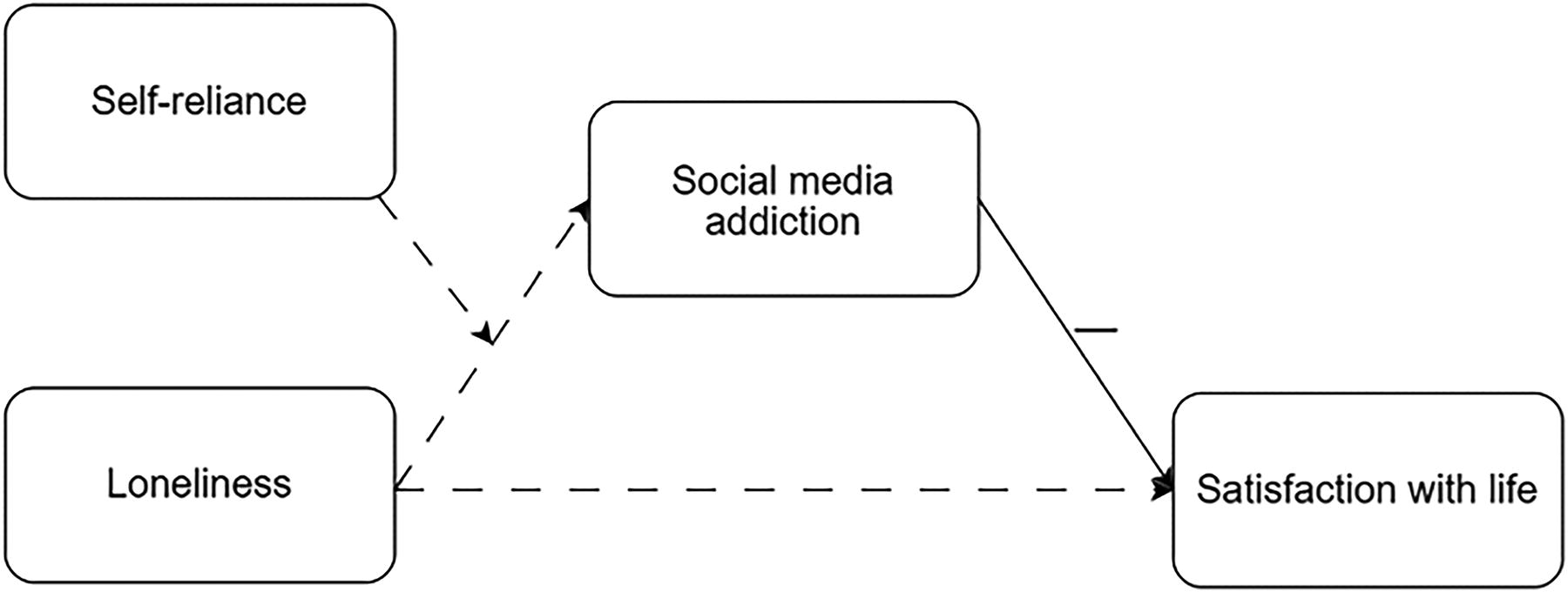
Gen X: A moderated mediation model 7. Continuous lines indicate significant effects, and dashed lines indicate nonsignificant effects. Gen X, Generation X.

Gen Y: A moderated mediation model 7. Continuous lines indicate significant effects, and dashed lines indicate non-significant effects. Gen X, Generation Y.
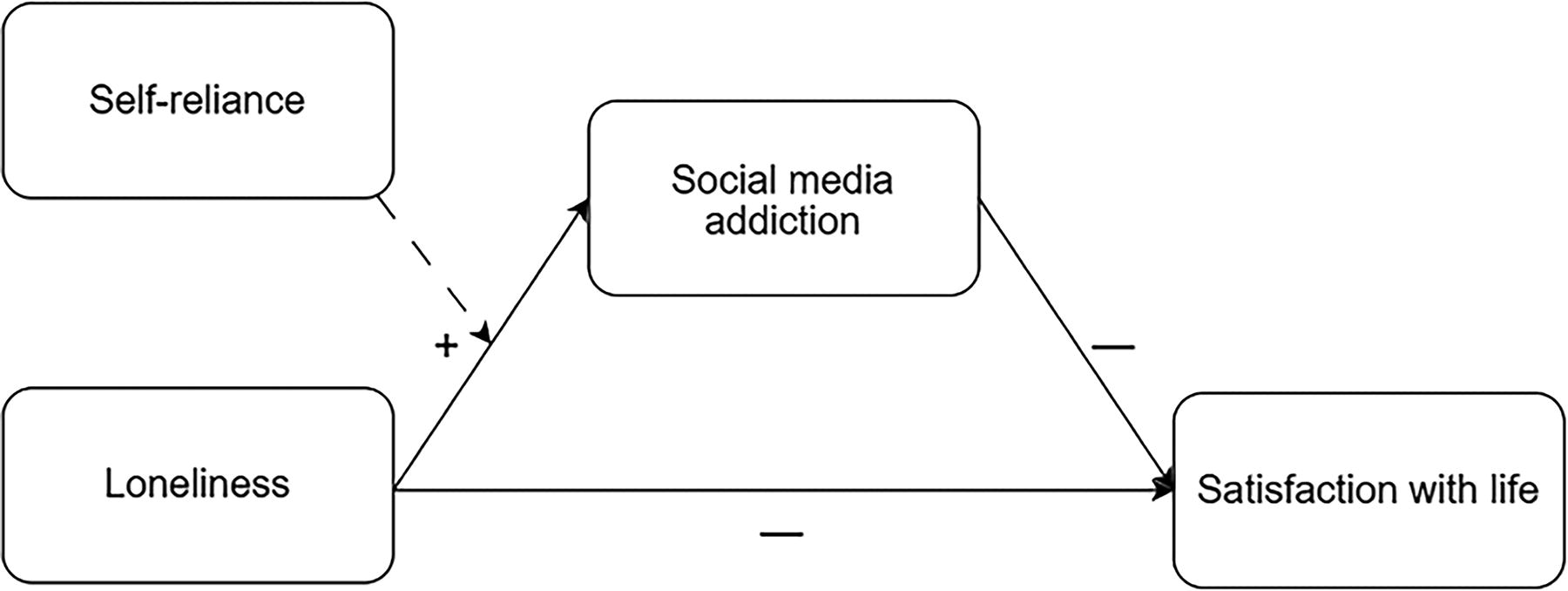
Gen Z: A moderated mediation model 7. Continuous lines indicate significant effects, and dashed lines indicate non-significant effects. Gen X, Generation Z.
Means, Standard Deviations, and Pearson Correlations of the Research Variables
Responses were given on a scale of 1 (hardly ever) to 3 (often).
Responses were given on a Likert-type scale from 1 (very rarely) to 5 (very often).
Responses were given on a Likert-type scale from 0 (strongly disagree) to 6 (strongly agree).
Responses were given on a Likert-type scale from 1 (strongly disagree) to 7 (strongly agree).
p < 0.05.
p < 0.01.
p < 0.001.
Results
Testing the hypotheses
In the context of the Gen X cohort, Hypothesis H1 was partially confirmed. No mediation or moderation effects were detected, and there were no direct effects observed between loneliness and both SMA and satisfaction with life. Nevertheless, a negative correlation between SMA and satisfaction with life was identified. However, within the Gen Y cohort, initial Hypothesis H2 was confirmed, such that besides the negative direct effect of loneliness on satisfaction with life, loneliness was positively correlated with SMA, which, in turn, was negatively correlated with satisfaction with life. A moderating effect of self-reliance on the positive association between loneliness and SMA was found to be significant, with a more pronounced association at lower level self-reliance (SD = −1) than on moderate level self-reliance (SD = 0), and not significant at higher level self-reliance (SD =+1). In the Gen Z cohort, initial Hypothesis H3 was partially confirmed. A negative direct effect of loneliness on satisfaction with life was detected, and a positive correlation was found between loneliness and SMA, which, in turn, was negatively correlated with satisfaction with life. However, the association between loneliness and SMA was not moderated by self-reliance. For the regression coefficients and standard errors in the moderated mediation model, see Table 3. For conditional direct effects of loneliness on SMA at varying values of self-reliance see Table 4. For conditional indirect effects of loneliness on satisfaction with life, see Table 5.
Regression Coefficients and Standard Errors in the Moderated Mediation Model
p < 0.01.
p < 0.001.
CI, confidence interval; SE, standard error.
Conditional Direct Effects of Loneliness on Social Media Addiction at Varying Values of Self-Reliance
p < 0.01.
p < 0.001.
Conditional Indirect Effects of Loneliness on Satisfaction with Life
Discussion
The current study investigated the moderating role of self-reliance in the relationships between loneliness, SMA, and life satisfaction in three generational cohorts of men: X, Y, and Z. Our findings underscore the dual role of social media use in contemporary society, both as an adaptive coping strategy for alleviating loneliness and as a maladaptive one by amplifying social comparison and dissatisfaction. By viewing these dynamics through the lens of generational masculinity norms, this study advances our understanding of how societal expectations shape emotional and digital behaviors across various generational cohorts.
For instance, the findings for Gen X highlight how traditional hegemonic masculinity norms may be related to prioritizing offline coping mechanisms over digital engagement, which is reflected in the lack of association between loneliness and SMA. We assume that Gen X men may use social media as a supplementary tool rather than a primary source for addressing loneliness. We also found that SMA did not mediate the relationship between loneliness and life satisfaction. There was no evidence of a moderation effect of self-reliance on the relationship between loneliness and SMA. The lack of mediation and moderation effects may reflect the hegemonic masculinity norms prevalent in Gen X, 46 where men might be less inclined to express loneliness on social media or seek online validation. As “digital immigrants,” Gen X men may have developed coping mechanisms that prioritize offline interactions and relationships. The absence of a significant mediating effect suggests that, when faced with loneliness, Gen X men may turn to offline strategies rather than relying on social media. Traditional masculine ideals of face-to-face communication and personal connection could influence their coping mechanisms. 47
The only significant negative correlation in Gen X was found between SMA and life satisfaction. This could be linked to a reluctance among Gen X men to engage emotionally on digital platforms. Seeking validation or expressing vulnerability online may conflict with the traditional masculine identity of Gen X men, creating negative psychological reactions and aligning their life satisfaction more closely with real-world interactions and achievements rather than online engagement. 48
Unlike Gen X, and in line with the research literature, 27 our findings indicate that Gen Y exhibits a more fluid and expressive approach to masculinity, compared with the hegemonic masculinity norms prevalent during the formative years of Gen X. 49 We found a positive correlation between loneliness and SMA among Gen Y men. This may be attributed to Gen Y’s inclusive masculinity, characterized by greater openness, an emphasis on building connections, and digital engagement. 50 Seeking connection through social media could be an expression of their willingness to break away from traditional norms of stoicism in moments of loneliness, meet new people, share their feelings, seek empathy, and obtain online validation. 27 The significant moderating effect at lower levels of self-reliance suggests that, for less self-reliant Gen Y men, the allure of instant digital connection might be more pronounced. Such men may turn to social media to escape from real-life challenges, stressors, or negative emotions, but in doing so they risk adopting a compulsive behavior with its concomitant negative consequences. Accordingly, the negative correlation between SMA and satisfaction with life implies that, despite their use of social media for connection and coping with loneliness, Gen Y men may find the quality of these digital connections insufficient for overall life satisfaction.
As with Gen Y, a mediation effect of SMA was also identified in Gen Z in the relationships between loneliness and life satisfaction. However, the lack of moderation in the association between loneliness and SMA by self-reliance suggests that, unlike the observed patterns in Gen Y, self-reliance may not explain how Gen Z men navigate the relationship between loneliness and digital engagement. This finding aligns with the soft masculinity principles embraced by Gen Z, which de-emphasizes traditional traits like self-reliance in favor of emotional openness, sensitivity, and a fluid approach to interpersonal connection. In this framework, loneliness may not carry the same social stigma for Gen Z men, nor is it necessarily counteracted through individualistic coping strategies such as self-reliance, as was the case in Gen Y. Instead, Gen Z’s soft masculinity allows for a more relational approach when addressing loneliness, where digital engagement serves as a natural extension of their comfort with seeking connection and expressing vulnerability. For Gen Z—digital natives—social media provides instant and continuous connectivity to friends, family, and a global network and serves as a space to express their identities, interests, and values. 51 As social media is an integral part of daily Gen Z lives, their adoption of soft masculinity—emphasizing emotional openness and relational connection—shapes their approach to coping with loneliness in the virtual world, regardless of their level of self-reliance, as they challenge traditional masculinity norms such as toughness, stoicism, and dominance. 52
Conclusions
This study makes several key contributions. First, it explores the intersection of real and virtual lives across three generations, examining how problematic social media use may stem from real-life social concerns. Second, it enriches the literature on masculinity and generational cohorts, illustrating how self-reliance and responses to loneliness vary by generation. Third, the findings extend current understandings of loneliness and SMA by demonstrating how generational shifts in masculinity explain these dynamics. While loneliness is often conceptualized as a universal emotional experience, this study reveals that its interaction with SMA is shaped by unique generational norms and masculine traits. By situating these findings within broader sociocultural changes, this research provides a framework for understanding how societal expectations pertaining to masculinity can amplify or mitigate the emotional and digital coping mechanisms employed by men.
As we navigate the nuanced landscapes of Gen X, Y, and Z, the hegemonic masculinity norms of Gen X “digital immigrants” may steer them toward offline coping mechanisms, while Gen Y’s embrace of inclusive masculinity fosters a more expressive approach that intertwines with social media use. Notably, for Gen Z, the adoption of soft masculinity, characterized by emotional openness and reduced emphasis on self-reliance, suggests a paradigm shift in the perception of loneliness and connectivity in the digital-native generation. This not only underscores the evolving dynamics of masculinity—from hegemonic to inclusive and soft—but also emphasizes the need for tailored interventions that resonate with the distinct digital journeys and sociocultural shifts shaping life satisfaction among men of each generation.
Research limitations and suggestions for future research
The current study has several limitations. One limitation is the use of convenience sampling, which prevents assessing the sample’s representativeness. In addition, the cross-sectional design with anonymous respondents hindered gathering information from multiple sources for the same participants. 53 Future research should validate these results using a longitudinal design. Another limitation is that the study did not differentiate between social media platforms. Future research should explore how the unique characteristics of different platforms affect the relationship between loneliness, SMA, and life satisfaction. The current study did not differentiate between types of problematic social media use (e.g., FOMO, compulsive checking and posting, social comparison, seeking online validation, and impaired offline relationships). Future research should address this gap.
Moreover, the outcomes of this study were likely influenced by cultural norms pertaining to masculinity, self-reliance, and digital engagement, which reflect the individualistic tendencies characteristic of the society in which this research was conducted. In contrast, in collectivist societies, factors such as tendencies to conformity, emotional reliance on close relationships, and adherence to traditional expectations might serve as alternative moderators, affecting the relationship between loneliness, social media addiction, and life satisfaction.
Footnotes
Authors' Contributions
S.L.: Conceptualization, writing (initial draft), writing (review & editing)-M.K.: Conceptualization, writing (initial draft), data curation, formal analysis, methodology, validation, writing (initial draft).
Declaration
During the preparation of this work, the author(s) used ChatGPT in order to improve readability and language. After using this tool, the author(s) reviewed and edited the content as needed and take(s) full responsibility for the content of the publication.
Ethics Statement
The present study was conducted after obtaining approval from the Institutional Ethics Committee for Non-Clinical Human Studies at the authors’ university (AU-SOC-MK-20221031).
Author Disclosure Statement
No competing financial interests exist.
Funding Information
The current study did not receive any funding.