




Abstract
Sexual harassment (SH) against women is one of the most worldwide problems. To mitigate its incidence, various programs, including virtual reality (VR), have been developed for both prevention and treatment. 360-degree video has emerged as a subfield of VR capable of inducing the body swap illusion and facilitating perspective-taking (PT), as well as eliciting related emotions. The present study represents a progression from a previously published work, featuring a within-subjects design approach that showed the superiority of the immersive video to elicit empathy compared to a control condition. The aim is to investigate and validate the feasibility of using 360-degree video to foster empathy, PT, and a sense of oneness, potentially reducing violent attitudes toward a female victim of SH compared with a traditional PT task (control condition) in a between-subjects design. Forty Mexican men were randomly assigned to one of the conditions. Results confirmed the feasibility of the 360-degree video in significantly enhancing PT and a sense of oneness compared with the control condition. However, no significant changes were observed for the variables of empathy and violent attitude. Moreover, the findings supported the potential of the 360-degree video in eliciting a sense of ownership and presence with the virtual character and the immersive environment, with ownership showing a positive correlation with empathy and PT. Lastly, participant body awareness was found to be a positive predictor of ownership. Limitations and future directions are discussed.
Introduction
One of the most pressing global issues is sexual harassment (SH) against women, often manifesting through unwanted sexual comments, gestures, or actions.1–2 Research suggests that a primary driver of harassment is a lack of empathy. 3 As a key component of emotional intelligence, empathy is essential for fostering strong social connections, encouraging cooperation, and enabling effective communication. 4 It is composed by two factors, emotional and cognitive empathy: the former involves experiencing emotions in response to others’ emotions or expressions of emotions; the latter, involves understanding others’ thoughts and feelings without necessarily reacting emotionally.5–6 In line with this argument, compared to the normal population, offenders have lower degrees of emotional and cognitive empathy. 7 To address this issue, various programs have been developed to enhance empathy, withvirtual reality (VR) emerging as a powerful tool.
VR has exploded to study empathy, leveraging its capability to enable individuals to adopt the perspective of someone else. 8 In brief, VR is an advanced technology that allows users to be present and interact with a three-dimensional environment.9–10 VR designers have harnessed advanced graphics, motion-sensing, and surround sound to create immersive experiences that place users in challenging environments, such as refugee camps or instances of discrimination. 11 By facilitating perspective-taking (PT), VR has been shown to enhance empathy, even in those who may lack the motivation or ability to empathize on their own. 12 A related technology is the 360-degree video, a subfield of VR that allows users to engage with immersive content on various devices (laptops, mobile phones, or head-mounted displays) offering a fully immersive experience that deepens the involvement in the scenario. 13 Furthermore, the 360-degree video has lower production cost as it requires less specialized equipment, and expertise and less development time compared to developing interactive VR experiences. 14 The literature demonstrates the growing significance of this immersive technology in inducing PT and eliciting empathy,15–16 thanks to its feature of embodied technology in terms of ownership, agency, and location. 17
The present study is a step forward to a previously published work 16 that employed a within-subjects design with counterbalanced conditions, alternating between the 360-degree video and narrative conditions. This approach allowed each participant to experience both conditions, and the results indicated a significant carryover effect for the immersive condition when compared with the traditional PT task in increasing empathy, PT, and the sense of oneness, and decreasing of violent attitudes toward the victim. However, the within-subjects design presents some limitations in terms of assessing the true superiority of the 360-degree video. The counterbalancing of conditions may have introduced order effects, where participants’ experiences in the narrative condition could have influenced their responses in the immersive condition, or vice versa. This makes it difficult to isolate the impact of the 360-degree video on the outcome variables. While the carryover effect was significant, it does not conclusively establish whether the 360-degree video itself was superior in fostering the psychological changes or whether the exposure to both conditions played a role. To address these limitations and better isolate the impact of the immersive condition, the present study adopts a between-subjects design, where participants will only experience either the 360-degree video or the narrative condition, but not both. The study hypothesizes that the 360-degree video will demonstrate superiority in enhancing empathy, PT, and a sense of oneness, while decreasing violent attitudes toward the victim, compared to the narrative task. This design is expected to provide more robust evidence of the immersive video’s effectiveness, offering clearer insight into the benefits of 360-degree video in promoting empathy and relate variables.
Method
The study was approved by the Ethics Committee of the Universidad Nacional Autónoma de Mexico (registration number: EP/PMDPSIC/0151/19).
Participants
The study is aimed at Mexican men and they are excluded if they are <18 years old; unable to execute free physical movements, history of SH with legal consequences, use or abuse of drugs, and receive psychological treatment. The sample size was calculated according to the previously published study (Ventura et al., 2021), which used G*power v. 3.1.9.734 to detect an effect greater than or equal to d = 0.40 for: (a) an omnibus F test for “Repeated measures, within-between interaction” with two groups and three measurements, and (b) an omnibus F test, “Repeated measures, within-between interaction,” as a standard in psychology. 18
Questionnaires
Sociodemographic questionnaire (age, education level, occupation, presence of psychiatric and/or physical problems, and history of sexual abuse).
Machismo and caballerismo scale. 19
It is a self-report scale containing 20 items that measure the constructs of machismo and chivalry. The items are rated on a 7-point scale (1 = strongly disagree and 7 = strongly agree).
Attitude toward gender-based violence scale. 20
This is an ad hoc self-report with five items rated on a 5-point scale (1 = not at all; 5 = totally), based on the original scale of Ambivalent Sexism, which measures men’s attitudes toward female violence.
Toronto alexithymia scale. 21
It is a self-report scale containing 20 items that measure: difficulty expressing feelings, difficulty identifying feelings, and externally oriented thinking. Items are rated on a 7-point scale (1 = strongly disagree; 7 = strongly agree).
Inclusion of other in the self scale. 22
It contains seven Venn-like diagrams that represent the sense of oneness (i.e., closeness and connectedness) with the female victim, where a greater overlap between the two circles represents a closer relationship.
Interpersonal reactivity index. 23
It is a self-report containing 28 items that measure: PT; fantasy; empathic concern; and personal distress. Items are rated on a 7-point scale (1 = strongly disagree; 7 = strongly agree).
Empathy scale
This is an ad hoc self-report containing 5 items (1 = not at all; 5 = totally) that measure empathy state. 15
Perspective-taking scale
It is an ad hoc self-report based on a previous study, 15 and it consists of eight items rated on a 5-point scale (1 = not at all; 5 = totally) assessing participants’ ability to take the victim’s perspective.
Multidimensional assessment of interoceptive awareness. 24
It is a self-report containing 32 items rated on a 6-point scale (0 = never; 5 = always) which measures the interoceptive awareness of participants’ body. It comprises eight factors: noticing, not distracting, not worrying, attention regulation, emotional awareness, self-regulation, and body listening.
Embodiment, presence, and sickness scale
It contains 16 items rated on a 7-point scale (1 = strongly disagree; 7 = strongly agree). Ten items assess the body illusion toward the victim’s body (α = 0.88); 25 three items assess the sense of presence (α = 0.46); 26 and three items the cybersickness (α = 0.87). 27
The 360-degree video content
The 360-degree video was recorded in first-person perspective with the LG360-105 camera. During the recording, the camera was attached to the female performer’s head with proper support. The content is based on the qualitative analysis of two focus groups with Mexican women who described SH episodes that occurred in the city (Fig. 1). The details of the scenario are described in the published article. 16
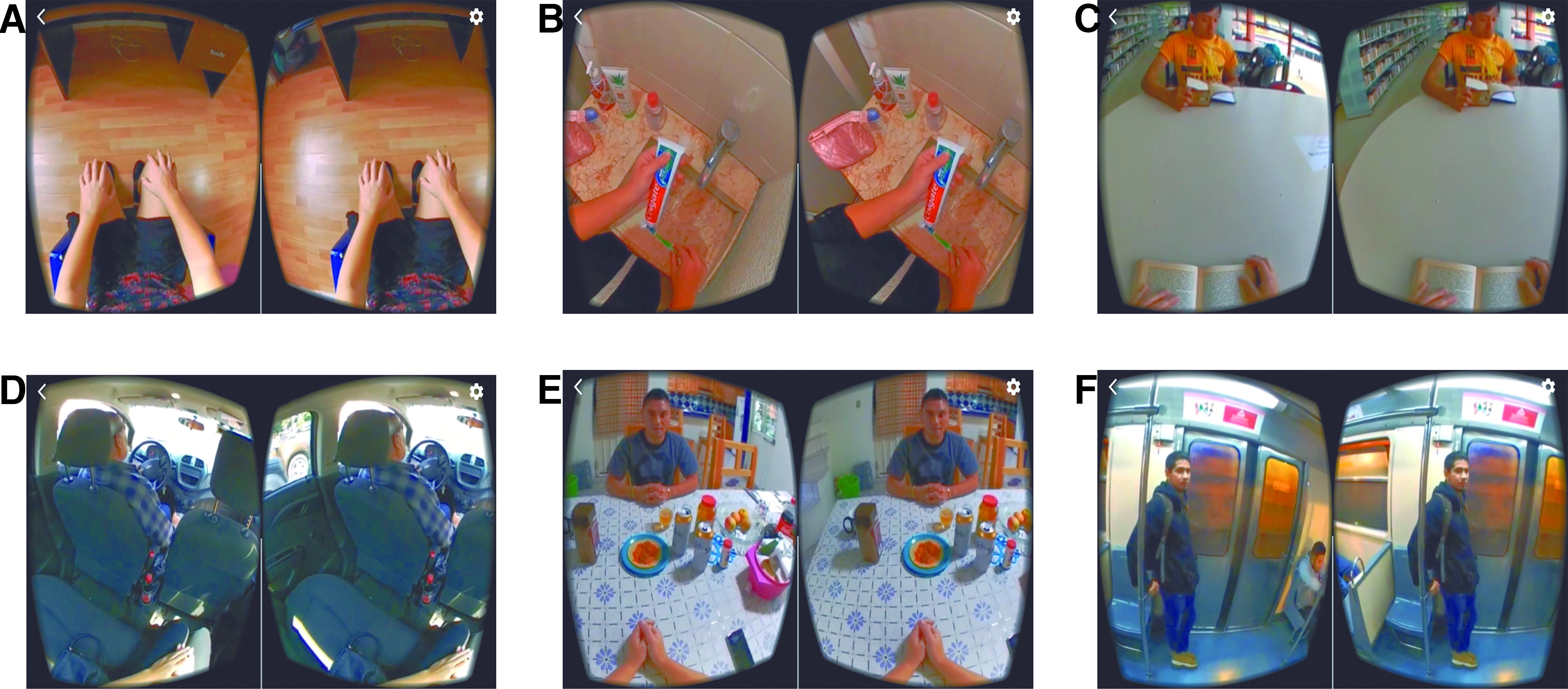
Frames of the sexual harassment scenarios in the 360-degree video VR experience.
Procedure
The experiment was conducted at the Universidad Nacional Autónoma de México. Initially, participants provided informed consent and were then randomly assigned to one of two conditions: the 360-degree video or the traditional PT task (narrative), both of which presented the same story of a typical journey of a female victim of SH in Mexico City. Subsequently, participants completed baseline questionnaires covering sociodemographic information, the Machismo and Caballerismo scale (MCS), Attitude Toward Gender-Based Violence Scale (ATG-S), Toronto Alexithymia Scale (TAS-20), interpersonal reactivity index (IRI), empathy scale (ES), and multidimensional assessment of interoceptive awareness (MAIA). Following the pretest phase, participants engaged in the experimental session corresponding to their assigned condition. After the manipulation session, participants completed post test questionnaires, including ATG-S, inclusion of other in the self scale (IOS), ES, PT-Scale (PT-S), and the Embodiment, Presence, and Sickness Scale for the 360-degree video condition.
Data Analyses
Analysis was conducted using the Statistical Package for Social Sciences. Descriptive statistics for both the experimental and control groups encompassed calculations such as the mean and standard deviation. Initially, two 2 × 2 mixed design ANOVAs, with two time points (baseline and post test) as within-subject factors and conditions (360-degree video and narrative) as between-subject factors, were performed to examine the effects of conditions on ES and ATG-S (main effect of time). Following this, the Student t test for independent samples were employed to assess the effects of the condition on the IOS and PT-S scales. Post hoc analyses using Bonferroni corrections were conducted in cases of significant effects. Subsequently, one sample t tests were carried out to investigate whether the effect of the 360-degree video condition on embodiment scores, sense of presence, and sickness significantly deviated from the chance level of four. Additionally, Pearson correlations were executed among the outcome variables of the experimental group. Finally, multilevel regression was performed to investigate the predictor variables of the sense of embodiment.
Results
Differences in sociodemographic, psychological variables, and baseline measures between conditions
Forty Mexican men participated in this study. Descriptive statistics for the sociodemographic and trait measures are shown in Table 1. There were no significant differences between conditions for age, t(38) = −0.33, p = 0.954; history of mental or chronic illness, t(38) = −0.87, p = 0.08; machismo, t(38) = −2.17, p = 0.154; alexithymia, t(38) = −1.43, p = 0.635; interpersonal reactivity index, t(38) = 0.689, p = 0.488; or corporal awareness (MAIA), t(38) = 0.892, p = 0.992.
Descriptive Statistics of Sociodemographic and Traits Measures (N = 40)
Cronbach’s alphas are referred to the internal consistency of the sample of this study.
MCS, Machismo and Caballerismo Scale; TAS-20, Toronto Alexithymia scale; IRI, interpersonal reactivity index; MAIA, multidimensional assessment of interoceptive awareness.
Effects of the conditions on empathy, violent attitude, sense of oneness, and PT
Regarding the effect of the conditions on ES, results showed no significant difference on time between baseline and after the 360-degree video (p = 0.402), and between baseline and after the narrative (p = 0.379). No significant difference was also found in the interaction between time and condition (p = 0.863) (Table 2).
Means, Standard Deviations, Cronbach’s Alpha, and ANOVA Results for the Dependent Variables
Concerning the effect of the condition on ATG-S, results showed no significant difference in time between baseline and after the 360-degree video (p = 0.464), and between baseline and after the narrative (p = 0.541). Moreover, we found no significant difference in the interaction between time and condition (p = 0.342) (Table 2).
In the case of the IOS and PT, an independent samples' t test indicated a significant difference between conditions for both variables; IOS, t(38) = 2.355, p < 0.05, d = 0.74, and PT, t(38) = 2.236, p < 0.05, d = 0.71. (Table 2 and Fig. 2).

Graphical representation of the mean, median, minimum, and maximum levels of the variables’ sense of oneness
The impact of the 360-degree video on embodiment, presence, and sickness
During the 360-degree video condition, participants demonstrated significant score on embodiment greater than the chance of 4 for the factors of ownership (M = 4.86, SD = 1.05), t(19) = 2.939, p < 0.05, d = 0.81, and location (M = 5.50, SD = 1.28), t(19) = 5.252, p < 0.05, d = 1.17, but not for agency (M = 4.36, SD = 1.07), t(19) = 1.251, p = 0.233, d = 0.34. Furthermore, participants demonstrated a significant sense of presence (M = 5.13, SD = 0.98), t(19) = 14.361, p < 0.05, d = 1.15, but not a significant level of sickness (M = 4.33, SD = 1.83), t(19) = 5.696, p = p < 0.05, d = 0.18.
Relationship among ES, ATG-S, IOS, PT-S, and embodiment and sense of presence
Pearson’s correlations among the variables are shown in Table 3. Positive significant correlations were found between the factor of ownership of the sense of embodiment and ES, r(14) = 0.58, p < 0.05, and PT-S, r(14) = 0.75, p < 0.01. No other significant correlations were found (Fig. 3).

Graphical representation of the Pearson’s correlation between the sense of ownership and perspective-taking
Relationships Between Outcome Variables (ES, ATG-S, IOS, PT-S) and Embodiment and Sense of Presence for the Experimental Group (360-Degree Video)
p < 0.05.
p < 0.001.
ES, Empathy Scale; ATG-S, Attitude Towards Gender Scale; IOS, Inclusion of Other in the Self Scale; PT-S, Perspective Taking Scale.
MAIA as predictor of the sense of ownership
Finally, the multiple regression analysis, to predict the sense of ownership, showed that the factor Body Trusting of the Multidimensional Assessment of Interoceptive Awareness was a significant positive predictor. This model was statistically significant, F(1, 13) = 21.76, p < 0.001, R2 = 0.645, explaining 64.5% of the variance. None of the psychological trait variables entered in the second step were significant (p > 0.05) (Fig. 4).

Graphical representation of the regression between the sense of ownership and body trusting factor of MAIA scale.
Discussion
The present study is a step forward to a previously published study, 16 which demonstrated a significant carryover effect in terms of empathy and related variables including PT and violent attitude for the 360-degree video compared with the traditional PT task (narrative) toward a female victim of SH in a within-subjects design. The present study has the aim to confirm the feasibility of the 360-degree video to foster empathy, PT, and sense of oneness, as well as a decrease in violent attitude toward a female victim of SH compared with the control condition, but in a between-subjects design. Results demonstrated no significant difference in empathy from before to after both conditions, in contrast with the published study. 16 The most plausible explanation for this result lies in the design differences between the two studies. The first study 16 adopted a within-subjects design with counterbalanced conditions, so this dual exposure could have resulted in an additive or cumulative effect, amplifying the overall impact on empathy regardless of the condition. In contrast, the current study employed a between-subjects design, where participants only experienced one condition (either the 360-degree video or the narrative), without the benefit of experiencing both. Consequently, the lack of significant difference between the conditions may be due to the stronger impact of combined exposure in the counterbalanced design, which enhanced empathy more than exposure to a single condition in isolation. In this line, prospective studies are hypothesizing the use of the 360-degree video to enhance empathy, supported by psychoeducation programs. 22 No significant results emerged also for the variable violent attitude, that is the immersive experience was not stronger than the narrative condition to decrease the attitude. However, these findings should be interpreted with caution because the internal consistency of these self-reports is limited.
Regarding the sense of oneness and PT, they were significantly higher after the 360-degree video condition than the narrative condition. These results confirmed the previous study 16 in which both variables, sense of oneness and PT, demonstrated a carryover effect for the 360-degree video, namely the variables were higher when the 360-degree video was presented before the narrative task than when it was presented after it. Results confirmed the feasibility of the 360-degree video immersive experience to foster the PT with the outgroup12,16
As underlined in the first study, 16 an important component of the experiment is the embodiment exercise at the beginning of the VR experience. The present work confirmed the significant results of the 360-degree video to induce a high sense of ownership with the virtual character, as well the sense of location. However, the sense of agency was not significant as the environment is prerecorded and not interactive. Results confirm previous findings about the feasibility of the 360-degree video to induce the sense of embodiment,28–29 this suggests that participants who experienced a stronger illusion of embodying a female body were more capable of adopting the victim’s perspective and empathizing with her.
Moreover, the finding showed significant results for the sense of presence demonstrated that participants feel inside the virtual environment during the exposition. 30
Another finding emerged from the correlation analysis, demonstrating a positive relationship between the sense of ownership for the embodied female victim and the variables of PT and empathy, 28 contrary to the first study that demonstrated more positive correlation. 16 This may due to the difference in the sample sizes and participant characteristics. Specifically, in the first study, all 44 participants experienced the 360-degree immersive video, providing a larger and more consistent dataset for analyzing the relationship between embodiment and the outcome variables. In contrast, in the present study, only 20 participants watched the immersive video and responded to the embodiment questionnaire. The smaller sample size in the current study likely impacted the results, as statistical power is reduced when fewer participants are involved, making it more difficult to detect significant relationships between variables. In addition, the characteristics of the participants themselves may have contributed to the variation in outcomes.
One of the added values of the present study, compared to the previous one, is the assessment of participants’ body awareness using the MAIA questionnaire. 24 Regression analysis demonstrated that the factor of body trusting is a positive predictor of the sense of ownership. Namely, participants who trust their bodies enough to “feel at home” in them are more inclined to be drawn into the illusion of having another body.
A relevant limitation of the 360-degree video is that it generates cybersickness. This is not a novel result17,31 as participants are merely passive observers and do not interact with the environment. The lack of interactivity may heighten disorientation and motion sickness, as users cannot control their movement or fully engage with the scenario. This limitation may have affected participants’ ability to identify with the environment and the female victim. One possible solution could be to enhance the camera output and minimize unnecessary movements when the camera is positioned on the performer’s head to record the video.
Other limits should be arisen. First, the scales of ES and ATG-S are ad hoc and should be tested through exploratory factor analysis with a larger sample to increase the internal consistency. Second, the sample size was four participants lower than that estimated to achieve the estimated effect size. As the study was conducted during a psychology student’s internship at the University, data collection concluded with a total of 40 participants, the majority of whom were students with a high level of education. The homogeneity in the sample may limit the generalizability of the findings, as individuals with different educational backgrounds might have varying perspectives, experiences, and responses to the problem of SH and the development of empathy skill. Consequently, the insights gathered may not accurately reflect the views of a more diverse population, potentially skewing the understanding of the issue being investigated. Future studies should expand the sample to include older participants and individuals from a broader range of social backgrounds. Third, the duration of the 360-degree video condition was longer than the narrative condition. This could compromise the results, as participants who watched the immersive video may have had more opportunities and time to empathize with the victim. Finally, as there is no followup session, it is not yet clear whether the significant changes in PT and the sense of oneness persist over time.
Despite the limitations, the present study confirmed the feasibility of the 360-degree video to foster the PT and the sense of oneness toward the victim of SH as was also found in the previous study of Ventura and colleagues (2021). Results highlight the potential of this technology as a valuable tool in educational programs designed to prevent aggressive gender behavior. Furthermore, its application in clinical settings could be instrumental in reducing recidivism by promoting empathy and understanding among individuals at risk of reoffending. By leveraging immersive experiences, 360-degree video may effectively facilitate emotional connections and behavioural change, making it a promising avenue for intervention strategies.
Footnotes
Author Disclosure Statement
No competing financial interests exist.
Funding Information
This study was supported by a grant from Generalitat Valenciana (BEFPI-2019) and Margarita Salas postdoctoral fellowship, Ministry of Universities of the Government of Spain (European Union NextGeneration EU, ref. UP2021-044).