




Abstract
This study examined the Proteus effect in autistic and neurotypical participants via the video game, The Sims. Thirty-two participants (16 autistic, 16 neurotypical) participated in a free-play session of The Sims, playing as either an attractive or unattractive avatar. In line with predictions, participants who had played as the attractive avatar negotiated for a significantly larger share of a fictional pot of money during a post-play economic game. Further, participants who had used the attractive avatar engaged in significantly more exercise activities in-game and flirted more often with nonplayable characters. While there was some evidence to suggest that autistic people may be less resistant to peer influence in the economic game, this study shows for the first time how the Proteus effect can be demonstrated in autistic people. These findings have important implications for understanding how autistic people experience video games and may be leveraged to improve outcomes for autistic video gamers.
The Proteus effect describes behavioral changes that occur after embodying avatars in virtual worlds and video games. The effect was first observed in a series of experiments 1 in which participants were randomly allocated to play as avatars that varied in attractiveness and height. In the first experiment, participants using more attractive avatars disclosed more personal information to a confederate. In the second experiment, participants with taller avatars negotiated for a larger share of money during a virtual economic game. Both experiments demonstrate that an avatar’s appearance can influence a person’s behavior within a virtual environment.
Observational data 2 has further demonstrated that, even in contexts where individuals selected their own avatar’s features, players with taller and more attractive avatars reached higher ranks on average within the game, suggesting these features also impact player performance and progression. More significantly, embodying taller avatars affected how aggressively participants negotiated with a confederate face-to-face after they had exited the virtual environment, suggesting the Proteus effect can bleed into one’s offline behavior. 2
The two most cited explanations for the Proteus effect are self-perception theory and priming.3,4 Self-perception theory 5 suggests that we learn about our attitudes and emotions by observing and ruminating upon past social behavior. Thus, when adopting behaviors associated with the physical characteristics of an avatar within a virtual environment (e.g., we might expect attractive people to behave more confidently), some of this virtual conduct may become internalized. 4 The priming explanation, however, suggests that the avatar simply serves as a prime that activates concepts associated with its characteristics.3,4 A meta-analysis 6 of 46 experimental studies suggests the Proteus effect is a reliable phenomenon, with results demonstrating a consistent small-to-medium effect size.
The Proteus effect has been investigated in various contexts, but no study to our knowledge has considered the effect on autistic people. Autism * is a neurodevelopmental condition affecting an estimated 2.5% of people 7 and its symptoms include social and communicative differences along with restricted interests and repetitive behaviors. 8 There is evidence that autistic people may find it more difficult than neurotypical individuals to recognize and understand another person’s mental state, such as in the Reading the Mind in the Eyes Test, 9 although this effect does not extend to nonhuman entities such as cartoons and animals,10,11 suggesting it might not also extend to avatars.
Research also suggests autistic people may particularly enjoy highly simulative games such as those involving role play (both in the real and virtual worlds), 12 and report forming social relationships and complex communities within role-playing games such as Second Life. 13 Furthermore, many interventions exist that use digitalized, gamified approaches to improving social skills and quality of life in autistic people, making an understanding of in-game behaviors and the utility of avatar-based personas particularly interesting. 14 Thus, it is important to understand whether autistic people can take the perspectives of avatars to the same extent as neurotypical individuals to provide insights into how they might experience simulative video games and virtual environments. The study’s principal aim was to test whether autistic people would experience the Proteus effect.
To our knowledge, no research has tested whether autistic people might have difficulties taking the perspectives of video game characters or virtual avatars, and there is mixed evidence as to whether one would expect them to display the Proteus effect or not. Equally, autistic people are less affected by heuristics and have more substantial deliberative reasoning and, therefore, weaker intuition. Similarly, autistic people have been shown to be less influenced by some biases, such as framing effects. 15 On the other hand, autistic people have been shown not to use prior knowledge and context as often when reasoning 16 and are less prone to bias when updating self-referential beliefs. 17 Therefore, there is mixed evidence as to whether we might expect autistic people to display a Proteus effect or not.
Method
Participants
Thirty-two participants were recruited via purposive opportunity sampling. The study was advertised via a large UK university’s student participant pool and circulated to relevant clubs and societies via the same university’s student union. The sample comprised 16 males and 16 females, with a mean age of 25.78 (standard deviation [SD] = 8.14, range = 18–48). Sixteen participants (9 male, 7 female, M = 24.94, SD = 8.07) indicated they had received a diagnosis of autism and a further 16 participants (7 male, 9 female, M = 26.63, SD = 8.39) comprised the neurotypical group. Statistical analysis confirmed correspondence between self-identification and participant scores on the Autistic Quotient (AQ)-Short. 18 An independent samples t-test indicates a significant difference (t(df = 30) = 4.81; p < 0.001, d = 4.48) between the autistic group (M = 76.94, SD = 4.78) and the neurotypical group (M = 69.31, SD = 4.16) on their AQ-Short 18 score.
Materials
The AQ-Short, 18 an abridged version of the 50-item Autism-Spectrum Quotient, is a self-report measure with 28 items and measured on a 4-point Likert scale with answer categories ranging from “1 = definitely agree” to “4 = definitely disagree.” Internal consistency has been reported as acceptable to good (α between 0.77 and 0.86). When using the AQ-Short to distinguish autistic people from neurotypical individuals, a cut-off score of >70 produces sensitivity and specificity scores of 0.94 and 0.91, respectively. 18
The Sims 4 is a social simulation video game in which players are responsible for directing actions and attending to their playable avatar’s needs (referred to as “Sims”). The game includes an elaborate avatar customization element in which various features can be edited, including gender, skin color, hair, body type, and clothing. The Windows edition of the game was purchased to play on a CyberPower gaming laptop.
Two male avatars differing in physical attractiveness were created in The Sims 4 for the study. As we do not have permission from Electronic Arts to use pictures from The Sims 4, we include illustrative examples with this article created using AI art generator DallE, which grants free to publish copyright for this use.
Similar to Yee and Bailenson, 1 we tested subjective determinations of avatar (Sim) attractiveness. A separate, convenience sample of 40 participants rated the two Sims for physical attractiveness on a 10-point scale. An independent samples t-test found a significant difference (t(df = 38) = −8.98; p < 0.001, d = 1.50), with the attractive Sim (M = 7.30, SD = 1.45) scoring significantly higher than the unattractive Sim (M = 3.05, SD = 1.54).
A house was built and furnished within The Sims 4 for use in the study. Various furnishings were included in the home to allow the player to satisfy the basic needs of their Sim: hunger, bladder, hygiene, social, fun, and energy. Further, the house was inhabited by six nonplayable characters (NPCs) of varying genders and attractiveness.
For the content analysis aspect of the study, codes were identified a priori, drawing on the researchers’ knowledge and experience of playing the game. The categories identified represent the entire range of available actions that players can make via their avatars within the game. The codebook included the following categories: (a) Passive entertainment, for example, playing video games and watching TV, (b) Flirtatious social interaction: flirting with NPCs, (c) Unpleasant social interaction: engaging in antisocial dialogue with NPCs, for example, insulting them, (d) General social interaction: getting to know NPCs, (e) Exercise, for example, using weights and swimming, (f) Mental self-improvement, for example, playing chess and reading, and (g) Denying self-care: denying the Sim basic needs (e.g., eating, bathing, sleeping, and using the toilet) after the Sim has requested this need to be satisfied. For each category, the number of instances of the behavior occurring during free play for each participant was tallied.
Procedure
Upon reading the information sheet and providing consent, participants were given a brief introduction and overview of the controls for the game. Participants in both groups were randomly assigned either the attractive or unattractive Sim and given 20 minutes to freely explore the house and interact with its features as they wished. Their in-game activity was recorded for later analysis via a screen capture tool.
Participants were then taken to a separate room and sat opposite the confederate whom they were led to believe was another participant in the study. Participants were informed there was a fictional pot of money totaling £100, and that they would need to negotiate a share of this pot over four successive rounds. Participants were told that the aim of the game was to win as big a share as possible while securing agreement from the other participant (confederate), who would either accept or reject the offer. In round 1, the participant made the first offer. In round 2, the confederate made a fair offer (50/50), and the participant was asked to accept or reject. In round 3, the participant made their second offer. Finally, in round 4, the confederate made an unfair offer (75/25), and the participant was asked to accept or reject. Based on prior investigations1,2 we expected the Proteus effect to show up in rounds 1, 3, and 4.
Results
We first report classical frequentist statistics, followed by Bayesian analysis. This was performed in Jeffreys’s Amazing Statistics Program (JASP), using default models and effects sizes. 19 BF10 are given, which indicates how much more likely H1 is over H0. A BF10 of below 1 shows support for the null, and above 1 support for the research hypothesis. As a rule of thumb, Bayes factors between 1 and 3 are considered anecdotal, 3 and 10 moderate, 10 and 30 strong, 30 and 100 very strong, and 100+ extreme. 20
Analysis of economic game data
A 2 × 2 × 2 mixed ANOVA was conducted with diagnosis type (autistic vs. neurotypical) and Sim attractiveness (attractive vs. unattractive) as the between-subject factors, and round (round 1 and round 3) as the within-subjects factor (see Table 1 for descriptive statistics). There was a significant main effect for Sim attractiveness (F(1,28) = 5.905; p < 0.05, n2 = 0.174). Participants using the attractive Sim (M = 63.28, SD = 12.51) requested a significantly larger share, irrespective of condition, compared to participants using the unattractive Sim (M = 52.81, SD = 11.21). There was a significant interaction between diagnosis type and round (F(1,28) = 6.158; p < 0.05, n2 = 0.180). The interaction plot (see Figure 3) shows that neurotypical participants’ requested share of the pot increased from round 1 to round 3, but autistic participants’ requested share decreased between rounds. There was a significant interaction between Sim attractiveness and round (F(1,28) = 4.409; p < 0.05, n2 = 0.136). The interaction plot (see Figure 4) shows that attractive avatars’ requested share of the pot decreased from round 1 to round 3, but unattractive avatars’ requested share increased between rounds.

Unattractive Sim.

Attractive Sim.

Interaction between diagnosis type and round.
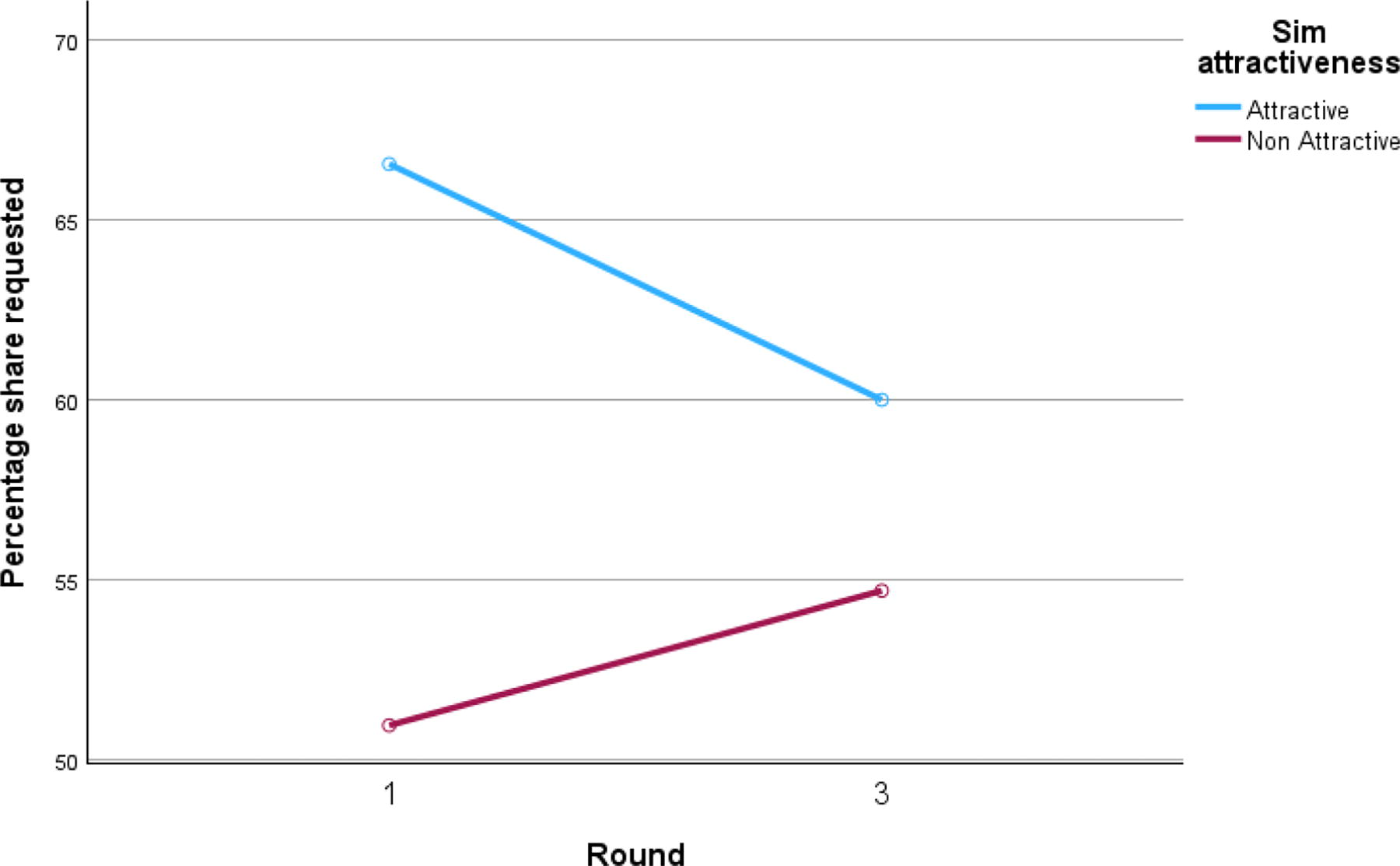
Interaction between Sim attractiveness and round.
Descriptive Statistics for Rounds 1 and 3 of the Economic Game
SD, standard deviation.
The main effects for diagnosis type and round were nonsignificant, as was the interaction between diagnosis type vs. Sim attractiveness vs. round (p > 0.05).
A Bayesian 2 × 2 between subjects ANOVA did not reveal any significant interaction for either round 1 (BF10 = 0.306) or round 3 (BF10 = 0.383). Bayesian between-group tests for each IV with non/directional tests as appropriate are also reported below. We hypothesized the attractive Sim group would ask for a higher split than the unattractive Sim group. Bayesian analysis provides moderate support for this hypothesis for round 1 (BF10 = 8.213) but only anecdotal evidence for round 3 (BF10 = 1.275). In terms of diagnosis type, we did not expect that this would affect the outcome of these game rounds and Bayesian analysis supported the null hypothesis for both round 1 (BF10 = 0.519) and round 3 (BF10 = 0.718).
Two separate chi-square tests of association for rounds 2 (fair offer) and 4 (unfair offer) revealed no significant effects on the frequencies of accept or reject decisions by participants (see Table 2 for cross-tabulation data). We also ran comparable Bayesian contingency table tests. For round 2 (fair offer) we did not have specific directional hypothesis. In this case, Bayesian analysis supported the null for both diagnosis type (BF10 = 0.491) and Sim attractiveness (BF10 = 0.491). For round 4 (unfair offer) we did not have a directional hypothesis for the diagnosis type and Bayesian analysis provided only anecdotal evidence for the research hypothesis, with autistic people being more likely to accept the unfair offer than neurotypical participants (BF10 = 1.25). For Sim attractiveness, we hypothesized those with the attractive Sim to be more likely to reject the offer than those with the unattractive Sim, but Bayesian analysis only provided anecdotal evidence for this (BF10 = 2.340).
Cross Tabulation for Frequency of Accept and Reject Decisions for Rounds 2 and 4
Analysis of in-game behavior data
A 2 × 2 between-subjects ANOVA was conducted with diagnosis type (autistic vs. neurotypical) and Sim attractiveness (attractive vs. unattractive) as the between-subject factors (see Table 3 for descriptive statistics). There was one significant interaction between diagnosis and Sim attractiveness for Flirtatious social interaction (F(3,28) = 15.503; p < 0.001, n2 = 0.356). The mean scores suggest participants in the neurotypical condition who played as the attractive Sim flirted more often than all other combinations. All other interactions were nonsignificant (p > 0.05). Comparable Bayesian 2 × 2 ANOVAs were also run, which indicated no support for the research hypothesis for any of the in-game behavior DVs (BF10 = 0.058–0.811), with only anecdotal evidence for flirtatious social interaction (BF10 = 1.00).
Descriptive Statistics for In-Game Behavior
For Sim Attractiveness, there was a significant effect for Flirtatious social interaction (F(3,28) = 18.939; p < 0.001, n2 = 0.403), with the attractive avatar (M = 1.38, SD = 1.63) averaging more than the unattractive avatar (M = 0.06, SD = 0.25). There was a significant effect for Exercise (F(3,28) = 24.185; p < 0.001, n2 = 0.463), with the attractive avatar (M = 2.31, SD = 1.08) averaging more than the unattractive avatar (M = 0.63, SD = 0.81). Finally, there was a significant effect for Denying self-care (F(3,28) = 16.133; p < 0.001, n2 = 0.366), with the attractive avatar (M = 2.13, SD = 1.20) averaging more than the unattractive avatar (M = 0.75, SD = 0.86).
Again, specific directional Bayesian tests were run for in-game behavior between Sim attractiveness. We predicted greater flirtatious interactions (BF10 = 23.482) and exercise (BF10 = 1533.283) among those with an attractive Sim, with Bayesian analysis providing strong and extreme support respectively. We also predicted less passive/entertainment activity (BF10 = 0.311) and less denying of self-care (BF10 = 0.092), but Bayesian analysis did not support these hypotheses. We did not have specific predictions for this condition in terms of unpleasant social behaviors (BF10 = 0.373), general social behaviors (BF10 = 0.763) or mental self-improvement behaviors (BF10 = 0.363), and Bayesian analysis also supported the null hypothesis.
For diagnosis type, there was a significant effect for Flirtatious social interaction (F(3,28) = 12.411; p < 0.01, n2 = 0.307), with the neurotypical group (M = 1.25, SD = 1.69) averaging more than the autistic group (M = 0.19, SD = 0.40). There was a significant effect for General social interaction (F(3,28) = 8.321; p < 0.01, n2 = 0.229), with the neurotypical group (M = 3.88, SD = 1.54) averaging more than the autistic group (M = 2.44, SD = 1.32). There was a significant effect for mental self-improvement (F(3,28) = 5.605; p < 0.05, n2 = 0.167), with the autistic group (M = 2.38, SD = 0.96) averaging more than neurotypical group (M = 1.44, SD = 1.21). Finally, there was a significant effect for Denying self-care (F(3,28) = 4.800; p < 0.05, n2 = 0.146), with the autistic group (M= 1.81, SD = 1.38) averaging more than the neurotypical group (M = 1.06, SD = 0.99).
We did not make specific directional predictions in terms of diagnosis type. Bayesian analysis showed anecdotal evidence for less flirtatious social interactions (BF10 = 2.947), moderate evidence for less general social behaviors (BF10 = 5.932), but more anecdotal evidence for both denying self-care (BF10 = 1.077) and more mental improvement behaviors (BF10 = 2.895) among autistic participants, while supporting the null hypothesis for passive entertainment behaviors (BF10 = 0.384), unpleasant social interactions (BF10 = 0.373), and physical improvement behaviors (BF10 = 0.339).
Discussion
We provide evidence that embodying attractive avatars in The Sims can produce the Proteus effect in both autistic as well as neurotypical people. Within the economic game, both frequentist and Bayesian statistics provided support for the effect of avatar attractiveness in round 1, with the Bayes factor showing moderate support. Participants playing as the attractive avatar requested 16% more of the share compared to participants playing as the unattractive avatar. Neurotypical participants also held onto their original offer more firmly. The neurotypical group increased their offer by 4.69% from round 1 to 3, whereas the autistic group decreased theirs by 7.50%. This aligns with observations around a reduced interest in competing for social status in autistic people 21 or perhaps suggests autistic participants were less resistant to peer influence.
Differences in the in-game behavior of participants based on avatar attractiveness were supported with both frequentist and Bayesian statistics. Participants, irrespective of diagnosis, flirted with NPCs more often, and exercised more regularly when their avatar was attractive, with Bayes factors providing strong and extreme support for these hypotheses, respectively. Thus, participants engaged with their virtual environments in ways that reflected stereotypical attitudes towards more attractive individuals, e.g., behaving more confidently and demonstrating increased motivation for maintaining or improving physical appearance. Both frequentist and Bayesian statistics provided evidence that neurotypical individuals engaged in more general social interactions (e.g., getting to know the other NPCs) within the game than autistic participants, with the Bayes factor showing moderate support. These findings seem to reflect diagnostic criteria focusing on deficits in social communication in the offline world, particularly a difficulty in initiating conversations. 8
There are several reasons to think that autistic people would be able to demonstrate the Proteus effect in line with neurotypicals. For one, there is research that suggests that autistic people are susceptible to stereotyping based on attractiveness.22,23 However, other work suggests that more implicit measures of stereotype recognition in autistic people is comparatively reduced. 24 This works suggests that not only is the implicit recognition of stereotypes intact in autistic participants but it translates to behavioral change. Future work looking to create Virtual Reality (VR) interventions for those on the spectrum may want to harness the Proteus effect to improve outcomes for autistic players, such as encouraging the embodiment of aspirational avatars to promote more confident behaviors. Given research showing autistic people are more likely to experience poorer self-esteem and mental health, 25 improving these self-perceptions in games through attractive avatar role-play may help improve these outcomes.
Research work building on this study should seek to address some of its limitations. As both male and female participants were provided with a male avatar, future work should test the Proteus effect in people with autism in cases where the avatar’s gender aligns with the gender of the person playing as them. In addition, given the modest sample size in the current project, future studies should seek to gather data from larger, more diverse samples of autistic participants.
In summary, the present article provides the first evidence, to our knowledge, to demonstrate that the Proteus effect works similarly in autistic people as it does in neurotypical individuals. We provide evidence that during and after embodying attractive avatars, both autistic and neurotypical individuals behave in more confident ways inside and outside of the game. Recent work has shown that autistic individuals experience “bleed” or overlap between in and out of game behaviors from characters during tabletop role-playing games such as Dungeons and Dragons. 26 The present work now extends these findings to video games, which may have the power to be more immersive and produce more long-lasting effects. Given that people may be stereotyped based on their gender, future work may also consider whether the Proteus effect is affected by avatar gender, particularly when the gender of the avatar does not match the player’s gender.
Footnotes
Acknowledgment
The authors would like to thank Emma Eglington and Dianne Williams for their support with data collection.
Authors’ Contributions
C.F., L.C., and G.A. conceived of the idea. C.F. and D.C. set up and carried out the experiment. C.F. conducted the frequentist analysis, while L.C. conducted the Bayesian analysis. C.F. led on the write-up of the paper but all authors discussed the results, contributed to the final manuscript and supported the revisions process.
Author Disclosure Statement
No competing financial interests exist.
Funding Information
No funding was received for this article.
*
While there isn’t a clear consensus on the language used to describe autism, we use identity first language throughout this article as there is evidence that this is preferred by the autistic community, e.g. Buryetal. (2023).
Bury SM, Jellett R, Spoor JR, Hedley D. “It defines who I am” or “It’s something I have”: What language do [autistic] Australian adults [on the autism spectrum] prefer? Journal of Autism and Developmental Disorders 2023;53(2):677–687.