




Abstract
The connection between bullying others and depression is clear. Less clear are the communicative paths through which being a bully leads to depression. Cyberbullying consists of communicative episodes that transcend modes of communication, contexts, and relationships wherein a social network of communicators pursues a subordinate goal of harming other(s) mentally, emotionally, and/or physically to achieve a hierarchically represented set of superordinate goals. Rooted in this conceptualization, we asked 739 undergraduate students to report on a memorable episode of which 374 met our criteria and reported on sending a series of hurtful messages. We employed close-ended self-report measures, as well as open-ended responses subjected to Linguistic Inquiry and Word Count (LIWC-22) sentiment analysis, and moderated mediation models. Data suggest four conclusions. First, the extent to which bullies attack for five cyberbullying goals (insecurity, past-harm, highlight-differences, upward-mobility, and revenge) depends on how identifiable a cyberbully feels during the bullying episodes. Second, whereas bivariate associations among the five goals and depression emerged, when considering the full theoretical model, only insecurity goals sustained as an effective predictor of increased levels of depression. Third, anonymous bullies who attack because they are insecure are less depressed than confident and identifiable bullies, but only if they experience negative emotions post-attack. Finally, message severity (assessed via LIWC-22) was (a) an ineffective mediator, (b) not associated with depression or identifiability, and (c) mostly not associated with goals.
Cyberbullying precipitates depression. 1 With few exceptions,2,3 most empirical cyberbullying work on mental health does not consider communication dynamics beyond categorizing the incident as cyberbullying or “traditional” nonmediated bullying. 4 We aim to understand the sociocognitive processes of cyberbullying to explain how communication dynamics predict depression.
Cyberbullying and depression
Cyberbullying is a goal-directed process wherein a social network of communicators seeks to harm each other.4–8 Cyberbullying is repetitive, connected to power, and often in service of hierarchically structured goals superordinate to harming, such as coping with insecurities or seeking revenge.1,2 Bullies frequently attack to gain status in social networks.9,10 Cyberbullying is often public with an audience who could intervene in prosocial ways,11,12 do nothing,13, 14 or exacerbate negative outcomes.3,15
Cyberbullying is unique given the overlap between being a bully and a victim, the so-called bully-victims. 7 Cybervictimization predicts increased anxiety, risky online behavior, stress, and suicidal ideation.15,16 Cyberbullying predicts similar negative consequences.7,17 Meta-analyses reveal unaccounted variance in depression 18 with several4,19,20 differentiating bullying as traditional or cyber, suggesting communication mode adds explanatory power. We focus on bullies and their communication dynamics rather than victims given the role of bullies as initiators of hostility.
Cyberbullying, goals, and identifiability
Cyberbullying goals, or desired end-states superordinate to the goal of harming others, likely influence depression. 2 Bullying to gain power can moderate the association between bullying frequency and depression. 1 Likewise, anonymity can alter mental health consequences for bullies when taking into account identifiability.3,21 Identifiability is the extent to which a sender perceives that others can see them as the source of messages, 22 which reduces the risk of reprimands for bullies while increasing severity for victims because accountability is difficult.3,23 Cyberbullying goals might depend on bully’s identifiability to the target24,25; meta-analyses show cyberbullying often has unique mental health effects compared to face-to-face bullying. 4
Cyberbullying and message severity
Message severity is the extent to which messages are “hostile, hateful, and vulgar and focus on valid immutable characteristics.” 2 (p1196) Bullies who reoffend tend to be more depressed 1 ; therefore, having malicious goals cognitively active along with sending and resending more hateful messages has potential implications for depression. Thus, we anticipate a moderated serial mediation process. Our general theoretical model is depicted in Figure 1. The identifiability of a cyberbully predicts their goals for bullying, which in turn predicts message severity, which predicts depression. We are unclear on the specific direction of the indirect effects for each goal because of the hate injected into some cyberbullying goals relative to others. Indeed, we expect the valence of cyberbullies’ emotional reaction, such as remorse, could moderate this mediation process.1,26
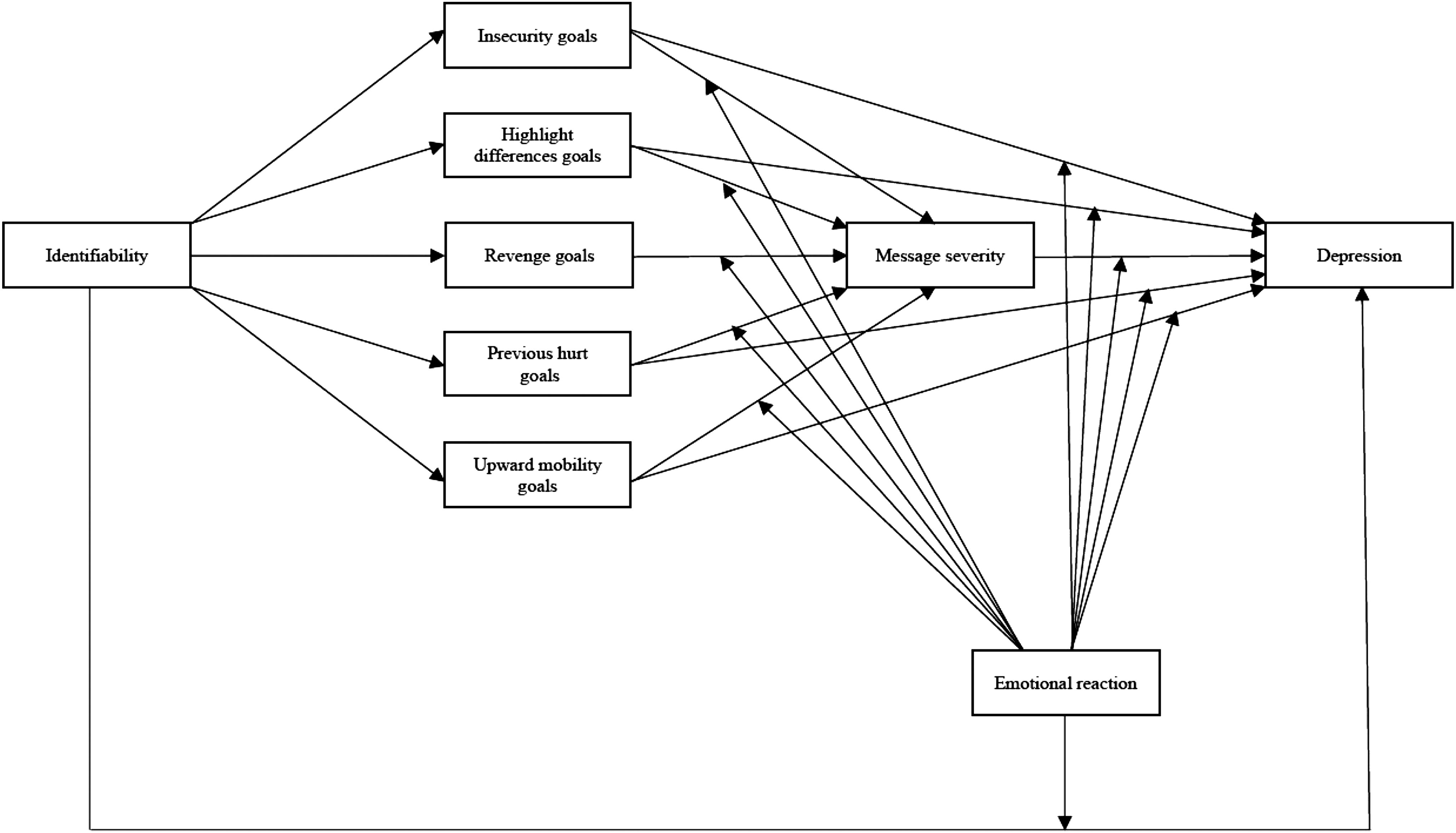
Conceptual model of predictions.
Method
Participants and procedure
The final sample consisted of 374 undergraduate students who met our requirement of having sent a series of hurtful messages intended to cause someone harm at some point in their memorable past. Approximately three-quarters were female (77.8 percent), and 22.2 percent were male (age: M = 20, SD = 2.10, range = 18–35). Almost half of the participants were Asian (48.8 percent), 26.6 percent were Hispanic, 16.0 percent were White, and the remaining 8.6 percent identified with another race.
After providing informed consent, participants recalled an episode wherein they bullied someone (although we never used the words bully*, cyberbully*, victim*, or target*), answered a series of questions about the episode (open-ended items first followed by randomized close-ended items), and then completed randomized individual difference measures. Participants recalled instances that were not two-sided arguments between friends and family. We asked for instances in which they intended to cause the receiver of their messages some mental, emotional, and/or psychological pain. Of the 739 students who started the survey, 402 (54.5 percent) met our requirement. Participants (N = 28; 7.0 percent) who sped through the survey, defined as people who took 1.75 SDs below the median survey time checking for an optimal face valid cutoff starting at 1 SD with 0.25 increments, were removed from the dataset. The 374 participants in the final sample averaged 26 minutes completing the survey (SD = 491.2 seconds, range = 434–3,333 seconds), whereas those removed spent 4 minutes (SD = 69.48 seconds, range = 133–374 seconds).
Multiple messages were sent during the bullying incident (Median: 4, Mode: 2, Mean without an outlier: 18.58, SD without outlier: 163.59) over a few days (Median: 3, Mode: 1, Mean: 38.46, SD: 167.44). A bit over half of participants sent messages via one mode of communication with 44 percent reporting 2 or more and 16 percent reporting 3 or more. A fifth of bullying episodes took place within a few months of recall (18.70 percent), 46.00 percent occurred 1–3 years prior, 18.70 percent occurred 4–6 years prior, and 16.6 percent occurred 7+ years prior. All items for measures and instructions and full results are available on Open Science Framework (OSF): https://osf.io/mkr85/?view_only=de52980bde7c4807a11eb519692663f9.
Predictors
Identifiability
Six items captured how identifiable participants felt during the episode on a 7-point scale (M = 5.97, SD = 1.47, α = 0.90, 7 = strongly agree).
Goals
Past research, as well as open-ended pilot data, suggested the following cyberbullying goals2,27,28: revenge (M = 4.44, SD = 1.83, α = 0.82), insecurity (M = 2.69, SD = 1.46, α = 0.86), highlight-differences (M = 2.06, SD = 1.27, α = 0.68), upward-mobility (M = 2.55, SD = 1.23, α = 0.83), and previous hurt (M = 3.12, SD = 1.57, α = 0.71). All goals were assessed on 7-point scale (7 = strongly agree). Factor analysis confirmed these dimensions.
Message severity
Using LIWC-22, 29 we analyzed the first two of three open-ended questions focused on: (a) the circumstances participants sent hurtful messages, (b) the content of messages, and (c) the reactions they intended to generate in target. Our analyses focus on six LIWC-22 dimensions: clout (M = 32.99, SD = 29.51), negative emotion (M = 3.02, SD =2.56), negative tone (M = 5.16, SD = 3.68), physical processes (M = 1.42, SD = 1.66), swear (M = 0.24, SD = 1.05), and social processes (M = 19.56, SD = 6.12) words. Results were replicated using (b) responses that were only focused on message content.
Moderator
Emotional reaction
We assessed how participants felt after sending the messages using 14 semantic differential items (M = 3.21, SD = 1.13, α = 0.91, 7 = positively valenced).
Outcome measure
Depression
Participants completed 18 items of the Beck Depression Inventory (M = 14.14, SD = 8.86, α = 0.89). 30
Controls
Given likely correlations with bullying and depression,2,31,32 we measured two controls.
Childhood trauma
Participants responded to the Childhood Trauma Questionnaire on a 1 (never true) to 5 (very often true) scale (M = 2.51, SD = 0.58, α = 0.72). 33
Verbal aggression
Participants completed the Verbal Aggressive Scale (M = 2.07, SD = 0.74, α = 0.86, 5 = high). 34
Results
We customized Model 80 of Hayes’s 35 PROCESS for R version 4.3. With 5,000 bootstraps, models included one predictor (identifiability, X), six goal mediators (M1-5), followed by one bullying message severity serial mediator (M6), one moderator (emotional reaction, W), and one outcome (depression, Y). The sixth mediator captures the severity of the hurtful messages, operationalized as each of six LIWC-22 variables and tested in six separate models. Verbal aggression and childhood trauma were covariates; age and gender also served as controls. Results focus on overall conclusions and significant paths across all PROCESS models, as the OSF contains unabridged results. We first report direct effects on depression, which are the same across models, and then the unique conditional direct and indirect effects for LIWC measures, which vary across models. Table 1 has the correlation matrix.
Descriptives and Correlations
p < 0.05.
p < 0.01.
p < 0.001.
Direct predictive effects
Increased identifiable predicted decreased insecurity (β = −0.12, p = 0.022, CI = −0.22, −0.02), previous-hurt (β = −0.13, p = 0.020, CI = −0.24, −0.02), highlight-differences (β = −0.13, p = 0.003, CI = −0.22, −0.05), and upward-mobility (β = −0.20, p < 0.001, CI = −0.28, −0.12) cyberbullying goals, whereas increased identifiable predicted increased revenge goals (β = 0.24, p = 0.056, CI = 0.12–0.37).
Only one of the five goals significantly predicted any of the message severity variables: Increased hurt goals predicted more clout (β = 6.84, p = 0.042, CI = 0.24–13.43) and negative tone (β = 0.90, p = 0.027, CI = 0.10–1.70).
Only insecurity goals significantly directly predicted depression across all models (β = 3.32–3.57, p < 0.05, LLCI = 1.05–1.32, ULCI = 5.59–5.85).
No LIWC variable significantly predicted depression.
Conditional direct effects
We tested six versions of our moderated mediation model, one for each LIWC variable used to measure message severity. Five of the six models demonstrated no conditional direct effects of identifiability on depression as a function of emotional reaction. Given this inconsistent finding across LIWC-22 measures, we do not consider it further.
Conditional indirect effects
We found a significant indirect effect of identifiability on depression only through insecurity goals for all models. At negatively valenced emotional reaction (M = 2.07, 16th percentile), the conditional indirect effect of identifiability predicted decreased depression through insecurity goals for negative emotion (β = −0.21; CI = −0.50, −0.011), negative tone (β = −0.21; CI = −0.49, −0.010), clout (β = −0.22; CI = −0.52, −0.020), swear (β = −0.20; CI = −0.480, −0.002), physical (β = −0.22; CI = −0.51, −0.011), and social (β = −0.21; CI = −0.51, −0.011) measures of severity. At medium (M = 3.21, 50th percentile) or high (M = 4.29, 84th percentile) levels of emotional reaction, there were no significant indirect effects of identifiability on depression through insecurity goals.
We also tested the full moderated serial mediation model of each of the five goals via a message severity variable on the relationship between identifiability and depression. LIWC measures were never an effective mediator for all models whatever the level of emotional reaction.
Discussion
Cyberbullying’s connection to depression is complex. Our data emphasize the role of communication dynamics in this link. First, cyberbullying goals depend on identifiability. 3 Cyberbullying for revenge emerged in more identifiable circumstances, whereas bullies sought highlight-difference, insecurity, previous-hurt, and upward-mobility goals when relatively more anonymous. Indeed, revenge is particularly rewarding when victims recognize it as a response to past wrongdoings. 36 Upward-mobility goals were more common under nonidentifiable conditions, suggesting audiences beyond the target might be more meaningful. Anonymous bullies are seen as more interpersonally attractive as targets increasingly infer upward-mobility goals drive cyberbullying. 8 Although we did not measure if participants thought they were identifiable to an audience of peers or authorities, goals likely vary in terms of bullies’ identifiability to social networks beyond victims.
Second, cyberbullying goals bivariately predicted depression, but when considering full models only insecurity goals sustained as an effective predictor of depression. Cyberbullying research has assessed incident rates and frequency of messages, but less often measured goals and message content to understand cyberbullying and mental health as we did.2,3 At the same time, our cross-sectional data are not causal.
Third, anonymous and insecure cyberbullies were less depressed than confident and identifiable ones, assuming some negative emotional reactions following the episode. Thus, attacking others might have positive outcomes for mental health under certain conditions for bullies. Perhaps our data reflect a remorse process for cyberbullies warranting more theorizing and testing with alternative methods. 37
Fourth, the severity of cyberbullying was not associated with depression, goals, or identifiability, despite past research illustrating that perceived severity and goals predict the mental health of targets. 2 Sender–receiver differences for cyberbullying seem just as crucial as communication mode and anonymity for all involved.4,7 From a bully’s perspective, goals are likely more salient than linguistic strategies to secure goals and thus more likely to predict depression; whereas from a victim’s point of view, the language that targets receive might matter more for mental health. Goal contagion and projection processes are likely relevant as well.38,39
Across all these issues, future work would gain from measuring depression and other mental health scales, such as an eating disorder assessment, via longitudinal and diary methods to avoid our self-report and cross-sectional limitations, especially alongside measures of cyberbullying goals and technological affordances, to advance our understanding of the communication dynamics of bullying and mental health.
Footnotes
Author Disclosure Statement
The authors do not have any conflicts of interest to report.
Funding Information
No funding was received for this article.