




Abstract
Nowadays, with the widespread use of the Internet, cyberbullying has become a pervasive threat to people. This study aimed to create a structural model of cyberbullying based on dark personality traits, with empathy as a mediating factor among students. A total of 360 students of the Mohaghegh Ardabili University were included using the multistage random sampling method. Data were collected using the Cyber-Bullying/Victimization Experiences Questionnaire, Dark Triad Personality Scale, and Questionnaire Measure of Emotional Empathy. Collected data were analyzed using Pearson’s correlation test and structural equation modeling in SPSS and AMOS 24. The direct route of Machiavellianism and psychopathy was positively significant for cyberbullying and negatively significant for empathy. Empathy also has a direct negative effect on cyberbullying. Furthermore, there was an indirect effect of Machiavellianism and psychopathy on cyberbullying through empathy. Dark personality traits including Machiavellianism and psychopathy are significant risk factors for cyberbullying, with these traits indirectly contributing to cyberbullying through empathy deficits.
Introduction
Bullying is aggressive behavior where individuals or groups intentionally target others. A common form, cyberbullying, involves harassment online through disrespect and neglect. 1 With the rise of Internet and smartphone access, cyberbullying has become a significant global issue in the 21st century.2–3 In cyberbullying, one person abuses their power to scare the other. 4
Researchers have focused on how dark personality traits, such as Machiavellianism, psychopathy, and narcissism, influence cyberbullying. 5 Individuals with high Machiavellianism often mistreat others to achieve their goals, regardless of others’ satisfaction. 6 In a recent study by Triantoro et al., 7 Machiavellianism was found to be the strongest predictor of cyberbullying (β = 0.154, p = 0.01), followed by psychopathy (β = 0.113, p = 0.01) and narcissism (β = 0.059, p = 0.01). Psychopaths exhibit impulsive behavior, callousness, low empathy, 8 and aggression, often viewing themselves as superior and having difficulty learning from punishment. 9 Studies link psychopathy to bullying behaviors.10–14 In contrast, narcissists crave excessive admiration, see themselves as exceptional, have low empathy, and are often self-centered and exploitative. 15 A recent research 16 demonstrated a positive correlation between narcissism and cyberbullying (r = 0.20, p < 0.01).
Empathy, the ability to understand and share others’ feelings, contributes to engaging in cyberbullying behavior. 17 Empathy can be viewed as both a trait-level (between-person) and a state-level (within-person) construct. 18 Trait empathy reflects a person’s general tendency to show empathetic behavior, while state empathy involves variations in empathetic responses influenced by specific interactions 18 or social contexts. 19 In a recent study, 20 cyberbullying was related to the dark triad personality traits including Machiavellianism (r = 0.27, p < 0.001), psychopathy (r = 0.40, p < 0.001), and narcissism (r = 0.21, p < 0.001). Consistently, Dow and Crawley 21 discovered that psychopathy (r = –0.35, p < 0.001) and Machiavellianism (r = –0.28, p < 0.001) have a negative correlation with empathy. However, Wigati et al. 22 revealed that empathy does not play a role in cyberbullying and has no impact on it. This finding was further supported by Mujidin et al.’s study. 23 Both studies were conducted in East Asian countries, where researches (e.g., by Xu et al. 24 ) suggest that people tend to show lower sympathy and empathy toward those in distress. On the contrary, Martinez et al. 25 and Talaei and Kadkhodaei 26 suggested that empathy effectively reduces cyberbullying, with another study 2 indicating empathy moderates the link between moral disengagement and cyberbullying. Zhu et al. 27 also identified empathy as a protective factor. Alavi et al. 10 found no link between Machiavellianism and cyberbullying, while narcissism and psychopathy showed a positive correlation. Conversely, Gajda et al. 28 argued that Machiavellianism and psychopathy relate to cyberbullying, but narcissism has little impact.
Overall, cyberbullying is a significant health concern, with studies indicating that dark triad personality traits might predict it, though findings are inconsistent and the mechanisms remain unclear. Conflicting results about empathy’s role may stem from factors such as gender bias 20 and cultural differences in empathic patterns (e.g., Wigati et al. 22 and Mujidin et al. 23 ). Similarly, studies show mixed findings on the link between dark triad personality traits and cyberbullying, influenced by measurement methods (see Gajda et al. 28 ) and cultural effects (see Alavi et al. 10 ).
Research indicates that personality significantly influences the perpetration of visual and text-based cyberbullying. Cyberbullies typically spend considerable time online and engage in risky behaviors, but individual personality traits are key predictors of this behavior.29,30 Dark triad traits, known for their exploitative nature, show indifference to the harm caused to others in the pursuit of personal goals. 31 Jones and Figueredo 32 found that all three traits are linked by a core of callousness and manipulation, with similar studies noting deficits in empathy 33 and low agreeableness. 34
Due to the various limitations and conflicting results of past research, and the important role of personality traits in the development of cyberbullying behavior, it is crucial to study dark triad personality traits along with other factors that may influence cyberbullying behavior. Therefore, this study investigates the role of dark triad personality traits in cyberbullying behavior, with emotional empathy as a mediator. Our research explores this connection, shown in Figure 1. Although the mediation model was based on theoretical frameworks, our hypotheses were atemporal, meaning causality cannot be inferred from the analysis. 35 This study is significant due to conflicting results in this area, providing insights for future research.
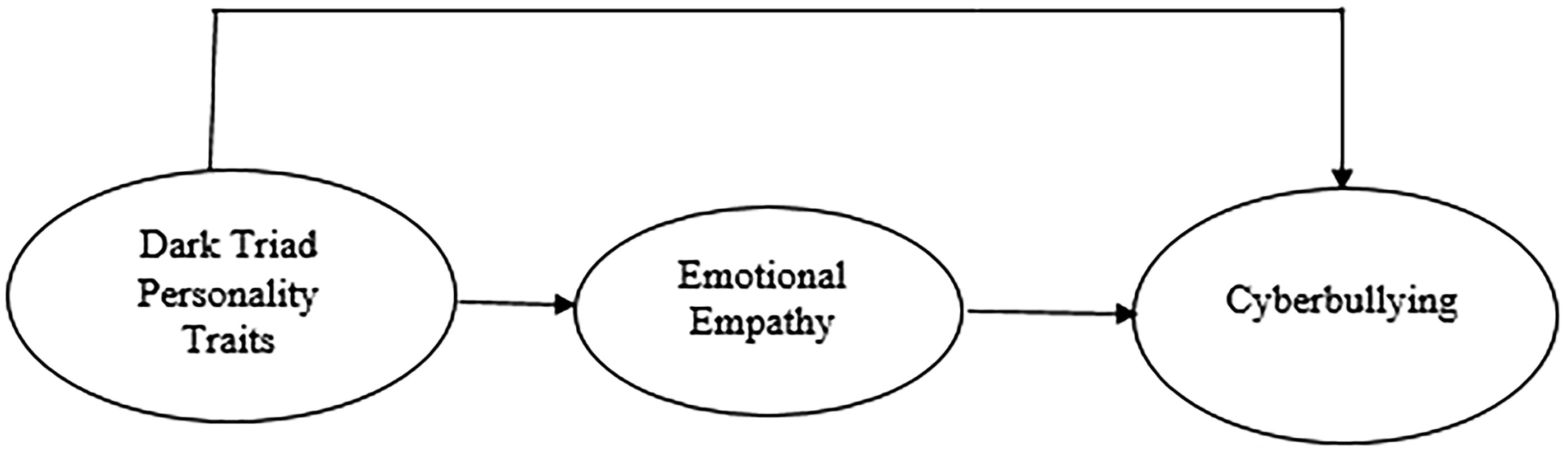
The proposed model of cyberbullying.
Materials and Methods
Participants and procedure
The study protocol was approved by the Institutional Review Board of the University of Mohaghegh Ardabili (ID: IR.UMA.REC.1401.080). A total of 360 students from the University of Mohaghegh Ardabili were selected as the study sample through cluster sampling, meeting the inclusion and exclusion criteria.
Inclusion criteria required informed written consent and participants aged 18–65 years. Exclusion criteria included comorbid disorders (e.g., substance abuse, psychotic disorders) assessed via the Structured Clinical Interview for Diagnostic and Statistical Manual of Mental Disorders, Fifth Edition [DSM-5], Research Version [SCID-5-RV]), recent psychiatric interventions (past 6 months), severe physical issues, visual or hearing impairments, a history of neurological disorders (assessed via self-reports), and failure to meet study requirements.
We randomized three of the nine faculties and selected four classes from each for data collection, totaling 522 participants. After explaining the research objectives and ethical considerations, 83 individuals declined to participate, leaving 439 assigned. Of these, 79 were excluded for reasons such as comorbid psychiatric disorders (N = 56), previous interventions (N = 19), and physical problems (N = 4). Ultimately, 360 individuals participated, but seven incomplete questionnaires were removed, resulting in 353 fully completed questionnaires for analysis. Descriptive statistics of the demographic information and baseline variables are presented in Table 1.
Descriptive Statistics of the Study Variables
SD = Standard Deviation.
Measures
Structured Clinical Interview for Diagnostical and Statistical Manual for Mental Disorders, Fifth Edition, Research Version
This interview helps mental health professionals diagnose psychiatric disorders. 36 The SCID-5-RV’s screening feature is ideal for specific research study assessments. 37
Cyber-bullying/Victimization Experiences Questionnaire
This questionnaire by Antoniado et al. 38 is divided into two subscales: cyber victimization and cyberbullying. The original study reported reliability coefficients of 0.89 for cyberbullying, 0.80 for cyber victimization, and 0.91 for the overall questionnaire. In the current study, Cronbach’s alpha values were 0.91 for cyberbullying, 0.84 for cyber victimization, and 0.93 for the entire questionnaire.
Dark Triad Personality Scale
This scale, developed by Jonason and Webster, 39 includes three subscales: Machiavellianism, psychopathy, and narcissism. The test–retest reliability coefficients were 0.86 for Machiavellianism, 0.76 for psychopathy, and 0.87 for narcissism, with an overall reliability of 0.89. In the current study, Cronbach’s alpha values were 0.83 for Machiavellianism, 0.73 for psychopathy, 0.84 for narcissism, and 0.87 for the entire questionnaire.
Questionnaire Measure of Emotional Empathy
This questionnaire was used to assess trait-level empathy in relation to cyberbullying behavior. This was developed by Mehrabian and Epstein 40 to measure an individual’s emotional and empathic responses to the emotional reactions of others through seven subscales: reactive empathy, expressive empathy, cooperative empathy, emotional effectiveness, emotional stability, empathy toward others, and control. The total scale reliability is reported at 0.84, 40 with a current study alpha of 0.89.
Data analysis
The Pearson correlation test was conducted using IBM SPSS version 26 to explore the relationship between variables. Mediational hypotheses were examined through structural equation modeling (SEM) with AMOS software, assessing fitness indices based on Kline’s criteria. 41
Results
Table 2 reveals a significant positive correlation between cyberbullying and the dark traits of Machiavellianism, narcissism, and psychopathy (p < 0.01). In addition, empathy scores are negatively correlated with cyberbullying and Machiavellianism and psychopathy traits (p < 0.01). We calculated partial correlations between Dark Triad Personality Traits and cyberbullying while controlling for empathy (see Table 2). Our findings indicated a significant correlation between these traits and cyberbullying, even when accounting for empathy (r = 0.53, p < 0.01).
Correlations and Partial Correlations Among Model Variables
p < 0.05.
p < 0.01.
Implementation of the model showed that fitness indices had the desired values (IFI = 0.94, TLI = 0.93, GFI = 0.91, CFI = 0.94, χ2/df = 2.04, PCFI = 0.80, PNFI = 0.76, and RMSEA = 0.055) (see Figure 2).

Structural equation modeling (standard mode).
Results revealed that both Machiavellianism and psychopathy had significant negative impacts on empathy; similarly, the direct route of empathy on cyberbullying was negatively significant. In addition, Machiavellianism and psychopathy had significant and positive effects on cyberbullying (Table 3).
The Direct Effects of all Paths for the Model
According to the findings presented in Table 4, Machiavellianism and psychopathy, which are considered dark personality traits, have indirect impacts on cyberbullying through empathy. However, the study did not confirm the indirect effect of narcissism on cyberbullying through empathy.
The Results of the Indirect Effect Analysis
We conducted a hierarchical regression analysis by introducing empathy in the first step and Dark Triad Personality Traits in the second. It revealed that both models were significant (see Table 5); empathy explained 31.7 percent of the variance in cyberbullying, F(1, 351) = 163.07, p < 0.001, adj. ΔR2 = 0.317 (see Model 1, Table 5). Adding Dark Triad scores to the model significantly increased the explained variance in cyberbullying, F(2, 350) = 183.51, p < 0.001, adj. ΔR2 = 0.195. In this model, Dark Triad Personality Traits significantly predicted cyberbullying while controlling for empathy (see β-values of Model 2, Table 5).
Hierarchical Regression Analyses Predicting Cyberbullying
p < 0.001.
SE, standard error.
We developed a bi-factor model to assess if the shared variance in empathy and Dark Triad traits accounts for the observed correlations. Implementation of the bi-factor model showed that fitness indices had the desired values (IFI = 0. 94, TLI = 0.92, GFI = 0.95, AGFI = 0.92, CFI = 0.94, χ2/df = 2.64, PCFI = 0.67, PNFI = 0.65, and RMSEA = 0.068) (see Figure 3).

Bi-factor model of the variance of empathy and Dark Triad Personality Traits.
Discussion
The study examined the links between dark personality traits, emotional empathy, and cyberbullying in university students. Results showed that Machiavellianism and psychopathy directly increase cyberbullying. These findings are consistent with multiple studies28,42–45 and inconsistent with the results of some other studies.11,12,46 Some reasons for these agreements and disagreements can be attributed to the significant role of empathy in the present study. Besides, our results showed that narcissism had no significant effect on cyberbullying, which was inconsistent with the results of Baughman et al., 47 Goodboy and Martin, 29 and van Geel et al. 15 Again, given that empathy was the main responsible for the reported relationship between Dark Triad and cyberbullying, some reason for these agreements and disagreements can be attributed to this significant factor. Moreover, when justifying the findings of the recent research, we can point to the differences in personality traits of people. Narcissists are more self-centered and focused on seeking attention, making them less likely to engage in online bullying. In contrast, people with Machiavellian traits plan their harmful actions to avoid detection and maintain credibility. Thus, cyberspace offers a suitable platform for these individuals to engage in cyberbullying. 48 To support our findings, we can cite a research study conducted by Sari and Adriani, 48 which showed that narcissistic individuals become more self-centered as they seek attention, while those with Machiavellian traits plan their actions to avoid being exposed when harming others. Zhu and Jin’s 49 research also showed that Machiavellianism and psychopathy have stronger links with aggression than narcissism. Panatik et al. 43 suggested that both Machiavellianism and psychopathy traits can lead to cyberbullying attitudes in students, while narcissism does not predict this behavior.
Our study found that empathy has a direct negative impact on cyberbullying which is consistent with some previous studies.50–53 However, this contradicts the results of other studies.20,23,54 This disagreement with previous studies may stem from methodological issues, such as gender-specific patterns (e.g., Schade et al. 20 ) and cultural effects (e.g., Wigati et al. 22 and Mujidin et al. 23 ). Individuals with low empathy tend to engage in antisocial behaviors, 55 likely due to difficulties in regulating their emotions. 56
The study found that Machiavellianism and psychopathy directly reduce empathy levels, aligning with previous research.57–59 This finding contradicted Schade et al., 20 who claimed that empathy did not significantly affect the link between dark triad personality traits and cyberbullying, attributing this to gender-specific patterns in their research. Research shows that individuals with dark personality traits often have difficulty identifying emotions in facial expressions and tend to exhibit lower levels of empathy. 59
Our study found that Machiavellianism and psychopathy indirectly contributed to cyberbullying through empathy, while we did not confirm empathy’s mediating role with narcissism. These findings align with previous research showing a negative correlation between empathy and dark personality traits.21,57,58 Our findings are also consistent with other studies.50–53,60 Dark personality traits are nonadaptive behaviors that can increase the likelihood of cyberbullying, marked by low empathy and reduced shame after aggressive actions. Interestingly, narcissists, who seek approval, are less prone to cyberbullying.
The current study highlights the need for specialists in cyberbullying to assess dark personality traits. Effective evaluation allows for psychotherapeutic programs that consider the role of empathy in individuals with Machiavellianism and psychopathy who engage in cyberbullying. Our findings emphasize the importance of therapeutic approaches that enhance empathy in such patients. Psychotherapeutic methods, including cognitive and mindfulness-based interventions, can be effective in this regard.
The present study has several limitations. It is cross-sectional and observational, so causal conclusions cannot be drawn. Future research should consider a longitudinal design. In addition, the small sample size limited to university students may affect the generalizability of the results. Larger and more diverse samples from the broader population are needed. Lastly, the study focused solely on emotional empathy, overlooking cognitive empathy, which should be included in future research.
Conclusions
Our research indicated that Machiavellianism and psychopathy traits significantly influence cyberbullying, mediated by emotional empathy. Health care professionals should consider these psychological factors when developing therapeutic plans.
Footnotes
Acknowledgment
All authors thank the subjects for their sincere cooperation in performing the study.
Authors' Contributions
S.B. conceived the original idea, designed and directed the project, and developed the theoretical framework. S.B. and S.N. contributed to sample preparation; S.N. carried out the implementation; S.B. performed the analytic calculations; S.D. & S.B., wrote the article. Jobson, L., conceived the study and was in charge of the overall direction and planning. All authors provided critical feedback and helped shape the research, analysis, and manuscript.
Ethics Code
The institutional review board of Mohaghegh Ardabili University approved the study protocol (IR.UMA.REC.1401.080).
Compliance with Ethical Standards
All procedures performed in this study involving human participants were under the ethical standards of the institutional research committee and complied with the 1964 Declaration of Helsinki and its later amendments or comparable ethical standards.
Informed Consent
Informed consent was obtained from all participants included in the study.
Author Disclosure Statement
The authors declared no potential conflicts of interest concerning the research, authorship, and/or publication of this article.
Funding Information
No funding was received for this article.