




Abstract
The popularity of video games and esports has increased the demand for scientific research examining the psychological factors associated with video game performance. Tilt, a common term in gaming, is characterized by negative emotion and a decline in performance. The term tilt is commonly used within the gaming community, yet there is a lack of research examining tilt in video games from a psychological perspective. This article focuses on gaining insight from gamers regarding their understanding and experience of tilt in gaming using a qualitative approach. Thematic analysis of gamers responses determined tilt to be multifaceted, incorporating negative emotions and behavior, hindering cognition, and resulting in poor in-game performance. These results provide an important contribution to our conceptual understanding of tilt, illuminating the multitude of emotions involved in tilt, the antecedent factors, and insight regarding gamers strategies to deal with tilt. This study builds upon our understanding of tilt, providing practical information for esports psychologists to identify, understand, and effectively train players in managing tilt and improving performance. This study highlights the need for evidence-based tailored interventions centered upon reducing tilt and improving video game performance.
Introduction
The reach of video games is widespread, enjoyed both recreationally and competitively across the globe. 1 Within the videogame industry, competitive video gaming, known as esports, has also flourished. The popularity of esports is evidenced in viewership, with 921 million people viewing esports content in 2022. 2 This exceptionally high engagement, paired with extensive prize pools for esports competitions, has increased the demand for scientific research examining determinants of optimal esports and video game performance. One area which has gained increased interest relates to the contribution of psychological factors to performance, observable in studies examining the role of psychological skill use, 3 mental toughness, 4 stress, 5 coping,6,7 and self-regulation 8 in esports performance.
Regarding psychological skill use, Himmelstein et al. 3 report that engagement in goal setting, imagery, emotion regulation, and attentional control is related to optimal performance, highlighting the utility of psychological skills training in esports. Researchers examining stressors and coping in esports report players to experience both internal and external stressors, 6 noting players engagement in problem, emotion, and avoidant-focused coping strategies to deal with stressors. In research examining the role of self-regulation in esports performance, it was reported that higher self-regulation is positively associated with esports performance. 8 The ability to regulate emotions effectively is an important psychological skill in video game performance and in reducing gamers likelihood of experiencing the psychological state of tilt. 9
The term tilt derives from pinball and relates to when a player would shake the pinball machine out of frustration at the game. As a result of which, tilt would flash on screen, ending the game. 10 The term is also used in poker, whereby researchers describe tilt as players losing emotional control and making poor decisions.11,12 The term tilt has since been adopted as a common term within the gaming community. Despite this, there is a dearth of research empirically examining tilt, with Sharma et al., 13 highlighting tilt in gaming to be an understudied research area. Wu et al. 14 conference paper provided initial insight into defining tilt in esports. In this study, high school MOBA players were surveyed and reported tilt to relate to emotions such as anger, frustration, and deterioration in game play ability. In 2024, McLinton and Pascale 9 highlighted that no fundamental definition of tilt in gaming existed, illustrating the need to better understand the construct of tilt and how it manifests among esports players. McLinton and Pascale 9 interviewed six esports professionals. They provided insights into the conceptualization of tilt, describing it as an emotional state, involving feelings of indignation and frustration, which inhibit decision making. 9 They also examined esports-specific factors that induce or mitigate tilt.
In 2024, Bonilla et al. 15 also highlighted that the concept of tilt in gaming had yet to be operationalized and defined. These researchers interviewed 27 participants including pro, semi pro, amateur players, and coaches to define and conceptualize tilt. They concluded tilt to be a state of frustration and anger, which negatively impacts performance and attention, resulting in negative thoughts regarding mistakes. These studies offer valuable contributions to a novel avenue of research. McClinton and Pascale 9 stress the dearth of research in the area and how an understanding of tilt is critical to better inform esports psychologists. For this reason, our study aims to build upon the current available research.
The aforementioned studies predominantly focused on esports. However, given the staggering number of gamers worldwide, we believe there is a need to better understand tilt across a broader demographic of video gamers and game genres. The purpose of this study is to utilize a qualitative approach to examine gamers understanding of tilt. Specifically, the aim of this study is to examine how gamers conceptualize tilt in video gaming. Second, we aim to identify the factors that contribute to this experience of tilt. Lastly, we aim to identify the strategies currently used by gamers to deal with tilt. In doing so, we aim to support the needs of all gamers and help improve their in-game coping strategies. Our study offers the unique advantage of insight from a wide variety of gamers.
Materials
The data from this study emanate from larger study on tilt in gaming. 16 This article focuses specifically on the qualitative data collected from this study. Data were collected in the format of online questionnaire via the survey platform, Qualtrics. 17 This allowed for a wide variety of perspectives and experiences to be captured. 18 NVIVIO software v.14 was used to analyze the content.
Methods
Participant recruitment and procedure
Inclusion criteria necessitated being aged 18 or over and playing video games. Participants were invited to participate through a survey link via email and online gaming platforms. Participants were provided with an information sheet and required to provide consent to access the survey. This study was approved by the University of Limerick Faculty of Education and Health Sciences Research Ethics Committee in the University of Limerick (2023_06_25_EHS) in accordance with the Declaration of Helsinki.
Procedure
Participants were presented with three questions relating to their experience of tilt when gaming. Tilt is a common term within the gaming community. Despite this, participants were given a brief description of tilt at the beginning of the study. Participants responded using open text boxes for the questions to allow for responses unrestricted by-word count. Questions included:
In relation to your experience of gaming, what comes to mind when you think of tilt?
What factors contribute to your experience of tilt?
What are your current strategies if any, to deal with tilt?
Participant information
Data were provided by 1,958 participants. Incomplete/blank responses (n = 918), extreme responses, whereby the same response was repeatedly given (n = 20), and responses which could not be placed according to a game genre (n = 13) were excluded, leaving 1,007 participants. Participants included PC gamers (n = 633), console gamers (333), and mobile/handheld console gamers (n = 41), 797 males, 173 females, and 37 nonbinary/did not disclose. Multiplayer and single player games were included, such as shooter (n = 361), multiplayer online battle arena (n = 111), action/adventure (n = 301), real-time strategy (n = 72), sim racing (n = 35), fighting (n = 26), and social simulation (n = 24) games.
Data analysis
Responses were analyzed using NVIVO software v.14, by manually coding responses to the three questions. Manual codes were generated using words to label the content of the responses. The number of times a code was identified was recorded to determine its prominence in the dataset, by tracking the number of references each code had. Similar codes were grouped together and then were labeled with an overarching theme that encapsulated those codes. This process is outlined in an example provided (Figure 1). Labeling by the author S.C. was verified by the authors A.J.T. and M.C. Revisions to codes and themes were implemented following suggested amendments by the other authors, until 95% agreement was reached.
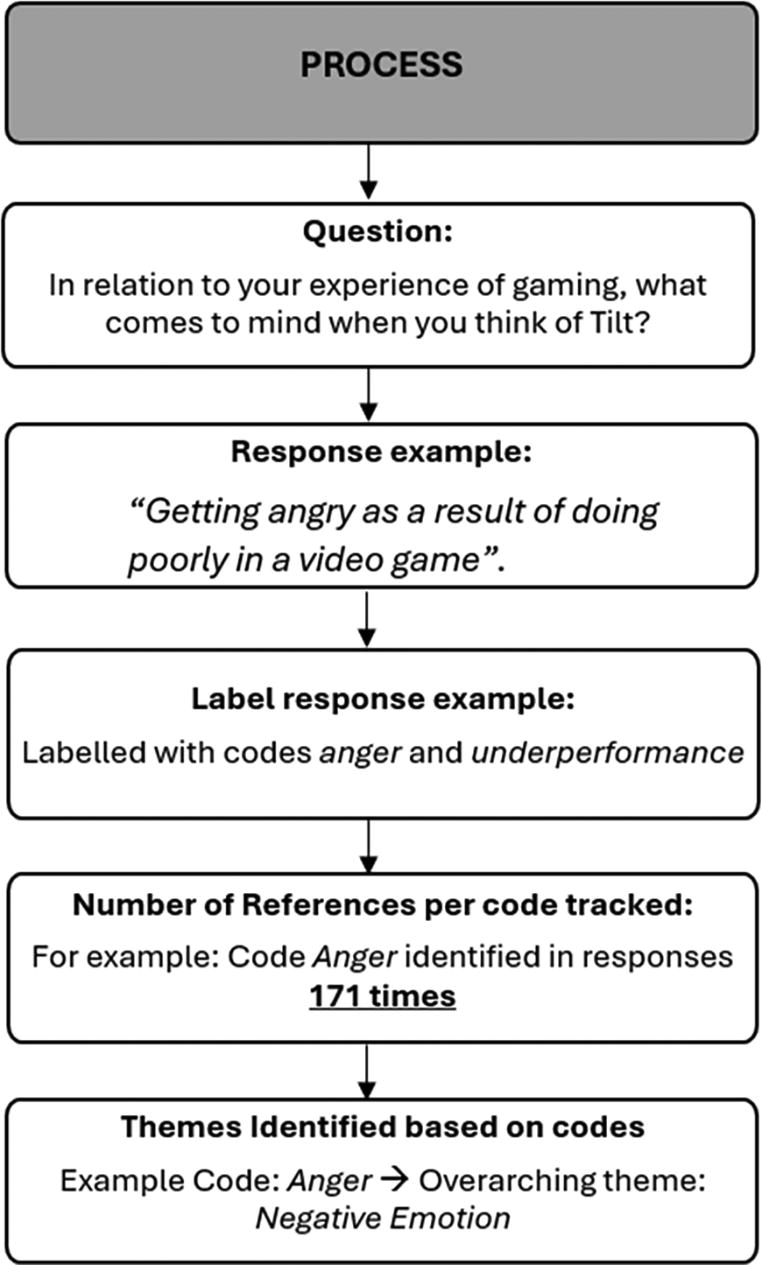
Process of coding responses and identifying themes.
Results
The first question gamers were asked was “In relation to your experience of gaming, what comes to mind when you think of tilt?” Results are synthesized in Table 1. Gamers characterized tilt as encompassing negative emotions and behavior, negatively impacting cognition and game performance. This definition was generated based on the frequency in which codes were referenced. Negative emotion (Table 1; 1A) was the most prominent theme, containing 13 codes and 856 references, followed by poor performance (Table 1; 1B) (3 codes and 150 references), negative behavior (Table 1; 1C) (4 codes and 99 references), and negatively impacted cognition (Table 1; 1D) (3 codes and 44 references).
Gamer’s Depiction of Tilt in Video Gaming, Including Codes, Number of References per Code, Themes, and Sample of Quotes
Gamer’s definitions of tilt most prominently included descriptions of negative emotions. Gamers characterized tilt as “getting angry as a result of doing poorly in a video game” and “getting frustrated with myself or other people when not performing well.” Poor performance was also illuminated as a key component of tilt. This finding is reflected in gamers reports of tilt occurring when “playing far worse than I know I am capable of.” Additionally, gamers acknowledged tilt to negatively impact cognition. This was evidenced in codes inclusive of a loss of focus and poor decision making, with gamers describing tilt as “letting emotion and frustration cloud your judgment” and a “loss of critical thinking.” Gamers also highlighted negative behavior to be a facet of tilt, reporting tilt to involve “toxic behaviour” and “blaming others.”
The second question gamers were asked was “what factors contribute to your experience of tilt?” The results are synthesized in Table 2 and reported in order of prominence in the dataset. Gamers reported poor performance (Table 2; 2A; 3 codes 460 references), unfairness in the game (Table 2; 2B; 3 codes 385 references), issues with teammates (Table 2; 2C; 4 codes, 335 references), opposition (Table 2; 2D; 3 codes, 212 references), and lastly game/internet issues (Table 2; 2E; 3 codes, 187 references) as the main factors contributing to tilt.
Gamer’s Depiction of Factors that Contribute to Tilt in Video Gaming, Including Codes, Number of References per Code, Themes, and Sample of Quotes
Poor performance was the most reported risk factor for experiencing tilt. Examples include gamers depictions of “my own performance being poor” and “If I believe my performance is not up to my standard.” Unfairness in the game was the second most prominent theme, evidenced in gamers reports of “unfairness and lack of good luck” as contributing to tilt. Issues with teammates also contributed to gamers experience of tilt. Support for this finding is offered in codes pertaining to teammate performance, negativity from teammates, and problematic communication, with gamers reporting “teammates not communicating at all when needed” as contributing to tilt. Opposition was also determined to be a risk factor, with gamers depicting the “unsportsmanlike behavior of other players” and “other players comments/actions” as contributing to tilt.
The third question in which gamers were asked was “What are your current strategies if any, to deal with tilt?” Strategies reported by gamers are presented in Table 3 in order of prominence in dataset. These include adaptive avoidant coping (Table 3; 3A; 3 codes 571 references), adaptive problem-focused coping (Table 3; 3B; 5 codes, 304 references), adaptive emotion-focused coping (Table 3; 3B, 7 codes 282 references), maladaptive emotion-focused coping (Table 3; 3D, 1 code, 22 references), and maladaptive avoidant-focused coping (Table 3; 3E, 2 codes, 47 references).
Gamer’s Depiction of Strategies to Prevent Tilt in Video Gaming, Including Codes, Number of References per Code, Themes, and Sample of Quotes
Gamers predominantly reported engaging in adaptive coping strategies, with 81.93% of responses classified as adaptive. This was evidenced in problem-focused coping, which involves managing stressful situations by modifying or eliminating the source of stress via behavioral changes. 19 Gamers reported “coming up with different strategies in-game to overcome an obstacle,” suggesting that they “search for strategies or tips online to deal with the issue.” Gamers also indicated engagement in adaptive emotion-focused coping. This coping style involves regulative efforts to reduce the emotional impact of the stressful situation 19 with gamers expressing that they engage in “breathing exercise to get my brains attention drawn away from the game and calm down.”
Gamers also expressed engagement in adaptive avoidant coping. Notably, avoidant coping involves attempts to orient away from a stressor 20 and has been identified as an “in-between” coping style, potentially adaptive or maladaptive depending on the context in which it is used. 21 Engaging in avoidant coping can be beneficial in certain situations, for instance, by taking a break from a task. 21 Engagement in this coping style was seen as adaptive in this context, with gamers reporting creating distance from the game and taking “a break from the game to calm down.”
Engagement in maladaptive strategies was reported less frequently, constituting 18.07% of responses. Maladaptive emotion-focused coping was observable in gamers depiction of reactive behavior. Bertsch et al. 22 suggest that engagement in reactive behavior is linked to poor emotion regulation. There was also evidence of maladaptive avoidant coping. Examples include gamers stating that they “just ignore it.” Lastly, gamers highlighted they had a lack of strategies to deal with tilt, evidenced in quotes such as “I don’t have any coping strategies.”
Discussion
This study sets out to create a better conceptual understanding of tilt across a wide demographic of gamers and games using a qualitative approach. We aimed to identify the factors contributing to this experience and determine gamers strategies to deal with tilt. Gamers characterized tilt as incorporating emotions such as anger, rage, frustration, and annoyance. In determining negative emotion as an overarching theme, our findings align with other research in esports, which also depicts tilt as an emotional process incorporating frustration and anger.9,14,15 Bonilla et al. 15 note that this sense of frustration players describe intensifies when players are unable to overcome game challenges, resulting in diminished performance.
Our research also identified poor performance as a central theme of tilt. It is documented that motivation to perform well predisposes players to experiencing decrements in performance due to excessive arousal.23,24 It is plausible that gamers experience a drop off in performance due to excessive motivation to perform well. Neuroscientific support for this is offered by the recognition that dopamine plays a role in motivation. 25 Aarts et al. 25 report high levels of dopamine synthesis capacity in tasks involving monetary bonuses can negatively impact cognitive control, resulting in a drop off in performance.
This neuroscientific evidence for excessive motivation negatively impacting performance via cognitive control offers support for our finding that tilt encompasses negatively impacted cognition. This is unsurprising, given the recognition that negative emotions impair cognitive performance and increase reaction times. 26 The practical significance of this finding becomes apparent when considering the fast-paced nature of esports, which necessitate fast reaction times, accurate decision making, and high-level cognitive performance. These results illuminate the importance of effective emotion regulation optimizing cognitive performance and reducing tilt.
Our research highlighted numerous factors contributing to tilt, with poor performance identified as the most common overarching theme. Bonilla et al. 15 and McLinton and Pascale 9 also report diminished performance as a potential trigger of tilt. We also determined feelings of unfairness to contribute to tilt. Researchers have demonstrated that perceived unfairness not only reduces performance but also generates negative emotional reactions. 27 Opposition was also identified as a risk factor for tilt, a finding which aligns with esports research on tilt. 9 Finding opponents as a source of tilt is important information for esports psychologists to be cognizant of when preparing players for competition.
Communication issues with teammates were also identified as contributing to tilt. This finding corroborates with Smith et al. 6 and Poulus et al. 7 research whereby communication issues were identified as stressors for esports teams. These findings demonstrate the need for interventions centered on improving communication and cohesion between players to improve team dynamics, experience, and game performance. In identifying these risk factors, we contribute novel information on how to assess a gamers risk of experiencing tilt.
In this study, gamers reported a multitude of coping strategies to deal with tilt. Gamers reported engagement in problem-focused coping. This coping style is linked with a greater sense of control and psychological well-being 28 and lower levels of burnout. 29 Gamers also reported engaging in adaptive emotion-focused coping. This style of coping involves regulative efforts to reduce the emotional impact of the stressful situation. 19 For instance, gamers reported utilizing breathwork to reduce tilt. Slow breathing has been shown to improve parasympathetic activity via increased vagally mediated heart rate variability (HRV). 30
Gamers also reported engagement in adaptive avoidant coping. Engagement in this coping style is evidenced in gamers reporting taking breaks and creating distance from the game. Research supports the utility of engaging in this strategy, with research suggesting taking breaks to improve resilience to stress, 31 cognitive performance, 32 and positive affect. 33 DiFrancisco-Donoghue et al. 34 found breaking up prolonged sitting during game play with 6-minute walk breaks to improve executive functioning among esports players, highlighting the potential benefit of break taking for both gamer cognition and performance. Gamers provided evidence of engagement in emotion, problem, and avoidant-focused coping strategies, a finding which corroborates with Smith et al., 6 who also found esports players to adopt a combination of problem, emotion, and avoidant-based coping. Researchers recognize that people employ a combination of strategies and that flexibility in coping strategies associated with better health outcomes.35,36
This synthesis of results provides an important framework in understanding the strategies gamers employ in response to tilt, better equipping us in understanding how to support gamers. In demonstrating that some gamers do not have strategies to deal with tilt, these results demonstrate the need for more focus to be attributed to evidence-based interventions to support gamers needs. Researchers recognize that currently interventions for gamers are lacking, with Leis et al. 37 highlighting that there were no interventions to improve coping and performance among esports players. Poulus et al. 38 took an important step toward changing this narrative, conducting a pilot study examining coping effectiveness training with five esports players. Poulus et al. 38 found the intervention to increase players perception of coping effectiveness and subjective performance. This work provides an important starting point, but more research examining evidence-based interventions in the context of video gaming and esport is needed.
Research from traditional sport provides a potential framework for designing and advancing the evidence-based interventions for gamers. While video gaming presents unique challenges not seen in traditional sports such as technical issues, gaming also shares communalities with traditional sport. Gaming requires mental skills, 39 fast reaction times, 40 quick decision-making skills, 41 and is cognitively demanding. 42
In traditional sport, researchers found that implementing both psychological skill training and mindfulness training improves the athlete’s ability to manage emotions and sustain attentional control. 43 Orbach and Blumenstein 44 found preparatory routines helped athletes to regulate their emotions and improve performance. Balk et al. 45 found that getting athletes to employ emotion regulation strategies such as cognitive reappraisal helped athletes cope with the stress of competition. Research in sport demonstrates the potential utility of psychological interventions to help gamers improve upon their coping strategies in game.
A limitation of our study is that given the data collection format was an online survey, there were drop-out and retention issues. Future studies could benefit from more in-depth focus group and interview type research methodologies. This research relied upon self-reported data. For future research, it would be beneficial to empirically examine the effectiveness of interventions to improve players coping and emotion regulation in game via physiological and neural measurements such as HRV and neural activity.
Conclusion
This study sets out to create a better conceptual understanding of tilt, the antecedent factors contributing to tilt, and gamers strategies to deal with it. The results build an important framework for understanding tilt, determining tilt to be multifaceted, incorporating negative emotions and behavior, negatively impacting cognition, and resulting in poor in-game performance. The results have practical implications for esports psychologists, equipping them with valuable information to identify, understand, and effectively train players to manage tilt. Our research demonstrates the role of effective emotion regulation in reducing tilt and improving performance, while also demonstrating the need for evidence-based tailored interventions to reduce experience of tilt in video games.
Footnotes
Authors' Contributions
S.C.C.: Writing—original draft, writing—review & editing, methodology, investigation, formal analysis, conceptualization. A.J.T.: Writing—original draft, writing—review & editing, supervision, methodology, investigation, formal analysis. M.J.C.: Writing—original draft, writing—review & editing, supervision, methodology, investigation, formal analysis, funding acquisition.
Author Disclosure Statement
No interests to disclose.
Funding Information
This work was supported with the financial support of the Science Foundation Ireland grant 13/RC/2094_P2 and co-funded under the European Regional Development Fund through the Southern & Eastern Regional Operational Programme to Lero—The Research Ireland Centre for Software (www.lero.ie).