




Abstract
Currently, time spent online viewing short-form video (SFV) has become an increasingly popular activity. SFV users spend over two hours daily across a variety of SFV platforms. Undergirded by the theory of technological affordances, the present study is the first to investigate the relative strength of three tech affordances—recommendation accuracy, serendipity, and perceived effortlessness offered by three popular SFV platforms: TikTok, Instagram Reels, and YouTube Shorts. A survey of 555 college students was conducted. Each respondent was asked to rate each of the three SFV platforms on an 18-item scale that measured the three tech affordances of interest. Respondents then completed scales that measured social media engagement and social media addiction. As posited, SFV users rated the TikTok platform as offering more tech affordances than Instagram Reels and YouTube Shorts. Study results also found tech affordances derived from TikTok and Instagram Reels indirectly impact addictive social media use through the mediating variable of social media engagement. Study results show affordances offered by SFVs, as designed, are associated with heightened social media engagement, and ultimately, addiction. Future research should investigate these tech affordances and others and their relationship with heightened social media use, as well as how SFV is used (passively or actively) impacts engagement and its potential outcomes.
A recent survey of young adults found that 34 percent of Instagram users and 47 percent of TikTok users wished the platforms were never invented. 1 The present study investigates a recent technological development in social media—short-form video (SFV). The advent of SFV began with TikTok. Instagram Reels and YouTube Shorts are more recent additions to the SFV space. All SFV platforms have unique aspects but basically involve watching short videos generally under 60 seconds in length. There are 1.6 billion monthly active users of TikTok who watch an average of 54 minutes daily. 2 Instagram Reels has 2 billion monthly active users who watch an average of 33 minutes daily. YouTube Shorts has 1.5 billion monthly active users who watch an average of 49 minutes daily. A survey of U.S. internet users found TikTok was the most used SFV platform with 39 percent of users reporting that they use the popular SFV platform while 23 and 22 percent reported using YouTube Shorts and Instagram Reels, respectively. 3
Social Media Use and Well-Being
Social media use can have positive outcomes such as fostering and maintaining relationships. 4 Social media offers a nearly limitless number of opportunities to bond with others. 5 Social media use can also be a tool to express/create one’s identity.6–9 Bekalu et al. found that “routine use” of social media was positively associated with social well-being, mental health, and self-rated health. However, the authors also found emotional connections to social media led to lower levels of physical, mental, and social well-being. 10 Social media use can also boost self-esteem, subjective well-being, build social capital, perceived social support, lower levels of depression, and even foster optimism.11–15
Research results regarding the relationship between social media use and well-being have been mixed. 5 A large body of research has found a negative relationship between social media use and well-being. Heavier social media use has been associated with higher levels of stress, anxiety, depression, less satisfaction with relationships, decreased subjective well-being, and reduced sleep quality.16–19
Based upon a scoping review, Schonning et al. conclude that most studies regarding the outcomes of social media use have had a decided focus on the pathologies and potential negative outcomes of its use. 4 Regarding SFV use specifically, across both adult and college student samples, David and Roberts found SFV use increased the likelihood of phubbing others, and this relationship was mediated by self-control. The authors conclude that SFV use undermines self-control, which has widespread implications given the central role self-control plays in nearly all human decision-making and behavior. 20
Consistent with these findings, an experiment conducted by Chen et al. found that college students who were addicted to SFV had more trouble maintaining attention, more attentional deficits, and poorer concentration than students not addicted to SFV. 21 Yang et al. found that college students who use SFVs more frequently experienced greater time distortion than those who spent less time on SFV. 22 These results are consistent with the findings of Roberts and David who compared TikTok and Instagram Reels across five flow dimensions. Germane to the present discussion, TikTok users reported higher levels of time distortion than Instagram users. TikTok users become so engaged in scrolling through carefully curated videos that they continue the activity despite its negative consequences—a positive indicator of addictive use. Twenty-four percent of TikTok users scored high enough to be categorized as addicted to SFV. 23
Tech Affordances, Social Media Engagement, and SFV Addiction
SFV platforms are designed to maintain user attention for as long as possible. 24 The theory of technological affordances is useful in understanding how SFV platforms encourage heavy use of their offerings. Based upon the pioneering work of James A. Gibson, affordances theory posits that all things, including humans, orient to objects in their world based upon the affordances these objects offer. These affordances are best understood as “the possibilities that they offer for action.” 25
Hutchby was the first to apply affordances theory in a technological context. Zhao and Wagner and others have argued that the affordances theory supports the link between features of a technology and user experience. 26 It is important to note that a feature of an object and its affordances are two different things. Features are static attributes of an object that are not altered by the user’s interaction with the object, whereas affordances are the potential for action(s) afforded to users by an object or environment. 27 A key difference between affordances and features is that affordances are relational, based upon interactions between the user and the object, while features are static—a property of the object itself. Another difference between affordances and features is that affordances entail what actions are possible based upon the interactions between the actor and his or her goals and the object itself. Features do not change based upon how the object is used. 28 A technological affordance is not a feature of the object, but a relationship between the user, the technology, and how this relationship “offers possible (and actual) outcomes”. 28 Affordances may possess both positive and negative connotations, intended and unintended consequences, short- and long-term consequences, and can both enable and restrict action. 29
Zhao and Wagner identified three technological affordances that encourage people to use TikTok: perceived effortlessness, recommendation accuracy, and perceived serendipity. In a survey of 401 TikTok users, the authors found that all three of these affordances contribute to TikTok users’ experiences 26 of losing track of time and his/her environment and continuing the behavior despite its potentially negative consequences. 23 The experience of flow is thought to be an antecedent to problematic and/or addictive behavior.30–32
Perceived effortlessness has long been considered an important prerequisite to technology adoption/use.22,33,34 Compared to Instagram Reels and YouTube Shorts, TikTok is considered the prototype for ease of use. 26 Upon entering the TikTok app, users are served a continuous stream of highly personalized videos. Users simply swipe up to view the next video. TikTok’s ease of use is an important technology affordance in sustaining user attention.
TikTok is also renowned for its recommendation algorithm and serendipity.26,35 Its recommendation algorithm is responsible for choosing the right type of videos to maintain user attention. The serendipity of a recommendation algorithm is its ability to provide fresh, novel, and unexpected content to avoid boredom. A recommendation algorithm with good serendipity provides videos that exceed user expectations and elicit feelings of surprise. Engaging content and perceived effortlessness are essential elements of the continued use of SFVs.
While Zhao and Wagner 26 investigated the influence of the above technological affordances on flow experiences when using TikTok, the present study investigates these three technological affordances (while acknowledging other affordances likely exist) and their impact on social media engagement and ultimately addiction across three of the most popular SFV platforms—TikTok, Instagram Reels, and YouTube Shorts. It is expected that across the three platforms, TikTok will receive higher ratings for each affordance. These expected higher ratings for TikTok could help explain why apprehension regarding addiction is of greater concern for TikTok than for Instagram Reels and YouTube Shorts.23,30,32,36
Qin et al. conclude that TikTok has a powerful algorithm recommendation system and is more addictive compared to other social media platforms. 32 Zhao refers to Douyin (the Chinese equivalent of TikTok) as a “Time Black Hole”. 36 (p3) Strong evidence of TikTok’s addictive qualities can be found in Douyin’s own efforts to combat addictive use of its platform. Douyin requires developers to add an “anti-Addiction” notification to their content. The longer someone uses SFV platforms, the better the recommendation algorithms can serve up a continuous array of entertaining, relevant, and satisfying videos. This deeper understanding of its users leads to increased and possibly excessive and/or addictive use of the SFV platform. 30
Yan, He, and Li surveyed 496 Chinese Douyin users and concluded that recommendation algorithms quickly learn the interests of users through AI technology. 37 This knowledge of user interests leads to immersive experiences where users spend more time than expected viewing SFVs, leading to addictive use. Hasan, Jha, and Liu agree that recommendation algorithms encourage continued use and ultimately excessive and/or addictive use. 35 The authors argue that peer pressure or other social factors play less of a role in SFV viewing giving recommendation systems increased control over the time people spend watching videos.
Due to their use of certain technological affordances, SFVs are prone to excessive use and addiction.38,39 Xie et al. argue that, according to the temporal motivation theory, individuals prefer immediate simple pleasures over more distal rewards. 38 The instant gratification offered by SFV platforms makes them vulnerable to overuse and addiction.22,30,36
Study objectives
The present research seeks to (i) assess the relative strength of tech affordances (specifically recommendation accuracy, serendipity, and perceived effortlessness) across three SFV platforms—TikTok, Instagram Reels, and YouTube Shorts; (ii) examine the relationship between these tech affordances and addictive use across the three popular SFV platforms; and (iii) investigate the potential mediating role of social media engagement on the tech affordances—addictive use relationship. See Figure 1 for the study’s model.
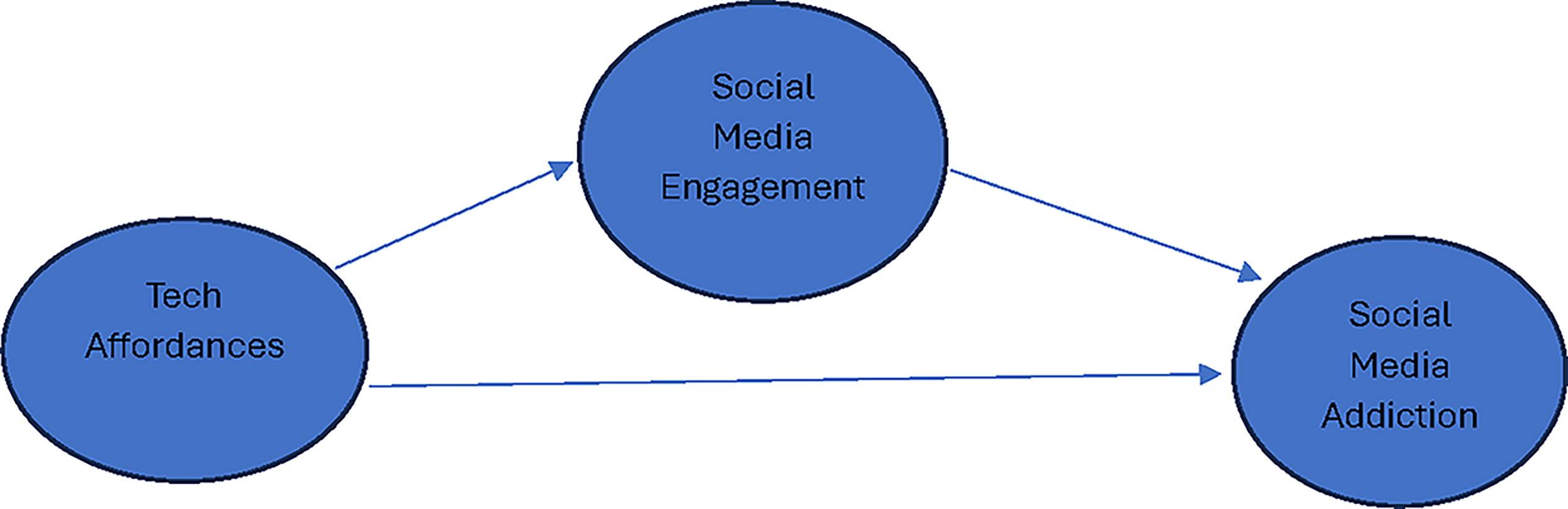
Conceptual model.
Method
A total of 550 undergraduate students at a large university in the United States participated in the study during the spring of 2024 for course credit. The study was approved by the authors’ University Institutional Review Board (IRB). After being invited into a computer lab and randomly seated at individual computers, participants began the study. Participants were asked to indicate which of several social media video-sharing apps they have used over the past week (i.e., Instagram Reels, TikTok, YouTube Shorts). Most participants (96.2 percent) reported having used at least one of the three SFV platforms over the past week. Details of the sample are provided in Table 1.
Descriptive Statistics and Demographic Profile of the Sample
Next, participants were asked a series of questions regarding each platform that they reported having used over the past week. Specifically, technological affordances was assessed for each respective SFV platform (Cronbach’s αInstagram = 0.72; Cronbach’s αTikTok = 0.77; Cronbach’s αYouTube = 0.78) using an 18-item scale adapted from Zhao and Wagner which consists of three subdimensions (perceived effortlessness, recommendation accuracy, and serendipity). 26 Table 2 shows the complete list of items.
Technological Affordances Scale Items and Reliability Scores Across Social Media Platforms
Items shown are for Instagram; items were adapted for TikTok and YouTube Shorts by replacing “Instagram” with the other respective platforms as needed. Respondents responded to the technology affordance items using a Likert scale ranging from 1 (strongly disagree) to 7 (strongly agree).
Next, participants responded to a six-item measure of social media engagement (SME) (Cronbach’s α = 0.83) adapted from the Przybylski et al. Social Media Engagement Questionnaire. 40 Participants also responded to the six-item Bergen Social Media Addiction Scale41,42 (Cronbach’s α = 0.86), as well as demographic variables.
Analyses and Results
One objective of the current research was to examine the relative level of tech affordances offered across the three SFV platforms. As shown in Table 3, the mean score for each tech-affordance subdimension (i.e., recommendation accuracy, serendipity, and perceived effortlessness) varied across SFV platforms. A series of paired-sample t-tests revealed that the tech affordances derived from TikTok were greater than those derived from Instagram and YouTube, and the tech affordances derived from Instagram were greater than those from YouTube. Tables 4–6 show the correlations between tech affordances for each respective platform and SME and addiction.
Means, Standard Deviations, and Correlations for TikTok-Based Tech Affordances, SME, and Addiction
The Tech Affordances measure for each platform is made up of the average of Rec Accuracy, Serendipity, and Effortlessness for the respective platform. Participants responded to the technological affordances items using a Likert scale ranging from 1 (strongly disagree) to 7 (strongly agree). The response format for SME was a scale ranging from 1 (not one day) to 8 (seven days/week). The response format for Addiction was a 5-point scale ranging from very rarely to very often.
p < 0.10.
p < 0.05.
p < 0.01.
Mean Scores (with Standard Deviation) of Technological Affordances Across Short-Form Video Platforms
The Tech Affordances measure for each platform is made up of the average of Recommendation Accuracy, Serendipity, and Effortlessness for the respective platform. Since the subdimensions vary in their number of items, it would have skewed the Tech Affordances measure to calculate it by summing (or averaging) all 18 items.
Means, Standard Deviations, and Correlations for Instagram-Based Tech Affordances, SME, and Addiction
The Tech Affordances measure for each platform is made up of the average of Rec Accuracy, Serendipity, and Effortlessness for the respective platform. Participants responded to the technological affordances items using a Likert scale ranging from 1 (strongly disagree) to 7 (strongly agree). The response format for SME was a scale ranging from 1 (not one day) to 8 (seven days/week). The response format for Addiction was a 5-point scale ranging from very rarely to very often.
p < 0.10.
p < 0.05.
p < 0.01.
SME, social media engagement.
Means, Standard Deviations, and Correlations for YouTube-Based Tech Affordances, SME, and Addiction
The Tech Affordances measure for each platform is made up of the average of Rec Accuracy, Serendipity, and Effortlessness for the respective platform. Participants responded to the technological affordances items using a Likert scale ranging from 1 (strongly disagree) to 7 (strongly agree). The response format for SME was a scale ranging from 1 (not one day) to 8 (seven days/week). The response format for Addiction was a 5-point scale ranging from very rarely to very often.
p < 0.10.
p < 0.05.
p < 0.01.
SD, standard deviation.
Next, the Preacher and Hayes PROCESS bootstrapping SPSS macro was used to test our conceptual model and the relationship between technological affordances derived from SFV platforms and SME and addiction. 43 This method uses an ordinary least-squares path analysis to estimate model coefficients and assess the indirect and/or direct effects of technological affordances on engagement and addiction; 44 it uses a bootstrapping procedure (n = 5,000) to calculate bias-corrected 95% confidence intervals associated with the statistical significance of the indirect effects, without relying on any assumptions about the normality of the sampling distribution.43,45
The PROCESS Model 4 was run for each respective SFV platform, beginning with Instagram. Results of these analyses are provided in Table 7. First, the model tests the link between Instagram-based technological affordances and SME (F1, 389) = 5.304, p < 0.05, R2 = 0.014). Results show that Instagram-based technological affordances are positively associated with SME (β = 0.116, p < 0.05). Next, the model tests whether Instagram-based technological affordances and SME are associated with addiction. Results (F2, 388 = 50.64, p < 0.05, R2 = 0.207) indicate that SME is positively associated with addiction (β = 0.442, p < 0.05), but the direct effect of technological affordances on addiction is not significant (p > 0.05). Importantly, however, the results show support for mediation, such that Instagram-based tech affordances has a significant and positive indirect association with addiction through SME (β = 0.051, SE = 0.029, 95% CI: 0.005, 0.122).
Results of Model Testing for Each Social Media Platform
Results are based on the Preacher and Hayes PROCESS Model 4 testing. Standardized coefficients are presented.
p < 0.10.
p < 0.05.
TA, technological affordances.
Similar results were found for TikTok. TikTok-based technological affordances (β = 0.342, p < 0.05) are positively associated with SME (F1, 300) = 39.85, p < 0.05, R2 = 0.117). Additionally, TikTok-based tech affordances (βTikTok-based TA = 0.162, p < 0.05) and SME (βSME = 0.374, p < 0.05) are directly associated with addiction (F2, 299 = 39.04, p < 0.05, R2 = 0.207). Consistent with findings for Instagram-based tech affordances, the results show support for mediation such that TikTok-based technological affordances has a significant and positive indirect association with addiction through SME (β = 0.128, SE = 0.025, 95% CI: 0.081, 0.180). Interestingly, however, when the same analyses were conducted for YouTube Shorts, no significant results were found. Specifically, YouTube-based technological affordances are not associated (p > 0.10) with SME or addiction.
Of note, we conducted the same analyses as presented above but where gender was included as a control variable. The results were consistent with those presented above. Also of note, we wanted to dig deeper into the effects of specific tech affordances on SME and addiction. As such, we conducted the same analyses as presented above but for each tech-affordance subdimension. The results of these analyses, which can be found in the Supplementary Appendix, were largely consistent with those presented above.
Discussion
The present study is the first to investigate the relative strength of tech affordances across three popular SFV platforms. SFV use has become increasingly popular. SFV platforms are designed to engage users for as long as possible. Research on the impact of technology affordances in encouraging such use is still in its infancy. Research on the affordances and their role in excessive/addictive SFV use is critical because of the impact of excessive use on user well-being.
As posited, TikTok was rated higher than Instagram Reels and YouTube Shorts across all three tech affordances (see Table 3). The extant literature supports such a finding. TikTok’s recommendation algorithm and ease of use are considered lynchpins of its ability to attract and maintain users.22,26,30,36 This finding is an important contribution to the literature as most prior research has ignored differences in technological affordances across SFV platforms. These types of differences across SFV platforms were exposed in the current research. It might be helpful to consider communications research pioneer Wilbur Schramm’s thinking on how individuals make decisions when choosing media. 46 Schramm argues that possible rewards provided by a particular media divided by the effort required to access those rewards equal the probability of continued use. In the case of TikTok, its AI-enabled algorithms and ability to serve up relevant, fun, and entertaining videos often with unexpected surprises (serendipity), and its perceived effortlessness creates a situation that fosters engagement and encourages continued use. TikTok’s recommendation algorithm emphasizes these affordances, particularly, perceived effortlessness and delivering personalized content which evolve naturally from affordances theory which argues humans orient to objects in their environment based upon the affordances these objects offer—their possibilities for action.
From the present study results, it appears that SFV users perceive greater tech affordances from TikTok than from Instagram Reels and YouTube Shorts. Zhao 36 does an excellent job explaining how the TikTok recommendation algorithm is created and why it is so effective in encouraging continued use of the platform. The detailed explanation of how the TikTok recommendation algorithm is created makes it clear as to how the algorithm provides a continuous supply of highly relevant and entertaining videos leading to excessive and possibly addictive use. And the longer an individual uses TikTok, the more accurate the algorithm becomes. As Xie et al. assert, by their very design, SFVs are “prone to excessive use and addiction.” 38 (p2)
An additional contribution of the present study is its examination of the tech affordances offered by each respective SFV platform and their relationship with social media engagement and potential addiction. Results for TikTok find that tech affordances are associated with continued engagement with the platform which, in turn, is associated with higher possibilities of addictive use. Qin et al. 32 (p1) note that, “TikTok has one of the most advanced algorithm systems and is the most addictive as compared to other social media platforms.” Consistent with current results, the researchers found that TikTok’s perceived effortlessness and personalized content increased the likelihood of achieving flow which led to addictive use of the platform.
The present study’s conceptual model was also supported for Instagram Reels. Instagram-based tech affordances were found to be associated with addictive use, and this relationship was mediated by social media engagement. However, no significant role for perceived effortlessness was found. From a user’s perspective, Instagram requires two clicks and choice of a video before viewing a video, whereas users of TikTok view videos as soon as they enter the app. The study provides insights into what types of affordances work best in encouraging SFV use. As stated earlier, the present study’s results (see Table 3) suggest that TikTok offers more technological affordances derived from its perceived effortlessness, recommended videos, and serendipity compared to Instagram Reels and YouTube Shorts.
The above findings are interesting and insightful in and of themselves, but their real importance is that they provide insight into how the design of SFV platforms encourages excessive and possibly addictive use. Research suggests that excessive use of SFV platforms can be negatively associated with mental and physical well-being, relationships, and productivity. 20 The opportunity costs of excessive/addictive SFV use are high. 23 A deeper understanding of how SFV platforms encourage overuse is critical to initiating personal and public policy to combat its negative effects.
Future Research and Limitations
Although this study was the first to investigate the relative tech affordances offered by three popular SFV platforms and their impact on social media engagement and addictive use, the results must be tempered by certain limitations. First, the cross-sectional nature of the study precludes making any causal attributions between the study’s variables. Second, although we investigated three important tech affordances identified in the extant literature; many other affordances exist which might impact the use of particular SFV platforms. 47 Yan et al. 37 suggest that structural features of media messages, or videos in the present case, and/or personally salient stimuli can impact responses and behaviors to SFVs. How much of SFV’s success is due to the fundamental differences between SFVs compared to more traditional social media like Facebook? SFV platforms recommend content and provide an endless supply of personally curated videos in an easy-to-use format. Future research is needed to identify relevant affordances of SFVs and their importance in encouraging/compelling continued use.
Another limitation could be that the present study did not identify how people used the SFV platforms. Were respondents passively scrolling the videos or actively creating and posting their own videos and commenting on others’ videos? Although the vast majority of SFV viewing is passive 5 , future research needs to investigate how it is used impacts how often it is used and its addictive potential. The active/passive social media use hypotheses suggest that active social media use has greater positive outcomes, while passive use is associated with more negative outcomes.5,14,48,49 Again, the fundamental differences between more traditional social media and SFVs require that this relationship be investigated.
Conclusion
Based upon the present study’s results, it appears that TikTok is rated more highly by users across all three technological affordances studied. TikTok is seen as requiring less effort, offering more engaging content, and often surprising users with new, unexpected content. These three technological affordances were found to enhance user engagement and lead to addictive use for TikTok and Instagram Reels users. SFV platforms are carefully designed to intentionally keep individuals on the platform as long as possible despite clear evidence of the negative costs of such behavior.24,26,30,36 And, like other AI-based technologies, the problem may only get worse. As Zhao suggests, the longer someone uses TikTok, the more accurate its algorithm becomes. 36
Footnotes
Authors’ Contributions
J.A.R.: Conceptualization, writing—original draft, writing—review and editing, supervision, project administration, and funding acquisition. M.E.D.: Conceptualization, methodology, validation, formal analysis, investigation, data curation, writing—review and editing, and visualization.
Author Disclosure Statement
No competing financial interests exist.
Funding Information
No funding was received for this article.

References
Supplementary Material
Please find the following supplemental material available below.
For Open Access articles published under a Creative Commons License, all supplemental material carries the same license as the article it is associated with.
For non-Open Access articles published, all supplemental material carries a non-exclusive license, and permission requests for re-use of supplemental material or any part of supplemental material shall be sent directly to the copyright owner as specified in the copyright notice associated with the article.
