




Abstract
Objectification, being perceived and treated merely as an object with a denial of one’s humanness, has been linked to numerous adverse outcomes in daily life. Despite this, its influence on online behaviors, particularly problematic gaming, remains underexplored. The current research (total N = 1,000) extends the literature on objectification by investigating the effect of objectification on problematic gaming. Study 1, with a correlational design (N = 300), established a significant association between objectification and problematic gaming. Subsequent experimental studies (Studies 2 and 3) demonstrated that objectification directly contributes to increased problematic gaming intentions. Study 2, with a measurement-of-mediation design (N = 300), also identified escapism as a mediating factor, suggesting that objectification intensifies the motive to escape from reality, thereby increasing problematic gaming intentions. Furthermore, Study 3, with a moderation design (N = 400), revealed that perceived meaning in life could mitigate the negative impact of objectification on problematic gaming intentions. Collectively, these findings advance our understanding of the detrimental effects of objectification, highlighting its role in problematic gaming and identifying the potential intervention.
Introduction
In the digital age, video games significantly impact user’s mental health and social behaviors. The prevalence of problematic gaming—a pattern characterized by a loss of control over gaming and increased priority given to gaming over other activities—has risen among adolescents and young adults, particularly during the COVID-19 pandemic. 1 While there is a debate about classifying gaming addiction as a distinct disorder or a symptom of underlying mental health issues,2,3 the consequences of problematic gaming 1 are clear. Studies show that problematic gaming is associated with increased depression aggression, as well as decreased occupational and academic performance and poorer sleep quality.4–7 Given its harmful impacts, exploring the antecedents and the underlying mechanism of the problem is momentous, which may help prevent these adverse effects.
Previous research suggests that experiencing maltreatment during interpersonal interactions can make individuals more addicted to digital games.8,9 Following this line of research, this article details an investigation of an underexplored interpersonal experience that may cause problematic gaming: objectification. When people are treated as mere tools while denying their humanness, objectification occurs.10–12 While previous studies have demonstrated that objectification is prevalent in people’s daily lives and often produces adverse outcomes,10–16 limited research has focused on the potential Internet-based outcomes of objectification, 17 especially nonsexual objectification. Thus, we aim to investigate this issue by linking objectification and problematic gaming to fully reveal that objectification influences people offline and online. We also propose and examine meaning in life (MIL) as a possible strategy to reduce the adverse effect of objectification on problematic gaming.
Objectification and Its Outcomes
Objectification, where individuals are treated merely as tools to achieve others’ goals, is often at the expense of recognizing their inherent humanness.10–12 In such an experience, useful functions of the objectified targets were separated from them, reduced to the status of mere instruments. 13 As theorized by Fredrickson and Roberts, 14 objectification experience could make those objectified targets internalize the perspective of objectifiers and treat themselves as instruments to satisfy the needs and achieve the goals of objectifiers. They also indicate that such a self-objectification process may motivate objectified targets to pay more attention to their imperfections that are adverse or useless to others, which might then lead to a series of psychological hurts, such as shame and anxiety.
Supporting the theory, previous researchers have empirically identified various negative effects of objectification experience, including depression, 13 work disengagement, 10 and job burnout. 14 Objectification also exacerbates negative interpersonal behaviors like aggression and diminishes prosocial actions.15,16 With the pervasive integration of the Internet into daily life, it is plausible that objectification could also extend its negative influences on online behaviors. However, few studies have explored the link between objectification and Internet-based outcomes. 17 Our study contributes to this literature by focusing on whether objectification experiences promote maladaptive Internet usage, particularly in problematic gaming.
Two lines of research suggest that objectification may prompt individuals to engage in problematic gaming. First, problematic gaming often serves as a coping mechanism in response to adverse experiences such as rejection and bullying.18,19 Given that objectification typically evokes similar negative emotions,13,20 it is plausible that objectification could similarly drive individuals toward problematic gaming as a form of escapism. Second, objectification has been shown to impair fundamental human needs, such as belonging, control, self-esteem, and meaningful existence, by inducing feelings akin to ostracism.10,20,21 Digital games can potentially satisfy these needs by providing alternative avenues for social interaction, achievement, and identity formation. 22 In addition to this argument, a recent empirical study has supported our argument. Chau et al. showed that sexual objectification is positively associated with Internet addiction as well as anxiety and depression. 17 Building upon their findings, we currently examined the causal effect of general objectification on problematic gaming, a typical Internet-based addicted behavior. Thus, we hypothesized that individuals who experience objectification may turn to problematic gaming (H1).
The Mediation of Escapism
We propose that escapism mediates the relationship between objectification and problematic gaming. As a major process that signals an avoidant coping strategy, 23 escapism serves as a mental diversion, helping individuals to distract themselves from real-life problems,24,25 and is frequently adopted in response to adverse events. When encountering maltreatment, individuals may adopt an avoidant coping strategy, which could make them keep a distance from the threat and anxiety-arousing stimuli. 26 Specifically, previous studies link maltreatment to escapism. For example, Gabbiadini et al. observed that individuals experiencing heightened loneliness engaged more in escapism, which in turn fosters behaviors such as problematic gaming. 27 Similarly, Lee and Chen noted that individuals would employ escapism in response to unemployment. 28 In objectification, which is a form of maltreatment leading to multiple intrapersonal sufferings,20,29 escapism may emerge as a response. Indeed, previous research suggests that when women are sexually objectified, they may endorse avoidant coping strategies as a response.30,31 We extended these findings by investigating the nonsexual objectification. We propose that individuals subjected to objectification will experience stronger escapism.
Both theoretical and empirical research underlines the importance of escapism as a motivator for video game engagement. The Compensatory Internet Use Model suggests that Internet applications, such as online games and social media, provide a means for individuals to cope with problematic situations. 32 When faced with unresolved difficulties, individuals may turn to escapism—choosing to leave reality behind. Numerous studies have demonstrated the significant predictive effect of escapism on problematic gaming.32–36 Thus, we proposed that escapism mediates the relationship between the experience of objectification and the subsequent engagement in problematic gaming (H2).
MIL as a Buffering Mechanism
We argue that MIL, defined as a subjective sense of coherence, purpose, and significance in one’s life,37,38 can moderate the objectification-problematic gaming link. People may experience meaning in their lives across various contexts, such as ingroup contact, 39 interpersonal intimacy, 40 and self-compassion. 41 Theoretically, MIL provides individuals with a framework for understanding their experiences and motivations, ultimately fostering greater control and direction in life. Empirical research has consistently shown the protective functions of MIL; individuals with higher MIL levels exhibit greater psychological well-being but lower rates of stress, uncertainty, addiction, and depression.42–45 In relevance to the current research, Zhao et al. demonstrated that higher MIL is associated with reduced game addiction. 9
We believe that individuals with a strong sense of MIL may be less vulnerable to the detrimental effects of objectification (i.e., problematic gaming). Both theories and empirical studies have demonstrated that objectification is problematic due to adverse influences. Specifically, objectification makes people feel interchangeable and insignificant.46,47 As MIL can provide one’s significance in their life, it should lead to opposite effects to those induced by objectification. In line with this argument, Auzoult found that meaning at work can reduce the negative consequence of working objectification. 48 Moving beyond their findings on objectification in a working context, we expanded the research scope to general objectification as well as the effect of objectification on Internet-related consequences. Collectively, we hypothesized that MIL may weaken the link between objectification and problematic gaming (H3).
Overview of Research
In the current research, we used correlational and experimental designs to examine the hypotheses. Study 1, with a correlational design, examined whether objectification was positively linked to problematic gaming. To further examine the causal effect of objectification on problematic gaming, we conducted two experimental studies. Study 2 examined whether and how objectification induced problematic gaming. Specifically, we propose that escapism could account for the effect of objectification on problematic gaming. Study 3 examined whether MIL could weaken the link between objectification and problematic gaming. The combination of these methods provides a comprehensive approach to address our research question. Unless noted otherwise, participants’ responses were made on 7-point Likert scales.
According to the Open Science Policy, we uploaded the data at https://10.17605/OSF.IO/SEUH6. https://osf.io/seuh6/?view_only=728288bc0f034aa888558c0a931d319f. All studies were ethically approved by the university’s Institutional Review Board (No. SCNU-PSY-2023–016).
Study 1
Study 1 aimed to test the correlation between objectification and problematic gaming. We predicted that participants who have experienced more objectification would report more problematic gaming.
Method
Participants
We recruited 300 participants via Credamo (192 women, Mage = 30.38, standard deviation [SD] = 8.23; 18–61) on December 18, 2023. Each participant was compensated with a small monetary payment (3 CNY) for their participation. The sensitive power analysis indicated that the current sample size could detect the effect size as small as r = 0.16, based on α = 0.05, power = 0.8.
Procedures and measures
After providing the informed consent, participants reported their objectification experience and problematic gaming. Problematic gaming was measured by five items adapted from Lammens et al., 49 with a sample item as “I thought about playing a game all day long.” Objectification was measured by seven items borrowed from Belmi and Schroeder, 10 with a sample item as “I felt treated as I am an object.” We calculated the average scores for two constructs, with higher scores indicating stronger problematic gaming (M = 3.06, SD = 1.52; α = 0.89, ω = 0.89) and objectification (α = 0.91, ω = 0.91), respectively. Finally, the participants were thanked.
Result and discussion
The correlational results indicated that objectification was positively associated with game addiction, r(300) = 0.32, p < 0.001, 95 percent confidence interval (CI) (0.22, 0.42). We also conducted a regression analysis on game addiction by including objectification, gender, and age in the model (see Table 1).
The Descriptive and Regression Results on Problematic Gaming in Study 1
Gender (0 = male, 1 = female); for objectification, skewness = 0.76 (SE = 0.14) and kurtosis = −0.28 (SE = 0.28); for problematic gaming, skewness = 0.47 (SE = 0.14) and kurtosis = −0.94 (SE = 0.28).
CI, confidence interval; SD, standard deviation; SE, standard error.
The correlational study supports our hypothesis that objectification was positively associated with problematic gaming, somehow consistent with Chau et al. 17 Collectively, our findings showed that objectification, whether sexual-based or general-based, is associated with Internet-related addiction. However, the correlational design cannot reveal the causal effect of objectification on problematic gaming. We tested their causal link in the following study by directly manipulating objectification.
Study 2
Study 2 advanced the previous findings by manipulating objectification to test causation and examining the mediation effect of escapism. We argue that escapism could explain the relationship between objectification and problematic gaming intentions. We used a recall-and-writing method to induce participants’ objectification, which has been used in previous studies.20,50 The study was preregistered at https://aspredicted.org/MLP_32S.
Method
Participants
According to a power analysis for the mediation test, we needed at least 250 participants to satisfy power = 0.8. 51 Thus, we recruited 300 participants via Credamo (Mage = 29.58, SD = 7.82, 18–63; 195 women) on January 12, 2024. Participants received 3 CNY as compensation for their participation.
Procedure and measures
After providing informed consent, participants were randomly assigned to either objectification (N = 150) or control (N = 150) conditions. Those in the objectification condition were instructed to recall and write an instance when they felt objectified by others. Participants in the control group wrote about their activities from the previous Wednesday. After writing, participants reported their current feeling of objectification as a manipulation check (i.e., “Now, I feel objectified.”). Next, participants evaluated their escapism and problematic gaming intentions; the two scales were presented randomly. Escapism was measured using the scale with three items borrowed from Yee, 35 with a sample item as “I play the game for escaping from the real world.” The game addiction intention was measured by the item used in Study 1. We slightly revised the five items, with a sample as “I want to play the game all day.” We calculated the average scores of two constructs, and the higher scores indicated stronger escapism (M = 3.14, SD = 1.1; α = 0.78, ω = 0.78) and problematic gaming intentions (M = 3.15, SD = 1.53; α = 0.9, ω = 0.9), respectively. Finally, participants reported their demographic information, including gender and age, followed by debriefing and thanks.
Result and discussion
Manipulation check and main results
A preliminary analysis including gender indicated that neither the main effect of gender (p = 0.118) nor the interaction with objectification (p = 0.317) were significant; thus, the gender would be analyzed further. We conducted a series of t tests on the main variables. Participants in the objectification (vs. control) condition reported greater objectification feelings, problematic gaming intentions, and escapism (see Table 2). All results supported our hypotheses.
The Descriptive Results for Manipulation Checks and Problematic Gaming Intentions in Conditions and the Results of the t Test in Study 2
SE only for skewness and kurtosis statistics.
PGI, problematic gaming intentions; MC, manipulation check.
Mediation analysis
To examine the mediation effect of escapism, we performed a mediation analysis using the jAMM module 1.2.1 in Jamovi 2.3.28. This module primarily focuses on regression-based approaches, which can provide an accurate method for calculating the indirect effect (IE) in mediation analysis (see more details in https://jamovi-amm.github.io/index.html). The results showed that objectification positively predicted escapism, B = 0.51, standard error (SE) = 0.12, p < 0.001, and escapism predicted game addiction intentions, B = 0.46, SE = 0.08, p < 0.001. A bootstrapping analysis with 5,000 replications showed a significant IE via escapism, IE = 0.23, SE = 0.07, 95 percent CI: (0.1, 0.37), p < 0.001 (see Figure 1). The results support our argument that objectification leads to problematic gaming intentions mediated by enhanced escapism.
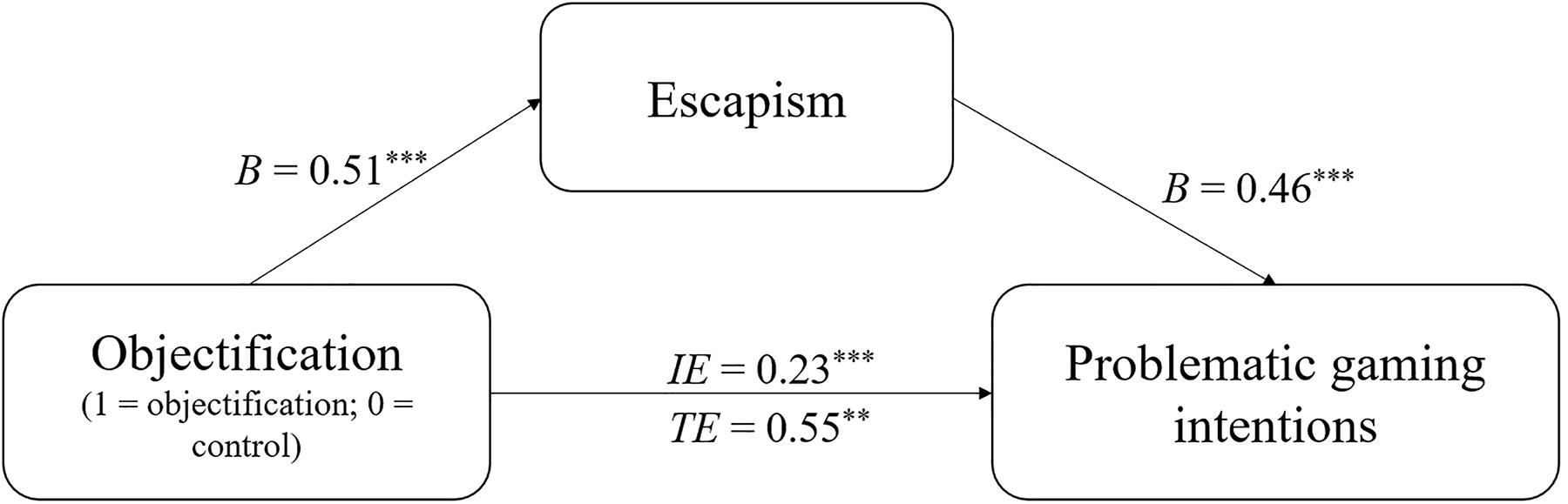
Escapism mediates the effect of objectification on problematic gaming intentions in Study 2. ***p < 0.001, **p < 0.01; IE, indirect effect; TE, total effect.
Study 3
Studies 1 and 2 showed that objectification was positively linked to or increased problematic gaming. In Study 3, we aimed to examine whether MIL could mitigate the effect of objectification on problematic gaming intentions. We manipulated objectification and MIL and measured problematic gaming intentions. We predicted that MIL could weaken the impact of objectification on problematic gaming.
Method
Participants
As we employed a two-by-two between-participants design, we expanded the sample size to ensure that we may have adequate power to detect the effect size (f = 0.15). We recruited 400 participants via Credamo (268 women; Mage = 31.15, SD = 9.56, 18–77) on March 7, 2024. Participants received compensation for their participation (3 CNY).
Procedure and measures
After providing informed consent, participants were randomly assigned to either objectification or control conditions. We used a scenario-based manipulation of workplace objectification.15,20 Participants were asked to imagine that they were company employees. In the objectification condition, they were treated as objects. In the control condition, participants imagined that they recently failed a task in the company. After the manipulation, we asked participants to report their objectification experience as the manipulation (i.e., “I feel objectified.”). We also used two items to assess (a) participants’ level of imagination vividness (i.e., “I can vividly imagine the situation.”) and (b) the participants’ negative feelings (i.e., “I feel negative.”). Next, participants responded to the problematic gaming scale used in Study 2 (M = 2.84, SD = 1.36; α = 0.86, ω = 0.87).
Afterward, participants were randomly assigned to either MIL or non-MIL conditions. Participants were required to write a few things that make them feel meaningful (vs. nonmeaningful) in their lives in each condition. After writing, participants responded to one item regarding their MIL on a seven-point scale (i.e., “I feel my life is meaningful.”). Finally, participants reported their demographic information, including gender, age, and employment, followed by debriefing.
Result and discussion
Manipulation checks on objectification
A preliminary test including gender as a control variable indicated that neither the main effect (p = 0.431), two-way interactions with objectification (p = 0.221) and with MIL (p = 0.792), respectively, nor the three-way interaction with objectification and MIL (p = 0.507) were significant. Thus, we would not analyze gender in the subsequent analysis.
We performed a series of independent t tests on manipulation checks. The results showed that participants in the objectification condition (N = 200) felt a stronger objectification experience than those in the control condition (N = 200), indicating that the manipulation was successful. We also found that participants in the objectification condition felt more negative than those in the control condition; thus, the negative feeling would be analyzed as a control variable. Finally, participants in the two conditions had a similar level of imaginary vividness (see Table 3 and Table 4.).
Skewness and Kurtosis Results for Problematic Gaming Intentions in Study 3
SE (skewness) = 0.24, SE (kurtosis) = 0.48.
MIL, meaning in life.
The Descriptive Results for Manipulation Checks and Problematic Gaming Intentions in Conditions and the Results of the t Test in Study 3
Manipulation check on MIL
An independent t test on MIL showed that participants in the MIL condition reported a greater level of meaningful feeling (M = 6.24, SD = 1.11) than those in the non-MIL condition (M = 5.7, SD = 1.5), t(398) = 3.87, p < 0.001, d = 0.39, 95 percent CI (0.19, 0.59), suggesting that our manipulation of MIL is successful.
Problematic gaming intentions
To examine our primary hypothesis that MIL could alleviate the effect of objectification on problematic gaming intention, we conducted a 2 × 2 ANCOVA on problematic gaming intentions, including objectification and MIL as two factors and the negative feeling as a covariate. The main effects of objectification, F(1, 395) = 7.49, partial η2 = 0.02, p = 0.006, and MIL, F(1, 395) = 19.37, partial η2 = 0.05, p < 0.001, were significant, whereas the effect of the negative feeling was not, F(1, 395) = 0.01, partial η2 = 0.001, p = 0.97. More importantly, the interaction effect of objectification × MIL was significant, F(1, 395) = 3.99, p = 0.046, partial η2 = 0.01 (see Figure 2). The simple analysis suggested that in the objectification condition, people reported a lower level of game addiction intentions when perceived MIL (M = 2.6, SE = 0.13) compared with those perceived no MIL (M = 3.44, SE = 0.13), t(396) = −4.53, p < 0.001, d = −0.64, 95 percent CI (−0.92, −0.36). However, no significant effect of MIL (MMIL = 2.49, SEMIL = 0.13; Mnon-MIL = 2.81, SEnon-MIL = 0.13) was found when people were in the nonobjectification condition, t(396) = 1.7, p = 0.325, d = 0.24, 95 percent CI (−0.52, 0.04). By manipulating MIL directly, our results suggest that MIL helps buffer against objectification’s effect on problematic gaming intentions.
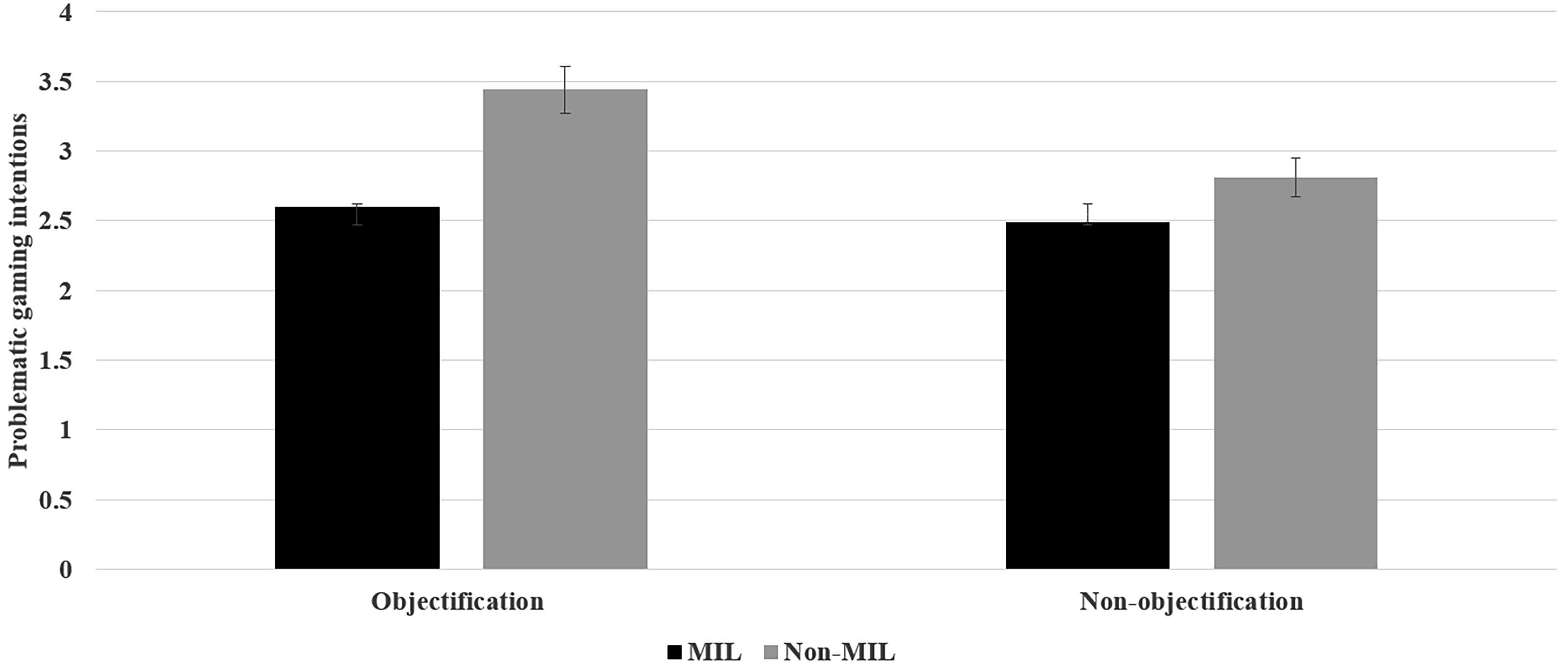
Problematic gaming intentions as a function of objectification and MIL in Study 3. Error bars represent 95 percent CI. CI, confidence interval; MIL, meaning in life.
General discussion
Objectification (i.e., being treated as an instrument) harms the targets in people’s daily lives.29,52 Although relatively few studies examined the influences of objectification on people’s online behavior, 17 their findings were still limited in the sexual domain and female targets. Through three studies, we consistently found that objectification was positively associated with (Study 1) or increased the likelihood of problem gaming (Studies 2 and 3). We also found that escapism mediated the link of objectification-problematic gaming (Study 2). Finally, we demonstrated that MIL reduced the effect of objectification on problematic gaming (Study 3).
Implications
Our research has implications in the field of objectification. Previous research on objectification has primarily focused on the sexual domain.17,50,53 More recent studies found that objectification can also occur in general interpersonal interactions and result in detrimental consequences.15,29 Our results underscore that objectification can critically increase problematic gaming, which is highly prevalent and associated with other psychological problems.54,55 Our findings are consistent with and go beyond previous study 17 by highlighting that nonsexual objectification can also induce problematic Internet usage. Collectively, we demonstrated that the negative influence of objectification occurs not only offline but also online.
Moreover, by identifying the effect of MIL in mitigating the impact of objectification on problematic gaming, we further enrich the literature on objectification by suggesting a potential intervention to limit the negative effects of objectification. With a correlational design, Auzoult found that meaning at work could moderate the association between objectification and self-perceived humanness. 48 In line with this finding, our findings provide causal evidence regarding the effectiveness of MIL in fighting against objectification. Together, these consistent findings imply the possibility of MIL in mitigating other negative consequences of objectification (e.g., self-harm), which can be examined in future studies. Broadly speaking, as previous studies indicate that MIL is an important source that helps people cope with suffering, 45 future research may continue to explore MIL serving as an effective strategy to weaken the impacts induced by other maltreatment (e.g., ostracism).
Second, our research could enrich the literature on problematic gaming. Theoretically, together with previous research,8,9 our findings further support the effect of negative interpersonal interaction on problematic gaming. Specifically, objectified individuals could employ problematic gaming in response to their objectification experience. More practically, by identifying objectification as another antecedent of problematic gaming, we suggested one potential strategy to limit problematic gaming. For instance, for those adolescents who are suffering from problematic gaming, helping them to develop more positive interpersonal relationships, in which they are treated decently as full human beings rather than objectified, might help them get rid of game addiction.
Third, we found that escapism mediates the effect of objectification on problematic gaming. We believe that this mediation is significant because it can interpret not only the effect of objectification on problematic gaming but also other individuals’ responses to objectification. For instance, Baldissarri and Andrighetto detected a negative effect of working objectification on employees’ task engagement. 56 Indeed, individuals expect to escape from objectification in working contexts, resulting in reducing their task engagement. It may inspire future researchers to explore other potential outcomes of objectification linked to escapism. For example, as people can escape unpleasant states via consuming behavior, 57 scholars may investigate whether objectification increases irrational consumption.
Broadly speaking, our findings have significant practical implications, particularly for individuals who experience objectification in various contexts. Previous research has shown that objectification occurs in multiple domains, such as the industrial, organizational, and educational contexts.10,20,58,59 In our findings, identifying MIL as a moderating variable has clear applications in real-world interventions. As our results suggest, promoting MIL may mitigate the negative consequences of objectification in gaming contexts and broader life experiences. For example, interventions designed to enhance individuals’ sense of MIL, as tested by Manco and Hamby, could be applied across various settings, including clinical practice, education, and workplace environments. 60 Specifically, a recent study suggests that a simple, everyday strategy can help foster MIL by showing how viewing life as a “hero’s journey” can enhance MIL, 61 providing an accessible framework for individuals to reframe their life narratives. People experiencing objectification may benefit from engaging in these MIL-promoting activities, such as reframing their experiences through narrative or viewing challenges as part of a larger, meaningful journey. This could help individuals regain a sense of agency and purpose, which may counterbalance the negative effects of objectification on their problematic gaming and overall well-being.
Limitations and future directions
We noted several limitations of the current work. First, we solely focused on problematic gaming, one limited aspect of people’s online behaviors. According to Tian et al., 62 objectification could thwart individuals’ belongingness. As such, objectified individuals may turn to online approaches to restore their sense of belongingness, such as problematic use of social media. Future researchers may continue to test this possibility.
Second, while our findings are robust and consistent, they are primarily based on self-reported data, which could be complemented in future studies with objective behavioral measures, such as actual gaming duration. 63 Additionally, across our studies, we only recruited participants from China. Although we did not propose any cultural differences in our findings, the possibility cannot be ruled out based on current data. In the future, those effects need to be replicated with participants from diverse cultural backgrounds to enhance their generalization.
Moreover, according to our results of Study 2, escapism could only partially mediate the relationship between objectification and game addiction, which suggests that there may be other mechanisms that account for such an effect. For instance, Tian et al. found the negative effect of objectification on individuals’ sense of belongingness, 62 while Xu et al. identified the contribution of the need for the relationship to game addiction. 64 As such, it is possible that objectified individuals become addicted to video games because they expect to build positive social relationships and restore belongingness during the games. Therefore, future researchers could explore other factors (e.g., the need for belongingness) that could also account for the effect of objectification on game addiction.
Lastly, although we demonstrate the moderated effect of MIL, other mechanisms may also be helpful. For example, self-compassion as an effective strategy for coping with personal suffering, 65 which can promote well-being and reduce self-harm intention.66,67 Consequently, self-compassion may also help reduce the adverse outcomes of objectification. Exploring other potential moderators could further enrich our understanding of how to mitigate the negative impacts of objectification.
Conclusions
Objectification is a pervasive issue that significantly harms individuals across multiple domains, including online environments. Our findings elucidate the pathway through which objectification leads to problematic gaming via escapism and highlight the mitigating potential of MIL. Empowering individuals with a sense of meaning and purpose in life emerges as an effective strategy to buffer the adverse effects of objectification, pointing toward promising future interventions.
Authors’ Note
1. Researchers have used problematic gaming, excessive gaming, gaming disorder, and addicted gaming to refer to the pattern of gaming behavior characterized by a loss of control over gaming. 68 To summarize, we consistently used problematic gaming in the article.
2. To examine the robustness of our proposed mediation model, we conducted an alternative test by reversing the mediator (i.e., escapism) and dependent variable (i.e., problematic gaming intentions). In the alternative model, the mediator is problematic gaming intentions and the outcome variable is escapism. The mediation test using 5,000 replications showed that objectification positively predicts problematic gaming intentions (B = 0.55, SE = 0.04, p = 0.002) and problematic gaming intentions predict escapism (B = 0.23, SE = 0.04, p < 0.001). More importantly, the IE of objectification on escapism via problematic gaming intentions was significant, IE = 0.13, SE = 0.05, p = 0.005, 95 percent CI (0.04, 0.22). As the alternative model remains significant, we urge readers to be cautious about the results. In particular, we did not manipulate escapism; thus, its causal effect on problematic gaming intentions cannot be fully confirmed.
Footnotes
Acknowledgment
The authors express special thanks to all the participants.
Authors’ Contributions
J.S.: Conceptualization, methodology, investigation, writing, and reviewing. Z.Z.: Conceptualization, investigation, and writing. Z.C.: Reviewing and editing. T.W.: Data collection and writing. X.H.: Supervision.
Ethical Approval and Informed Consent Statements
Ethical approval (No. SCNU-PSY-2023-016) was received from South China Normal University. All participants gave their consent before the study tasks and they were also thanked and debriefed after the study tasks.
Disclosure Statement

Author Disclosure Statement
The authors have no conflicting interests to disclose.
Funding Information
This research is supported by The China Postdoctoral Science Foundation (2023M741241).