




Abstract
Recent research has investigated the connection between artificial intelligence (AI) utilization and feelings of loneliness, yielding inconsistent outcomes. This meta-analysis aims to clarify this relationship by synthesizing data from 47 relevant studies across 21 publications. Findings indicate a generally significant positive correlation between AI use and loneliness (r = 0.163, p < 0.05). Specifically, interactions with physically embodied AI are marginally significantly associated with decreased loneliness (r = −0.266, p = 0.088), whereas engagement with physically disembodied AI is significantly linked to increased loneliness (r = 0.352, p < 0.001). Among older adults (aged 60 and above), AI use is significantly positively associated with loneliness (r = 0.352, p < 0.001), while no significant correlation is observed (r = 0.039, p = 0.659) in younger individuals (aged 35 and below). Furthermore, by incorporating positive attitudes toward AI, the study reveals that the influence of AI use in exacerbating loneliness outweighs the reverse impact, although both directions show significant positive relationships. These results enhance the understanding of how AI usage relates to loneliness and provide practical insights for addressing loneliness through AI technologies.
Introduction
Artificial intelligence (AI), defined as machines capable of executing tasks that typically require the human brain to accomplish, 1 has origins dating back to the 1940s. 2 As a broader term, AI encompasses social robots, social chatbots, AI voice assistants, and digital humans, among others. Rust and Huang contend that as AI capabilities evolve, kinds of AI (including mechanical, analytical, and even empathetic) will increasingly engage in emotional work. 3 This aligns with recent research indicating that AI has transformative potential in enhancing diagnostics, monitoring, and treatment for mental health disorders, 4 as the textual and visual mentalizing of AI has been proven close to human performance standards. 5 Specifically on the issue of loneliness, diverse AI forms, including social robots,6–8 social chatbots,9–11 AI voice assistants,12,13 and digital humans,14,15 have been deployed to address loneliness. Loneliness is typically understood as the perceived disparity between an individual’s desired and actual social connections. 16 As a risk factor for early mortality 17 and a significant global health concern that impacts the health and well-being of all age groups across the world by the WHO, 18 it may benefit from AI’s latest advancements as therapeutic tools to mitigate feelings of isolation, 19 as the advent of large language models should boost AI’s efficacy in this area. 20
However, extant research examining the link between AI usage and loneliness remains inconclusive. Certain studies suggest that AI interaction can offer companionship and social support in a manner akin to human interaction, potentially reducing loneliness.13,21–23 Conversely, other studies report no significant reduction in loneliness following AI interventions24–27 with some even indicating that AI use may exacerbate loneliness. 28 The ambiguous relationship between AI use and loneliness necessitates a meta-analysis to discern patterns and deviations in reported outcomes.
It is important to note that AI encompasses both physically embodied forms (e.g., robots, smart speaker) and disembodied forms (e.g., chatbots, applications, digital humans). Embodiment refers to an intelligent agent that exists not solely as abstract algorithms but as a physical agent, which can act on environmental stimuli. Conversely, physical disembodiment refers to scenarios in which users engage with virtual agents, such as chatbots, applications, and digital humans, rather than interacting with a physical entity. Previous research has highlighted the differential impact of embodiment or disembodiment on individuals’ responses to AI,29,30 necessitating further investigation to validate the moderating role of AI types (physically embodied vs. disembodied) on the correlation between AI use and loneliness. Additionally, studies indicate that age differences affect behavioral intentions and technology acceptance 31 with younger individuals generally more willing to embrace new technologies compared to older adults. 32 Given that loneliness affects individuals across all age groups, including older adults 33 and children, 34 it raises the question of whether the relationship between AI use and loneliness is more significant for younger users. Lastly, recent research suggests that greater loneliness may lead to less favorable attitudes toward adopting AI as a companion 35 or bolster the intention to use AI, 36 further complicating the already unclear relationship between AI use and loneliness. This ambiguity prompts the question: does loneliness drive AI adoption, or does AI usage influence loneliness?
In order to address existing gaps and inquiries, this study investigates the association between AI use and loneliness through meta-analysis. Additionally, we evaluated the moderating roles of physical embodiment (embodied vs. disembodied) and age groups (young vs. old) to gain a deeper insight into the relationship dynamics. Furthermore, we explored the effect directions between AI use and loneliness to figure out whether loneliness drives AI use or, alternatively, whether AI use predicts loneliness. The research contributes to deepen the nuanced understanding of the interplay between AI use and loneliness and offers empirical evidence on the impact of various AI types in mitigating loneliness.
Methods
Literature search and selection criteria
Preferred Reporting Items for Systematic Reviews and Meta-Analyses guided the meta-analysis process. 37 We employed two approaches to ensure comprehensive coverage of the literature. First, we systematically searched various electronic databases (Web of Science, JSTOR, ProQuest, Emerald, Wiley, Elsevier) using keywords and combinations including AI, ChatGPT, chatbot, chat robot, AIGC, robot, as well as loneliness and solitude (as of June 6, 2024). Additionally, we conducted a snowballing search based on the reference list of review articles to supplement our findings. Based on the retrieved literature, the literature screening process (see Fig. 1) was conducted according to the following criteria:

Preferred Reporting Items for Systematic Reviews and Meta-Analyses (PRISMA) flowchart of the screening process.
We included only studies that empirically examined the quantitative relationship between AI use and loneliness.
In alignment with the focus of this study, we retained only those studies that explicitly included variables related to AI use and loneliness.
To meet the requirements of meta-analysis, eligible articles must report adequate statistical information for the required effect sizes, including directly usable quantitative indicators or those obtainable through corresponding calculations.
The first author conducted all database searches, with results exported to Zotero for duplicate removal. Subsequently, first and second authors independently screened all titles and abstracts to identify potentially relevant articles. Then two authors independently assessed the full texts of the selected studies to determine whether they met the eligibility criteria. Disagreement was fully discussed and the third author was consulted when necessary. Finally, our final sample comprised 47 studies from 21 articles including journal articles and conference papers across various disciplines. Supplementary Appendix SA1 presents the basic information of the studies included in the meta-analysis.
Data extraction and coding
A predefined and clear meta-analysis coding scheme guided the extraction of information from each study. We recorded the authors, publication year, journal/conference source, sample size, participants’ characteristics, and types of AI, along with details of the focal variable information (i.e., constructs and measurement) and statistics for effect sizes. The extracted data were managed in Microsoft Excel 2021. Notably, some research reported usable statistics across various dimensions of a single predictor and the dependent variable (e.g., Jones et al., 2021). In such cases, we averaged the various statistics to produce a mean value. 38 Additionally, multiple studies within the same article, involving different samples, various research contexts (e.g., countries), or the same sample at different time points, were coded as separate studies for analysis.
Initially, two coauthors independently extracted information from each study and subsequently cross-verified their coded data. Any discrepancies were discussed among all coauthors to reach a consensus. Finally, 10% of the coded results were sampled to assess intercoder reliability, 39 revealing no significant differences (overall consistency >95%).
Given that different studies conceptualize variables in various ways, it was necessary to map these conceptualizations to a construct variable framework. 40 Based on the research questions, we reclassified and restructured the included studies, summarizing the focal variable frameworks (i.e., AI use, loneliness, positive feelings toward AI, physical embodiment, and age) in Supplementary Appendix SA2, based on AI scenarios, stimuli materials, and participants’ characteristics reported in the literature.
For example, we define the “young” group in the current meta-analysis as individuals under 35 years of age, aligning with the APA Dictionary of Psychology’s definition of “adulthood,” which has been used in recent loneliness assessments in young adults.41,42 On the contrary, we adopt the United Nation’s definition of “older persons” as those aged 60 years or over for the “old,” a classification used in studies examining older individuals’ attitudes toward AI in alleviating loneliness. 25 However, studies with participants of all ages are difficult to categorize. Therefore, they were excluded from the moderation analysis of age following the previous studies’ approach.43,44 Notably, we integrated four common variables (i.e., warmth, competence, AI well-being, and gratification) as a single variable, termed positive feelings toward AI to test the causal relationships between AI use and loneliness. The detailed review and conceptualization of variables and relationships between them (see Supplementary Data S1).
Computing effect sizes
Consistent with most meta-analyses, this study used Pearson’s correlation coefficient (r) as the effect size measure.38,45 For studies not reporting r, other statistics (e.g., t and df; F and df; β) that can be converted into r using various transformation formulas39,46,47 were also recorded. However, we excluded experimental studies that reported only means and standard deviations. Although different forms of reported results can be calculated using the same effect size in a meta-analysis, it is crucial to consider whether the meaning of the outcome measures is consistent. 48 In the context of AI use and loneliness, means and standard deviations report outcomes as descriptive magnitude measures (e.g., the degree of increased or decreased loneliness), while r and related metrics are inferential statistics to estimate relationships. 48 Thus, combining data with different characteristics reduces the validity of the conversion process, potentially affecting the conclusions drawn. 48
To calculate combined effect sizes, Pearson’s correlation coefficient (r) was initially converted to Fisher’s z-scale using the Eq. (1). Notably, for studies that did not report r but provided usable t-values or F-values, these values were first converted to r. Studies with missing data were excluded:
The variance of Fisher’s Z can be approximated using Eq. (2):
Statistical analysis
This study employed a random-effects model to calculate the combined effect sizes which accounts for study heterogeneity by incorporating the variance between studies (τ2) in weights (
Finally, we conducted effect path analyses to compare the two models presented in Figure 2. Model 1 proposed that positive feelings toward AI predict AI use, which, in turn, contributes to increased loneliness. Conversely, Model 2 posited that loneliness contributes to positive feelings toward AI, thereby promoting AI use. Following the methodologies of prior research,50,52,53 a correlation matrix was generated using estimates of the relationships between variables derived from the meta-analysis. The hypothesized models were tested against the correlation matrix, assuming the identified effects were accurate. Chi-square tests were then employed to compare the theoretical values in the hypothesized models with the values in the observed correlation matrix. A significant chi-square value indicates that the hypothesized model may not fit the actual data, whereas a nonsignificant chi-square value suggests alignment between the hypothesized model and the observed data. Although this does not fully establish the causal pathways in the hypothesized model, 54 it supports the hypothesized structure as a plausible explanation 50 and facilitates a better understanding of the discrepancies in effect direction.
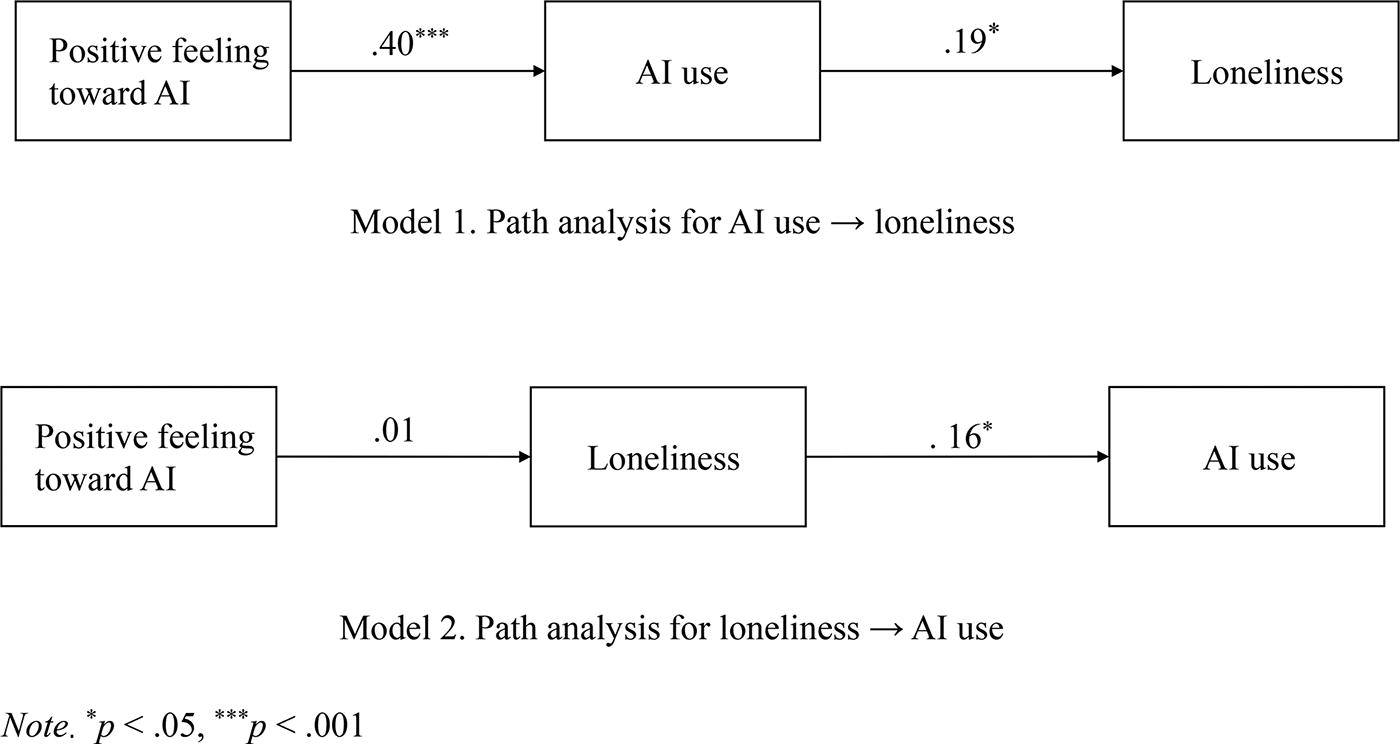
Models for path analysis.
This study utilizes the metafor and metaSEM packages in R to calculate effect sizes, conduct heterogeneity tests, perform main effect analysis and path analysis, examine moderation effects, and test for publication bias. Specifically, moderation effects are analyzed using Q-test for subgroup analysis, categorizing AI types into physically embodied and disembodied, and age groups into older adults (60 and above) and younger individuals (35 and below). Publication bias is assessed using Begg’s test and the Trim and Fill method. Begg’s test employs corrected rank correlation analysis to evaluate the correlation between effect size and standard error with a significant result indicating potential publication bias. 55 The Trim and Fill test corrects for publication bias by simulating missing studies to provide a more unbiased effect size estimate, 56 which is regarded as the most effective and informative tool for assessing publication bias. 57 Notably, if the effect size does not significantly differ before and after correction, and the final conclusion remains consistent, the publication bias is considered to be within a reasonable range, 55 suggesting the impact of publication bias is negligible.
Results
Overall analysis
The Q-test and the I2 test results (see Table 1) demonstrated significant heterogeneity among the included studies, with significant Q and I2 above 75%. This significant heterogeneity affirmed the appropriateness of employing a random-effects model for calculating combined effect sizes and underscored the necessity for moderator analysis.
Results of Heterogeneity Tests and Meta-Analysis
Kendall’s tau is the core statistic of Begg’s test, representing the rank correlation coefficient between the effect size estimates and their variances.
p < 0.01.
p < 0.05.
p < 0.001.
AI, artificial intelligence; CI, confidence interval; k, number of studies; N, total number of participants; PFTAI, positive feelings toward AI; r, combined weighted mean observed correlation (Pearson’s r).
The combined effect sizes revealed a significant positive correlation between AI use and loneliness (r = 0.163, p = 0.02 < 0.05), corresponding to a relatively small effect (0.10). 58
Given the significant heterogeneity, this study conducted a leave-one-out sensitivity analysis to verify the robustness of the meta-analysis results. Detailed findings from the sensitivity analysis are presented in Supplementary Appendices SA3 and SA4. Results showed that the effect size estimates exhibited minimal variation across analyses, predominantly ranging from 0.14 to 0.18, signifying a minor impact on individual studies. The standard error remained consistently low, fluctuating between 0.056 and 0.072, suggesting high precision. After excluding individual studies, the z-values and p-values mostly remained statistically significant (p < 0.05), suggesting robust overall results.
Moderation analysis
In this study, each level of moderator satisfied the requirement of at least four Effect Sizes (ESs) for Q-test. 59 Additionally, post hoc analysis was employed when Q-test yielded significant results. The results of moderation analyses are summarized in Table 2. The findings indicated that AI types had a marginally significant moderating effect on the correlation between AI use and loneliness (Q = 2.92, p = 0.088) with lower I2 (97.54%), suggesting AI types could explain sources of high heterogeneity to some degree. Specifically, the use of physically disembodied AI demonstrated a significantly positive association with loneliness (r = 0.352, p < 0.001), while the use of physically embodied AI exhibited a marginally significant negative association with loneliness (r = −0.266, p = 0.088).
Moderating Effects of AI Types and Age on Correlations Between AI Use and Loneliness
p < 0.01.
p < 0.01.
p < 0.001.
Qbetween, Q-value for heterogeneity between subgroups.
Additionally, age significantly moderated the correlation between AI use and loneliness (Q = 21.48, p < 0.001) with decreased I2 (89.14%), as a significant source of heterogeneity. For individuals aged 60 years or older, the association between AI use and loneliness was significantly positive (r = 0.352, p < 0.001), whereas for younger individuals (≤35 years old), the correlation was not significant (r = 0.039, p = 0.659).
To further explore the sources of high heterogeneity, we also considered three additional factors: AI use measurement, loneliness measurement, and study design, and conducted subgroup analyses for each (for results, see Supplementary Appendix SA5).
Path analysis
Model 1 (see Fig. 2) indicated a significant path from positive feelings toward AI to AI use (ρ = 0.40, p < 0.001), as well as a significant path from AI use to loneliness (ρ = 0.19, p = 0.014 < 0.05). The overall test of fit for the indirect effects demonstrated no significant difference between the meta-analytic correlations and the hypothesized model (χ2 = 6.880, df = 5, p = 0.230), suggesting that the model was consistent with the observed data and that the hypothesized path (AI use → loneliness) could explain the correlation between AI use and loneliness.
Additionally, Model 2 (see Fig. 2) showed a nonsignificant path from positive feelings toward AI to loneliness (ρ = 0.01, p = 0.904) but revealed a significant path from loneliness to AI use (ρ = 0.16, p = 0.014 < 0.05). The chi-square test yielded a nonsignificant value (χ2 = 0.992, df = 5, p = 0.963), suggesting that the model aligned with the observed data and that the hypothesized path (loneliness → AI use) could also explain the correlation between AI use and loneliness. A comparison of the two paths between AI use and loneliness showed that the influence of AI use on increasing loneliness was relatively greater than the effect of loneliness on promoting AI use.
Publication bias analysis
Begg’s test for the three meta-analyses demonstrated no significant publication bias for the relationships between AI use and loneliness (Kendall’s tau = 0.102, p = 0.317) or between loneliness and positive feelings toward AI (Kendall’s tau = −0.101, p = 0.668), except for the association between AI use and positive feelings toward AI (Kendall’s tau = 0.435, p = 0.094). Consequently, the Trim and Fill method was further employed for AI use and positive feelings toward AI. One study was filled based on the estimated number of missing studies, and the combined correlation coefficient (r = 0.379, p < 0.001) using the random-effects model showed no significant change from the original meta-analysis (r = 0.397, p < 0.001), indicating the impact of publication bias is negligible. These results confirmed the reliability of the meta-analyses.
Discussion
Loneliness is recognized as a global health threat and a social pathology. 60 AI is expected to play a key role in providing emotional support, 3 particularly in addressing loneliness. 6 However, existing research on the relationship between AI use and loneliness has produced inconsistent findings. Further investigation is required to comprehend the association between AI use and loneliness, particularly in relation to differences in physical embodiment (embodied vs. disembodied) and age (young vs. old). Additionally, the effect direction between AI use and loneliness remains an important yet unclear issue. To address these concerns, this study conducted a meta-analysis of existing literature up to June 6, 2024, examining the correlation between AI use and loneliness. It also assessed the moderating effects of AI type (embodied vs. disembodied) and age (young vs. old) on this association, while exploring the causal relationship between AI use and loneliness by incorporating positive feelings toward AI.
The results indicated: (a) a significantly positive correlation between AI use and loneliness; (b) a positive association between the use of physically disembodied AI and loneliness, while a negative association was observed between embodied AI usage and loneliness; (c) a significant positive association between AI use and loneliness for older individuals (60 years and above), whereas no significant correlation was found for younger individuals (35 years and below); and (d) both paths (AI use→loneliness, and loneliness→AI use) were significantly positive, with the influence of AI use on increasing loneliness being relatively greater than the effect of loneliness on promoting AI use.
These findings enhance our nuanced understanding of the dynamics between AI use and loneliness, supporting the embodiment theory in this context. Practically, this study provides empirical evidence for utilizing various types of AI to combat loneliness and underscores the importance of considering age differences in AI use.
A vicious cycle? The relationship between loneliness and AI use
Despite high expectations for AI in addressing loneliness through digital humans, 14 chatbots,10,11 social robots,6,61 and even sex robots, 62 our research reveals a positive correlation between AI use and loneliness. Path analysis indicates that AI use increases loneliness, which subsequently leads to more AI use, with the former effect being more pronounced. This creates a vicious cycle: the more individuals engage with AI, the lonelier they become, and the lonelier they feel, the more they seek out AI. This result goes beyond the previous research perspectives that focused on the unidirectional relationship between AI use and loneliness and also echoes some prior research findings from unidirectional view. For instance, some studies find that loneliness promotes AI use,28,60 while some others suggest AI use increases loneliness.11,36,63 We attribute this phenomenon to the underlying causes of loneliness and the limitations of AI.
The causes of loneliness are complex, involving a myriad of social, economic, and cultural factors. 64 As a symptom of disrupted social identity, loneliness emerges within the context of social embeddedness. 60 It manifests when the quality of relationships falls short of expectations or when individuals do not receive adequate recognition in social interactions. 65 When individuals perceive themselves as unable to be active, interconnected members of a shared social experience, loneliness compels them to withdraw from existing relationships in pursuit of more fulfilling connections. 60 From this “Uses and Gratifications” perspective, it is understandable that lonely individuals may turn to AI, which is designed to provide companionship, affirmation, and a semblance of “empathy.”
However, the harm and negative emotions associated with loneliness often require addressing past experiences of rejection, neglect, abandonment, and social invisibility, or through anticipating new, future relationships. 60 Although AI can offer a sense of “companionship” and “connection,” current AI systems lack true emotional functionality and empathetic capacity, and therefore cannot provide the genuine social inclusion that lonely individuals require. 66 Even the most “social” AI to date lacks intersubjectivity and vital elements for social recognition. AI merely tracks and mimics human emotional expressions without engaging in the essence of social interaction, which encompasses all forms of emotional dialogue (both material and symbolic).60,66 Consequently, when lonely individuals turn to AI, they cannot genuinely alleviate their loneliness. Instead, they may experience even greater loneliness after interacting with a machine that lacks autonomy and self-reflection. Therefore, the current use of AI falls into a paradoxical vicious cycle. As Jacobs noted, “What appears surmountable with an AIC (Artificial Intelligence Companion) as a relational artifact is actually often reproduced by it: digital loneliness!” 50 However, to the best of our knowledge, there is currently no empirical research directly supporting the “vicious cycle” between AI use and loneliness, highlighting an avenue for future study to test the bidirectional relationships through long-term, intervention-based, or observational studies.
“Love, old & robots”: Specific conditions for AI usage in combating loneliness
Despite the vicious cycle identified in the meta-analysis, the use of AI is not entirely ineffective in combating loneliness. The impact of AI on loneliness is contingent upon specific conditions. For instance, we found a significant positive correlation between a positive attitude toward AI and its usage. Although there was no significant correlation between positive feelings toward AI and loneliness, existing studies suggest that users’ perceptions of AI companionship are crucial for its effectiveness. 60 If users attribute specific meanings to AI or perceive it as a partner 67 and cultivate a parasocial relationship with AI, 10 the drawbacks often associated with AI may not apply to them. For instance, some individuals have even married a digital hologram named Hatsune Miku, 68 while others have held funerals for their AI pets. 69 For these individuals, AI transcends mere functionality, embodying love and meaning. Consequently, questions surrounding AI’s intersubjectivity and consciousness become irrelevant. For them, an AI that embodies love and meaning assumes the status of a genuine entity capable of alleviating loneliness.
Moreover, the study revealed a significant positive correlation between AI use and loneliness among older adults, whereas this relationship was insignificant for younger individuals. This discrepancy may relate to several factors. First, loneliness, as a form of social suffering, often manifests in more vulnerable social groups, such as old groups. 70 In this study, individuals under 35 were categorized as young, and those over 60 as elderly. Generally, younger individuals engage in extensive social activities and possess high vitality, whereas older adults often experience loneliness due to retirement and social isolation. 71 Therefore, older adults are more sensitive to loneliness than their younger counterparts. Second, according to cognitive load theory, cognitive overload occurs when cognitive demands exceed the limit of cognitive activities. 72 As individuals age, declines in cognitive functions result in greater Information and Communications Technology (ICT)-related overload for older adults. Therefore, older adults typically experience more technostress compared to younger groups 32 when utilizing AI. This overload may slow and reduce the depth of older adults’ learning of AI functionalities, potentially exacerbating the negative impact of AI on loneliness among older users. Third, according to the technology acceptance model, perceived ease of use is a significant predictor of technology acceptance intentions. However, older adults generally encounter greater stress and resistance when adopting new technologies like AI,31,32 as mentioned earlier, which likely decreases their acceptance intentions. In turn, it exacerbates their sense of disconnection from the world, consequently, increases their loneliness. Additionally, compared to younger individuals, older adults may be less inclined to project emotions and meaning onto AI in their actual use. As a result, AI usage could intensify the loneliness already experienced by the elderly. This finding underscores the necessity of considering the acceptance and practical circumstances of older adults when leveraging the latest technologies to help them combat loneliness. This may clarify why social robots designed for the elderly are often created as physical entities, such as Paro7,73 and Pepper,74,75 to mitigate acceptance challenges.
This study also found that physically disembodied AI correlates positively with loneliness, whereas embodied AI correlates negatively. This observation explains why some studies on social companion robots report a significant decrease in loneliness following robotic interventions.73,74 These findings lend support to the embodiment theory, which posits that embodied robots, despite lacking genuine emotional support and recognition, provide a tangible and perceptible presence. This presence can foster a sense of companionship, thereby reducing loneliness.30,76 In contrast, disembodied AI, which lacks social presence, is less likely to elicit positive evaluations and responses from users. 77 As previously noted, when disembodied AI fails to alleviate loneliness, it can exacerbate it instead. 60 Therefore, a negative correlation may exist between disembodied AI and loneliness.
Limitations and avenues for future research
This study offers valuable insights into the dynamics of AI use and loneliness. Practically, it provides empirical evidence on employing different types of AI to combat loneliness and emphasizes the importance of considering age differences in AI use. However, several limitations indicate avenues for future research.
First, although the sample size falls within an acceptable range, the overall sample size available for the meta-analysis remains relatively small, given that AI is a relatively new research subject. As more research is conducted on the causes and effects of AI use, future studies can encompass a broader array of research and variables to yield deeper insights. For instance, future research could explore the relationship between AI use and loneliness across various cultural contexts. Additionally, more nuanced subdivisions of variables such as AI use and age could be examined, such as investigating the impact of problematic AI use on loneliness during childhood, adolescence, and adulthood.
Second, since this study used Pearson’s correlation coefficient as the effect size, we excluded effect sizes from experimental studies that reported only means and standard deviations to reduce errors from double calculation. Future research could use Cohen’s d as the effect size to conduct meta-analyses on experimental studies that report only means and standard deviations, providing a more comprehensive understanding of the relationship between AI use and loneliness.
Finally, most of the selected studies are cross-sectional in nature. Future research could explore the long-term effects of AI use through meta-analyses of longitudinal studies. Such endeavors would enhance our understanding of the impact of AI on loneliness and other emotional states over time, thereby providing a more nuanced insight into the dynamics of human–AI interaction.
Footnotes
Acknowledgments
The authors express their gratitude to the researchers and participants of the reviewed studies who provided the material for this article.
Authors’ Contributions
X.D.: Conceptualization, investigation, methodology, formal analysis, writing—original draft, and writing—review and editing. J.X.: Conceptualization, investigation, writing—original draft, and writing—review and editing. H.G.: Conceptualization, project administration, funding acquisition, writing—review and editing, and supervision.
Author Disclosure Statement
The authors declared no potential conflicts of interest with respect to the research, authorship, and/or publication of this article.
Funding Information
This work was supported by the National Social Science Foundation of China under Grant No. 23BXW032.

References
Supplementary Material
Please find the following supplemental material available below.
For Open Access articles published under a Creative Commons License, all supplemental material carries the same license as the article it is associated with.
For non-Open Access articles published, all supplemental material carries a non-exclusive license, and permission requests for re-use of supplemental material or any part of supplemental material shall be sent directly to the copyright owner as specified in the copyright notice associated with the article.
